 Add to Chrome
 Add to Firefox
 Add to Edge
Continuous Vision-Language-Action Co-Learning with Semantic-Physical Alignment for Behavioral Cloning
Nov 18, 2025
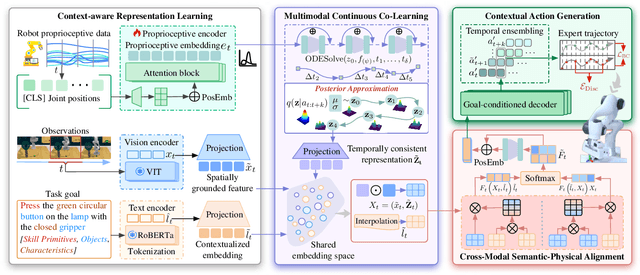
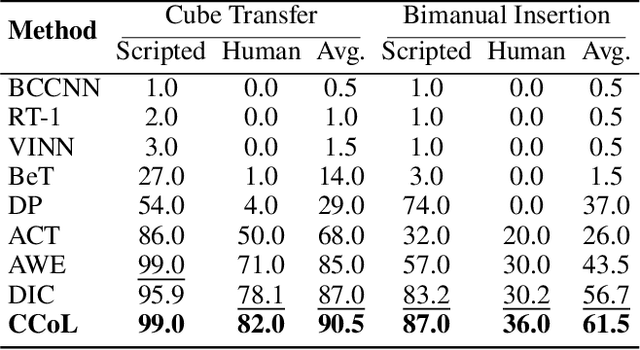
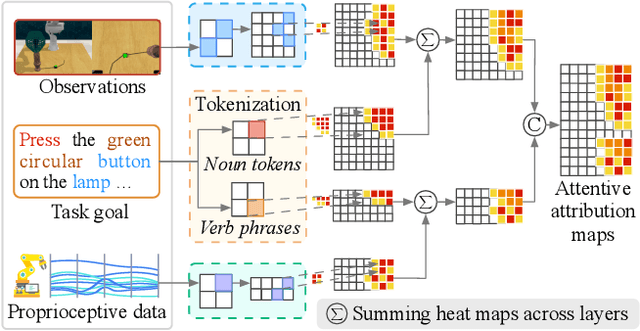
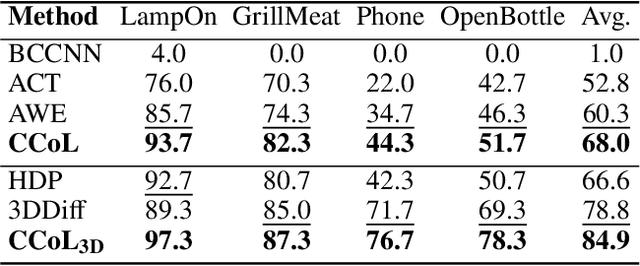
Language-conditioned manipulation facilitates human-robot interaction via behavioral cloning (BC), which learns control policies from human demonstrations and serves as a cornerstone of embodied AI. Overcoming compounding errors in sequential action decisions remains a central challenge to improving BC performance. Existing approaches mitigate compounding errors through data augmentation, expressive representation, or temporal abstraction. However, they suffer from physical discontinuities and semantic-physical misalignment, leading to inaccurate action cloning and intermittent execution. In this paper, we present Continuous vision-language-action Co-Learning with Semantic-Physical Alignment (CCoL), a novel BC framework that ensures temporally consistent execution and fine-grained semantic grounding. It generates robust and smooth action execution trajectories through continuous co-learning across vision, language, and proprioceptive inputs (e.g., robot internal states). Meanwhile, we anchor language semantics to visuomotor representations by a bidirectional cross-attention to learn contextual information for action generation, successfully overcoming the problem of semantic-physical misalignment. Extensive experiments show that CCoL achieves an average 8.0% relative improvement across three simulation suites, with up to 19.2% relative gain in human-demonstrated bimanual insertion tasks. Real-world tests on a 7-DoF robot further confirm CCoL's generalization under unseen and noisy object states.

BSO: Binary Spiking Online Optimization Algorithm
Nov 16, 2025Binary Spiking Neural Networks (BSNNs) offer promising efficiency advantages for resource-constrained computing. However, their training algorithms often require substantial memory overhead due to latent weights storage and temporal processing requirements. To address this issue, we propose Binary Spiking Online (BSO) optimization algorithm, a novel online training algorithm that significantly reduces training memory. BSO directly updates weights through flip signals under the online training framework. These signals are triggered when the product of gradient momentum and weights exceeds a threshold, eliminating the need for latent weights during training. To enhance performance, we propose T-BSO, a temporal-aware variant that leverages the inherent temporal dynamics of BSNNs by capturing gradient information across time steps for adaptive threshold adjustment. Theoretical analysis establishes convergence guarantees for both BSO and T-BSO, with formal regret bounds characterizing their convergence rates. Extensive experiments demonstrate that both BSO and T-BSO achieve superior optimization performance compared to existing training methods for BSNNs. The codes are available at https://github.com/hamings1/BSO.
PhysWorld: From Real Videos to World Models of Deformable Objects via Physics-Aware Demonstration Synthesis
Oct 24, 2025Interactive world models that simulate object dynamics are crucial for robotics, VR, and AR. However, it remains a significant challenge to learn physics-consistent dynamics models from limited real-world video data, especially for deformable objects with spatially-varying physical properties. To overcome the challenge of data scarcity, we propose PhysWorld, a novel framework that utilizes a simulator to synthesize physically plausible and diverse demonstrations to learn efficient world models. Specifically, we first construct a physics-consistent digital twin within MPM simulator via constitutive model selection and global-to-local optimization of physical properties. Subsequently, we apply part-aware perturbations to the physical properties and generate various motion patterns for the digital twin, synthesizing extensive and diverse demonstrations. Finally, using these demonstrations, we train a lightweight GNN-based world model that is embedded with physical properties. The real video can be used to further refine the physical properties. PhysWorld achieves accurate and fast future predictions for various deformable objects, and also generalizes well to novel interactions. Experiments show that PhysWorld has competitive performance while enabling inference speeds 47 times faster than the recent state-of-the-art method, i.e., PhysTwin.
VitaBench: Benchmarking LLM Agents with Versatile Interactive Tasks in Real-world Applications
Sep 30, 2025As LLM-based agents are increasingly deployed in real-life scenarios, existing benchmarks fail to capture their inherent complexity of handling extensive information, leveraging diverse resources, and managing dynamic user interactions. To address this gap, we introduce VitaBench, a challenging benchmark that evaluates agents on versatile interactive tasks grounded in real-world settings. Drawing from daily applications in food delivery, in-store consumption, and online travel services, VitaBench presents agents with the most complex life-serving simulation environment to date, comprising 66 tools. Through a framework that eliminates domain-specific policies, we enable flexible composition of these scenarios and tools, yielding 100 cross-scenario tasks (main results) and 300 single-scenario tasks. Each task is derived from multiple real user requests and requires agents to reason across temporal and spatial dimensions, utilize complex tool sets, proactively clarify ambiguous instructions, and track shifting user intent throughout multi-turn conversations. Moreover, we propose a rubric-based sliding window evaluator, enabling robust assessment of diverse solution pathways in complex environments and stochastic interactions. Our comprehensive evaluation reveals that even the most advanced models achieve only 30% success rate on cross-scenario tasks, and less than 50% success rate on others. Overall, we believe VitaBench will serve as a valuable resource for advancing the development of AI agents in practical real-world applications. The code, dataset, and leaderboard are available at https://vitabench.github.io/
STARC: See-Through-Wall Augmented Reality Framework for Human-Robot Collaboration in Emergency Response
Sep 19, 2025In emergency response missions, first responders must navigate cluttered indoor environments where occlusions block direct line-of-sight, concealing both life-threatening hazards and victims in need of rescue. We present STARC, a see-through AR framework for human-robot collaboration that fuses mobile-robot mapping with responder-mounted LiDAR sensing. A ground robot running LiDAR-inertial odometry performs large-area exploration and 3D human detection, while helmet- or handheld-mounted LiDAR on the responder is registered to the robot's global map via relative pose estimation. This cross-LiDAR alignment enables consistent first-person projection of detected humans and their point clouds - rendered in AR with low latency - into the responder's view. By providing real-time visualization of hidden occupants and hazards, STARC enhances situational awareness and reduces operator risk. Experiments in simulation, lab setups, and tactical field trials confirm robust pose alignment, reliable detections, and stable overlays, underscoring the potential of our system for fire-fighting, disaster relief, and other safety-critical operations. Code and design will be open-sourced upon acceptance.
DVDP: An End-to-End Policy for Mobile Robot Visual Docking with RGB-D Perception
Sep 16, 2025Automatic docking has long been a significant challenge in the field of mobile robotics. Compared to other automatic docking methods, visual docking methods offer higher precision and lower deployment costs, making them an efficient and promising choice for this task. However, visual docking methods impose strict requirements on the robot's initial position at the start of the docking process. To overcome the limitations of current vision-based methods, we propose an innovative end-to-end visual docking method named DVDP(direct visual docking policy). This approach requires only a binocular RGB-D camera installed on the mobile robot to directly output the robot's docking path, achieving end-to-end automatic docking. Furthermore, we have collected a large-scale dataset of mobile robot visual automatic docking dataset through a combination of virtual and real environments using the Unity 3D platform and actual mobile robot setups. We developed a series of evaluation metrics to quantify the performance of the end-to-end visual docking method. Extensive experiments, including benchmarks against leading perception backbones adapted into our framework, demonstrate that our method achieves superior performance. Finally, real-world deployment on the SCOUT Mini confirmed DVDP's efficacy, with our model generating smooth, feasible docking trajectories that meet physical constraints and reach the target pose.
HCRide: Harmonizing Passenger Fairness and Driver Preference for Human-Centered Ride-Hailing
Aug 06, 2025Order dispatch systems play a vital role in ride-hailing services, which directly influence operator revenue, driver profit, and passenger experience. Most existing work focuses on improving system efficiency in terms of operator revenue, which may cause a bad experience for both passengers and drivers. Hence, in this work, we aim to design a human-centered ride-hailing system by considering both passenger fairness and driver preference without compromising the overall system efficiency. However, it is nontrivial to achieve this target due to the potential conflicts between passenger fairness and driver preference since optimizing one may sacrifice the other. To address this challenge, we design HCRide, a Human-Centered Ride-hailing system based on a novel multi-agent reinforcement learning algorithm called Harmonization-oriented Actor-Bi-Critic (Habic), which includes three major components (i.e., a multi-agent competition mechanism, a dynamic Actor network, and a Bi-Critic network) to optimize system efficiency and passenger fairness with driver preference consideration. We extensively evaluate our HCRide using two real-world ride-hailing datasets from Shenzhen and New York City. Experimental results show our HCRide effectively improves system efficiency by 2.02%, fairness by 5.39%, and driver preference by 10.21% compared to state-of-the-art baselines.
IONext: Unlocking the Next Era of Inertial Odometry
Jul 23, 2025Researchers have increasingly adopted Transformer-based models for inertial odometry. While Transformers excel at modeling long-range dependencies, their limited sensitivity to local, fine-grained motion variations and lack of inherent inductive biases often hinder localization accuracy and generalization. Recent studies have shown that incorporating large-kernel convolutions and Transformer-inspired architectural designs into CNN can effectively expand the receptive field, thereby improving global motion perception. Motivated by these insights, we propose a novel CNN-based module called the Dual-wing Adaptive Dynamic Mixer (DADM), which adaptively captures both global motion patterns and local, fine-grained motion features from dynamic inputs. This module dynamically generates selective weights based on the input, enabling efficient multi-scale feature aggregation. To further improve temporal modeling, we introduce the Spatio-Temporal Gating Unit (STGU), which selectively extracts representative and task-relevant motion features in the temporal domain. This unit addresses the limitations of temporal modeling observed in existing CNN approaches. Built upon DADM and STGU, we present a new CNN-based inertial odometry backbone, named Next Era of Inertial Odometry (IONext). Extensive experiments on six public datasets demonstrate that IONext consistently outperforms state-of-the-art (SOTA) Transformer- and CNN-based methods. For instance, on the RNIN dataset, IONext reduces the average ATE by 10% and the average RTE by 12% compared to the representative model iMOT.
S$^4$C: Speculative Sampling with Syntactic and Semantic Coherence for Efficient Inference of Large Language Models
Jun 17, 2025Large language models (LLMs) exhibit remarkable reasoning capabilities across diverse downstream tasks. However, their autoregressive nature leads to substantial inference latency, posing challenges for real-time applications. Speculative sampling mitigates this issue by introducing a drafting phase followed by a parallel validation phase, enabling faster token generation and verification. Existing approaches, however, overlook the inherent coherence in text generation, limiting their efficiency. To address this gap, we propose a Speculative Sampling with Syntactic and Semantic Coherence (S$^4$C) framework, which extends speculative sampling by leveraging multi-head drafting for rapid token generation and a continuous verification tree for efficient candidate validation and feature reuse. Experimental results demonstrate that S$^4$C surpasses baseline methods across mainstream tasks, offering enhanced efficiency, parallelism, and the ability to generate more valid tokens with fewer computational resources. On Spec-bench benchmarks, S$^4$C achieves an acceleration ratio of 2.26x-2.60x, outperforming state-of-the-art methods.
X-Scene: Large-Scale Driving Scene Generation with High Fidelity and Flexible Controllability
Jun 16, 2025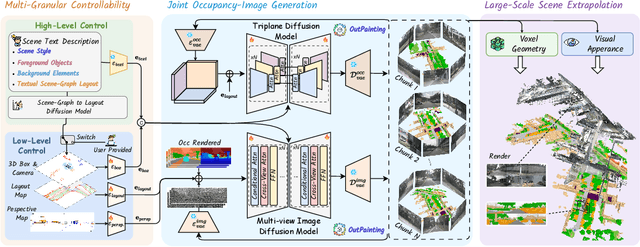

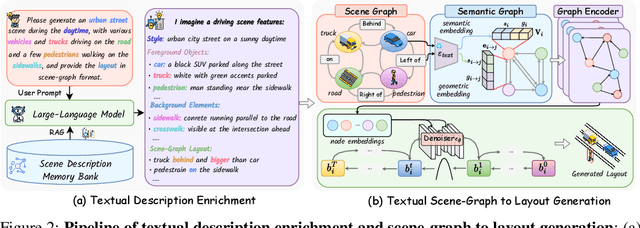
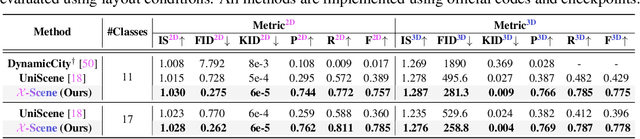
Diffusion models are advancing autonomous driving by enabling realistic data synthesis, predictive end-to-end planning, and closed-loop simulation, with a primary focus on temporally consistent generation. However, the generation of large-scale 3D scenes that require spatial coherence remains underexplored. In this paper, we propose X-Scene, a novel framework for large-scale driving scene generation that achieves both geometric intricacy and appearance fidelity, while offering flexible controllability. Specifically, X-Scene supports multi-granular control, including low-level conditions such as user-provided or text-driven layout for detailed scene composition and high-level semantic guidance such as user-intent and LLM-enriched text prompts for efficient customization. To enhance geometrical and visual fidelity, we introduce a unified pipeline that sequentially generates 3D semantic occupancy and the corresponding multiview images, while ensuring alignment between modalities. Additionally, we extend the generated local region into a large-scale scene through consistency-aware scene outpainting, which extrapolates new occupancy and images conditioned on the previously generated area, enhancing spatial continuity and preserving visual coherence. The resulting scenes are lifted into high-quality 3DGS representations, supporting diverse applications such as scene exploration. Comprehensive experiments demonstrate that X-Scene significantly advances controllability and fidelity for large-scale driving scene generation, empowering data generation and simulation for autonomous driving.