 Add to Chrome
 Add to Firefox
 Add to Edge
F-Eval: Asssessing Fundamental Abilities with Refined Evaluation Methods
Jan 26, 2024
Large language models (LLMs) garner significant attention for their unprecedented performance, leading to an increasing number of researches evaluating LLMs. However, these evaluation benchmarks are limited to assessing the instruction-following capabilities, overlooking the fundamental abilities that emerge during the pre-training stage. Previous subjective evaluation methods mainly reply on scoring by API models. However, in the absence of references, large models have shown limited ability to discern subtle differences. To bridge the gap, we propose F-Eval, a bilingual evaluation benchmark to evaluate the fundamental abilities, including expression, commonsense and logic. The tasks in F-Eval include multi-choice objective tasks, open-ended objective tasks, reference-based subjective tasks and reference-free subjective tasks. For reference-free subjective tasks, we devise new evaluation methods, serving as alternatives to scoring by API models. We conduct evaluations on 13 advanced LLMs. Results show that our evaluation methods show higher correlation coefficients and larger distinction than other evaluators. Additionally, we discuss the influence of different model sizes, dimensions, and normalization methods. We anticipate that F-Eval will facilitate the study of LLMs' fundamental abilities.

Consolidating Trees of Robotic Plans Generated Using Large Language Models to Improve Reliability
Jan 15, 2024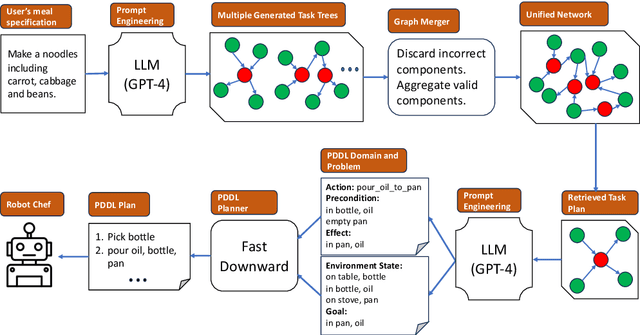
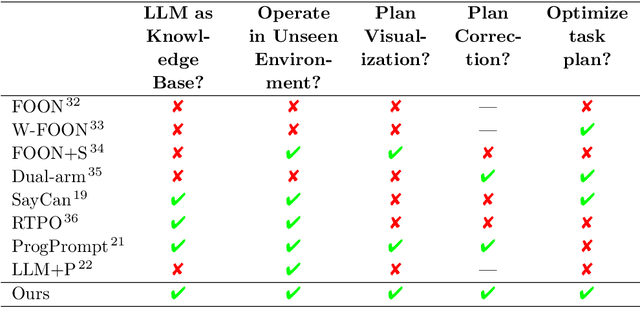
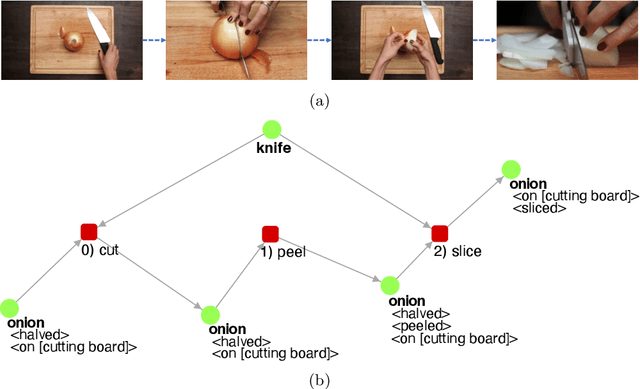
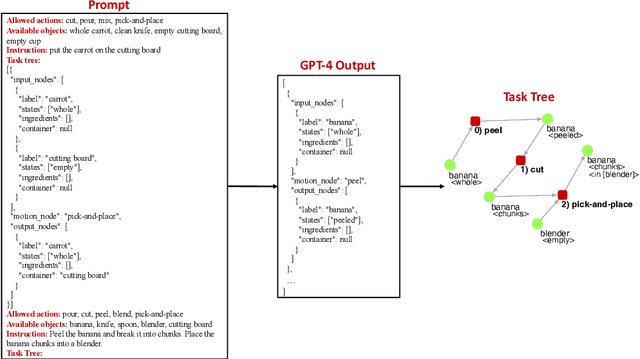
The inherent probabilistic nature of Large Language Models (LLMs) introduces an element of unpredictability, raising concerns about potential discrepancies in their output. This paper introduces an innovative approach aims to generate correct and optimal robotic task plans for diverse real-world demands and scenarios. LLMs have been used to generate task plans, but they are unreliable and may contain wrong, questionable, or high-cost steps. The proposed approach uses LLM to generate a number of task plans as trees and amalgamates them into a graph by removing questionable paths. Then an optimal task tree can be retrieved to circumvent questionable and high-cost nodes, thereby improving planning accuracy and execution efficiency. The approach is further improved by incorporating a large knowledge network. Leveraging GPT-4 further, the high-level task plan is converted into a low-level Planning Domain Definition Language (PDDL) plan executable by a robot. Evaluation results highlight the superior accuracy and efficiency of our approach compared to previous methodologies in the field of task planning.
CoLLiE: Collaborative Training of Large Language Models in an Efficient Way
Dec 01, 2023
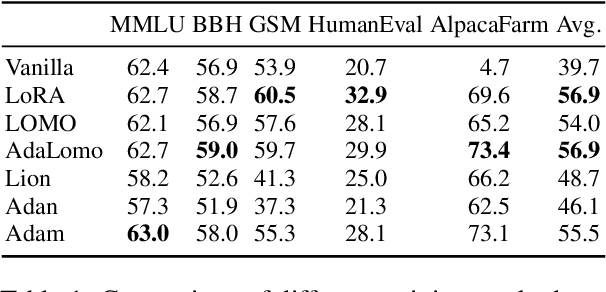
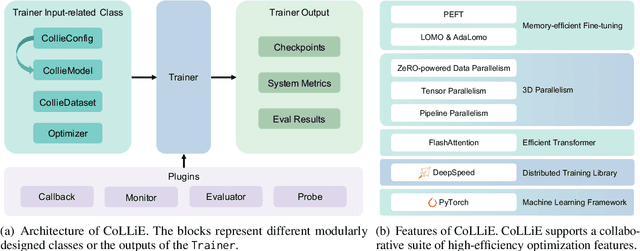
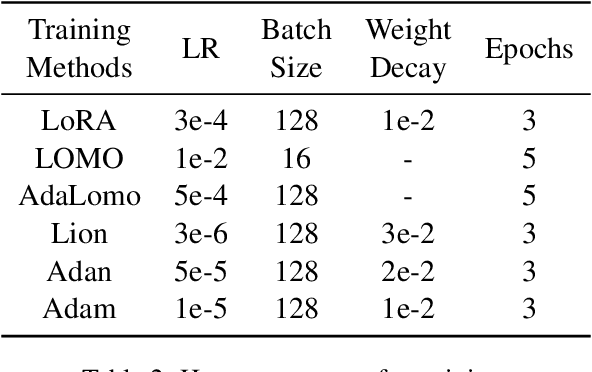
Large language models (LLMs) are increasingly pivotal in a wide range of natural language processing tasks. Access to pre-trained models, courtesy of the open-source community, has made it possible to adapt these models to specific applications for enhanced performance. However, the substantial resources required for training these models necessitate efficient solutions. This paper introduces CoLLiE, an efficient library that facilitates collaborative training of large language models using 3D parallelism, parameter-efficient fine-tuning (PEFT) methods, and optimizers such as Lion, Adan, Sophia, LOMO and AdaLomo. With its modular design and comprehensive functionality, CoLLiE offers a balanced blend of efficiency, ease of use, and customization. CoLLiE has proven superior training efficiency in comparison with prevalent solutions in pre-training and fine-tuning scenarios. Furthermore, we provide an empirical evaluation of the correlation between model size and GPU memory consumption under different optimization methods, as well as an analysis of the throughput. Lastly, we carry out a comprehensive comparison of various optimizers and PEFT methods within the instruction-tuning context. CoLLiE is available at https://github.com/OpenLMLab/collie.
PoseGPT: Chatting about 3D Human Pose
Nov 30, 2023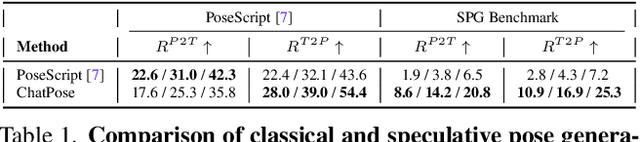
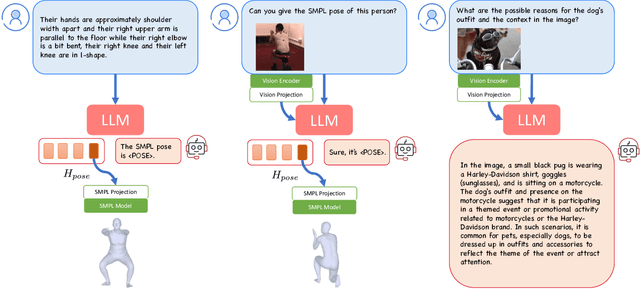

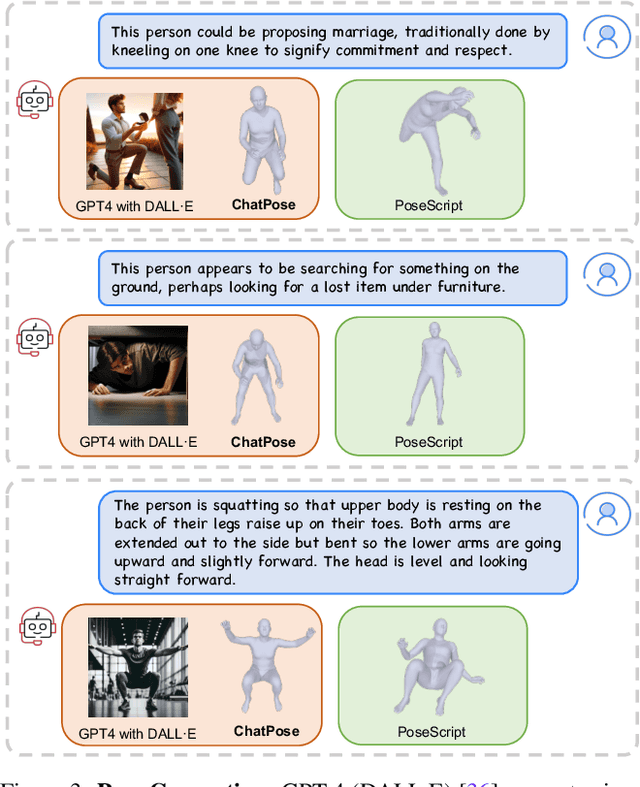
We introduce PoseGPT, a framework employing Large Language Models (LLMs) to understand and reason about 3D human poses from images or textual descriptions. Our work is motivated by the human ability to intuitively understand postures from a single image or a brief description, a process that intertwines image interpretation, world knowledge, and an understanding of body language. Traditional human pose estimation methods, whether image-based or text-based, often lack holistic scene comprehension and nuanced reasoning, leading to a disconnect between visual data and its real-world implications. PoseGPT addresses these limitations by embedding SMPL poses as a distinct signal token within a multi-modal LLM, enabling direct generation of 3D body poses from both textual and visual inputs. This approach not only simplifies pose prediction but also empowers LLMs to apply their world knowledge in reasoning about human poses, fostering two advanced tasks: speculative pose generation and reasoning about pose estimation. These tasks involve reasoning about humans to generate 3D poses from subtle text queries, possibly accompanied by images. We establish benchmarks for these tasks, moving beyond traditional 3D pose generation and estimation methods. Our results show that PoseGPT outperforms existing multimodal LLMs and task-sepcific methods on these newly proposed tasks. Furthermore, PoseGPT's ability to understand and generate 3D human poses based on complex reasoning opens new directions in human pose analysis.
Learning to (Learn at Test Time)
Oct 20, 2023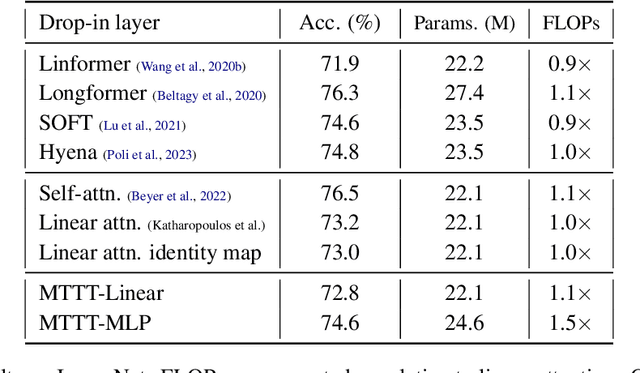

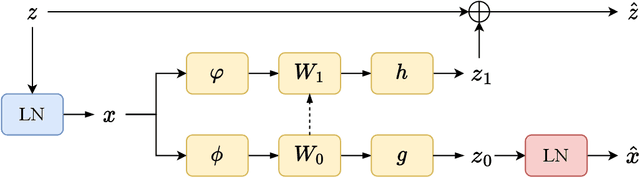
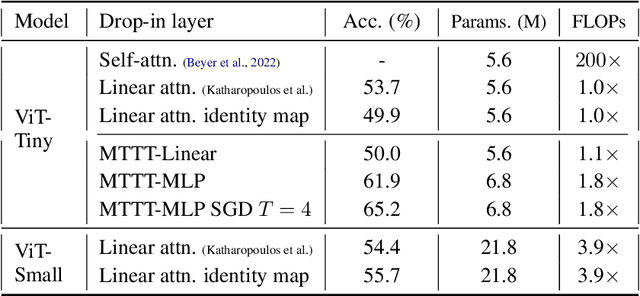
We reformulate the problem of supervised learning as learning to learn with two nested loops (i.e. learning problems). The inner loop learns on each individual instance with self-supervision before final prediction. The outer loop learns the self-supervised task used by the inner loop, such that its final prediction improves. Our inner loop turns out to be equivalent to linear attention when the inner-loop learner is only a linear model, and to self-attention when it is a kernel estimator. For practical comparison with linear or self-attention layers, we replace each of them in a transformer with an inner loop, so our outer loop is equivalent to training the architecture. When each inner-loop learner is a neural network, our approach vastly outperforms transformers with linear attention on ImageNet from 224 x 224 raw pixels in both accuracy and FLOPs, while (regular) transformers cannot run.
Provable Probabilistic Imaging using Score-Based Generative Priors
Oct 16, 2023Estimating high-quality images while also quantifying their uncertainty are two desired features in an image reconstruction algorithm for solving ill-posed inverse problems. In this paper, we propose plug-and-play Monte Carlo (PMC) as a principled framework for characterizing the space of possible solutions to a general inverse problem. PMC is able to incorporate expressive score-based generative priors for high-quality image reconstruction while also performing uncertainty quantification via posterior sampling. In particular, we introduce two PMC algorithms which can be viewed as the sampling analogues of the traditional plug-and-play priors (PnP) and regularization by denoising (RED) algorithms. We also establish a theoretical analysis for characterizing the convergence of the PMC algorithms. Our analysis provides non-asymptotic stationarity guarantees for both algorithms, even in the presence of non-log-concave likelihoods and imperfect score networks. We demonstrate the performance of the PMC algorithms on multiple representative inverse problems with both linear and nonlinear forward models. Experimental results show that PMC significantly improves reconstruction quality and enables high-fidelity uncertainty quantification.
Tool-Augmented Reward Modeling
Oct 02, 2023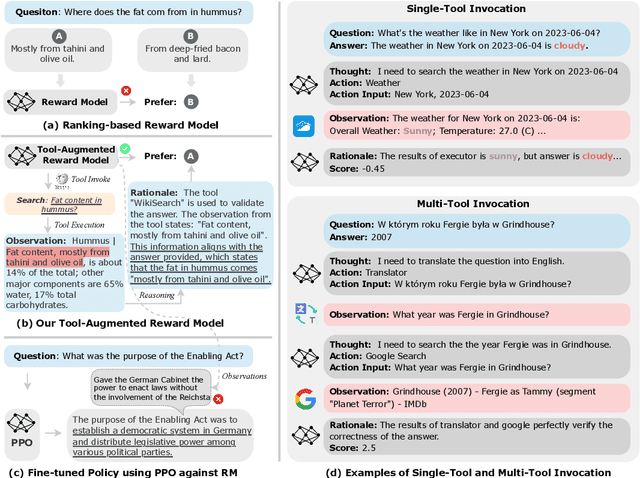
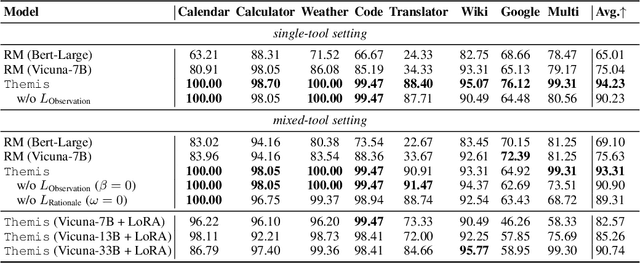
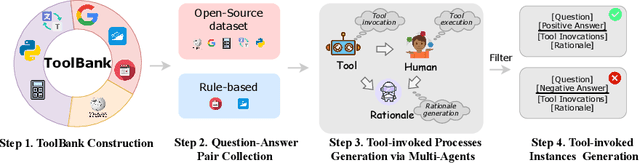

Reward modeling (a.k.a., preference modeling) is instrumental for aligning large language models with human preferences, particularly within the context of reinforcement learning from human feedback (RLHF). While conventional reward models (RMs) have exhibited remarkable scalability, they oft struggle with fundamental functionality such as arithmetic computation, code execution, and factual lookup. In this paper, we propose a tool-augmented preference modeling approach, named \name, to address these limitations by empowering RMs with access to external environments, including calculators and search engines. This approach not only fosters synergy between tool utilization and reward grading but also enhances interpretive capacity and scoring reliability. Our study delves into the integration of external tools into RMs, enabling them to interact with diverse external sources and construct task-specific tool engagement and reasoning traces in an autoregressive manner. We validate our approach across a wide range of domains, incorporating seven distinct external tools. Our experimental results demonstrate a noteworthy overall improvement of 17.7% across eight tasks in preference ranking. Furthermore, our approach outperforms Gopher 280B by 7.3% on TruthfulQA task in zero-shot evaluation. In human evaluations, RLHF trained with Themis attains an average win rate of 32% when compared to baselines across four distinct tasks. Additionally, we provide a comprehensive collection of tool-related RM datasets, incorporating data from seven distinct tool APIs, totaling 15,000 instances. We anticipate that this publicly available dataset will facilitate and inspire further research advancements in the field.
From Cooking Recipes to Robot Task Trees -- Improving Planning Correctness and Task Efficiency by Leveraging LLMs with a Knowledge Network
Sep 17, 2023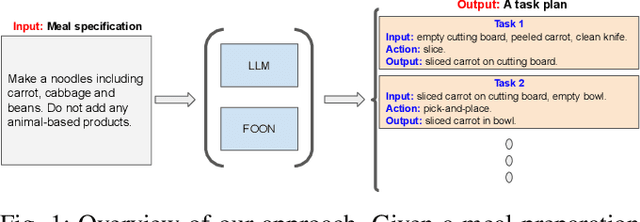
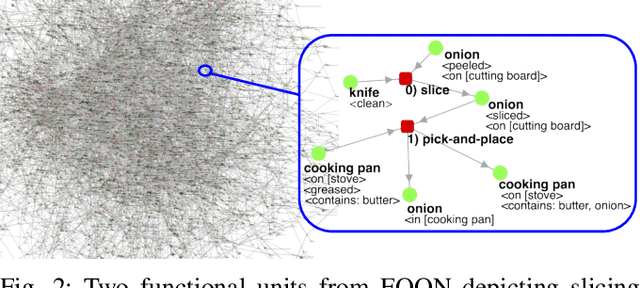
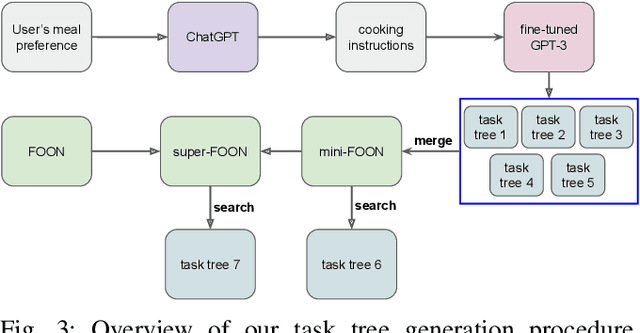
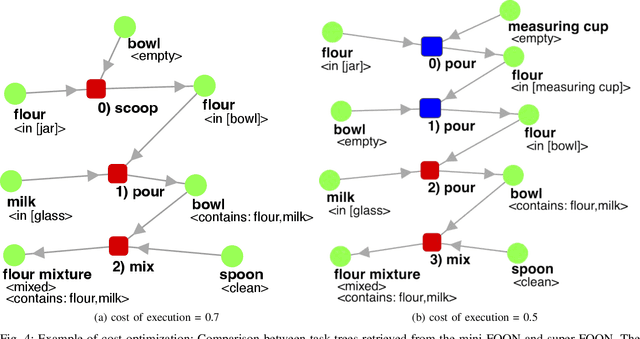
Task planning for robotic cooking involves generating a sequence of actions for a robot to prepare a meal successfully. This paper introduces a novel task tree generation pipeline producing correct planning and efficient execution for cooking tasks. Our method first uses a large language model (LLM) to retrieve recipe instructions and then utilizes a fine-tuned GPT-3 to convert them into a task tree, capturing sequential and parallel dependencies among subtasks. The pipeline then mitigates the uncertainty and unreliable features of LLM outputs using task tree retrieval. We combine multiple LLM task tree outputs into a graph and perform a task tree retrieval to avoid questionable nodes and high-cost nodes to improve planning correctness and improve execution efficiency. Our evaluation results show its superior performance compared to previous works in task planning accuracy and efficiency.
ActionPrompt: Action-Guided 3D Human Pose Estimation With Text and Pose Prompting
Jul 18, 2023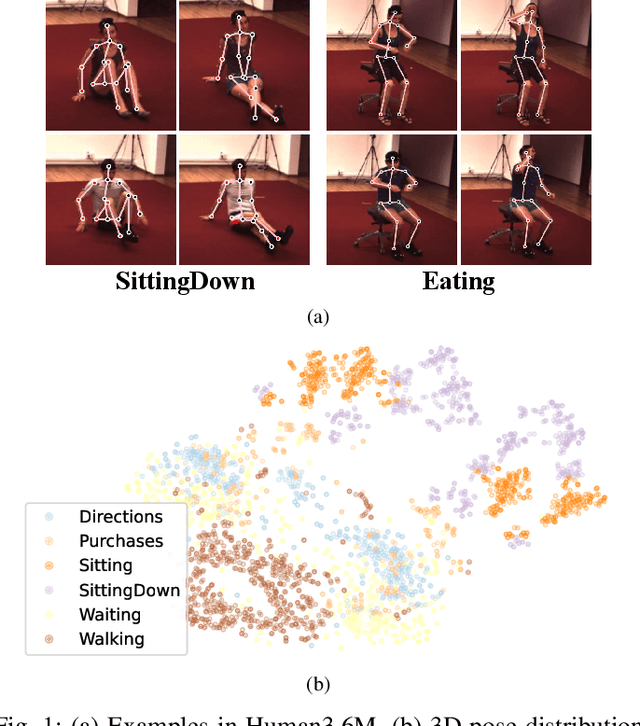
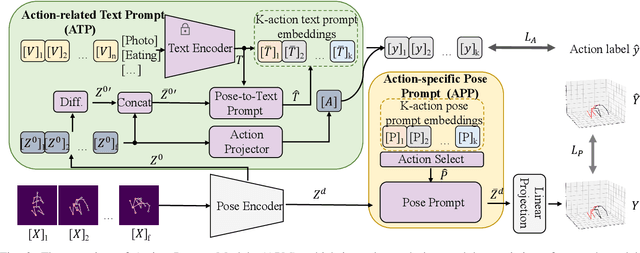
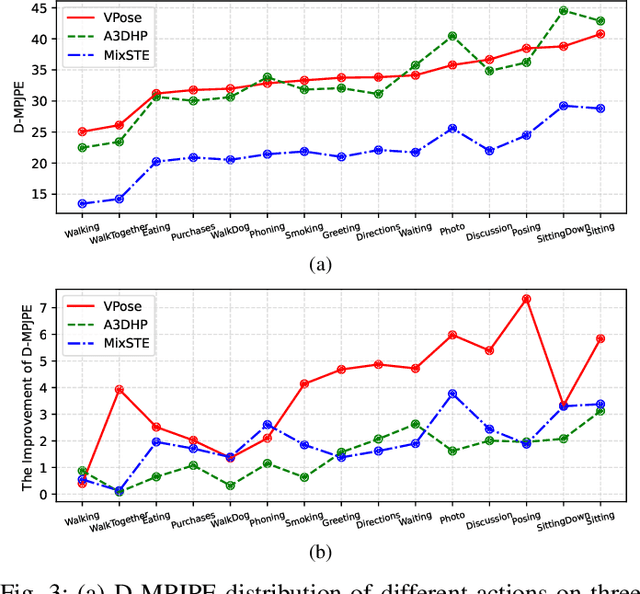
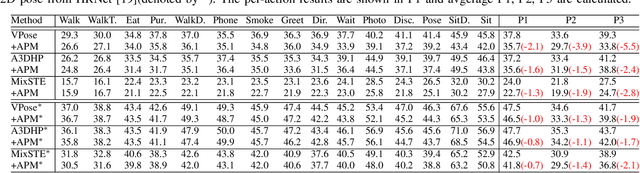
Recent 2D-to-3D human pose estimation (HPE) utilizes temporal consistency across sequences to alleviate the depth ambiguity problem but ignore the action related prior knowledge hidden in the pose sequence. In this paper, we propose a plug-and-play module named Action Prompt Module (APM) that effectively mines different kinds of action clues for 3D HPE. The highlight is that, the mining scheme of APM can be widely adapted to different frameworks and bring consistent benefits. Specifically, we first present a novel Action-related Text Prompt module (ATP) that directly embeds action labels and transfers the rich language information in the label to the pose sequence. Besides, we further introduce Action-specific Pose Prompt module (APP) to mine the position-aware pose pattern of each action, and exploit the correlation between the mined patterns and input pose sequence for further pose refinement. Experiments show that APM can improve the performance of most video-based 2D-to-3D HPE frameworks by a large margin.
Test-Time Training on Video Streams
Jul 12, 2023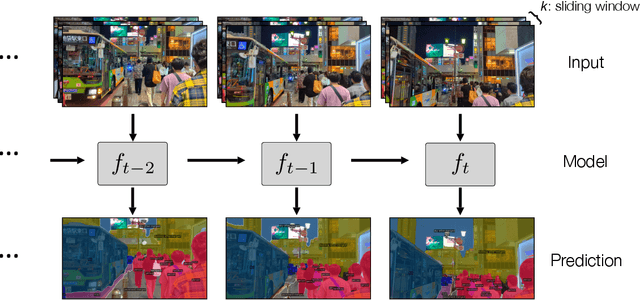
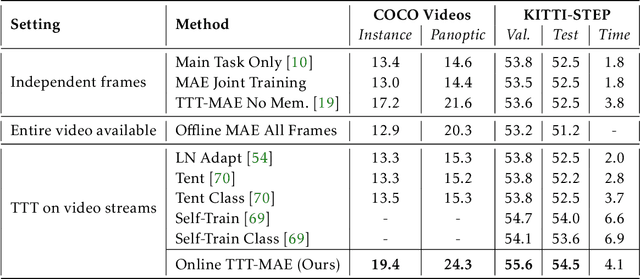
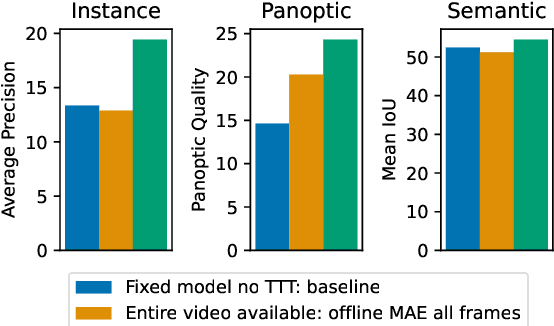
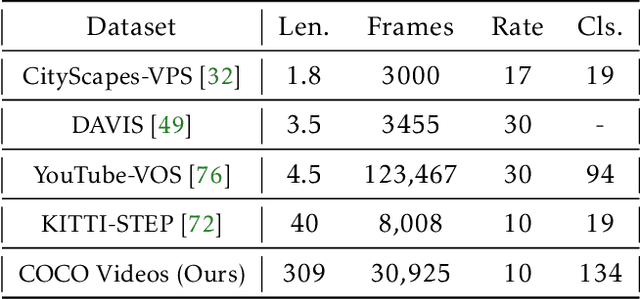
Prior work has established test-time training (TTT) as a general framework to further improve a trained model at test time. Before making a prediction on each test instance, the model is trained on the same instance using a self-supervised task, such as image reconstruction with masked autoencoders. We extend TTT to the streaming setting, where multiple test instances - video frames in our case - arrive in temporal order. Our extension is online TTT: The current model is initialized from the previous model, then trained on the current frame and a small window of frames immediately before. Online TTT significantly outperforms the fixed-model baseline for four tasks, on three real-world datasets. The relative improvement is 45% and 66% for instance and panoptic segmentation. Surprisingly, online TTT also outperforms its offline variant that accesses more information, training on all frames from the entire test video regardless of temporal order. This differs from previous findings using synthetic videos. We conceptualize locality as the advantage of online over offline TTT. We analyze the role of locality with ablations and a theory based on bias-variance trade-off.