 Add to Chrome
 Add to Firefox
 Add to Edge
Fourier Feature Pyramids for Physics-Informed Neural Networks
May 22, 2026
We present an improved neural field architecture for solving partial differential equations (PDEs). Current physics-informed neural networks (PINNs) provide a flexible framework for solving PDEs, but they struggle to achieve highly accurate solutions and require computation that scales poorly with parameter count. Our model, which we call beignet (Bandlimited Embedding with Interpolated Grid Network), replaces the random Fourier feature embedding used by existing PINN models with a trainable multi-resolution Fourier feature pyramid. To query beignet at a continuous coordinate, we use Fourier interpolation at each level of the pyramid to return features at the input coordinate, and then decode this vector with a fully-connected neural network trunk. Our model provides multiple benefits: 1) Spatial derivatives can be computed efficiently by using the chain rule to compose derivatives of the neural network computed with automatic differentiation with derivatives of the feature grid computed spectrally by the Fast Fourier transform (FFT). 2) beignet can achieve higher accuracy in a compute-efficient manner by scaling the parameter count of this Fourier feature pyramid, instead of the less-efficient strategy of scaling the neural network architecture. 3) beignet can directly control the representation bandlimit, resulting in more stable optimization for difficult PDEs. We demonstrate that beignet finds significantly more accurate solutions on PDE benchmarks using fewer parameters than state-of-the-art PINN methods. We further evaluate beignet on the self-similar inviscid Burgers blowup problem and show that it can minimize residuals to near machine precision using Adam, an accuracy regime previously attained only by using computationally expensive higher-order optimizers.

Optimizing Diffusion Priors with a Single Observation
Apr 22, 2026While diffusion priors generate high-quality posterior samples across many inverse problems, they are often trained on limited training sets or purely simulated data, thus inheriting the errors and biases of these underlying sources. Current approaches to finetuning diffusion models rely on a large number of observations with varying forward operators, which can be difficult to collect for many applications, and thus lead to overfitting when the measurement set is small. We propose a method for tuning a prior from only a single observation by combining existing diffusion priors into a single product-of-experts prior and identifying the exponents that maximize the Bayesian evidence. We validate our method on real-world inverse problems, including black hole imaging, where the true prior is unknown a priori, and image deblurring with text-conditioned priors. We find that the evidence is often maximized by priors that extend beyond those trained on a single dataset. By generalizing the prior through exponent weighting, our approach enables posterior sampling from both tempered and combined diffusion models, yielding more flexible priors that improve the trustworthiness of the resulting posterior image distribution.
Mapping Dark-Matter Clusters via Physics-Guided Diffusion Models
Mar 15, 2026Galaxy clusters are powerful probes of astrophysics and cosmology through gravitational lensing: the clusters' mass, dominated by 85% dark matter, distorts background light. Yet, mass reconstruction lacks the scalability and large-scale benchmarks to process the hundreds of thousands of clusters expected from forthcoming wide-field surveys. We introduce a fully automated method to reconstruct cluster surface mass density from photometry and gravitational lensing observables. Central to our approach is DarkClusters-15k, our new dataset of 15,000 simulated clusters with paired mass and photometry maps, the largest benchmark to date, spanning multiple redshifts and simulation frameworks. We train a plug-and-play diffusion prior on DarkClusters-15k that learns the statistical relationship between mass and light, and draw posterior samples constrained by weak- and strong-lensing observables; this yields principled reconstructions driven by explicit physics, alongside well-calibrated uncertainties. Our approach requires no expert tuning, runs in minutes rather than hours, achieves higher accuracy, and matches expertly-tuned reconstructions of the MACS 1206 cluster. We release our method and DarkClusters-15k to support development and benchmarking for upcoming wide-field cosmological surveys.
POLISH'ing the Sky: Wide-Field and High-Dynamic Range Interferometric Image Reconstruction with Application to Strong Lens Discovery
Mar 10, 2026Radio interferometry enables high-resolution imaging of astronomical radio sources by synthesizing a large effective aperture from an array of antennas and solving a deconvolution problem to reconstruct the image. Deep learning has emerged as a promising solution to the imaging problem, reducing computational costs and enabling super-resolution. However, existing DL-based methods often fall short of the requirements for real-world deployment due to limitations in handling high dynamic range, large field of view, and mismatches between training and test conditions. In this work, we build upon and extend the POLISH framework, a recent DL model for radio interferometric imaging. We introduce key improvements to enable robust reconstruction and super-resolution under real-world conditions: (1) a patch-wise training and stitching strategy for scaling to wide-field imaging and (2) a nonlinear arcsinh-based intensity transformation to manage high dynamic range. We conduct comprehensive evaluations using the T-RECS simulation suite with realistic sky models and point spead functions (PSF), and demonstrate that our approach significantly improves reconstruction quality and robustness. We test the model on realistic simulated strong gravitational lenses and show that lens systems with Einstein radii near the PSF scale can be recovered after deconvolution with our POLISH model, potentially yielding 10$\times$ more galaxy-galaxy lensing systems from the Deep Synoptic Array (DSA) survey than with image-plane CLEAN. Our results highlight the potential of DL models as practical, scalable tools for next-generation radio astronomy.
Sample-efficient evidence estimation of score based priors for model selection
Feb 24, 2026The choice of prior is central to solving ill-posed imaging inverse problems, making it essential to select one consistent with the measurements $y$ to avoid severe bias. In Bayesian inverse problems, this could be achieved by evaluating the model evidence $p(y \mid M)$ under different models $M$ that specify the prior and then selecting the one with the highest value. Diffusion models are the state-of-the-art approach to solving inverse problems with a data-driven prior; however, directly computing the model evidence with respect to a diffusion prior is intractable. Furthermore, most existing model evidence estimators require either many pointwise evaluations of the unnormalized prior density or an accurate clean prior score. We propose \method, an estimator of the model evidence of a diffusion prior by integrating over the time-marginals of posterior sampling methods. Our method leverages the large amount of intermediate samples naturally obtained during the reverse diffusion sampling process to obtain an accurate estimation of the model evidence using only a handful of posterior samples (e.g., 20). We also demonstrate how to implement our estimator in tandem with recent diffusion posterior sampling methods. Empirically, our estimator matches the model evidence when it can be computed analytically, and it is able to both select the correct diffusion model prior and diagnose prior misfit under different highly ill-conditioned, non-linear inverse problems, including a real-world black hole imaging problem.
U-DAVI: Uncertainty-Aware Diffusion-Prior-Based Amortized Variational Inference for Image Reconstruction
Feb 12, 2026Ill-posed imaging inverse problems remain challenging due to the ambiguity in mapping degraded observations to clean images. Diffusion-based generative priors have recently shown promise, but typically rely on computationally intensive iterative sampling or per-instance optimization. Amortized variational inference frameworks address this inefficiency by learning a direct mapping from measurements to posteriors, enabling fast posterior sampling without requiring the optimization of a new posterior for every new set of measurements. However, they still struggle to reconstruct fine details and complex textures. To address this, we extend the amortized framework by injecting spatially adaptive perturbations to measurements during training, guided by uncertainty estimates, to emphasize learning in the most uncertain regions. Experiments on deblurring and super-resolution demonstrate that our method achieves superior or competitive performance to previous diffusion-based approaches, delivering more realistic reconstructions without the computational cost of iterative refinement.
Dynamic Black-hole Emission Tomography with Physics-informed Neural Fields
Feb 08, 2026With the success of static black-hole imaging, the next frontier is the dynamic and 3D imaging of black holes. Recovering the dynamic 3D gas near a black hole would reveal previously-unseen parts of the universe and inform new physics models. However, only sparse radio measurements from a single viewpoint are possible, making the dynamic 3D reconstruction problem significantly ill-posed. Previously, BH-NeRF addressed the ill-posed problem by assuming Keplerian dynamics of the gas, but this assumption breaks down near the black hole, where the strong gravitational pull of the black hole and increased electromagnetic activity complicate fluid dynamics. To overcome the restrictive assumptions of BH-NeRF, we propose PI-DEF, a physics-informed approach that uses differentiable neural rendering to fit a 4D (time + 3D) emissivity field given EHT measurements. Our approach jointly reconstructs the 3D velocity field with the 4D emissivity field and enforces the velocity as a soft constraint on the dynamics of the emissivity. In experiments on simulated data, we find significantly improved reconstruction accuracy over both BH-NeRF and a physics-agnostic approach. We demonstrate how our method may be used to estimate other physics parameters of the black hole, such as its spin.
Revealing the 3D Cosmic Web through Gravitationally Constrained Neural Fields
Apr 21, 2025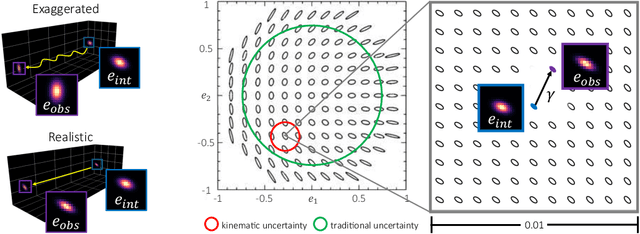
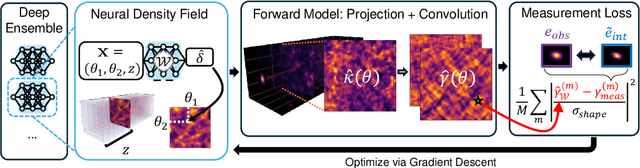
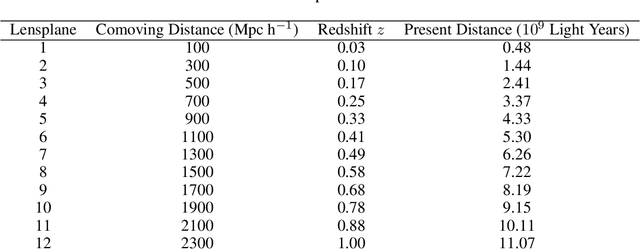
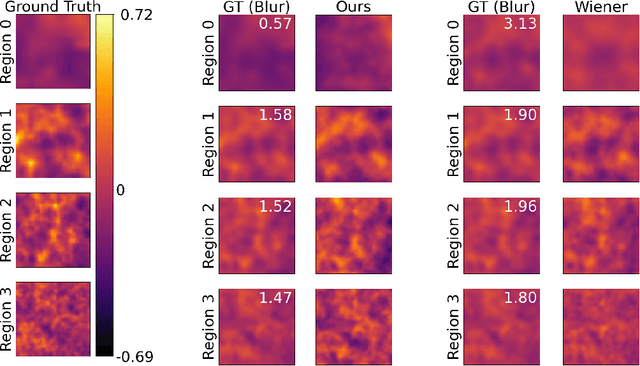
Weak gravitational lensing is the slight distortion of galaxy shapes caused primarily by the gravitational effects of dark matter in the universe. In our work, we seek to invert the weak lensing signal from 2D telescope images to reconstruct a 3D map of the universe's dark matter field. While inversion typically yields a 2D projection of the dark matter field, accurate 3D maps of the dark matter distribution are essential for localizing structures of interest and testing theories of our universe. However, 3D inversion poses significant challenges. First, unlike standard 3D reconstruction that relies on multiple viewpoints, in this case, images are only observed from a single viewpoint. This challenge can be partially addressed by observing how galaxy emitters throughout the volume are lensed. However, this leads to the second challenge: the shapes and exact locations of unlensed galaxies are unknown, and can only be estimated with a very large degree of uncertainty. This introduces an overwhelming amount of noise which nearly drowns out the lensing signal completely. Previous approaches tackle this by imposing strong assumptions about the structures in the volume. We instead propose a methodology using a gravitationally-constrained neural field to flexibly model the continuous matter distribution. We take an analysis-by-synthesis approach, optimizing the weights of the neural network through a fully differentiable physical forward model to reproduce the lensing signal present in image measurements. We showcase our method on simulations, including realistic simulated measurements of dark matter distributions that mimic data from upcoming telescope surveys. Our results show that our method can not only outperform previous methods, but importantly is also able to recover potentially surprising dark matter structures.
STeP: A General and Scalable Framework for Solving Video Inverse Problems with Spatiotemporal Diffusion Priors
Apr 10, 2025We study how to solve general Bayesian inverse problems involving videos using diffusion model priors. While it is desirable to use a video diffusion prior to effectively capture complex temporal relationships, due to the computational and data requirements of training such a model, prior work has instead relied on image diffusion priors on single frames combined with heuristics to enforce temporal consistency. However, these approaches struggle with faithfully recovering the underlying temporal relationships, particularly for tasks with high temporal uncertainty. In this paper, we demonstrate the feasibility of practical and accessible spatiotemporal diffusion priors by fine-tuning latent video diffusion models from pretrained image diffusion models using limited videos in specific domains. Leveraging this plug-and-play spatiotemporal diffusion prior, we introduce a general and scalable framework for solving video inverse problems. We then apply our framework to two challenging scientific video inverse problems--black hole imaging and dynamic MRI. Our framework enables the generation of diverse, high-fidelity video reconstructions that not only fit observations but also recover multi-modal solutions. By incorporating a spatiotemporal diffusion prior, we significantly improve our ability to capture complex temporal relationships in the data while also enhancing spatial fidelity.
InverseBench: Benchmarking Plug-and-Play Diffusion Priors for Inverse Problems in Physical Sciences
Mar 14, 2025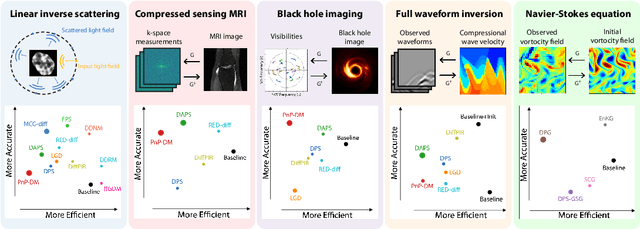
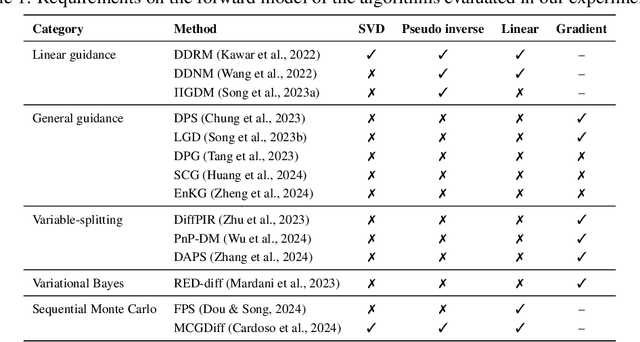
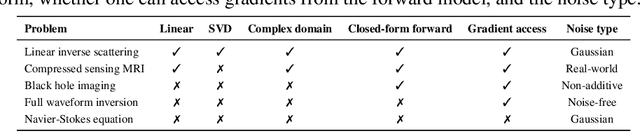
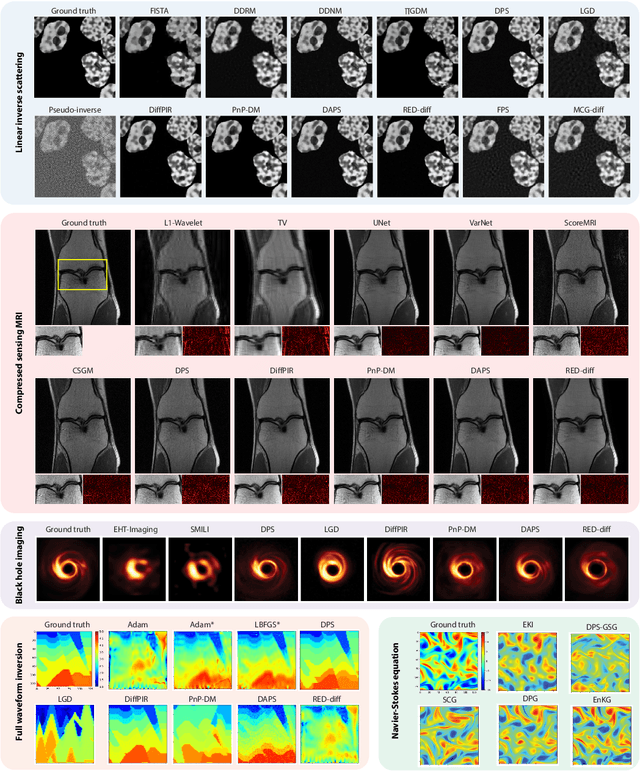
Plug-and-play diffusion priors (PnPDP) have emerged as a promising research direction for solving inverse problems. However, current studies primarily focus on natural image restoration, leaving the performance of these algorithms in scientific inverse problems largely unexplored. To address this gap, we introduce \textsc{InverseBench}, a framework that evaluates diffusion models across five distinct scientific inverse problems. These problems present unique structural challenges that differ from existing benchmarks, arising from critical scientific applications such as optical tomography, medical imaging, black hole imaging, seismology, and fluid dynamics. With \textsc{InverseBench}, we benchmark 14 inverse problem algorithms that use plug-and-play diffusion priors against strong, domain-specific baselines, offering valuable new insights into the strengths and weaknesses of existing algorithms. To facilitate further research and development, we open-source the codebase, along with datasets and pre-trained models, at https://devzhk.github.io/InverseBench/.