 Add to Chrome
 Add to Firefox
 Add to Edge
IDEA-Bench: How Far are Generative Models from Professional Designing?
Dec 16, 2024
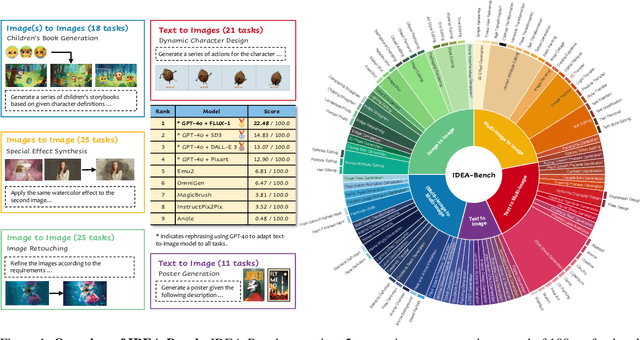
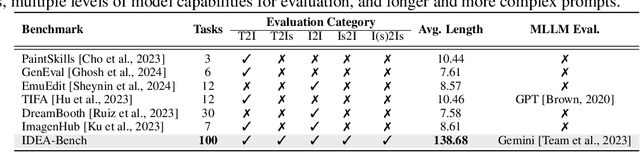
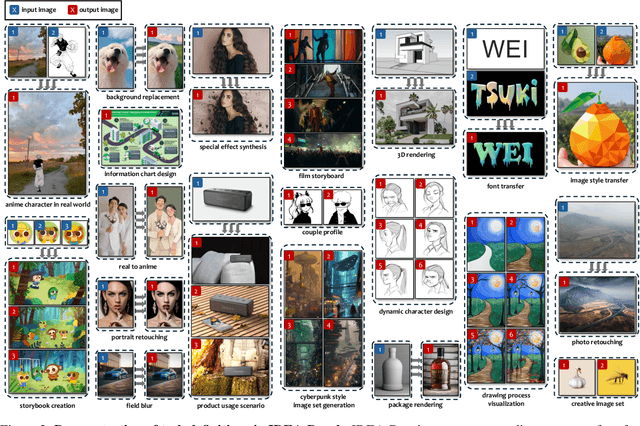
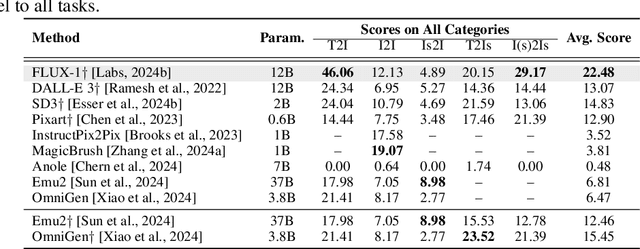
Real-world design tasks - such as picture book creation, film storyboard development using character sets, photo retouching, visual effects, and font transfer - are highly diverse and complex, requiring deep interpretation and extraction of various elements from instructions, descriptions, and reference images. The resulting images often implicitly capture key features from references or user inputs, making it challenging to develop models that can effectively address such varied tasks. While existing visual generative models can produce high-quality images based on prompts, they face significant limitations in professional design scenarios that involve varied forms and multiple inputs and outputs, even when enhanced with adapters like ControlNets and LoRAs. To address this, we introduce IDEA-Bench, a comprehensive benchmark encompassing 100 real-world design tasks, including rendering, visual effects, storyboarding, picture books, fonts, style-based, and identity-preserving generation, with 275 test cases to thoroughly evaluate a model's general-purpose generation capabilities. Notably, even the best-performing model only achieves 22.48 on IDEA-Bench, while the best general-purpose model only achieves 6.81. We provide a detailed analysis of these results, highlighting the inherent challenges and providing actionable directions for improvement. Additionally, we provide a subset of 18 representative tasks equipped with multimodal large language model (MLLM)-based auto-evaluation techniques to facilitate rapid model development and comparison. We releases the benchmark data, evaluation toolkits, and an online leaderboard at https://github.com/ali-vilab/IDEA-Bench, aiming to drive the advancement of generative models toward more versatile and applicable intelligent design systems.

MOVIS: Enhancing Multi-Object Novel View Synthesis for Indoor Scenes
Dec 16, 2024


Repurposing pre-trained diffusion models has been proven to be effective for NVS. However, these methods are mostly limited to a single object; directly applying such methods to compositional multi-object scenarios yields inferior results, especially incorrect object placement and inconsistent shape and appearance under novel views. How to enhance and systematically evaluate the cross-view consistency of such models remains under-explored. To address this issue, we propose MOVIS to enhance the structural awareness of the view-conditioned diffusion model for multi-object NVS in terms of model inputs, auxiliary tasks, and training strategy. First, we inject structure-aware features, including depth and object mask, into the denoising U-Net to enhance the model's comprehension of object instances and their spatial relationships. Second, we introduce an auxiliary task requiring the model to simultaneously predict novel view object masks, further improving the model's capability in differentiating and placing objects. Finally, we conduct an in-depth analysis of the diffusion sampling process and carefully devise a structure-guided timestep sampling scheduler during training, which balances the learning of global object placement and fine-grained detail recovery. To systematically evaluate the plausibility of synthesized images, we propose to assess cross-view consistency and novel view object placement alongside existing image-level NVS metrics. Extensive experiments on challenging synthetic and realistic datasets demonstrate that our method exhibits strong generalization capabilities and produces consistent novel view synthesis, highlighting its potential to guide future 3D-aware multi-object NVS tasks.
VividFace: A Diffusion-Based Hybrid Framework for High-Fidelity Video Face Swapping
Dec 15, 2024


Video face swapping is becoming increasingly popular across various applications, yet existing methods primarily focus on static images and struggle with video face swapping because of temporal consistency and complex scenarios. In this paper, we present the first diffusion-based framework specifically designed for video face swapping. Our approach introduces a novel image-video hybrid training framework that leverages both abundant static image data and temporal video sequences, addressing the inherent limitations of video-only training. The framework incorporates a specially designed diffusion model coupled with a VidFaceVAE that effectively processes both types of data to better maintain temporal coherence of the generated videos. To further disentangle identity and pose features, we construct the Attribute-Identity Disentanglement Triplet (AIDT) Dataset, where each triplet has three face images, with two images sharing the same pose and two sharing the same identity. Enhanced with a comprehensive occlusion augmentation, this dataset also improves robustness against occlusions. Additionally, we integrate 3D reconstruction techniques as input conditioning to our network for handling large pose variations. Extensive experiments demonstrate that our framework achieves superior performance in identity preservation, temporal consistency, and visual quality compared to existing methods, while requiring fewer inference steps. Our approach effectively mitigates key challenges in video face swapping, including temporal flickering, identity preservation, and robustness to occlusions and pose variations.
GaLore$+$: Boosting Low-Rank Adaptation for LLMs with Cross-Head Projection
Dec 15, 2024
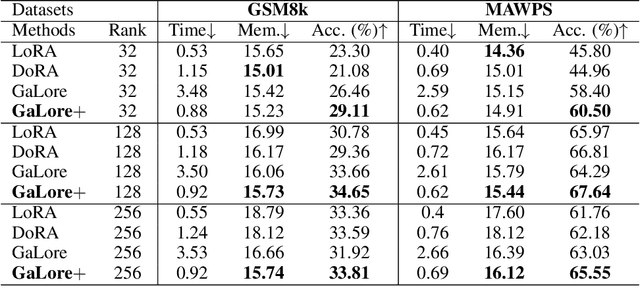

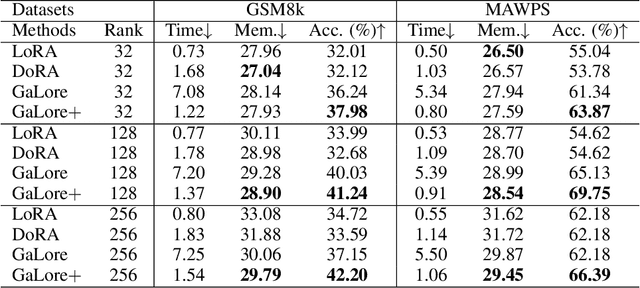
Recent low-rank training methods, such as GaLore, have significantly reduced the memory required to optimize large language models (LLMs). However, these methods often suffer from time-consuming low-rank projection estimations. In particular, the singular value decomposition (SVD) in GaLore can consume more than 80\% of the total training time. To address this issue, we propose GaLore$+$, which uses cross-head low-rank projection to reduce the substantial time consumption in estimating low-rank projections for multi-head attention. In addition, we employ randomized subspace iteration to achieve fast SVD. To further enhance performance, we propose sparsely coded residuals to reduce the errors caused by low-rank approximation on the first- and second-order moments of the optimizers and weight updates. We evaluate GaLore$+$ on arithmetic reasoning and natural language generation datasets. Our experiments demonstrate that GaLore$+$ delivers superior performance while achieving approximately $4\times$ fine-tuning speed compared to vanilla GaLore.
EasyRef: Omni-Generalized Group Image Reference for Diffusion Models via Multimodal LLM
Dec 12, 2024
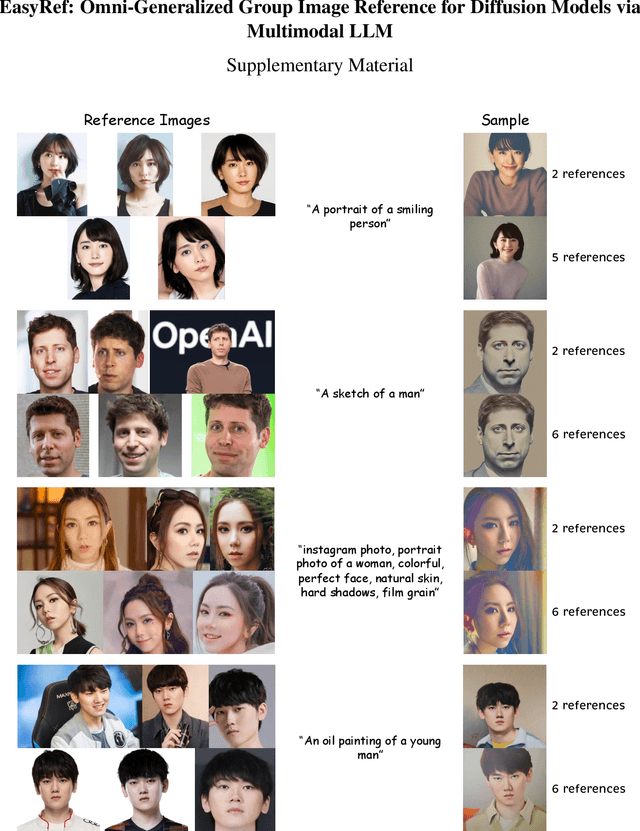


Significant achievements in personalization of diffusion models have been witnessed. Conventional tuning-free methods mostly encode multiple reference images by averaging their image embeddings as the injection condition, but such an image-independent operation cannot perform interaction among images to capture consistent visual elements within multiple references. Although the tuning-based Low-Rank Adaptation (LoRA) can effectively extract consistent elements within multiple images through the training process, it necessitates specific finetuning for each distinct image group. This paper introduces EasyRef, a novel plug-and-play adaptation method that enables diffusion models to be conditioned on multiple reference images and the text prompt. To effectively exploit consistent visual elements within multiple images, we leverage the multi-image comprehension and instruction-following capabilities of the multimodal large language model (MLLM), prompting it to capture consistent visual elements based on the instruction. Besides, injecting the MLLM's representations into the diffusion process through adapters can easily generalize to unseen domains, mining the consistent visual elements within unseen data. To mitigate computational costs and enhance fine-grained detail preservation, we introduce an efficient reference aggregation strategy and a progressive training scheme. Finally, we introduce MRBench, a new multi-reference image generation benchmark. Experimental results demonstrate EasyRef surpasses both tuning-free methods like IP-Adapter and tuning-based methods like LoRA, achieving superior aesthetic quality and robust zero-shot generalization across diverse domains.
See Further When Clear: Curriculum Consistency Model
Dec 09, 2024


Significant advances have been made in the sampling efficiency of diffusion models and flow matching models, driven by Consistency Distillation (CD), which trains a student model to mimic the output of a teacher model at a later timestep. However, we found that the learning complexity of the student model varies significantly across different timesteps, leading to suboptimal performance in CD.To address this issue, we propose the Curriculum Consistency Model (CCM), which stabilizes and balances the learning complexity across timesteps. Specifically, we regard the distillation process at each timestep as a curriculum and introduce a metric based on Peak Signal-to-Noise Ratio (PSNR) to quantify the learning complexity of this curriculum, then ensure that the curriculum maintains consistent learning complexity across different timesteps by having the teacher model iterate more steps when the noise intensity is low. Our method achieves competitive single-step sampling Fr\'echet Inception Distance (FID) scores of 1.64 on CIFAR-10 and 2.18 on ImageNet 64x64.Moreover, we have extended our method to large-scale text-to-image models and confirmed that it generalizes well to both diffusion models (Stable Diffusion XL) and flow matching models (Stable Diffusion 3). The generated samples demonstrate improved image-text alignment and semantic structure, since CCM enlarges the distillation step at large timesteps and reduces the accumulated error.
The Matrix: Infinite-Horizon World Generation with Real-Time Moving Control
Dec 04, 2024


We present The Matrix, the first foundational realistic world simulator capable of generating continuous 720p high-fidelity real-scene video streams with real-time, responsive control in both first- and third-person perspectives, enabling immersive exploration of richly dynamic environments. Trained on limited supervised data from AAA games like Forza Horizon 5 and Cyberpunk 2077, complemented by large-scale unsupervised footage from real-world settings like Tokyo streets, The Matrix allows users to traverse diverse terrains -- deserts, grasslands, water bodies, and urban landscapes -- in continuous, uncut hour-long sequences. Operating at 16 FPS, the system supports real-time interactivity and demonstrates zero-shot generalization, translating virtual game environments to real-world contexts where collecting continuous movement data is often infeasible. For example, The Matrix can simulate a BMW X3 driving through an office setting--an environment present in neither gaming data nor real-world sources. This approach showcases the potential of AAA game data to advance robust world models, bridging the gap between simulations and real-world applications in scenarios with limited data.
Revisiting Generative Policies: A Simpler Reinforcement Learning Algorithmic Perspective
Dec 02, 2024Generative models, particularly diffusion models, have achieved remarkable success in density estimation for multimodal data, drawing significant interest from the reinforcement learning (RL) community, especially in policy modeling in continuous action spaces. However, existing works exhibit significant variations in training schemes and RL optimization objectives, and some methods are only applicable to diffusion models. In this study, we compare and analyze various generative policy training and deployment techniques, identifying and validating effective designs for generative policy algorithms. Specifically, we revisit existing training objectives and classify them into two categories, each linked to a simpler approach. The first approach, Generative Model Policy Optimization (GMPO), employs a native advantage-weighted regression formulation as the training objective, which is significantly simpler than previous methods. The second approach, Generative Model Policy Gradient (GMPG), offers a numerically stable implementation of the native policy gradient method. We introduce a standardized experimental framework named GenerativeRL. Our experiments demonstrate that the proposed methods achieve state-of-the-art performance on various offline-RL datasets, offering a unified and practical guideline for training and deploying generative policies.
Pretrained Reversible Generation as Unsupervised Visual Representation Learning
Nov 29, 2024Recent generative models based on score matching and flow matching have significantly advanced generation tasks, but their potential in discriminative tasks remains underexplored. Previous approaches, such as generative classifiers, have not fully leveraged the capabilities of these models for discriminative tasks due to their intricate designs. We propose Pretrained Reversible Generation (PRG), which extracts unsupervised representations by reversing the generative process of a pretrained continuous flow model. PRG effectively reuses unsupervised generative models, leveraging their high capacity to serve as robust and generalizable feature extractors for downstream tasks. Our method consistently outperforms prior approaches across multiple benchmarks, achieving state-of-the-art performance among generative model-based methods, including 78\% top-1 accuracy on ImageNet. Extensive ablation studies further validate the effectiveness of our approach.
Reward driven workflows for unsupervised explainable analysis of phases and ferroic variants from atomically resolved imaging data
Nov 19, 2024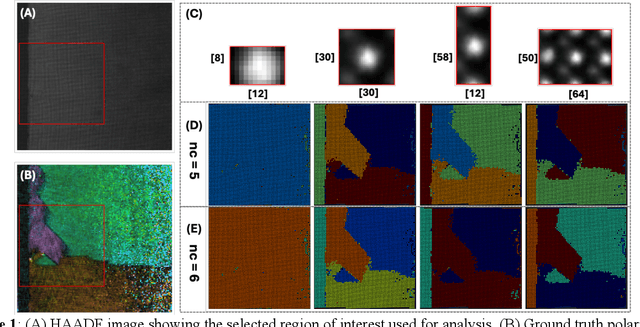
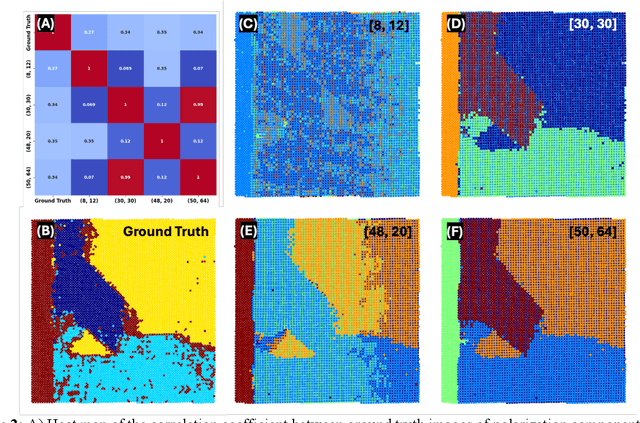
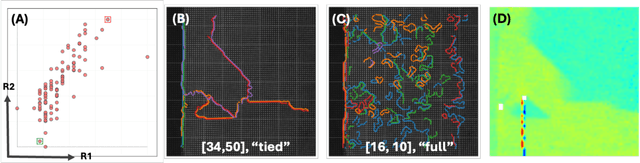
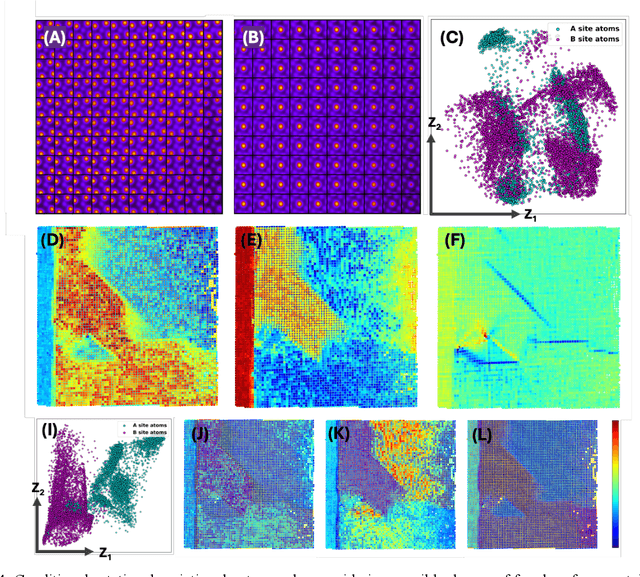
Rapid progress in aberration corrected electron microscopy necessitates development of robust methods for the identification of phases, ferroic variants, and other pertinent aspects of materials structure from imaging data. While unsupervised methods for clustering and classification are widely used for these tasks, their performance can be sensitive to hyperparameter selection in the analysis workflow. In this study, we explore the effects of descriptors and hyperparameters on the capability of unsupervised ML methods to distill local structural information, exemplified by discovery of polarization and lattice distortion in Sm doped BiFeO3 (BFO) thin films. We demonstrate that a reward-driven approach can be used to optimize these key hyperparameters across the full workflow, where rewards were designed to reflect domain wall continuity and straightness, ensuring that the analysis aligns with the material's physical behavior. This approach allows us to discover local descriptors that are best aligned with the specific physical behavior, providing insight into the fundamental physics of materials. We further extend the reward driven workflows to disentangle structural factors of variation via optimized variational autoencoder (VAE). Finally, the importance of well-defined rewards was explored as a quantifiable measure of success of the workflow.