 Add to Chrome
 Add to Firefox
 Add to Edge
Diffusion-based Dynamics Models for Long-Horizon Rollout in Offline Reinforcement Learning
May 29, 2024

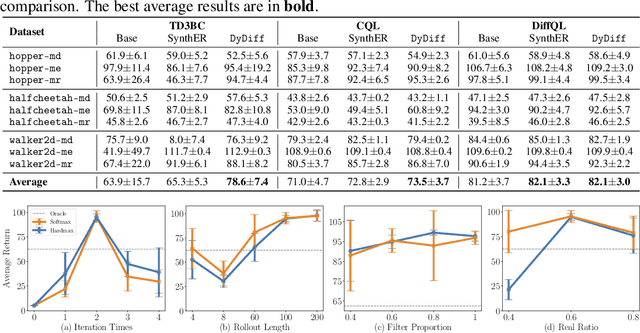
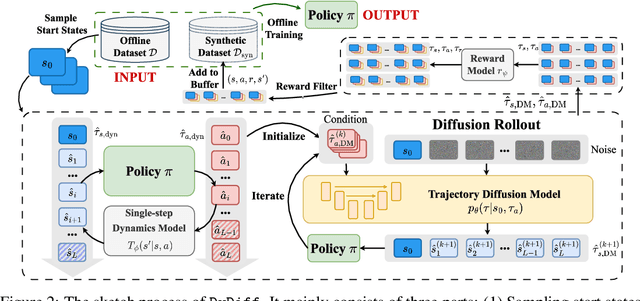
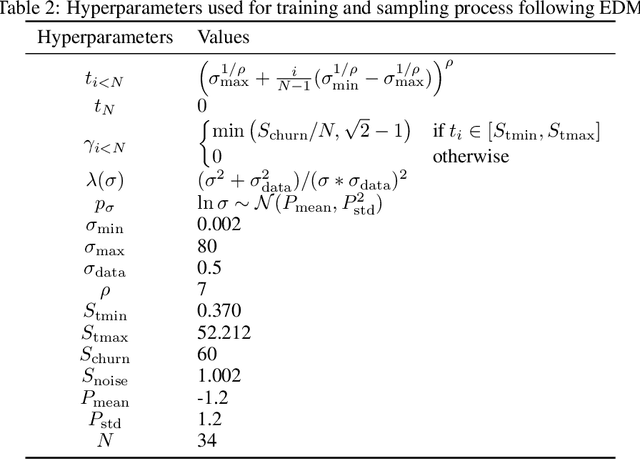
With the great success of diffusion models (DMs) in generating realistic synthetic vision data, many researchers have investigated their potential in decision-making and control. Most of these works utilized DMs to sample directly from the trajectory space, where DMs can be viewed as a combination of dynamics models and policies. In this work, we explore how to decouple DMs' ability as dynamics models in fully offline settings, allowing the learning policy to roll out trajectories. As DMs learn the data distribution from the dataset, their intrinsic policy is actually the behavior policy induced from the dataset, which results in a mismatch between the behavior policy and the learning policy. We propose Dynamics Diffusion, short as DyDiff, which can inject information from the learning policy to DMs iteratively. DyDiff ensures long-horizon rollout accuracy while maintaining policy consistency and can be easily deployed on model-free algorithms. We provide theoretical analysis to show the advantage of DMs on long-horizon rollout over models and demonstrate the effectiveness of DyDiff in the context of offline reinforcement learning, where the rollout dataset is provided but no online environment for interaction. Our code is at https://github.com/FineArtz/DyDiff.

Look into the Future: Deep Contextualized Sequential Recommendation
May 23, 2024
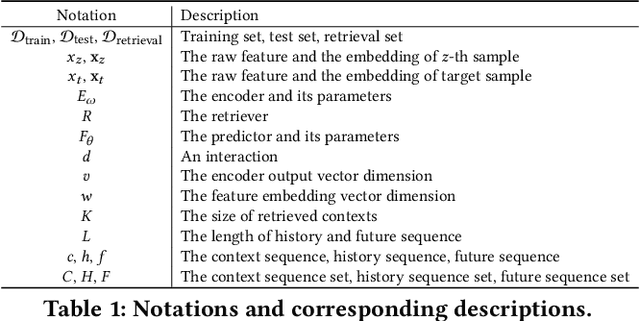
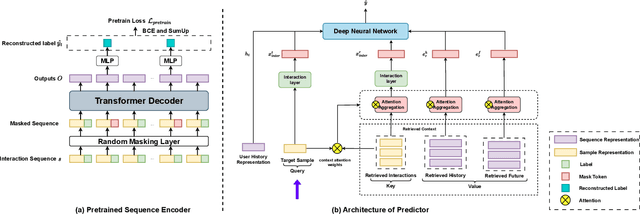
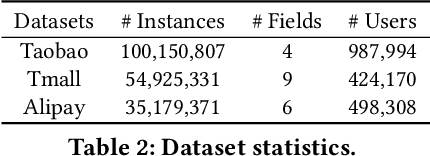
Sequential recommendation focuses on mining useful patterns from the user behavior history to better estimate his preference on the candidate items. Previous solutions adopt recurrent networks or retrieval methods to obtain the user's profile representation so as to perform the preference estimation. In this paper, we propose a novel framework of sequential recommendation called Look into the Future (LIFT), which builds and leverages the contexts of sequential recommendation. The context in LIFT refers to a user's current profile that can be represented based on both past and future behaviors. As such, the learned context will be more effective in predicting the user's behaviors in sequential recommendation. Apparently, it is impossible to use real future information to predict the current behavior, we thus propose a novel retrieval-based framework to use the most similar interaction's future information as the future context of the target interaction without data leakage. Furthermore, in order to exploit the intrinsic information embedded within the context itself, we introduce an innovative pretraining methodology incorporating behavior masking. This approach is designed to facilitate the efficient acquisition of context representations. We demonstrate that finding relevant contexts from the global user pool via retrieval methods will greatly improve preference estimation performance. In our extensive experiments over real-world datasets, LIFT demonstrates significant performance improvement on click-through rate prediction tasks in sequential recommendation over strong baselines.
Learning Structure and Knowledge Aware Representation with Large Language Models for Concept Recommendation
May 21, 2024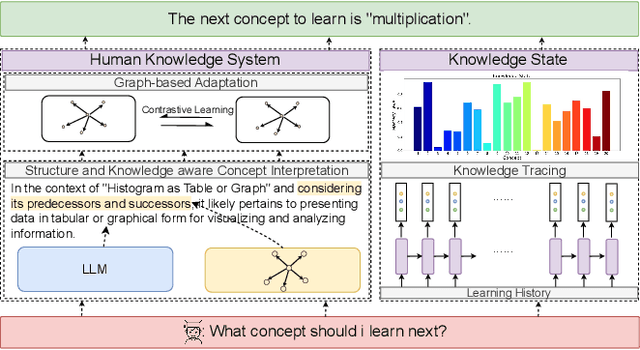
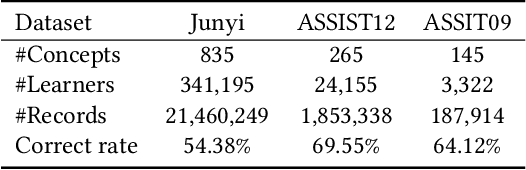

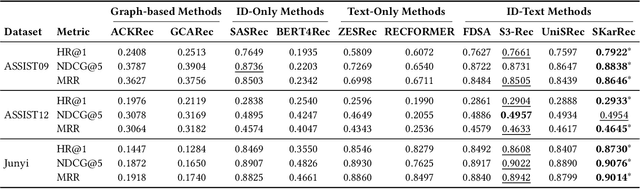
Concept recommendation aims to suggest the next concept for learners to study based on their knowledge states and the human knowledge system. While knowledge states can be predicted using knowledge tracing models, previous approaches have not effectively integrated the human knowledge system into the process of designing these educational models. In the era of rapidly evolving Large Language Models (LLMs), many fields have begun using LLMs to generate and encode text, introducing external knowledge. However, integrating LLMs into concept recommendation presents two urgent challenges: 1) How to construct text for concepts that effectively incorporate the human knowledge system? 2) How to adapt non-smooth, anisotropic text encodings effectively for concept recommendation? In this paper, we propose a novel Structure and Knowledge Aware Representation learning framework for concept Recommendation (SKarREC). We leverage factual knowledge from LLMs as well as the precedence and succession relationships between concepts obtained from the knowledge graph to construct textual representations of concepts. Furthermore, we propose a graph-based adapter to adapt anisotropic text embeddings to the concept recommendation task. This adapter is pre-trained through contrastive learning on the knowledge graph to get a smooth and structure-aware concept representation. Then, it's fine-tuned through the recommendation task, forming a text-to-knowledge-to-recommendation adaptation pipeline, which effectively constructs a structure and knowledge-aware concept representation. Our method does a better job than previous adapters in transforming text encodings for application in concept recommendation. Extensive experiments on real-world datasets demonstrate the effectiveness of the proposed approach.
CodeGRAG: Extracting Composed Syntax Graphs for Retrieval Augmented Cross-Lingual Code Generation
May 03, 2024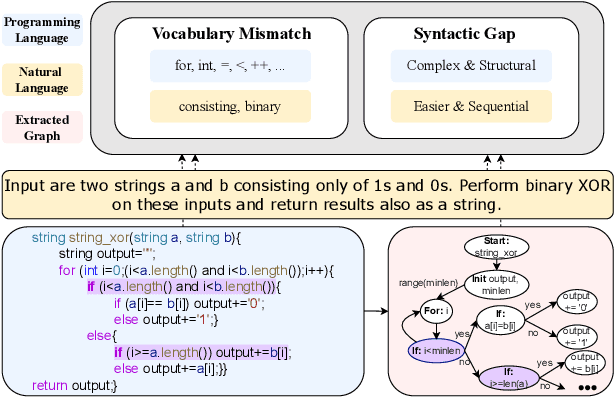
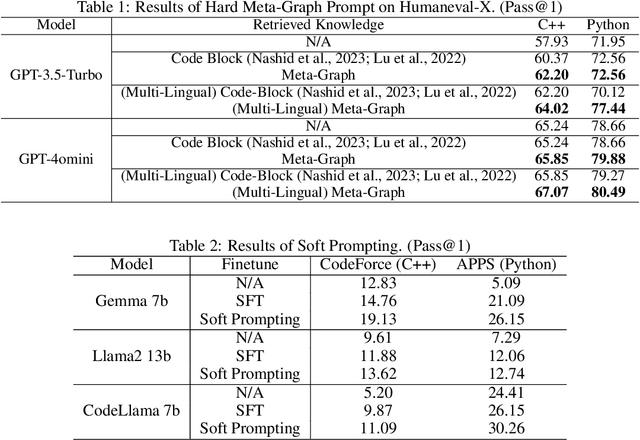
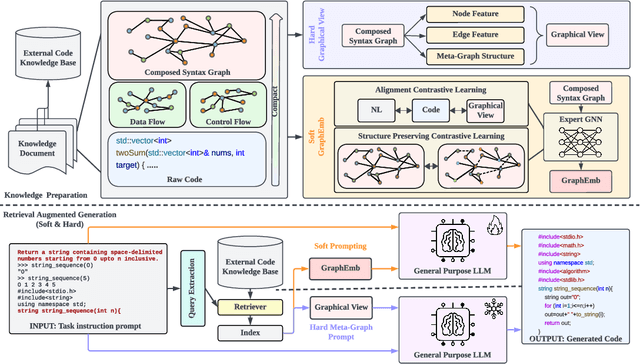
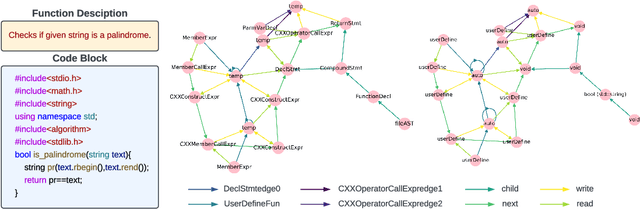
Utilizing large language models to generate codes has shown promising meaning in software development revolution. Despite the intelligence shown by the general large language models, their specificity in code generation can still be improved due to the syntactic gap and mismatched vocabulary existing among natural language and different programming languages. In addition, programming languages are inherently logical and complex, making them hard to be correctly generated. Existing methods rely on multiple prompts to the large language model to explore better solutions, which is expensive. In this paper, we propose Syntax Graph Retrieval Augmented Code Generation (CodeGRAG) to enhance the performance of LLMs in single-round code generation tasks. CodeGRAG extracts and summarizes the control flow and data flow of code blocks to fill the gap between programming languages and natural language. The extracted external structural knowledge models the inherent flows of code blocks, which can facilitate LLMs for better understanding of code syntax and serve as a bridge among different programming languages. CodeGRAG significantly improves the code generation ability of LLMs and can even offer performance gain for cross-lingual code generation, e.g., C++ for Python.
Retrieval and Distill: A Temporal Data Shift-Free Paradigm for Online Recommendation System
Apr 26, 2024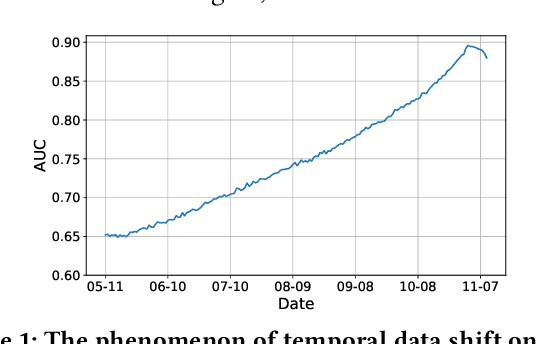
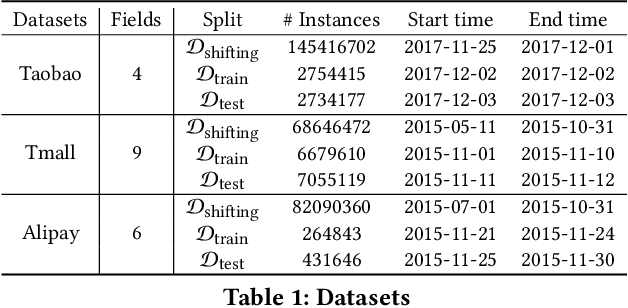
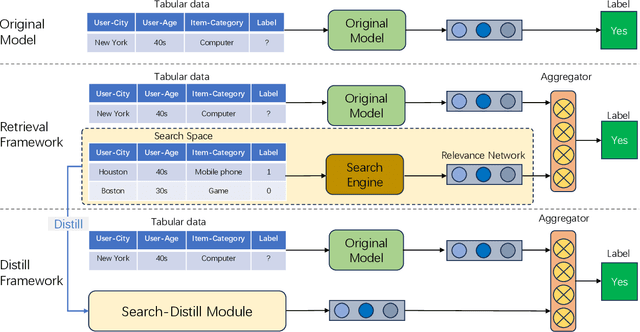
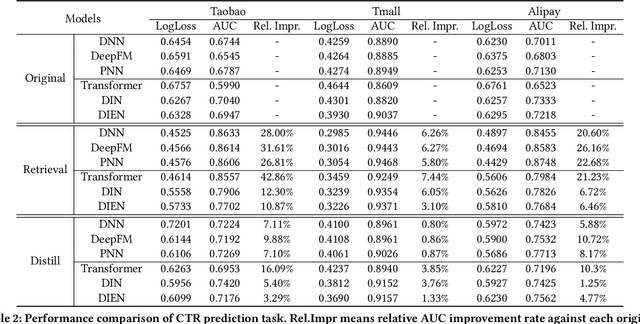
Current recommendation systems are significantly affected by a serious issue of temporal data shift, which is the inconsistency between the distribution of historical data and that of online data. Most existing models focus on utilizing updated data, overlooking the transferable, temporal data shift-free information that can be learned from shifting data. We propose the Temporal Invariance of Association theorem, which suggests that given a fixed search space, the relationship between the data and the data in the search space keeps invariant over time. Leveraging this principle, we designed a retrieval-based recommendation system framework that can train a data shift-free relevance network using shifting data, significantly enhancing the predictive performance of the original model in the recommendation system. However, retrieval-based recommendation models face substantial inference time costs when deployed online. To address this, we further designed a distill framework that can distill information from the relevance network into a parameterized module using shifting data. The distilled model can be deployed online alongside the original model, with only a minimal increase in inference time. Extensive experiments on multiple real datasets demonstrate that our framework significantly improves the performance of the original model by utilizing shifting data.
DRepMRec: A Dual Representation Learning Framework for Multimodal Recommendation
Apr 17, 2024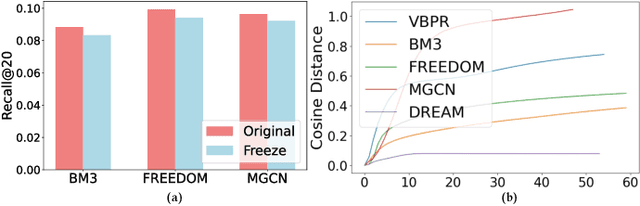
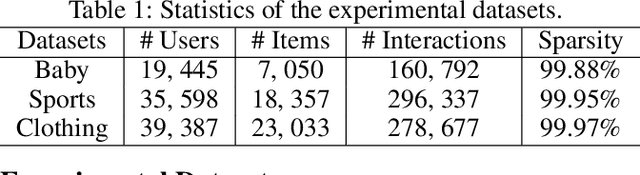
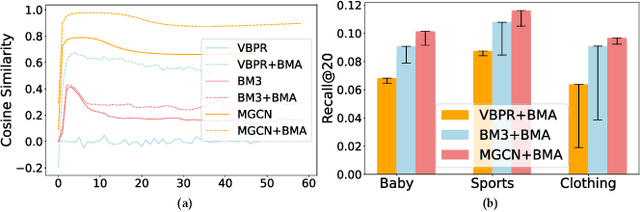

Multimodal Recommendation focuses mainly on how to effectively integrate behavior and multimodal information in the recommendation task. Previous works suffer from two major issues. Firstly, the training process tightly couples the behavior module and multimodal module by jointly optimizing them using the sharing model parameters, which leads to suboptimal performance since behavior signals and modality signals often provide opposite guidance for the parameters updates. Secondly, previous approaches fail to take into account the significant distribution differences between behavior and modality when they attempt to fuse behavior and modality information. This resulted in a misalignment between the representations of behavior and modality. To address these challenges, in this paper, we propose a novel Dual Representation learning framework for Multimodal Recommendation called DRepMRec, which introduce separate dual lines for coupling problem and Behavior-Modal Alignment (BMA) for misalignment problem. Specifically, DRepMRec leverages two independent lines of representation learning to calculate behavior and modal representations. After obtaining separate behavior and modal representations, we design a Behavior-Modal Alignment Module (BMA) to align and fuse the dual representations to solve the misalignment problem. Furthermore, we integrate the BMA into other recommendation models, resulting in consistent performance improvements. To ensure dual representations maintain their semantic independence during alignment, we introduce Similarity-Supervised Signal (SSS) for representation learning. We conduct extensive experiments on three public datasets and our method achieves state-of-the-art (SOTA) results. The source code will be available upon acceptance.
M-scan: A Multi-Scenario Causal-driven Adaptive Network for Recommendation
Apr 15, 2024We primarily focus on the field of multi-scenario recommendation, which poses a significant challenge in effectively leveraging data from different scenarios to enhance predictions in scenarios with limited data. Current mainstream efforts mainly center around innovative model network architectures, with the aim of enabling the network to implicitly acquire knowledge from diverse scenarios. However, the uncertainty of implicit learning in networks arises from the absence of explicit modeling, leading to not only difficulty in training but also incomplete user representation and suboptimal performance. Furthermore, through causal graph analysis, we have discovered that the scenario itself directly influences click behavior, yet existing approaches directly incorporate data from other scenarios during the training of the current scenario, leading to prediction biases when they directly utilize click behaviors from other scenarios to train models. To address these problems, we propose the Multi-Scenario Causal-driven Adaptive Network M-scan). This model incorporates a Scenario-Aware Co-Attention mechanism that explicitly extracts user interests from other scenarios that align with the current scenario. Additionally, it employs a Scenario Bias Eliminator module utilizing causal counterfactual inference to mitigate biases introduced by data from other scenarios. Extensive experiments on two public datasets demonstrate the efficacy of our M-scan compared to the existing baseline models.
Recall-Augmented Ranking: Enhancing Click-Through Rate Prediction Accuracy with Cross-Stage Data
Apr 15, 2024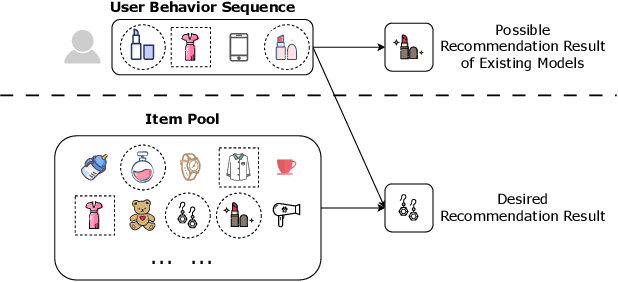
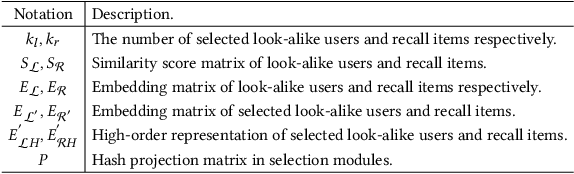
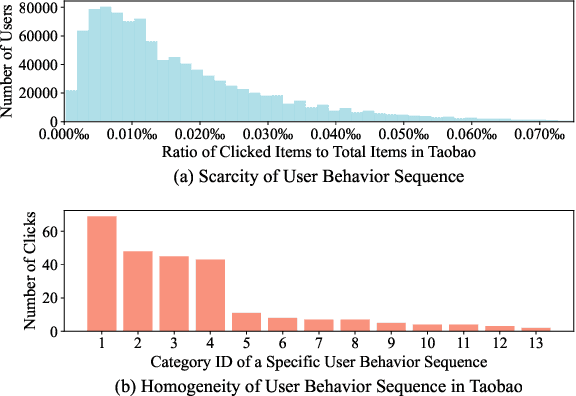
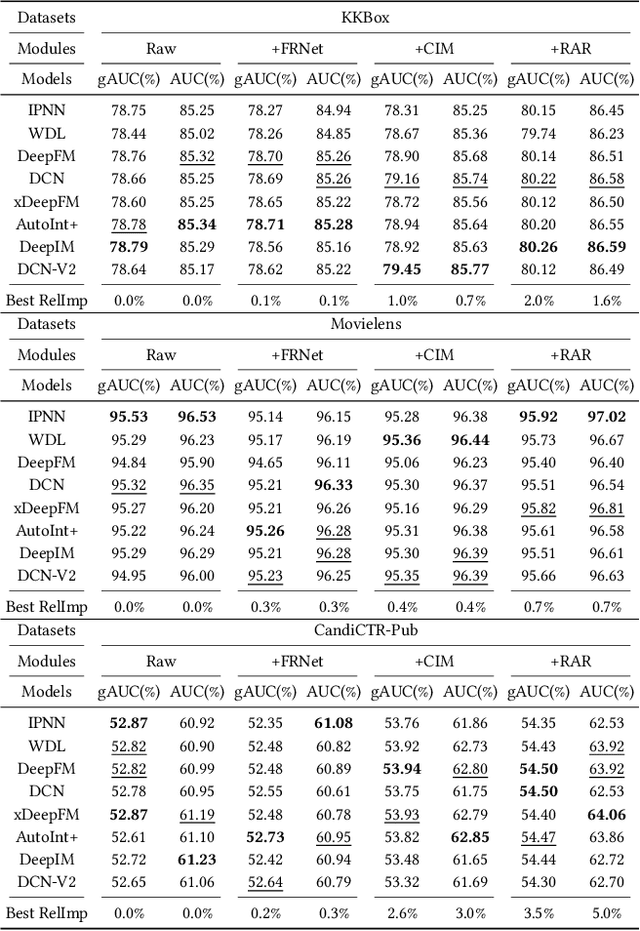
Click-through rate (CTR) prediction plays an indispensable role in online platforms. Numerous models have been proposed to capture users' shifting preferences by leveraging user behavior sequences. However, these historical sequences often suffer from severe homogeneity and scarcity compared to the extensive item pool. Relying solely on such sequences for user representations is inherently restrictive, as user interests extend beyond the scope of items they have previously engaged with. To address this challenge, we propose a data-driven approach to enrich user representations. We recognize user profiling and recall items as two ideal data sources within the cross-stage framework, encompassing the u2u (user-to-user) and i2i (item-to-item) aspects respectively. In this paper, we propose a novel architecture named Recall-Augmented Ranking (RAR). RAR consists of two key sub-modules, which synergistically gather information from a vast pool of look-alike users and recall items, resulting in enriched user representations. Notably, RAR is orthogonal to many existing CTR models, allowing for consistent performance improvements in a plug-and-play manner. Extensive experiments are conducted, which verify the efficacy and compatibility of RAR against the SOTA methods.
Emerging Platforms Meet Emerging LLMs: A Year-Long Journey of Top-Down Development
Apr 14, 2024Deploying machine learning (ML) on diverse computing platforms is crucial to accelerate and broaden their applications. However, it presents significant software engineering challenges due to the fast evolution of models, especially the recent \llmfull{s} (\llm{s}), and the emergence of new computing platforms. Current ML frameworks are primarily engineered for CPU and CUDA platforms, leaving a big gap in enabling emerging ones like Metal, Vulkan, and WebGPU. While a traditional bottom-up development pipeline fails to close the gap timely, we introduce TapML, a top-down approach and tooling designed to streamline the deployment of ML systems on diverse platforms, optimized for developer productivity. Unlike traditional bottom-up methods, which involve extensive manual testing and debugging, TapML automates unit testing through test carving and adopts a migration-based strategy for gradually offloading model computations from mature source platforms to emerging target platforms. By leveraging realistic inputs and remote connections for gradual target offloading, TapML accelerates the validation and minimizes debugging scopes, significantly optimizing development efforts. TapML was developed and applied through a year-long, real-world effort that successfully deployed significant emerging models and platforms. Through serious deployments of 82 emerging models in 17 distinct architectures across 5 emerging platforms, we showcase the effectiveness of TapML in enhancing developer productivity while ensuring model reliability and efficiency. Furthermore, we summarize comprehensive case studies from our real-world development, offering best practices for developing emerging ML systems.
Play to Your Strengths: Collaborative Intelligence of Conventional Recommender Models and Large Language Models
Mar 25, 2024The rise of large language models (LLMs) has opened new opportunities in Recommender Systems (RSs) by enhancing user behavior modeling and content understanding. However, current approaches that integrate LLMs into RSs solely utilize either LLM or conventional recommender model (CRM) to generate final recommendations, without considering which data segments LLM or CRM excel in. To fill in this gap, we conduct experiments on MovieLens-1M and Amazon-Books datasets, and compare the performance of a representative CRM (DCNv2) and an LLM (LLaMA2-7B) on various groups of data samples. Our findings reveal that LLMs excel in data segments where CRMs exhibit lower confidence and precision, while samples where CRM excels are relatively challenging for LLM, requiring substantial training data and a long training time for comparable performance. This suggests potential synergies in the combination between LLM and CRM. Motivated by these insights, we propose Collaborative Recommendation with conventional Recommender and Large Language Model (dubbed \textit{CoReLLa}). In this framework, we first jointly train LLM and CRM and address the issue of decision boundary shifts through alignment loss. Then, the resource-efficient CRM, with a shorter inference time, handles simple and moderate samples, while LLM processes the small subset of challenging samples for CRM. Our experimental results demonstrate that CoReLLa outperforms state-of-the-art CRM and LLM methods significantly, underscoring its effectiveness in recommendation tasks.