 Add to Chrome
 Add to Firefox
 Add to Edge
Learning from Unreachable Rewards: Hint-Conditioned Reinforcement Learning for Generative Recommendation
Aug 15, 2026
Semantic-ID generative recommenders represent each item as a short sequence of discrete semantic tokens and predict the next item by autoregressively generating this token sequence. This paradigm enables a unified generation interface for item IDs, histories, and item text, but it also creates a structured optimization bottleneck during reward-based post-training: when an early semantic token enters the wrong branch of the item-token space, finite rollout groups rarely reach the ground-truth item, so group-relative optimization receives identical zero rewards and produces no useful advantage. We propose Hint-Conditioned Generative Recommendation (HCGRec), a semantic-ID generative recommendation framework that recovers learning signal for such hard training instances. HCGRec diagnoses each instance with checkpoint rollouts and supplies a minimal target-prefix hint only when the current generator cannot reach the correct item. The model then generates the unhinted suffix under the hinted semantic branch, turning zero-reward groups into informative comparisons over item-token completions. Hinting also changes token identity: hinted prefix tokens are oracle-provided item context, while unhinted suffix tokens are sampled generation actions. We therefore introduce hint-aware credit decomposition, using supervised learning to preserve item-semantic and prefix-structure alignment for hinted tokens and GRPO to optimize the sampled suffix. Experiments on sequential recommendation benchmarks show that HCGRec substantially improves over supervised fine-tuning and vanilla reward-based post-training, while reducing zero-advantage training samples from over 70% to below 20%. The code is accessible at https://github.com/WncFht/GRec.

HCGRec: Hint-Conditioned Generative Recommendation with Semantic IDs
Aug 12, 2026Semantic-ID generative recommenders represent each item as a short sequence of discrete semantic tokens and predict the next item by autoregressively generating this token sequence. This paradigm enables a unified generation interface for item IDs, histories, and item text, but it also creates a structured optimization bottleneck during reward-based post-training: when an early semantic token enters the wrong branch of the item-token space, finite rollout groups rarely reach the ground-truth item, so group-relative optimization receives identical zero rewards and produces no useful advantage. We propose Hint-Conditioned Generative Recommendation (HCGRec), a semantic-ID generative recommendation framework that recovers learning signal for such hard training instances. HCGRec diagnoses each instance with checkpoint rollouts and supplies a minimal target-prefix hint only when the current generator cannot reach the correct item. The model then generates the unhinted suffix under the hinted semantic branch, turning zero-reward groups into informative comparisons over item-token completions. Hinting also changes token identity: hinted prefix tokens are oracle-provided item context, while unhinted suffix tokens are sampled generation actions. We therefore introduce hint-aware credit decomposition, using supervised learning to preserve item-semantic and prefix-structure alignment for hinted tokens and GRPO to optimize the sampled suffix. Experiments on sequential recommendation benchmarks show that HCGRec substantially improves over supervised fine-tuning and vanilla reward-based post-training, while reducing zero-advantage training samples from over 70% to below 20%. The code is accessible at https://github.com/WncFht/GRec.
Harness-R1: Learning to Edit Executable Runtime Harnesses from Agent Failure Trajectories
Aug 03, 2026Agents built around large language models continually accumulate interaction trajectories during deployment, yet their behavior typically remains fixed. Beyond updating model weights, these trajectories can improve the agent harness that constructs context, mediates tools, validates actions, and recovers execution. We introduce Harness-R1, the first method, to our knowledge, that makes failure-conditioned, lifecycle-wide editing of an existing executable runtime a learned capability. It post-trains a dedicated harness engineer with online reinforcement learning so that its edits are optimized for the realized task success they produce, rather than proposed by a fixed editor. A separate 9B engineer converts batches of target-agent failures into validated executable patches; fresh same-batch reruns of the frozen target provide outcome rewards, so training updates only the engineer. Cold-start supervised fine-tuning initializes this editing policy, which is then trained online with group-relative policy optimization. Across WebShop, ALFWorld, and DBBench, Harness-R1 raises vanilla Qwen3.5-9B success from 44.3% to 53.6% (+9.3 percentage points). After direct target-agent fine-tuning, a target-specific engineer raises the average further from 59.2% to 64.2% (+5.0 points); because these gains hold both before and after fine-tuning the target, Harness-R1 points toward co-evolving the harness engineer and the target agent.
VAD: Attributing Visual Evidence for Target Reconstruction in Multimodal On-Policy Distillation
Jul 30, 2026Multimodal on-policy distillation (OPD) transfers fine-grained visual knowledge by supervising student-generated trajectories with a privileged-view teacher. Yet its next-token corrections are source-mixed, combining visual signals with linguistic priors and teacher-specific effects. The key challenge is to estimate which corrections are supported by visual evidence, not merely where or how strongly to distill. We introduce Visual Attribution Distillation (VAD), a counterfactual target-reconstruction algorithm that estimates the visually attributable part of a teacher correction. At each student-generated prefix, VAD evaluates the same fixed teacher with the relevant evidence present and removed. The corresponding change in centered log-probabilities defines ut, a signed proxy for the visual evidence direction that estimates how revealing the evidence supports or refutes candidate tokens. VAD projects the original correction onto this proxy to obtain an intervention-aligned component and a proxy-unexplained residual, then reconstructs a student-anchored target from the former. During training, this reconstructed target supplies the primary supervision signal, while the privileged teacher contributes a weak regularizer. Across six fine-grained visual benchmarks at 4B and 9B scales, VAD outperforms direct privileged-view distillation and visual-advantage weighting. Token- level and controlled-target analyses show that the proxy-aligned component is enriched in task-relevant visual corrections and yields stronger target shifts, especially when evidence refutes a mistaken answer. These results support counterfactual target reconstruction as an effective alternative to source-mixed supervision.
SkillRise: Agentic Reinforcement Learning for Cross-Task Skill Evolution
Jul 29, 2026Large language model agents often encounter related yet distinct tasks that share reusable solution patterns. Yet standard agentic reinforcement learning treats tasks as independent episodes, while existing approaches to skill learning either focus on repeated attempts of one task or use pipelines with multiple stages that entangle extraction, retrieval, and execution. We introduce SkillRise, a unified reinforcement learning framework for learning skills across tasks. SkillRise organizes related instances into progressively challenging sequences and uses a single policy to alternate between task solving and curating an evolving skill document passed directly to the next task. Decoupled credit assignment across tasks supervises solving with the current task outcome and curation with discounted downstream outcomes. Experiments on ALFWorld, WebShop, and ScienceWorld show that SkillRise achieves the strongest Pass@1 performance among the compared methods, with gains over the strongest baseline ranging from 2.3 to 8.5 percentage points. Although trained across distinct tasks, its learned curation policy remains effective for repeated attempts on the same task. Further analysis reveals scaling at test time across tasks: performance improves with longer sequences of related tasks even when each task is attempted only once. This trend suggests that SkillRise reuses transferable skills across tasks rather than benefiting from repeated sampling of the same task. SkillRise further retains strong performance while substantially reducing the runtime overhead of skill learning pipelines with multiple stages. Together, these results provide a simple and efficient training paradigm for LLM agents to extract, refine, and reuse transferable skills across tasks.
DiffCold: A Diffusion-based Generative Model for Cold-Start Item Recommendation
Jun 10, 2026Cold-start item recommendation remains a persistent challenge in real-world systems due to the absence of interaction histories. While prior models attempt to bridge this gap using item content features, they universally suffer from the \textbf{seesaw dilemma}: enhancing performance for cold items inevitably degrades performance for warm items, and vice versa. We identify that this dilemma stems from a fundamental \textbf{distributional disparity}: warm item embeddings occupy a complex ``behavioral manifold" shaped by rich interaction signals, whereas cold item embeddings are constrained to a ``semantic manifold" derived solely from auxiliary content. Existing methods often force a rigid mapping between these inconsistent spaces, causing the model to sacrifice the precision of warm representations to accommodate cold ones. To address this, we propose \textbf{DiffCold}, a diffusion-based generative model that unifies warm and cold representations. Unlike GANs or VAEs, DiffCold leverages conditional diffusion to reconstruct warm item embeddings from content, preserving the underlying manifold structure without degradation. We further tailor this paradigm with two specific designs: a \textbf{Retrieval-enhanced Aggregator} that initializes generation using semantically similar warm items to bypass inefficient noise, and a \textbf{Simulation-based Representation Alignment} module that enforces distribution consistency between generated and real embeddings via contrastive learning. Experiments on three benchmarks confirm that DiffCold resolves the seesaw dilemma, consistently outperforming state-of-the-art methods across all metrics.
MMSkills: Towards Multimodal Skills for General Visual Agents
May 14, 2026Reusable skills have become a core substrate for improving agent capabilities, yet most existing skill packages encode reusable behavior primarily as textual prompts, executable code, or learned routines. For visual agents, however, procedural knowledge is inherently multimodal: reuse depends not only on what operation to perform, but also on recognizing the relevant state, interpreting visual evidence of progress or failure, and deciding what to do next. We formalize this requirement as multimodal procedural knowledge and address three practical challenges: (I) what a multimodal skill package should contain; (II) where such packages can be derived from public interaction experience; and (III) how agents can consult multimodal evidence at inference time without excessive image context or over-anchoring to reference screenshots. We introduce MMSkills, a framework for representing, generating, and using reusable multimodal procedures for runtime visual decision making. Each MMSkill is a compact, state-conditioned package that couples a textual procedure with runtime state cards and multi-view keyframes. To construct these packages, we develop an agentic trajectory-to-skill Generator that transforms public non-evaluation trajectories into reusable multimodal skills through workflow grouping, procedure induction, visual grounding, and meta-skill-guided auditing. To use them, we introduce a branch-loaded multimodal skill agent: selected state cards and keyframes are inspected in a temporary branch, aligned with the live environment, and distilled into structured guidance for the main agent. Experiments across GUI and game-based visual-agent benchmarks show that MMSkills consistently improve both frontier and smaller multimodal agents, suggesting that external multimodal procedural knowledge complements model-internal priors.
MuSEAgent: A Multimodal Reasoning Agent with Stateful Experiences
Mar 29, 2026Research agents have recently achieved significant progress in information seeking and synthesis across heterogeneous textual and visual sources. In this paper, we introduce MuSEAgent, a multimodal reasoning agent that enhances decision-making by extending the capabilities of research agents to discover and leverage stateful experiences. Rather than relying on trajectory-level retrieval, we propose a stateful experience learning paradigm that abstracts interaction data into atomic decision experiences through hindsight reasoning. These experiences are organized into a quality-filtered experience bank that supports policy-driven experience retrieval at inference time. Specifically, MuSEAgent enables adaptive experience exploitation through complementary wide- and deep-search strategies, allowing the agent to dynamically retrieve multimodal guidance across diverse compositional semantic viewpoints. Extensive experiments demonstrate that MuSEAgent consistently outperforms strong trajectory-level experience retrieval baselines on both fine-grained visual perception and complex multimodal reasoning tasks. These results validate the effectiveness of stateful experience modeling in improving multimodal agent reasoning.
LoopTool: Closing the Data-Training Loop for Robust LLM Tool Calls
Nov 18, 2025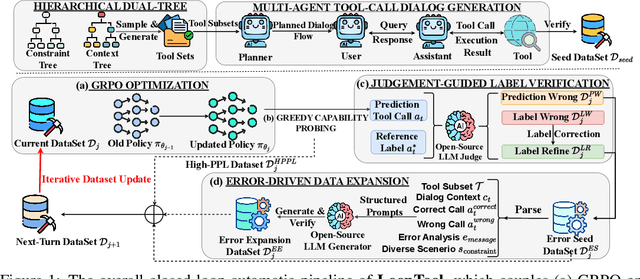
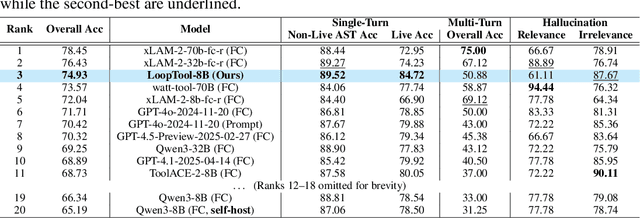

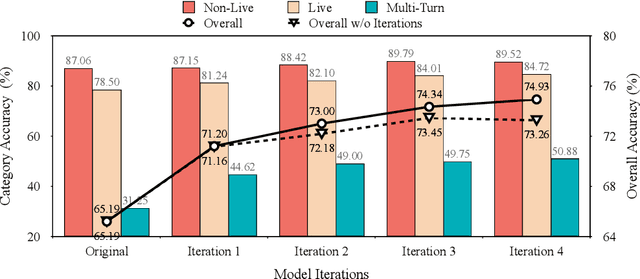
Augmenting Large Language Models (LLMs) with external tools enables them to execute complex, multi-step tasks. However, tool learning is hampered by the static synthetic data pipelines where data generation and model training are executed as two separate, non-interactive processes. This approach fails to adaptively focus on a model's specific weaknesses and allows noisy labels to persist, degrading training efficiency. We introduce LoopTool, a fully automated, model-aware data evolution framework that closes this loop by tightly integrating data synthesis and model training. LoopTool iteratively refines both the data and the model through three synergistic modules: (1) Greedy Capability Probing (GCP) diagnoses the model's mastered and failed capabilities; (2) Judgement-Guided Label Verification (JGLV) uses an open-source judge model to find and correct annotation errors, progressively purifying the dataset; and (3) Error-Driven Data Expansion (EDDE) generates new, challenging samples based on identified failures. This closed-loop process operates within a cost-effective, open-source ecosystem, eliminating dependence on expensive closed-source APIs. Experiments show that our 8B model trained with LoopTool significantly surpasses its 32B data generator and achieves new state-of-the-art results on the BFCL-v3 and ACEBench benchmarks for its scale. Our work demonstrates that closed-loop, self-refining data pipelines can dramatically enhance the tool-use capabilities of LLMs.
Fints: Efficient Inference-Time Personalization for LLMs with Fine-Grained Instance-Tailored Steering
Oct 31, 2025The rapid evolution of large language models (LLMs) has intensified the demand for effective personalization techniques that can adapt model behavior to individual user preferences. Despite the non-parametric methods utilizing the in-context learning ability of LLMs, recent parametric adaptation methods, including personalized parameter-efficient fine-tuning and reward modeling emerge. However, these methods face limitations in handling dynamic user patterns and high data sparsity scenarios, due to low adaptability and data efficiency. To address these challenges, we propose a fine-grained and instance-tailored steering framework that dynamically generates sample-level interference vectors from user data and injects them into the model's forward pass for personalized adaptation. Our approach introduces two key technical innovations: a fine-grained steering component that captures nuanced signals by hooking activations from attention and MLP layers, and an input-aware aggregation module that synthesizes these signals into contextually relevant enhancements. The method demonstrates high flexibility and data efficiency, excelling in fast-changing distribution and high data sparsity scenarios. In addition, the proposed method is orthogonal to existing methods and operates as a plug-in component compatible with different personalization techniques. Extensive experiments across diverse scenarios--including short-to-long text generation, and web function calling--validate the effectiveness and compatibility of our approach. Results show that our method significantly enhances personalization performance in fast-shifting environments while maintaining robustness across varying interaction modes and context lengths. Implementation is available at https://github.com/KounianhuaDu/Fints.