 Add to Chrome
 Add to Firefox
 Add to Edge
Open Domain Question Answering with Conflicting Contexts
Oct 16, 2024


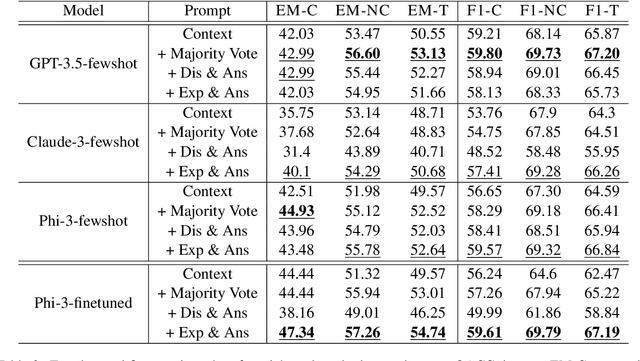
Open domain question answering systems frequently rely on information retrieved from large collections of text (such as the Web) to answer questions. However, such collections of text often contain conflicting information, and indiscriminately depending on this information may result in untruthful and inaccurate answers. To understand the gravity of this problem, we collect a human-annotated dataset, Question Answering with Conflicting Contexts (QACC), and find that as much as 25% of unambiguous, open domain questions can lead to conflicting contexts when retrieved using Google Search. We evaluate and benchmark three powerful Large Language Models (LLMs) with our dataset QACC and demonstrate their limitations in effectively addressing questions with conflicting information. To explore how humans reason through conflicting contexts, we request our annotators to provide explanations for their selections of correct answers. We demonstrate that by finetuning LLMs to explain their answers, we can introduce richer information into their training that guide them through the process of reasoning with conflicting contexts.

Domain-Conditioned Transformer for Fully Test-time Adaptation
Oct 14, 2024Fully test-time adaptation aims to adapt a network model online based on sequential analysis of input samples during the inference stage. We observe that, when applying a transformer network model into a new domain, the self-attention profiles of image samples in the target domain deviate significantly from those in the source domain, which results in large performance degradation during domain changes. To address this important issue, we propose a new structure for the self-attention modules in the transformer. Specifically, we incorporate three domain-conditioning vectors, called domain conditioners, into the query, key, and value components of the self-attention module. We learn a network to generate these three domain conditioners from the class token at each transformer network layer. We find that, during fully online test-time adaptation, these domain conditioners at each transform network layer are able to gradually remove the impact of domain shift and largely recover the original self-attention profile. Our extensive experimental results demonstrate that the proposed domain-conditioned transformer significantly improves the online fully test-time domain adaptation performance and outperforms existing state-of-the-art methods by large margins.
Lost in Tracking: Uncertainty-guided Cardiac Cine MRI Segmentation at Right Ventricle Base
Oct 04, 2024Accurate biventricular segmentation of cardiac magnetic resonance (CMR) cine images is essential for the clinical evaluation of heart function. However, compared to left ventricle (LV), right ventricle (RV) segmentation is still more challenging and less reproducible. Degenerate performance frequently occurs at the RV base, where the in-plane anatomical structures are complex (with atria, valve, and aorta) and vary due to the strong interplanar motion. In this work, we propose to address the currently unsolved issues in CMR segmentation, specifically at the RV base, with two strategies: first, we complemented the public resource by reannotating the RV base in the ACDC dataset, with refined delineation of the right ventricle outflow tract (RVOT), under the guidance of an expert cardiologist. Second, we proposed a novel dual encoder U-Net architecture that leverages temporal incoherence to inform the segmentation when interplanar motions occur. The inter-planar motion is characterized by loss-of-tracking, via Bayesian uncertainty of a motion-tracking model. Our experiments showed that our method significantly improved RV base segmentation taking into account temporal incoherence. Furthermore, we investigated the reproducibility of deep learning-based segmentation and showed that the combination of consistent annotation and loss of tracking could enhance the reproducibility of RV segmentation, potentially facilitating a large number of clinical studies focusing on RV.
Structured List-Grounded Question Answering
Oct 04, 2024Document-grounded dialogue systems aim to answer user queries by leveraging external information. Previous studies have mainly focused on handling free-form documents, often overlooking structured data such as lists, which can represent a range of nuanced semantic relations. Motivated by the observation that even advanced language models like GPT-3.5 often miss semantic cues from lists, this paper aims to enhance question answering (QA) systems for better interpretation and use of structured lists. To this end, we introduce the LIST2QA dataset, a novel benchmark to evaluate the ability of QA systems to respond effectively using list information. This dataset is created from unlabeled customer service documents using language models and model-based filtering processes to enhance data quality, and can be used to fine-tune and evaluate QA models. Apart from directly generating responses through fine-tuned models, we further explore the explicit use of Intermediate Steps for Lists (ISL), aligning list items with user backgrounds to better reflect how humans interpret list items before generating responses. Our experimental results demonstrate that models trained on LIST2QA with our ISL approach outperform baselines across various metrics. Specifically, our fine-tuned Flan-T5-XL model shows increases of 3.1% in ROUGE-L, 4.6% in correctness, 4.5% in faithfulness, and 20.6% in completeness compared to models without applying filtering and the proposed ISL method.
CriSPO: Multi-Aspect Critique-Suggestion-guided Automatic Prompt Optimization for Text Generation
Oct 03, 2024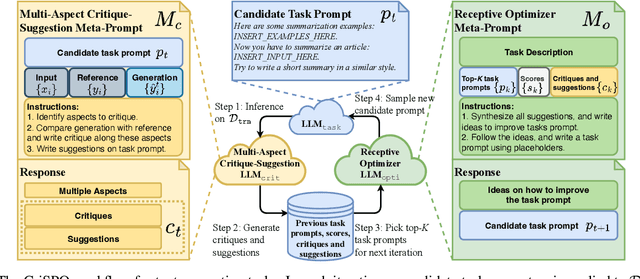


Large language models (LLMs) can generate fluent summaries across domains using prompting techniques, reducing the need to train models for summarization applications. However, crafting effective prompts that guide LLMs to generate summaries with the appropriate level of detail and writing style remains a challenge. In this paper, we explore the use of salient information extracted from the source document to enhance summarization prompts. We show that adding keyphrases in prompts can improve ROUGE F1 and recall, making the generated summaries more similar to the reference and more complete. The number of keyphrases can control the precision-recall trade-off. Furthermore, our analysis reveals that incorporating phrase-level salient information is superior to word- or sentence-level. However, the impact on hallucination is not universally positive across LLMs. To conduct this analysis, we introduce Keyphrase Signal Extractor (CriSPO), a lightweight model that can be finetuned to extract salient keyphrases. By using CriSPO, we achieve consistent ROUGE improvements across datasets and open-weight and proprietary LLMs without any LLM customization. Our findings provide insights into leveraging salient information in building prompt-based summarization systems.
Mamba Neural Operator: Who Wins? Transformers vs. State-Space Models for PDEs
Oct 03, 2024
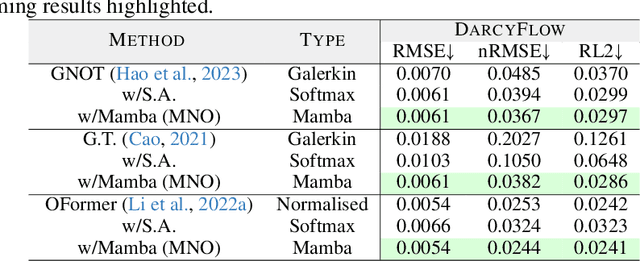
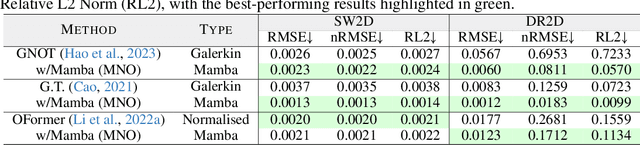
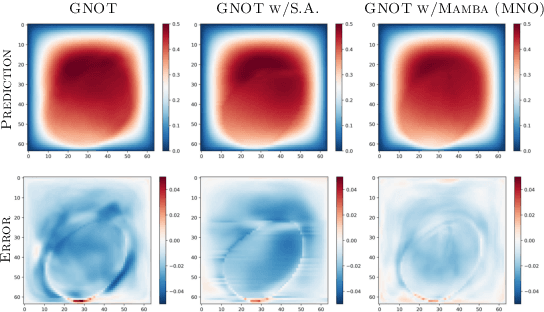
Partial differential equations (PDEs) are widely used to model complex physical systems, but solving them efficiently remains a significant challenge. Recently, Transformers have emerged as the preferred architecture for PDEs due to their ability to capture intricate dependencies. However, they struggle with representing continuous dynamics and long-range interactions. To overcome these limitations, we introduce the Mamba Neural Operator (MNO), a novel framework that enhances neural operator-based techniques for solving PDEs. MNO establishes a formal theoretical connection between structured state-space models (SSMs) and neural operators, offering a unified structure that can adapt to diverse architectures, including Transformer-based models. By leveraging the structured design of SSMs, MNO captures long-range dependencies and continuous dynamics more effectively than traditional Transformers. Through extensive analysis, we show that MNO significantly boosts the expressive power and accuracy of neural operators, making it not just a complement but a superior framework for PDE-related tasks, bridging the gap between efficient representation and accurate solution approximation.
PhyMPGN: Physics-encoded Message Passing Graph Network for spatiotemporal PDE systems
Oct 02, 2024Solving partial differential equations (PDEs) serves as a cornerstone for modeling complex dynamical systems. Recent progresses have demonstrated grand benefits of data-driven neural-based models for predicting spatiotemporal dynamics (e.g., tremendous speedup gain compared with classical numerical methods). However, most existing neural models rely on rich training data, have limited extrapolation and generalization abilities, and suffer to produce precise or reliable physical prediction under intricate conditions (e.g., irregular mesh or geometry, complex boundary conditions, diverse PDE parameters, etc.). To this end, we propose a new graph learning approach, namely, Physics-encoded Message Passing Graph Network (PhyMPGN), to model spatiotemporal PDE systems on irregular meshes given small training datasets. Specifically, we incorporate a GNN into a numerical integrator to approximate the temporal marching of spatiotemporal dynamics for a given PDE system. Considering that many physical phenomena are governed by diffusion processes, we further design a learnable Laplace block, which encodes the discrete Laplace-Beltrami operator, to aid and guide the GNN learning in a physically feasible solution space. A boundary condition padding strategy is also designed to improve the model convergence and accuracy. Extensive experiments demonstrate that PhyMPGN is capable of accurately predicting various types of spatiotemporal dynamics on coarse unstructured meshes, consistently achieves the state-of-the-art results, and outperforms other baselines with considerable gains.
Trustworthy Text-to-Image Diffusion Models: A Timely and Focused Survey
Sep 26, 2024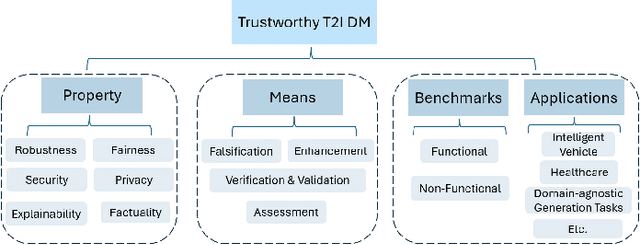
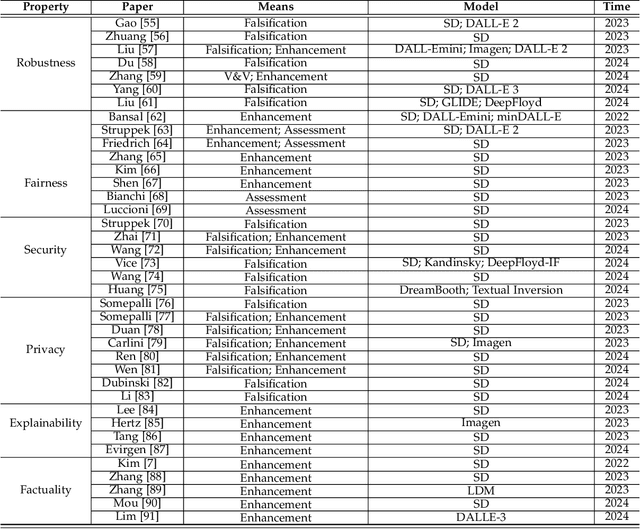
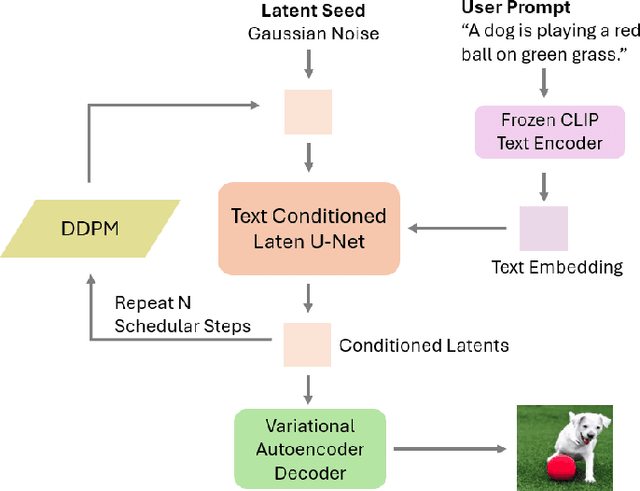
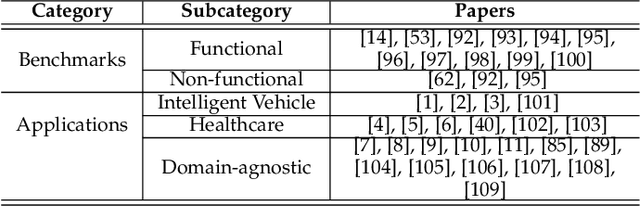
Text-to-Image (T2I) Diffusion Models (DMs) have garnered widespread attention for their impressive advancements in image generation. However, their growing popularity has raised ethical and social concerns related to key non-functional properties of trustworthiness, such as robustness, fairness, security, privacy, factuality, and explainability, similar to those in traditional deep learning (DL) tasks. Conventional approaches for studying trustworthiness in DL tasks often fall short due to the unique characteristics of T2I DMs, e.g., the multi-modal nature. Given the challenge, recent efforts have been made to develop new methods for investigating trustworthiness in T2I DMs via various means, including falsification, enhancement, verification \& validation and assessment. However, there is a notable lack of in-depth analysis concerning those non-functional properties and means. In this survey, we provide a timely and focused review of the literature on trustworthy T2I DMs, covering a concise-structured taxonomy from the perspectives of property, means, benchmarks and applications. Our review begins with an introduction to essential preliminaries of T2I DMs, and then we summarise key definitions/metrics specific to T2I tasks and analyses the means proposed in recent literature based on these definitions/metrics. Additionally, we review benchmarks and domain applications of T2I DMs. Finally, we highlight the gaps in current research, discuss the limitations of existing methods, and propose future research directions to advance the development of trustworthy T2I DMs. Furthermore, we keep up-to-date updates in this field to track the latest developments and maintain our GitHub repository at: https://github.com/wellzline/Trustworthy_T2I_DMs
xTED: Cross-Domain Policy Adaptation via Diffusion-Based Trajectory Editing
Sep 13, 2024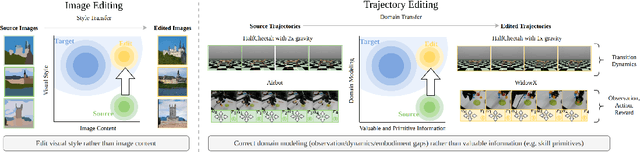
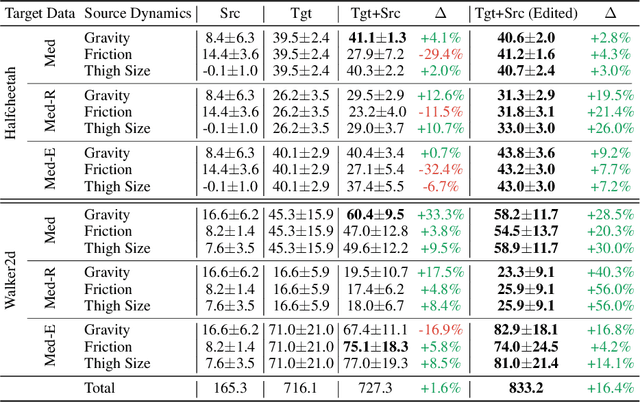
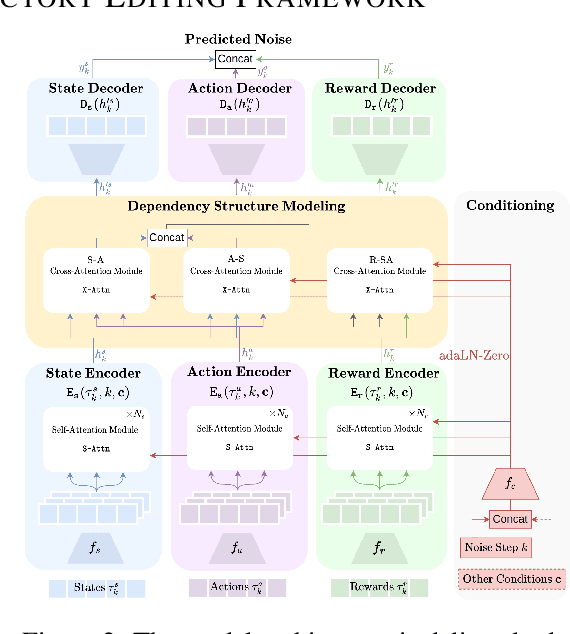

Reusing pre-collected data from different domains is an attractive solution in decision-making tasks where the accessible data is insufficient in the target domain but relatively abundant in other related domains. Existing cross-domain policy transfer methods mostly aim at learning domain correspondences or corrections to facilitate policy learning, which requires learning domain/task-specific model components, representations, or policies that are inflexible or not fully reusable to accommodate arbitrary domains and tasks. These issues make us wonder: can we directly bridge the domain gap at the data (trajectory) level, instead of devising complicated, domain-specific policy transfer models? In this study, we propose a Cross-Domain Trajectory EDiting (xTED) framework with a new diffusion transformer model (Decision Diffusion Transformer, DDiT) that captures the trajectory distribution from the target dataset as a prior. The proposed diffusion transformer backbone captures the intricate dependencies among state, action, and reward sequences, as well as the transition dynamics within the target data trajectories. With the above pre-trained diffusion prior, source data trajectories with domain gaps can be transformed into edited trajectories that closely resemble the target data distribution through the diffusion-based editing process, which implicitly corrects the underlying domain gaps, enhancing the state realism and dynamics reliability in source trajectory data, while enabling flexible choices of downstream policy learning methods. Despite its simplicity, xTED demonstrates superior performance against other baselines in extensive simulation and real-robot experiments.
Active-Passive Federated Learning for Vertically Partitioned Multi-view Data
Sep 06, 2024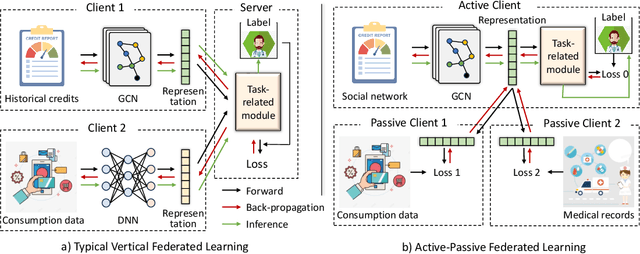


Vertical federated learning is a natural and elegant approach to integrate multi-view data vertically partitioned across devices (clients) while preserving their privacies. Apart from the model training, existing methods requires the collaboration of all clients in the model inference. However, the model inference is probably maintained for service in a long time, while the collaboration, especially when the clients belong to different organizations, is unpredictable in real-world scenarios, such as concellation of contract, network unavailablity, etc., resulting in the failure of them. To address this issue, we, at the first attempt, propose a flexible Active-Passive Federated learning (APFed) framework. Specifically, the active client is the initiator of a learning task and responsible to build the complete model, while the passive clients only serve as assistants. Once the model built, the active client can make inference independently. In addition, we instance the APFed framework into two classification methods with employing the reconstruction loss and the contrastive loss on passive clients, respectively. Meanwhile, the two methods are tested in a set of experiments and achieves desired results, validating their effectiveness.