 Add to Chrome
 Add to Firefox
 Add to Edge
World Value Models for Robotic Manipulation
Jun 23, 2026
Generalist value models play a pivotal role in scaling robotic policy learning from large-scale, mixed-quality data. Mathematically, accurate value estimation demands deep temporal understanding, requiring models to both ground the current belief using historical context and plan over future outcomes. However, most existing robotic value models are built on Vision-Language Model (VLM) backbones that are pretrained primarily on static or temporally sparse visual observations, lacking the requisite temporal modeling capabilities for value estimation. Unlike VLMs, world models naturally excel at temporal modeling and future planning, making them ideal foundations for learning generalizable value functions. Driven by this insight, we marry world models with value estimation to construct a new generalist robotic value model, World Value Model (WVM), that offers accurate task progressions to assess data quality. On standard benchmarks, WVM delivers state-of-the-art (SOTA) Value-Order Correlation (VOC) results. Complementing standard evaluation suites that contains only expert data, we further introduce Suboptimal-Value-Bench, a multi-embodiment benchmark consisting of 800 suboptimal trajectories with high-fidelity, human-labeled frame annotations. Our evaluations show that WVM maintains its SOTA performance on Suboptimal-Value-Bench, establishing its robustness in handling both expert and suboptimal data. When deployed for policy learning, WVM improves manipulation performance across various policy extraction approaches in both simulated and real-world deployment, providing robust guidance for learning from mixed-quality data.

TTT-VLA: Test-Time Latent Prompt Optimization for Vision-Language-Action Models
Jun 02, 2026Vision-Language-Action (VLA) models trained on large-scale data have made remarkable progress, but they remain vulnerable to distribution shifts at deployment time. Recent VLA models suggest that prompts can serve as an efficient interface for steering policy behavior, but existing prompt-based steering typically relies on external guidance. This raises a natural question: can test-time training (TTT) for VLA be achieved by optimizing a prompt, so that the steering interface itself can be learned and adapted from interaction? We address this question with TTT-VLA, a test-time training framework based on Latent Prompt Optimization (LPO). During training, the latent prompt is learned with an additional proxy task, providing an extra learned conditioning signal for policy learning. At test time, TTT is performed by collecting interaction data from the current environment and optimizing only the latent prompt on those data using the proxy task's self-supervised signal, without modifying the policy itself. Experiments on SimplerEnv demonstrate that the proposed method consistently improves task success rates in both single- and multi-embodiment settings. Further analysis shows that the gains arise primarily from correcting a small number of critical decisions rather than globally altering policy behavior. These results suggest that LPO provides an effective and practical pathway for deployment-time improvement of foundation manipulation policies.
Dichotomous Diffusion Policy Optimization
Dec 31, 2025Diffusion-based policies have gained growing popularity in solving a wide range of decision-making tasks due to their superior expressiveness and controllable generation during inference. However, effectively training large diffusion policies using reinforcement learning (RL) remains challenging. Existing methods either suffer from unstable training due to directly maximizing value objectives, or face computational issues due to relying on crude Gaussian likelihood approximation, which requires a large amount of sufficiently small denoising steps. In this work, we propose DIPOLE (Dichotomous diffusion Policy improvement), a novel RL algorithm designed for stable and controllable diffusion policy optimization. We begin by revisiting the KL-regularized objective in RL, which offers a desirable weighted regression objective for diffusion policy extraction, but often struggles to balance greediness and stability. We then formulate a greedified policy regularization scheme, which naturally enables decomposing the optimal policy into a pair of stably learned dichotomous policies: one aims at reward maximization, and the other focuses on reward minimization. Under such a design, optimized actions can be generated by linearly combining the scores of dichotomous policies during inference, thereby enabling flexible control over the level of greediness.Evaluations in offline and offline-to-online RL settings on ExORL and OGBench demonstrate the effectiveness of our approach. We also use DIPOLE to train a large vision-language-action (VLA) model for end-to-end autonomous driving (AD) and evaluate it on the large-scale real-world AD benchmark NAVSIM, highlighting its potential for complex real-world applications.
Efficient Robotic Policy Learning via Latent Space Backward Planning
May 11, 2025Current robotic planning methods often rely on predicting multi-frame images with full pixel details. While this fine-grained approach can serve as a generic world model, it introduces two significant challenges for downstream policy learning: substantial computational costs that hinder real-time deployment, and accumulated inaccuracies that can mislead action extraction. Planning with coarse-grained subgoals partially alleviates efficiency issues. However, their forward planning schemes can still result in off-task predictions due to accumulation errors, leading to misalignment with long-term goals. This raises a critical question: Can robotic planning be both efficient and accurate enough for real-time control in long-horizon, multi-stage tasks? To address this, we propose a Latent Space Backward Planning scheme (LBP), which begins by grounding the task into final latent goals, followed by recursively predicting intermediate subgoals closer to the current state. The grounded final goal enables backward subgoal planning to always remain aware of task completion, facilitating on-task prediction along the entire planning horizon. The subgoal-conditioned policy incorporates a learnable token to summarize the subgoal sequences and determines how each subgoal guides action extraction. Through extensive simulation and real-robot long-horizon experiments, we show that LBP outperforms existing fine-grained and forward planning methods, achieving SOTA performance. Project Page: https://lbp-authors.github.io
Skill Expansion and Composition in Parameter Space
Feb 09, 2025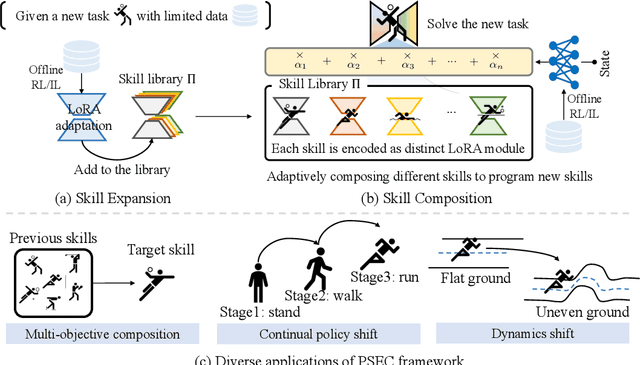
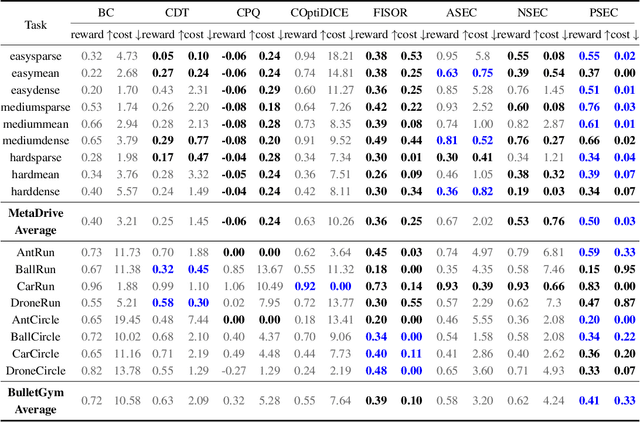
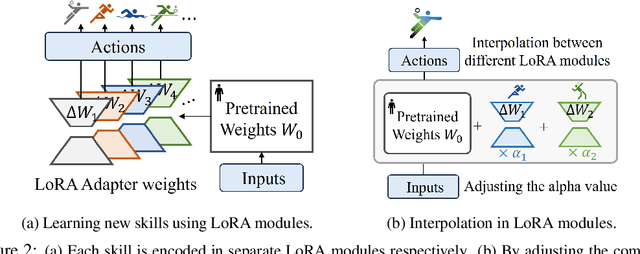
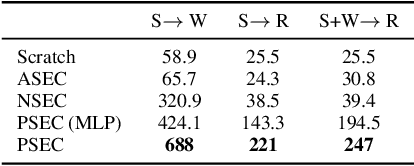
Humans excel at reusing prior knowledge to address new challenges and developing skills while solving problems. This paradigm becomes increasingly popular in the development of autonomous agents, as it develops systems that can self-evolve in response to new challenges like human beings. However, previous methods suffer from limited training efficiency when expanding new skills and fail to fully leverage prior knowledge to facilitate new task learning. In this paper, we propose Parametric Skill Expansion and Composition (PSEC), a new framework designed to iteratively evolve the agents' capabilities and efficiently address new challenges by maintaining a manageable skill library. This library can progressively integrate skill primitives as plug-and-play Low-Rank Adaptation (LoRA) modules in parameter-efficient finetuning, facilitating efficient and flexible skill expansion. This structure also enables the direct skill compositions in parameter space by merging LoRA modules that encode different skills, leveraging shared information across skills to effectively program new skills. Based on this, we propose a context-aware module to dynamically activate different skills to collaboratively handle new tasks. Empowering diverse applications including multi-objective composition, dynamics shift, and continual policy shift, the results on D4RL, DSRL benchmarks, and the DeepMind Control Suite show that PSEC exhibits superior capacity to leverage prior knowledge to efficiently tackle new challenges, as well as expand its skill libraries to evolve the capabilities. Project website: https://ltlhuuu.github.io/PSEC/.
Diffusion-Based Planning for Autonomous Driving with Flexible Guidance
Jan 26, 2025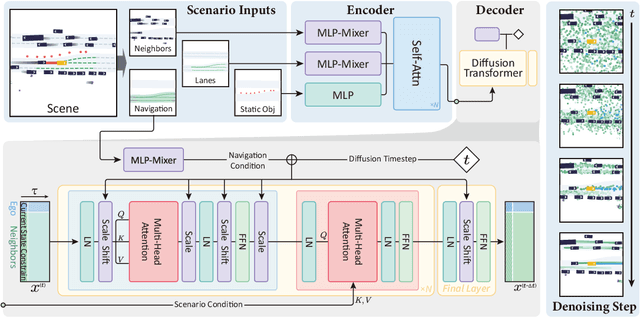
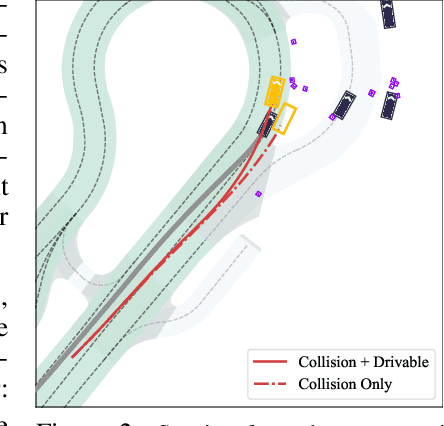

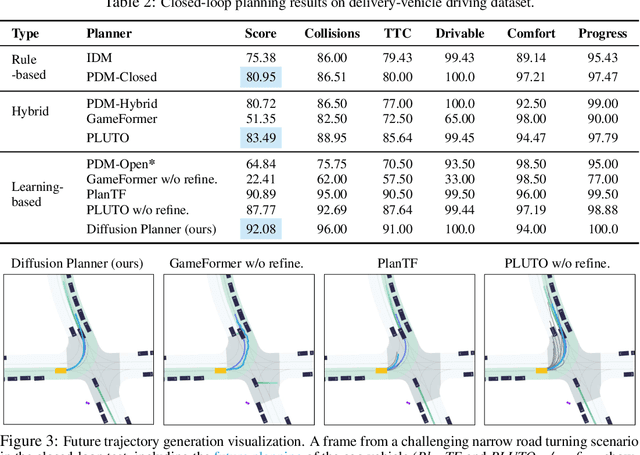
Achieving human-like driving behaviors in complex open-world environments is a critical challenge in autonomous driving. Contemporary learning-based planning approaches such as imitation learning methods often struggle to balance competing objectives and lack of safety assurance,due to limited adaptability and inadequacy in learning complex multi-modal behaviors commonly exhibited in human planning, not to mention their strong reliance on the fallback strategy with predefined rules. We propose a novel transformer-based Diffusion Planner for closed-loop planning, which can effectively model multi-modal driving behavior and ensure trajectory quality without any rule-based refinement. Our model supports joint modeling of both prediction and planning tasks under the same architecture, enabling cooperative behaviors between vehicles. Moreover, by learning the gradient of the trajectory score function and employing a flexible classifier guidance mechanism, Diffusion Planner effectively achieves safe and adaptable planning behaviors. Evaluations on the large-scale real-world autonomous planning benchmark nuPlan and our newly collected 200-hour delivery-vehicle driving dataset demonstrate that Diffusion Planner achieves state-of-the-art closed-loop performance with robust transferability in diverse driving styles.
Universal Actions for Enhanced Embodied Foundation Models
Jan 17, 2025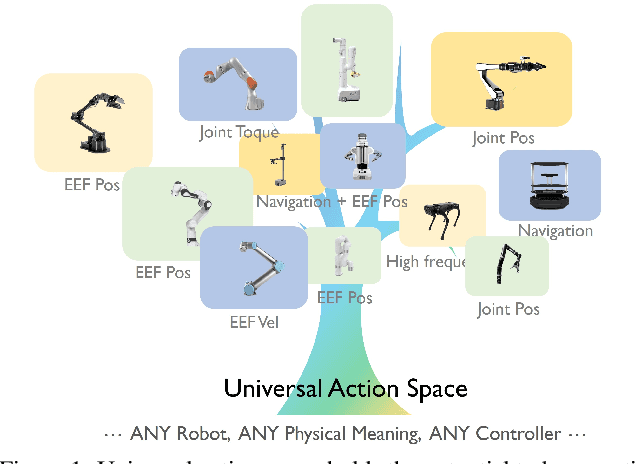
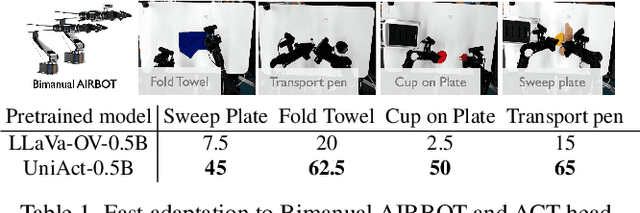
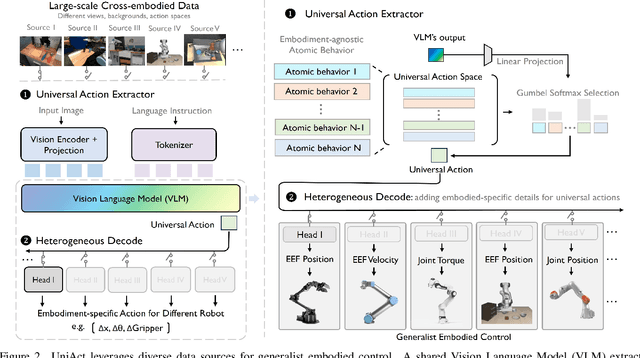
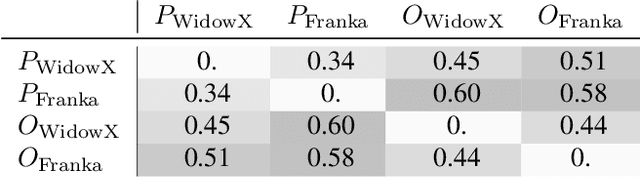
Training on diverse, internet-scale data is a key factor in the success of recent large foundation models. Yet, using the same recipe for building embodied agents has faced noticeable difficulties. Despite the availability of many crowd-sourced embodied datasets, their action spaces often exhibit significant heterogeneity due to distinct physical embodiment and control interfaces for different robots, causing substantial challenges in developing embodied foundation models using cross-domain data. In this paper, we introduce UniAct, a new embodied foundation modeling framework operating in a tokenized Universal Action Space. Our learned universal actions capture the generic atomic behaviors across diverse robots by exploiting their shared structural features, and enable enhanced cross-domain data utilization and cross-embodiment generalizations by eliminating the notorious heterogeneity. The universal actions can be efficiently translated back to heterogeneous actionable commands by simply adding embodiment-specific details, from which fast adaptation to new robots becomes simple and straightforward. Our 0.5B instantiation of UniAct outperforms 14X larger SOTA embodied foundation models in extensive evaluations on various real-world and simulation robots, showcasing exceptional cross-embodiment control and adaptation capability, highlighting the crucial benefit of adopting universal actions. Project page: https://github.com/2toinf/UniAct
Are Expressive Models Truly Necessary for Offline RL?
Dec 15, 2024


Among various branches of offline reinforcement learning (RL) methods, goal-conditioned supervised learning (GCSL) has gained increasing popularity as it formulates the offline RL problem as a sequential modeling task, therefore bypassing the notoriously difficult credit assignment challenge of value learning in conventional RL paradigm. Sequential modeling, however, requires capturing accurate dynamics across long horizons in trajectory data to ensure reasonable policy performance. To meet this requirement, leveraging large, expressive models has become a popular choice in recent literature, which, however, comes at the cost of significantly increased computation and inference latency. Contradictory yet promising, we reveal that lightweight models as simple as shallow 2-layer MLPs, can also enjoy accurate dynamics consistency and significantly reduced sequential modeling errors against large expressive models by adopting a simple recursive planning scheme: recursively planning coarse-grained future sub-goals based on current and target information, and then executes the action with a goal-conditioned policy learned from data rela-beled with these sub-goal ground truths. We term our method Recursive Skip-Step Planning (RSP). Simple yet effective, RSP enjoys great efficiency improvements thanks to its lightweight structure, and substantially outperforms existing methods, reaching new SOTA performances on the D4RL benchmark, especially in multi-stage long-horizon tasks.
Robo-MUTUAL: Robotic Multimodal Task Specification via Unimodal Learning
Oct 02, 2024


Multimodal task specification is essential for enhanced robotic performance, where \textit{Cross-modality Alignment} enables the robot to holistically understand complex task instructions. Directly annotating multimodal instructions for model training proves impractical, due to the sparsity of paired multimodal data. In this study, we demonstrate that by leveraging unimodal instructions abundant in real data, we can effectively teach robots to learn multimodal task specifications. First, we endow the robot with strong \textit{Cross-modality Alignment} capabilities, by pretraining a robotic multimodal encoder using extensive out-of-domain data. Then, we employ two Collapse and Corrupt operations to further bridge the remaining modality gap in the learned multimodal representation. This approach projects different modalities of identical task goal as interchangeable representations, thus enabling accurate robotic operations within a well-aligned multimodal latent space. Evaluation across more than 130 tasks and 4000 evaluations on both simulated LIBERO benchmark and real robot platforms showcases the superior capabilities of our proposed framework, demonstrating significant advantage in overcoming data constraints in robotic learning. Website: zh1hao.wang/Robo_MUTUAL
xTED: Cross-Domain Policy Adaptation via Diffusion-Based Trajectory Editing
Sep 13, 2024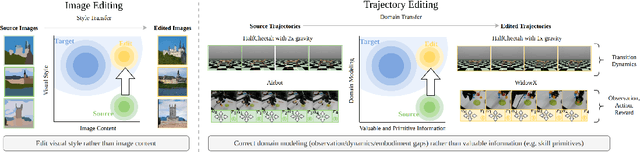
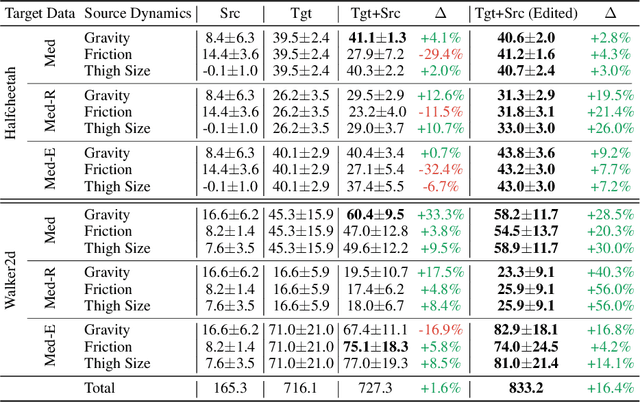
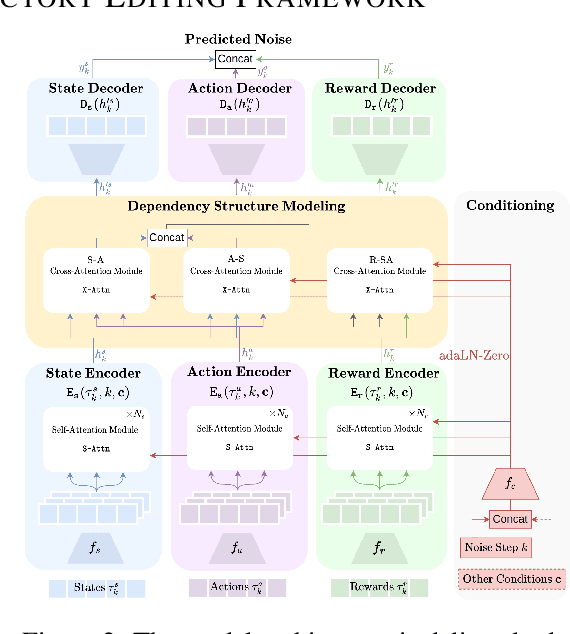

Reusing pre-collected data from different domains is an attractive solution in decision-making tasks where the accessible data is insufficient in the target domain but relatively abundant in other related domains. Existing cross-domain policy transfer methods mostly aim at learning domain correspondences or corrections to facilitate policy learning, which requires learning domain/task-specific model components, representations, or policies that are inflexible or not fully reusable to accommodate arbitrary domains and tasks. These issues make us wonder: can we directly bridge the domain gap at the data (trajectory) level, instead of devising complicated, domain-specific policy transfer models? In this study, we propose a Cross-Domain Trajectory EDiting (xTED) framework with a new diffusion transformer model (Decision Diffusion Transformer, DDiT) that captures the trajectory distribution from the target dataset as a prior. The proposed diffusion transformer backbone captures the intricate dependencies among state, action, and reward sequences, as well as the transition dynamics within the target data trajectories. With the above pre-trained diffusion prior, source data trajectories with domain gaps can be transformed into edited trajectories that closely resemble the target data distribution through the diffusion-based editing process, which implicitly corrects the underlying domain gaps, enhancing the state realism and dynamics reliability in source trajectory data, while enabling flexible choices of downstream policy learning methods. Despite its simplicity, xTED demonstrates superior performance against other baselines in extensive simulation and real-robot experiments.