 Add to Chrome
 Add to Firefox
 Add to Edge
A Cross-Architecture Audit of Direction-Based Inference-Time Defences in Vision-Language Models
Jul 30, 2026
Inference time defences against vision language model jailbreaks often subtract a calibrated direction from the residual stream at a chosen decoder layer. We compare five defence candidates across 15 model and layer cells from four architectural families under a magnitude controlled protocol that matches the intervention size for each prompt and pairs every direction with a random control of the same norm. The candidates are the mean image conditioning shift, a CMRM style refusal direction, a ShiftDC style attack specific residual, a prompt instruction to ignore the image, and a random control. No single candidate dominates on both refusal recovery and utility preservation. The image conditioning shift leads on LLaVA 1.5 and Pixtral 12B and is the only candidate whose utility loss remains at the measurement noise floor in every family. The prompt instruction leads on Qwen2.5 VL, while the attack specific residual leads on Qwen2 VL 2B. The image conditioning direction is direction specific in 13 of 15 cells, but strongly architecture specific and nontransferable across the only dimension compatible pair, LLaVA 1.5 13B and Pixtral 12B. We also connect text only and multimodal refusal geometry. The CMRM direction has positive cosine alignment with the image conditioning shift in all 15 cells, with mean 0.35, range 0.17 to 0.65, 15 to 25 times the random vector null, and a sign test p value of about 3e-5. These results show that the two recipes recover partially overlapping geometry and that direction based defences should be calibrated separately for each language decoder family.

Crossing the Margin Cliff: Toward Relearn-Robust LLM Unlearning via Margin Calibration
Jul 30, 2026Large language model unlearning is consistently fragile under relearn attacks. On TOFU, fine-tuning on twenty forget examples substantially recovers held-out forget-set ROUGE for every method we evaluate, and we trace this fragility to optimization geometry. The per-token answer margin of fourteen post-hoc methods spanning gradient, preference, and distillation families converges into a narrow band above the retain reference in 41 of 42 method--size cells, a regularity we call the margin cliff. We prove that this cliff follows whenever the retain coupling holds the diagnostic log-odds of forget content above a floor, a condition that token-saturating losses induce at stationarity and that we verify directly on 34 of 42 cells. Margin Calibration (\textsc{MC}) is a plug-in polish adding a non-saturating margin hinge anchored at the reference's per-token margin plus a KL probe on a disjoint instruction corpus, restoring forget-side pressure where the native loss saturates. Under a stated gradient-dominance condition, whose on-trajectory gradient signature we measure by instrumenting the polish, its stationary set lies on the cliff-crossing side, yielding an attack-budget upper bound on the relearn margin lift. Across TOFU (three Llama-3 sizes, three forget tiers), MUSE-News on Llama-2-7B-hf, and a Phi-3.5 panel, a single frozen configuration wins all 14 head-to-head forget aggregates and all populated relearn cells (panel-mean post-attack ROUGE-L $0.41$ to $0.18$) and lowers raw membership AUC on 13/14, with reduced retain-side utility as the main cost. A deployment variant matches these gains without a retain-trained reference.
Safety-Aligned 3D Object Detection: Single-Vehicle, Cooperative, and End-to-End Perspectives
Apr 02, 2026Perception plays a central role in connected and autonomous vehicles (CAVs), underpinning not only conventional modular driving stacks, but also cooperative perception systems and recent end-to-end driving models. While deep learning has greatly improved perception performance, its statistical nature makes perfect predictions difficult to attain. Meanwhile, standard training objectives and evaluation benchmarks treat all perception errors equally, even though only a subset is safety-critical. In this paper, we investigate safety-aligned evaluation and optimization for 3D object detection that explicitly characterize high-impact errors. Building on our previously proposed safety-oriented metric, NDS-USC, and safety-aware loss function, EC-IoU, we make three contributions. First, we present an expanded study of single-vehicle 3D object detection models across diverse neural network architectures and sensing modalities, showing that gains under standard metrics such as mAP and NDS may not translate to safety-oriented criteria represented by NDS-USC. With EC-IoU, we reaffirm the benefit of safety-aware fine-tuning for improving safety-critical detection performance. Second, we conduct an ego-centric, safety-oriented evaluation of AV-infrastructure cooperative object detection models, underscoring its superiority over vehicle-only models and demonstrating a safety impact analysis that illustrates the potential contribution of cooperative models to "Vision Zero." Third, we integrate EC-IoU into SparseDrive and show that safety-aware perception hardening can reduce collision rate by nearly 30% and improve system-level safety directly in an end-to-end perception-to-planning framework. Overall, our results indicate that safety-aligned perception evaluation and optimization offer a practical path toward enhancing CAV safety across single-vehicle, cooperative, and end-to-end autonomy settings.
Workflow-Level Design Principles for Trustworthy GenAI in Automotive System Engineering
Feb 23, 2026The adoption of large language models in safety-critical system engineering is constrained by trustworthiness, traceability, and alignment with established verification practices. We propose workflow-level design principles for trustworthy GenAI integration and demonstrate them in an end-to-end automotive pipeline, from requirement delta identification to SysML v2 architecture update and re-testing. First, we show that monolithic ("big-bang") prompting misses critical changes in large specifications, while section-wise decomposition with diversity sampling and lightweight NLP sanity checks improves completeness and correctness. Then, we propagate requirement deltas into SysML v2 models and validate updates via compilation and static analysis. Additionally, we ensure traceable regression testing by generating test cases through explicit mappings from specification variables to architectural ports and states, providing practical safeguards for GenAI used in safety-critical automotive engineering.
Validating Generalist Robots with Situation Calculus and STL Falsification
Jan 06, 2026Generalist robots are becoming a reality, capable of interpreting natural language instructions and executing diverse operations. However, their validation remains challenging because each task induces its own operational context and correctness specification, exceeding the assumptions of traditional validation methods. We propose a two-layer validation framework that combines abstract reasoning with concrete system falsification. At the abstract layer, situation calculus models the world and derives weakest preconditions, enabling constraint-aware combinatorial testing to systematically generate diverse, semantically valid world-task configurations with controllable coverage strength. At the concrete layer, these configurations are instantiated for simulation-based falsification with STL monitoring. Experiments on tabletop manipulation tasks show that our framework effectively uncovers failure cases in the NVIDIA GR00T controller, demonstrating its promise for validating general-purpose robot autonomy.
Randomized Smoothing Meets Vision-Language Models
Sep 19, 2025Randomized smoothing (RS) is one of the prominent techniques to ensure the correctness of machine learning models, where point-wise robustness certificates can be derived analytically. While RS is well understood for classification, its application to generative models is unclear, since their outputs are sequences rather than labels. We resolve this by connecting generative outputs to an oracle classification task and showing that RS can still be enabled: the final response can be classified as a discrete action (e.g., service-robot commands in VLAs), as harmful vs. harmless (content moderation or toxicity detection in VLMs), or even applying oracles to cluster answers into semantically equivalent ones. Provided that the error rate for the oracle classifier comparison is bounded, we develop the theory that associates the number of samples with the corresponding robustness radius. We further derive improved scaling laws analytically relating the certified radius and accuracy to the number of samples, showing that the earlier result of 2 to 3 orders of magnitude fewer samples sufficing with minimal loss remains valid even under weaker assumptions. Together, these advances make robustness certification both well-defined and computationally feasible for state-of-the-art VLMs, as validated against recent jailbreak-style adversarial attacks.
Cumulative Consensus Score: Label-Free and Model-Agnostic Evaluation of Object Detectors in Deployment
Sep 16, 2025Evaluating object detection models in deployment is challenging because ground-truth annotations are rarely available. We introduce the Cumulative Consensus Score (CCS), a label-free metric that enables continuous monitoring and comparison of detectors in real-world settings. CCS applies test-time data augmentation to each image, collects predicted bounding boxes across augmented views, and computes overlaps using Intersection over Union. Maximum overlaps are normalized and averaged across augmentation pairs, yielding a measure of spatial consistency that serves as a proxy for reliability without annotations. In controlled experiments on Open Images and KITTI, CCS achieved over 90% congruence with F1-score, Probabilistic Detection Quality, and Optimal Correction Cost. The method is model-agnostic, working across single-stage and two-stage detectors, and operates at the case level to highlight under-performing scenarios. Altogether, CCS provides a robust foundation for DevOps-style monitoring of object detectors.
On the Need for a Statistical Foundation in Scenario-Based Testing of Autonomous Vehicles
May 04, 2025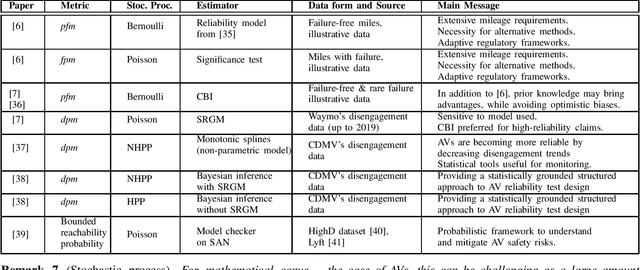
Scenario-based testing has emerged as a common method for autonomous vehicles (AVs) safety, offering a more efficient alternative to mile-based testing by focusing on high-risk scenarios. However, fundamental questions persist regarding its stopping rules, residual risk estimation, debug effectiveness, and the impact of simulation fidelity on safety claims. This paper argues that a rigorous statistical foundation is essential to address these challenges and enable rigorous safety assurance. By drawing parallels between AV testing and traditional software testing methodologies, we identify shared research gaps and reusable solutions. We propose proof-of-concept models to quantify the probability of failure per scenario (pfs) and evaluate testing effectiveness under varying conditions. Our analysis reveals that neither scenario-based nor mile-based testing universally outperforms the other. Furthermore, we introduce Risk Estimation Fidelity (REF), a novel metric to certify the alignment of synthetic and real-world testing outcomes, ensuring simulation-based safety claims are statistically defensible.
Mitigating Hallucinations in YOLO-based Object Detection Models: A Revisit to Out-of-Distribution Detection
Mar 10, 2025Object detection systems must reliably perceive objects of interest without being overly confident to ensure safe decision-making in dynamic environments. Filtering techniques based on out-of-distribution (OoD) detection are commonly added as an extra safeguard to filter hallucinations caused by overconfidence in novel objects. Nevertheless, evaluating YOLO-family detectors and their filters under existing OoD benchmarks often leads to unsatisfactory performance. This paper studies the underlying reasons for performance bottlenecks and proposes a methodology to improve performance fundamentally. Our first contribution is a calibration of all existing evaluation results: Although images in existing OoD benchmark datasets are claimed not to have objects within in-distribution (ID) classes (i.e., categories defined in the training dataset), around 13% of objects detected by the object detector are actually ID objects. Dually, the ID dataset containing OoD objects can also negatively impact the decision boundary of filters. These ultimately lead to a significantly imprecise performance estimation. Our second contribution is to consider the task of hallucination reduction as a joint pipeline of detectors and filters. By developing a methodology to carefully synthesize an OoD dataset that semantically resembles the objects to be detected, and using the crafted OoD dataset in the fine-tuning of YOLO detectors to suppress the objectness score, we achieve a 88% reduction in overall hallucination error with a combined fine-tuned detection and filtering system on the self-driving benchmark BDD-100K. Our code and dataset are available at: https://gricad-gitlab.univ-grenoble-alpes.fr/dnn-safety/m-hood.
Online Collision Risk Estimation via Monocular Depth-Aware Object Detectors and Fuzzy Inference
Nov 09, 2024This paper presents a monitoring framework that infers the level of autonomous vehicle (AV) collision risk based on its object detector's performance using only monocular camera images. Essentially, the framework takes two sets of predictions produced by different algorithms and associates their inconsistencies with the collision risk via fuzzy inference. The first set of predictions is obtained through retrieving safety-critical 2.5D objects from a depth map, and the second set comes from the AV's 3D object detector. We experimentally validate that, based on Intersection-over-Union (IoU) and a depth discrepancy measure, the inconsistencies between the two sets of predictions strongly correlate to the safety-related error of the 3D object detector against ground truths. This correlation allows us to construct a fuzzy inference system and map the inconsistency measures to an existing collision risk indicator. In particular, we apply various knowledge- and data-driven techniques and find using particle swarm optimization that learns general fuzzy rules gives the best mapping result. Lastly, we validate our monitor's capability to produce relevant risk estimates with the large-scale nuScenes dataset and show it can safeguard an AV in closed-loop simulations.