 Add to Chrome
 Add to Firefox
 Add to Edge
RADIUS: Ranking, Distribution, and Significance - A Comprehensive Alignment Suite for Survey Simulation
Mar 19, 2026
Simulation of surveys using LLMs is emerging as a powerful application for generating human-like responses at scale. Prior work evaluates survey simulation using metrics borrowed from other domains, which are often ad hoc, fragmented, and non-standardized, leading to results that are difficult to compare. Moreover, existing metrics focus mainly on accuracy or distributional measures, overlooking the critical dimension of ranking alignment. In practice, a simulation can achieve high accuracy while still failing to capture the option most preferred by humans - a distinction that is critical in decision-making applications. We introduce RADIUS, a comprehensive two-dimensional alignment suite for survey simulation that captures: 1) RAnking alignment and 2) DIstribUtion alignment, each complemented by statistical Significance testing. RADIUS highlights the limitations of existing metrics, enables more meaningful evaluation of survey simulation, and provides an open-source implementation for reproducible and comparable assessment.

Cross-Lingual LLM-Judge Transfer via Evaluation Decomposition
Mar 19, 2026As large language models are increasingly deployed across diverse real-world applications, extending automated evaluation beyond English has become a critical challenge. Existing evaluation approaches are predominantly English-focused, and adapting them to other languages is hindered by the scarcity and cost of human-annotated judgments in most languages. We introduce a decomposition-based evaluation framework built around a Universal Criteria Set (UCS). UCS consists of a shared, language-agnostic set of evaluation dimensions, producing an interpretable intermediate representation that supports cross-lingual transfer with minimal supervision. Experiments on multiple faithfulness tasks across languages and model backbones demonstrate consistent improvements over strong baselines without requiring target-language annotations.
MDSEval: A Meta-Evaluation Benchmark for Multimodal Dialogue Summarization
Oct 02, 2025Multimodal Dialogue Summarization (MDS) is a critical task with wide-ranging applications. To support the development of effective MDS models, robust automatic evaluation methods are essential for reducing both cost and human effort. However, such methods require a strong meta-evaluation benchmark grounded in human annotations. In this work, we introduce MDSEval, the first meta-evaluation benchmark for MDS, consisting image-sharing dialogues, corresponding summaries, and human judgments across eight well-defined quality aspects. To ensure data quality and richfulness, we propose a novel filtering framework leveraging Mutually Exclusive Key Information (MEKI) across modalities. Our work is the first to identify and formalize key evaluation dimensions specific to MDS. We benchmark state-of-the-art modal evaluation methods, revealing their limitations in distinguishing summaries from advanced MLLMs and their susceptibility to various bias.
Controllable Conversational Theme Detection Track at DSTC 12
Aug 26, 2025Conversational analytics has been on the forefront of transformation driven by the advances in Speech and Natural Language Processing techniques. Rapid adoption of Large Language Models (LLMs) in the analytics field has taken the problems that can be automated to a new level of complexity and scale. In this paper, we introduce Theme Detection as a critical task in conversational analytics, aimed at automatically identifying and categorizing topics within conversations. This process can significantly reduce the manual effort involved in analyzing expansive dialogs, particularly in domains like customer support or sales. Unlike traditional dialog intent detection, which often relies on a fixed set of intents for downstream system logic, themes are intended as a direct, user-facing summary of the conversation's core inquiry. This distinction allows for greater flexibility in theme surface forms and user-specific customizations. We pose Controllable Conversational Theme Detection problem as a public competition track at Dialog System Technology Challenge (DSTC) 12 -- it is framed as joint clustering and theme labeling of dialog utterances, with the distinctive aspect being controllability of the resulting theme clusters' granularity achieved via the provided user preference data. We give an overview of the problem, the associated dataset and the evaluation metrics, both automatic and human. Finally, we discuss the participant teams' submissions and provide insights from those. The track materials (data and code) are openly available in the GitHub repository.
Multilingual Self-Taught Faithfulness Evaluators
Jul 28, 2025The growing use of large language models (LLMs) has increased the need for automatic evaluation systems, particularly to address the challenge of information hallucination. Although existing faithfulness evaluation approaches have shown promise, they are predominantly English-focused and often require expensive human-labeled training data for fine-tuning specialized models. As LLMs see increased adoption in multilingual contexts, there is a need for accurate faithfulness evaluators that can operate across languages without extensive labeled data. This paper presents Self-Taught Evaluators for Multilingual Faithfulness, a framework that learns exclusively from synthetic multilingual summarization data while leveraging cross-lingual transfer learning. Through experiments comparing language-specific and mixed-language fine-tuning approaches, we demonstrate a consistent relationship between an LLM's general language capabilities and its performance in language-specific evaluation tasks. Our framework shows improvements over existing baselines, including state-of-the-art English evaluators and machine translation-based approaches.
PAARS: Persona Aligned Agentic Retail Shoppers
Mar 31, 2025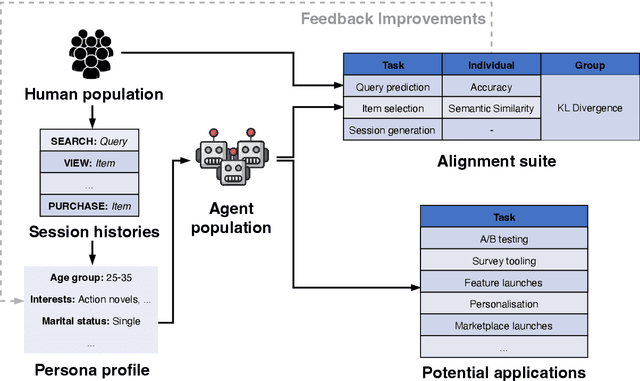
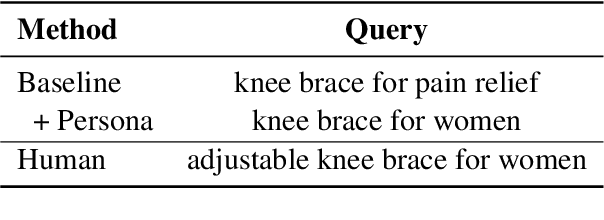
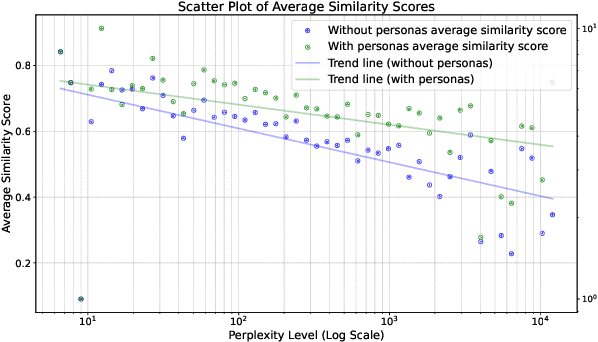
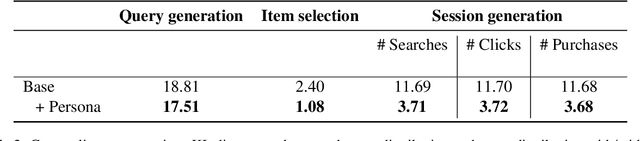
In e-commerce, behavioral data is collected for decision making which can be costly and slow. Simulation with LLM powered agents is emerging as a promising alternative for representing human population behavior. However, LLMs are known to exhibit certain biases, such as brand bias, review rating bias and limited representation of certain groups in the population, hence they need to be carefully benchmarked and aligned to user behavior. Ultimately, our goal is to synthesise an agent population and verify that it collectively approximates a real sample of humans. To this end, we propose a framework that: (i) creates synthetic shopping agents by automatically mining personas from anonymised historical shopping data, (ii) equips agents with retail-specific tools to synthesise shopping sessions and (iii) introduces a novel alignment suite measuring distributional differences between humans and shopping agents at the group (i.e. population) level rather than the traditional "individual" level. Experimental results demonstrate that using personas improves performance on the alignment suite, though a gap remains to human behaviour. We showcase an initial application of our framework for automated agentic A/B testing and compare the findings to human results. Finally, we discuss applications, limitations and challenges setting the stage for impactful future work.
GLEAN: Generalized Category Discovery with Diverse and Quality-Enhanced LLM Feedback
Feb 25, 2025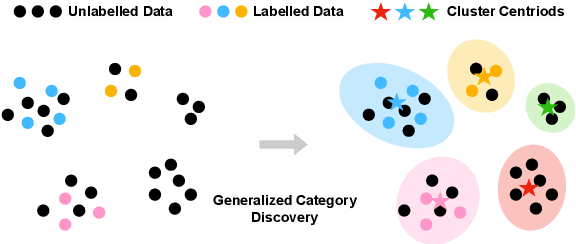
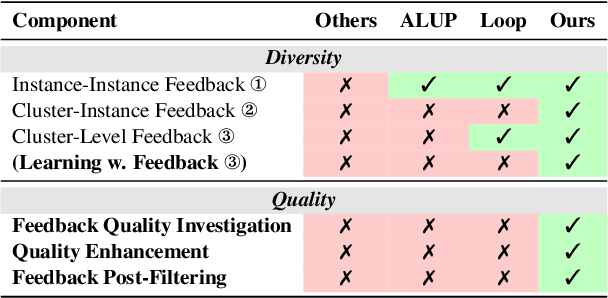
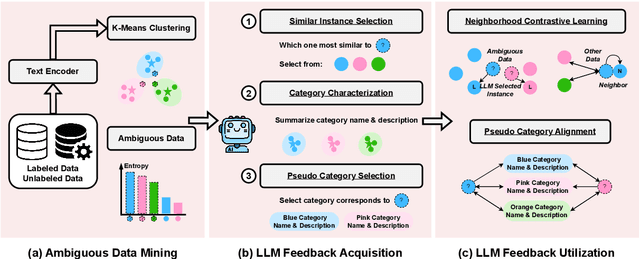
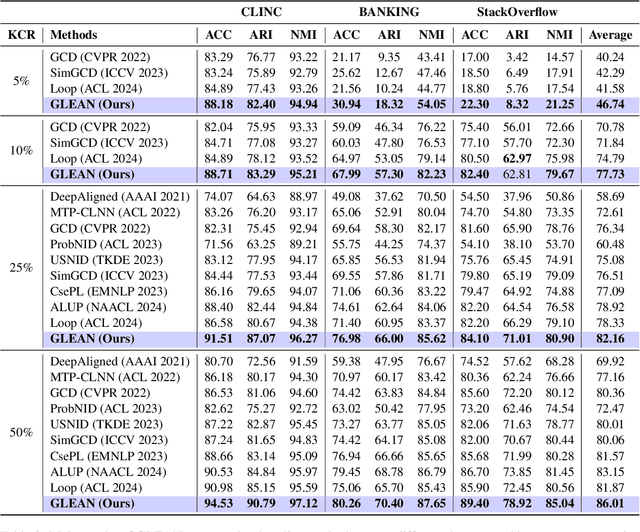
Generalized Category Discovery (GCD) is a practical and challenging open-world task that aims to recognize both known and novel categories in unlabeled data using limited labeled data from known categories. Due to the lack of supervision, previous GCD methods face significant challenges, such as difficulty in rectifying errors for confusing instances, and inability to effectively uncover and leverage the semantic meanings of discovered clusters. Therefore, additional annotations are usually required for real-world applicability. However, human annotation is extremely costly and inefficient. To address these issues, we propose GLEAN, a unified framework for generalized category discovery that actively learns from diverse and quality-enhanced LLM feedback. Our approach leverages three different types of LLM feedback to: (1) improve instance-level contrastive features, (2) generate category descriptions, and (3) align uncertain instances with LLM-selected category descriptions. Extensive experiments demonstrate the superior performance of \MethodName over state-of-the-art models across diverse datasets, metrics, and supervision settings. Our code is available at https://github.com/amazon-science/Glean.
MEMERAG: A Multilingual End-to-End Meta-Evaluation Benchmark for Retrieval Augmented Generation
Feb 25, 2025Automatic evaluation of retrieval augmented generation (RAG) systems relies on fine-grained dimensions like faithfulness and relevance, as judged by expert human annotators. Meta-evaluation benchmarks support the development of automatic evaluators that correlate well with human judgement. However, existing benchmarks predominantly focus on English or use translated data, which fails to capture cultural nuances. A native approach provides a better representation of the end user experience. In this work, we develop a Multilingual End-to-end Meta-Evaluation RAG benchmark (MEMERAG). Our benchmark builds on the popular MIRACL dataset, using native-language questions and generating responses with diverse large language models (LLMs), which are then assessed by expert annotators for faithfulness and relevance. We describe our annotation process and show that it achieves high inter-annotator agreement. We then analyse the performance of the answer-generating LLMs across languages as per the human evaluators. Finally we apply the dataset to our main use-case which is to benchmark multilingual automatic evaluators (LLM-as-a-judge). We show that our benchmark can reliably identify improvements offered by advanced prompting techniques and LLMs. We will release our benchmark to support the community developing accurate evaluation methods for multilingual RAG systems.
Faithful, Unfaithful or Ambiguous? Multi-Agent Debate with Initial Stance for Summary Evaluation
Feb 12, 2025Faithfulness evaluators based on large language models (LLMs) are often fooled by the fluency of the text and struggle with identifying errors in the summaries. We propose an approach to summary faithfulness evaluation in which multiple LLM-based agents are assigned initial stances (regardless of what their belief might be) and forced to come up with a reason to justify the imposed belief, thus engaging in a multi-round debate to reach an agreement. The uniformly distributed initial assignments result in a greater diversity of stances leading to more meaningful debates and ultimately more errors identified. Furthermore, by analyzing the recent faithfulness evaluation datasets, we observe that naturally, it is not always the case for a summary to be either faithful to the source document or not. We therefore introduce a new dimension, ambiguity, and a detailed taxonomy to identify such special cases. Experiments demonstrate our approach can help identify ambiguities, and have even a stronger performance on non-ambiguous summaries.
Hierarchical Multi-field Representations for Two-Stage E-commerce Retrieval
Jan 30, 2025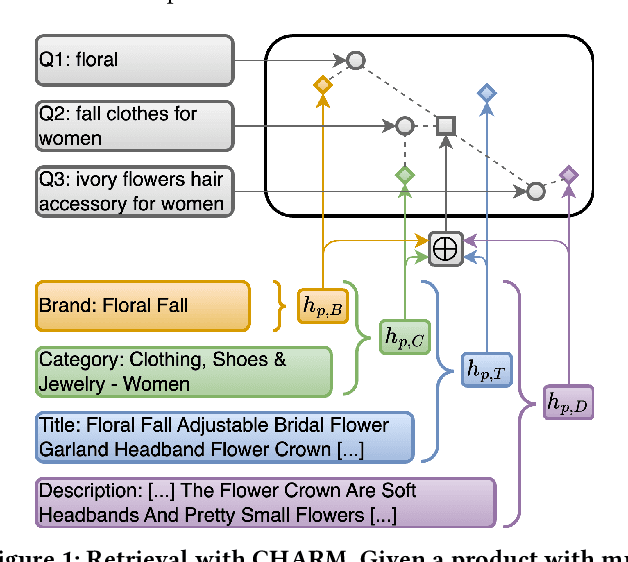
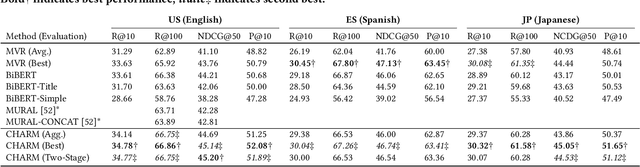
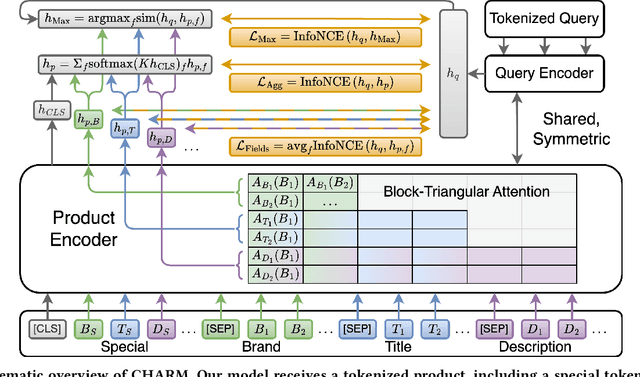
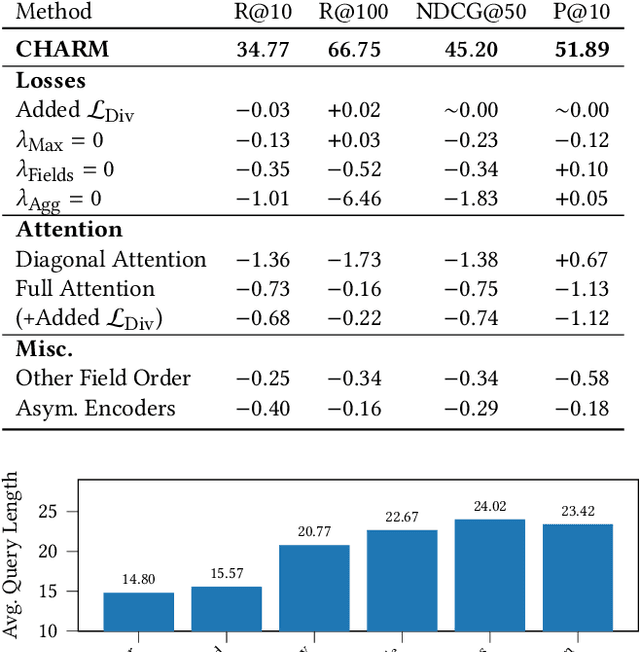
Dense retrieval methods typically target unstructured text data represented as flat strings. However, e-commerce catalogs often include structured information across multiple fields, such as brand, title, and description, which contain important information potential for retrieval systems. We present Cascading Hierarchical Attention Retrieval Model (CHARM), a novel framework designed to encode structured product data into hierarchical field-level representations with progressively finer detail. Utilizing a novel block-triangular attention mechanism, our method captures the interdependencies between product fields in a specified hierarchy, yielding field-level representations and aggregated vectors suitable for fast and efficient retrieval. Combining both representations enables a two-stage retrieval pipeline, in which the aggregated vectors support initial candidate selection, while more expressive field-level representations facilitate precise fine-tuning for downstream ranking. Experiments on publicly available large-scale e-commerce datasets demonstrate that CHARM matches or outperforms state-of-the-art baselines. Our analysis highlights the framework's ability to align different queries with appropriate product fields, enhancing retrieval accuracy and explainability.