 Add to Chrome
 Add to Firefox
 Add to Edge
GenerTTS: Pronunciation Disentanglement for Timbre and Style Generalization in Cross-Lingual Text-to-Speech
Jun 27, 2023
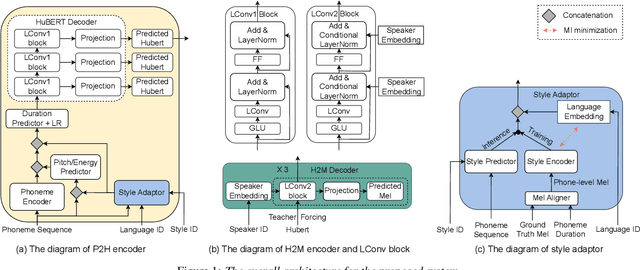



Cross-lingual timbre and style generalizable text-to-speech (TTS) aims to synthesize speech with a specific reference timbre or style that is never trained in the target language. It encounters the following challenges: 1) timbre and pronunciation are correlated since multilingual speech of a specific speaker is usually hard to obtain; 2) style and pronunciation are mixed because the speech style contains language-agnostic and language-specific parts. To address these challenges, we propose GenerTTS, which mainly includes the following works: 1) we elaborately design a HuBERT-based information bottleneck to disentangle timbre and pronunciation/style; 2) we minimize the mutual information between style and language to discard the language-specific information in the style embedding. The experiments indicate that GenerTTS outperforms baseline systems in terms of style similarity and pronunciation accuracy, and enables cross-lingual timbre and style generalization.

Ada-TTA: Towards Adaptive High-Quality Text-to-Talking Avatar Synthesis
Jun 06, 2023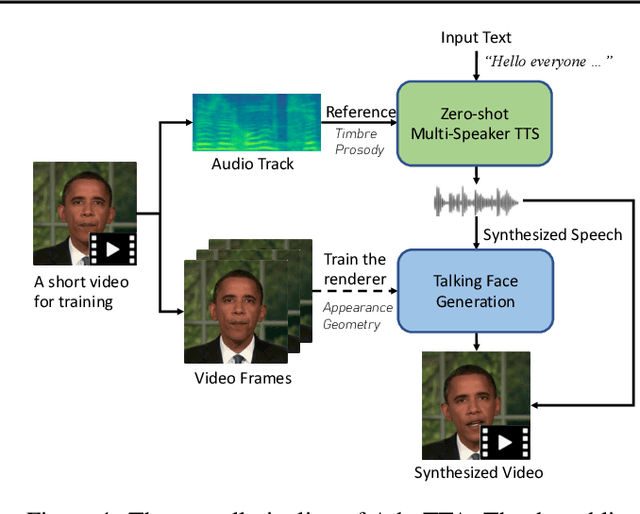
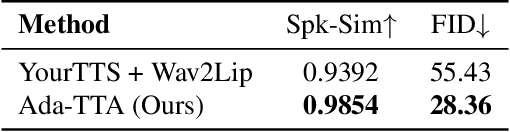

We are interested in a novel task, namely low-resource text-to-talking avatar. Given only a few-minute-long talking person video with the audio track as the training data and arbitrary texts as the driving input, we aim to synthesize high-quality talking portrait videos corresponding to the input text. This task has broad application prospects in the digital human industry but has not been technically achieved yet due to two challenges: (1) It is challenging to mimic the timbre from out-of-domain audio for a traditional multi-speaker Text-to-Speech system. (2) It is hard to render high-fidelity and lip-synchronized talking avatars with limited training data. In this paper, we introduce Adaptive Text-to-Talking Avatar (Ada-TTA), which (1) designs a generic zero-shot multi-speaker TTS model that well disentangles the text content, timbre, and prosody; and (2) embraces recent advances in neural rendering to achieve realistic audio-driven talking face video generation. With these designs, our method overcomes the aforementioned two challenges and achieves to generate identity-preserving speech and realistic talking person video. Experiments demonstrate that our method could synthesize realistic, identity-preserving, and audio-visual synchronized talking avatar videos.
Mega-TTS: Zero-Shot Text-to-Speech at Scale with Intrinsic Inductive Bias
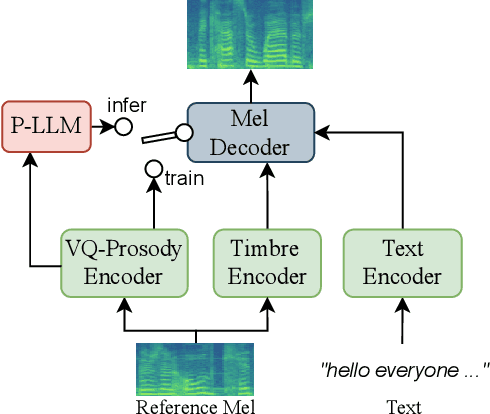
Jun 06, 2023Scaling text-to-speech to a large and wild dataset has been proven to be highly effective in achieving timbre and speech style generalization, particularly in zero-shot TTS. However, previous works usually encode speech into latent using audio codec and use autoregressive language models or diffusion models to generate it, which ignores the intrinsic nature of speech and may lead to inferior or uncontrollable results. We argue that speech can be decomposed into several attributes (e.g., content, timbre, prosody, and phase) and each of them should be modeled using a module with appropriate inductive biases. From this perspective, we carefully design a novel and large zero-shot TTS system called Mega-TTS, which is trained with large-scale wild data and models different attributes in different ways: 1) Instead of using latent encoded by audio codec as the intermediate feature, we still choose spectrogram as it separates the phase and other attributes very well. Phase can be appropriately constructed by the GAN-based vocoder and does not need to be modeled by the language model. 2) We model the timbre using global vectors since timbre is a global attribute that changes slowly over time. 3) We further use a VQGAN-based acoustic model to generate the spectrogram and a latent code language model to fit the distribution of prosody, since prosody changes quickly over time in a sentence, and language models can capture both local and long-range dependencies. We scale Mega-TTS to multi-domain datasets with 20K hours of speech and evaluate its performance on unseen speakers. Experimental results demonstrate that Mega-TTS surpasses state-of-the-art TTS systems on zero-shot TTS, speech editing, and cross-lingual TTS tasks, with superior naturalness, robustness, and speaker similarity due to the proper inductive bias of each module. Audio samples are available at https://mega-tts.github.io/demo-page.
Detector Guidance for Multi-Object Text-to-Image Generation
Jun 04, 2023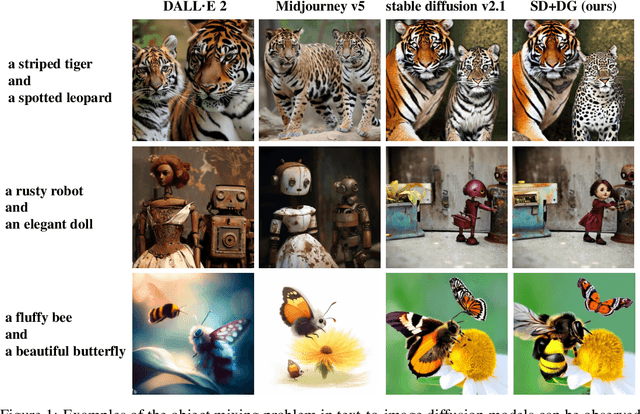

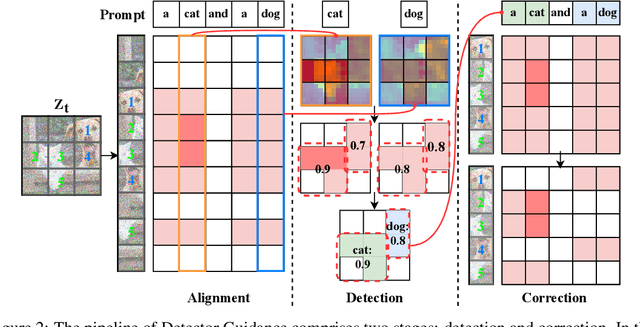

Diffusion models have demonstrated impressive performance in text-to-image generation. They utilize a text encoder and cross-attention blocks to infuse textual information into images at a pixel level. However, their capability to generate images with text containing multiple objects is still restricted. Previous works identify the problem of information mixing in the CLIP text encoder and introduce the T5 text encoder or incorporate strong prior knowledge to assist with the alignment. We find that mixing problems also occur on the image side and in the cross-attention blocks. The noisy images can cause different objects to appear similar, and the cross-attention blocks inject information at a pixel level, leading to leakage of global object understanding and resulting in object mixing. In this paper, we introduce Detector Guidance (DG), which integrates a latent object detection model to separate different objects during the generation process. DG first performs latent object detection on cross-attention maps (CAMs) to obtain object information. Based on this information, DG then masks conflicting prompts and enhances related prompts by manipulating the following CAMs. We evaluate the effectiveness of DG using Stable Diffusion on COCO, CC, and a novel multi-related object benchmark, MRO. Human evaluations demonstrate that DG provides an 8-22\% advantage in preventing the amalgamation of conflicting concepts and ensuring that each object possesses its unique region without any human involvement and additional iterations. Our implementation is available at \url{https://github.com/luping-liu/Detector-Guidance}.
StyleS2ST: Zero-shot Style Transfer for Direct Speech-to-speech Translation
Jun 01, 2023Direct speech-to-speech translation (S2ST) has gradually become popular as it has many advantages compared with cascade S2ST. However, current research mainly focuses on the accuracy of semantic translation and ignores the speech style transfer from a source language to a target language. The lack of high-fidelity expressive parallel data makes such style transfer challenging, especially in more practical zero-shot scenarios. To solve this problem, we first build a parallel corpus using a multi-lingual multi-speaker text-to-speech synthesis (TTS) system and then propose the StyleS2ST model with cross-lingual speech style transfer ability based on a style adaptor on a direct S2ST system framework. Enabling continuous style space modeling of an acoustic model through parallel corpus training and non-parallel TTS data augmentation, StyleS2ST captures cross-lingual acoustic feature mapping from the source to the target language. Experiments show that StyleS2ST achieves good style similarity and naturalness in both in-set and out-of-set zero-shot scenarios.
Make-An-Audio 2: Temporal-Enhanced Text-to-Audio Generation
May 29, 2023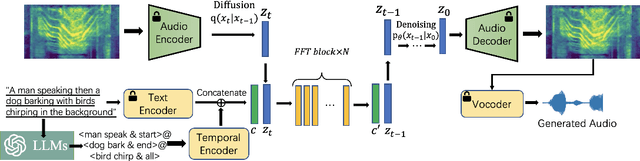
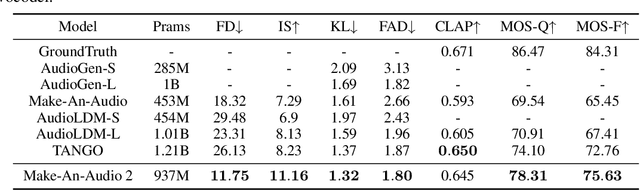
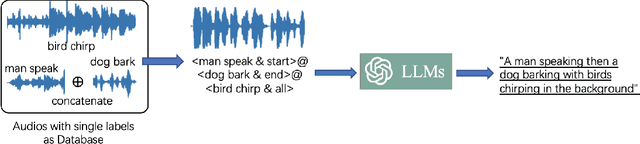
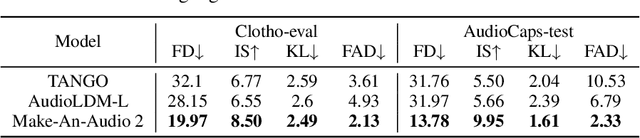
Large diffusion models have been successful in text-to-audio (T2A) synthesis tasks, but they often suffer from common issues such as semantic misalignment and poor temporal consistency due to limited natural language understanding and data scarcity. Additionally, 2D spatial structures widely used in T2A works lead to unsatisfactory audio quality when generating variable-length audio samples since they do not adequately prioritize temporal information. To address these challenges, we propose Make-an-Audio 2, a latent diffusion-based T2A method that builds on the success of Make-an-Audio. Our approach includes several techniques to improve semantic alignment and temporal consistency: Firstly, we use pre-trained large language models (LLMs) to parse the text into structured <event & order> pairs for better temporal information capture. We also introduce another structured-text encoder to aid in learning semantic alignment during the diffusion denoising process. To improve the performance of variable length generation and enhance the temporal information extraction, we design a feed-forward Transformer-based diffusion denoiser. Finally, we use LLMs to augment and transform a large amount of audio-label data into audio-text datasets to alleviate the problem of scarcity of temporal data. Extensive experiments show that our method outperforms baseline models in both objective and subjective metrics, and achieves significant gains in temporal information understanding, semantic consistency, and sound quality.
AV-TranSpeech: Audio-Visual Robust Speech-to-Speech Translation
May 24, 2023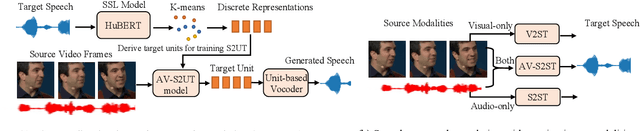
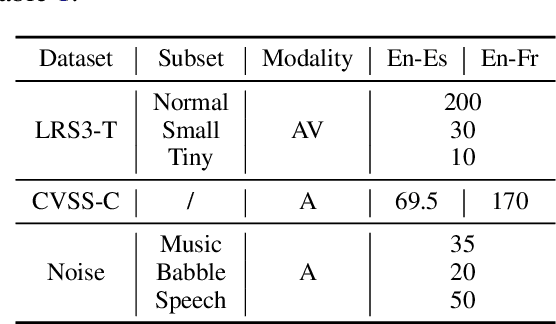
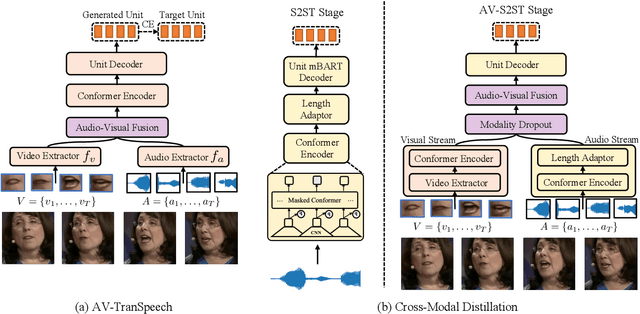
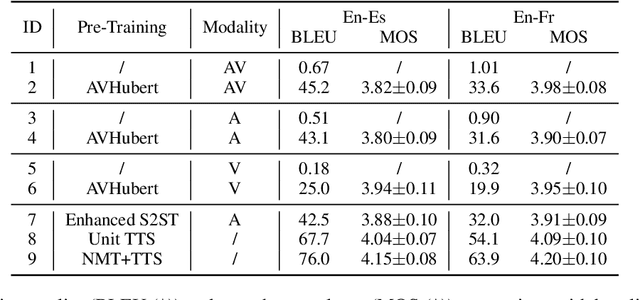
Direct speech-to-speech translation (S2ST) aims to convert speech from one language into another, and has demonstrated significant progress to date. Despite the recent success, current S2ST models still suffer from distinct degradation in noisy environments and fail to translate visual speech (i.e., the movement of lips and teeth). In this work, we present AV-TranSpeech, the first audio-visual speech-to-speech (AV-S2ST) translation model without relying on intermediate text. AV-TranSpeech complements the audio stream with visual information to promote system robustness and opens up a host of practical applications: dictation or dubbing archival films. To mitigate the data scarcity with limited parallel AV-S2ST data, we 1) explore self-supervised pre-training with unlabeled audio-visual data to learn contextual representation, and 2) introduce cross-modal distillation with S2ST models trained on the audio-only corpus to further reduce the requirements of visual data. Experimental results on two language pairs demonstrate that AV-TranSpeech outperforms audio-only models under all settings regardless of the type of noise. With low-resource audio-visual data (10h, 30h), cross-modal distillation yields an improvement of 7.6 BLEU on average compared with baselines. Audio samples are available at https://AV-TranSpeech.github.io
FluentSpeech: Stutter-Oriented Automatic Speech Editing with Context-Aware Diffusion Models
May 23, 2023Stutter removal is an essential scenario in the field of speech editing. However, when the speech recording contains stutters, the existing text-based speech editing approaches still suffer from: 1) the over-smoothing problem in the edited speech; 2) lack of robustness due to the noise introduced by stutter; 3) to remove the stutters, users are required to determine the edited region manually. To tackle the challenges in stutter removal, we propose FluentSpeech, a stutter-oriented automatic speech editing model. Specifically, 1) we propose a context-aware diffusion model that iteratively refines the modified mel-spectrogram with the guidance of context features; 2) we introduce a stutter predictor module to inject the stutter information into the hidden sequence; 3) we also propose a stutter-oriented automatic speech editing (SASE) dataset that contains spontaneous speech recordings with time-aligned stutter labels to train the automatic stutter localization model. Experimental results on VCTK and LibriTTS datasets demonstrate that our model achieves state-of-the-art performance on speech editing. Further experiments on our SASE dataset show that FluentSpeech can effectively improve the fluency of stuttering speech in terms of objective and subjective metrics. Code and audio samples can be found at https://github.com/Zain-Jiang/Speech-Editing-Toolkit.
CLAPSpeech: Learning Prosody from Text Context with Contrastive Language-Audio Pre-training
May 18, 2023Improving text representation has attracted much attention to achieve expressive text-to-speech (TTS). However, existing works only implicitly learn the prosody with masked token reconstruction tasks, which leads to low training efficiency and difficulty in prosody modeling. We propose CLAPSpeech, a cross-modal contrastive pre-training framework that explicitly learns the prosody variance of the same text token under different contexts. Specifically, 1) We encourage the model to connect the text context with its corresponding prosody pattern in the joint multi-modal space with the elaborate design of the encoder inputs and contrastive loss; 2) We introduce a multi-scale pre-training pipeline to capture prosody patterns in multiple levels. We show how to incorporate CLAPSpeech into existing TTS models for better prosody. Experiments on three datasets not only show that CLAPSpeech could improve the prosody prediction for existing TTS methods, but also demonstrate its generalization ability to adapt to multiple languages and multi-speaker TTS. We also deeply analyze the principle behind the performance of CLAPSpeech. Ablation studies demonstrate the necessity of each component in our method. Source code and audio samples are available at https://clapspeech.github.io.
GeneFace++: Generalized and Stable Real-Time Audio-Driven 3D Talking Face Generation
May 01, 2023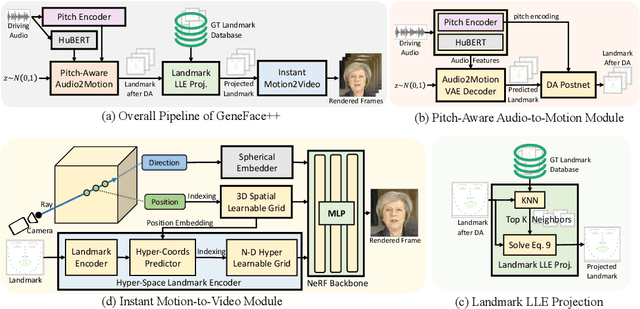
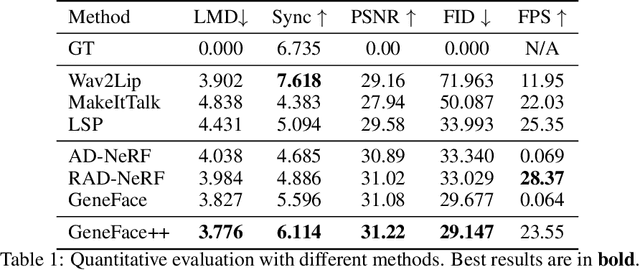
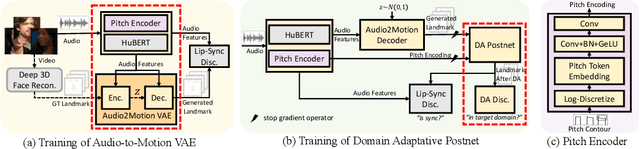

Generating talking person portraits with arbitrary speech audio is a crucial problem in the field of digital human and metaverse. A modern talking face generation method is expected to achieve the goals of generalized audio-lip synchronization, good video quality, and high system efficiency. Recently, neural radiance field (NeRF) has become a popular rendering technique in this field since it could achieve high-fidelity and 3D-consistent talking face generation with a few-minute-long training video. However, there still exist several challenges for NeRF-based methods: 1) as for the lip synchronization, it is hard to generate a long facial motion sequence of high temporal consistency and audio-lip accuracy; 2) as for the video quality, due to the limited data used to train the renderer, it is vulnerable to out-of-domain input condition and produce bad rendering results occasionally; 3) as for the system efficiency, the slow training and inference speed of the vanilla NeRF severely obstruct its usage in real-world applications. In this paper, we propose GeneFace++ to handle these challenges by 1) utilizing the pitch contour as an auxiliary feature and introducing a temporal loss in the facial motion prediction process; 2) proposing a landmark locally linear embedding method to regulate the outliers in the predicted motion sequence to avoid robustness issues; 3) designing a computationally efficient NeRF-based motion-to-video renderer to achieves fast training and real-time inference. With these settings, GeneFace++ becomes the first NeRF-based method that achieves stable and real-time talking face generation with generalized audio-lip synchronization. Extensive experiments show that our method outperforms state-of-the-art baselines in terms of subjective and objective evaluation. Video samples are available at https://genefaceplusplus.github.io .