 Add to Chrome
 Add to Firefox
 Add to Edge
DTFormer: A Transformer-Based Method for Discrete-Time Dynamic Graph Representation Learning
Jul 26, 2024
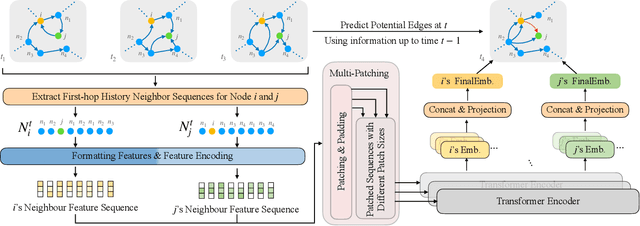

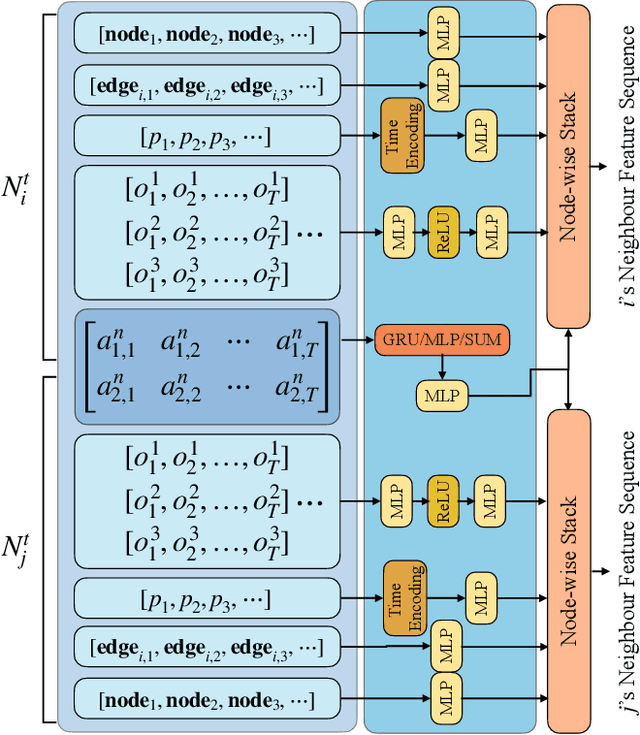

Discrete-Time Dynamic Graphs (DTDGs), which are prevalent in real-world implementations and notable for their ease of data acquisition, have garnered considerable attention from both academic researchers and industry practitioners. The representation learning of DTDGs has been extensively applied to model the dynamics of temporally changing entities and their evolving connections. Currently, DTDG representation learning predominantly relies on GNN+RNN architectures, which manifest the inherent limitations of both Graph Neural Networks (GNNs) and Recurrent Neural Networks (RNNs). GNNs suffer from the over-smoothing issue as the models architecture goes deeper, while RNNs struggle to capture long-term dependencies effectively. GNN+RNN architectures also grapple with scaling to large graph sizes and long sequences. Additionally, these methods often compute node representations separately and focus solely on individual node characteristics, thereby overlooking the behavior intersections between the two nodes whose link is being predicted, such as instances where the two nodes appear together in the same context or share common neighbors. This paper introduces a novel representation learning method DTFormer for DTDGs, pivoting from the traditional GNN+RNN framework to a Transformer-based architecture. Our approach exploits the attention mechanism to concurrently process topological information within the graph at each timestamp and temporal dynamics of graphs along the timestamps, circumventing the aforementioned fundamental weakness of both GNNs and RNNs. Moreover, we enhance the model's expressive capability by incorporating the intersection relationships among nodes and integrating a multi-patching module. Extensive experiments conducted on six public dynamic graph benchmark datasets confirm our model's efficacy, achieving the SOTA performance.

Towards Adaptive Neighborhood for Advancing Temporal Interaction Graph Modeling
Jun 14, 2024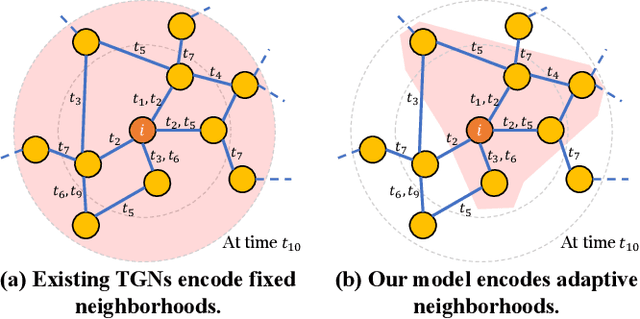
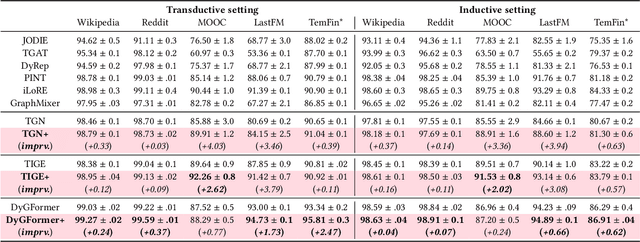
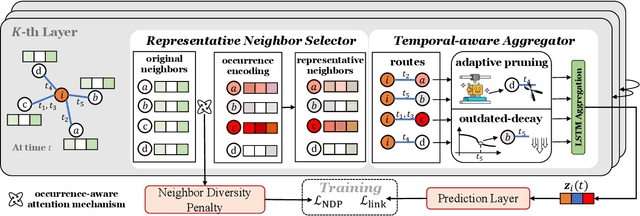

Temporal Graph Networks (TGNs) have demonstrated their remarkable performance in modeling temporal interaction graphs. These works can generate temporal node representations by encoding the surrounding neighborhoods for the target node. However, an inherent limitation of existing TGNs is their reliance on fixed, hand-crafted rules for neighborhood encoding, overlooking the necessity for an adaptive and learnable neighborhood that can accommodate both personalization and temporal evolution across different timestamps. In this paper, we aim to enhance existing TGNs by introducing an adaptive neighborhood encoding mechanism. We present SEAN, a flexible plug-and-play model that can be seamlessly integrated with existing TGNs, effectively boosting their performance. To achieve this, we decompose the adaptive neighborhood encoding process into two phases: (i) representative neighbor selection, and (ii) temporal-aware neighborhood information aggregation. Specifically, we propose the Representative Neighbor Selector component, which automatically pinpoints the most important neighbors for the target node. It offers a tailored understanding of each node's unique surrounding context, facilitating personalization. Subsequently, we propose a Temporal-aware Aggregator, which synthesizes neighborhood aggregation by selectively determining the utilization of aggregation routes and decaying the outdated information, allowing our model to adaptively leverage both the contextually significant and current information during aggregation. We conduct extensive experiments by integrating SEAN into three representative TGNs, evaluating their performance on four public datasets and one financial benchmark dataset introduced in this paper. The results demonstrate that SEAN consistently leads to performance improvements across all models, achieving SOTA performance and exceptional robustness.
Fair Evaluation of Federated Learning Algorithms for Automated Breast Density Classification: The Results of the 2022 ACR-NCI-NVIDIA Federated Learning Challenge
May 22, 2024The correct interpretation of breast density is important in the assessment of breast cancer risk. AI has been shown capable of accurately predicting breast density, however, due to the differences in imaging characteristics across mammography systems, models built using data from one system do not generalize well to other systems. Though federated learning (FL) has emerged as a way to improve the generalizability of AI without the need to share data, the best way to preserve features from all training data during FL is an active area of research. To explore FL methodology, the breast density classification FL challenge was hosted in partnership with the American College of Radiology, Harvard Medical School's Mass General Brigham, University of Colorado, NVIDIA, and the National Institutes of Health National Cancer Institute. Challenge participants were able to submit docker containers capable of implementing FL on three simulated medical facilities, each containing a unique large mammography dataset. The breast density FL challenge ran from June 15 to September 5, 2022, attracting seven finalists from around the world. The winning FL submission reached a linear kappa score of 0.653 on the challenge test data and 0.413 on an external testing dataset, scoring comparably to a model trained on the same data in a central location.
* 16 pages, 9 figures
Prompt Learning on Temporal Interaction Graphs
Feb 09, 2024Temporal Interaction Graphs (TIGs) are widely utilized to represent real-world systems. To facilitate representation learning on TIGs, researchers have proposed a series of TIG models. However, these models are still facing two tough gaps between the pre-training and downstream predictions in their ``pre-train, predict'' training paradigm. First, the temporal discrepancy between the pre-training and inference data severely undermines the models' applicability in distant future predictions on the dynamically evolving data. Second, the semantic divergence between pretext and downstream tasks hinders their practical applications, as they struggle to align with their learning and prediction capabilities across application scenarios. Recently, the ``pre-train, prompt'' paradigm has emerged as a lightweight mechanism for model generalization. Applying this paradigm is a potential solution to solve the aforementioned challenges. However, the adaptation of this paradigm to TIGs is not straightforward. The application of prompting in static graph contexts falls short in temporal settings due to a lack of consideration for time-sensitive dynamics and a deficiency in expressive power. To address this issue, we introduce Temporal Interaction Graph Prompting (TIGPrompt), a versatile framework that seamlessly integrates with TIG models, bridging both the temporal and semantic gaps. In detail, we propose a temporal prompt generator to offer temporally-aware prompts for different tasks. These prompts stand out for their minimalistic design, relying solely on the tuning of the prompt generator with very little supervision data. To cater to varying computational resource demands, we propose an extended ``pre-train, prompt-based fine-tune'' paradigm, offering greater flexibility. Through extensive experiments, the TIGPrompt demonstrates the SOTA performance and remarkable efficiency advantages.
A Survey of Privacy Threats and Defense in Vertical Federated Learning: From Model Life Cycle Perspective
Feb 06, 2024Vertical Federated Learning (VFL) is a federated learning paradigm where multiple participants, who share the same set of samples but hold different features, jointly train machine learning models. Although VFL enables collaborative machine learning without sharing raw data, it is still susceptible to various privacy threats. In this paper, we conduct the first comprehensive survey of the state-of-the-art in privacy attacks and defenses in VFL. We provide taxonomies for both attacks and defenses, based on their characterizations, and discuss open challenges and future research directions. Specifically, our discussion is structured around the model's life cycle, by delving into the privacy threats encountered during different stages of machine learning and their corresponding countermeasures. This survey not only serves as a resource for the research community but also offers clear guidance and actionable insights for practitioners to safeguard data privacy throughout the model's life cycle.
One Model to Rule them All: Towards Universal Segmentation for Medical Images with Text Prompts
Dec 28, 2023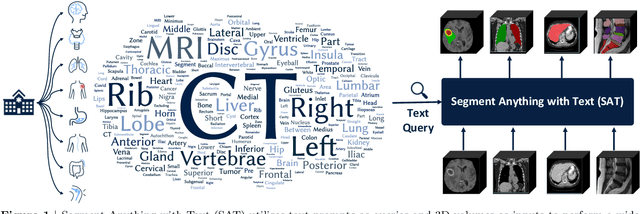
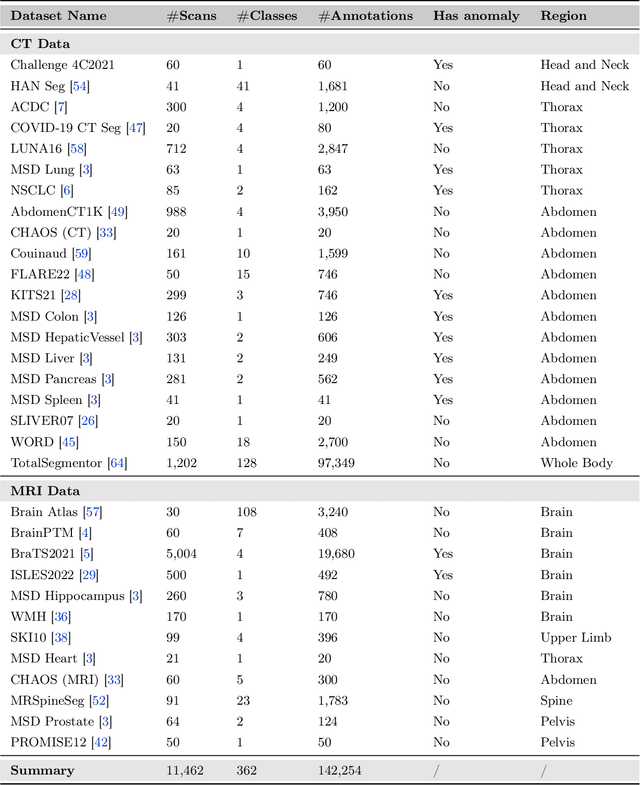
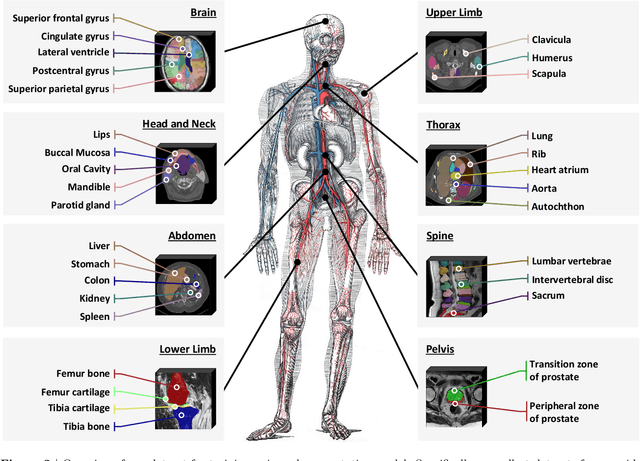

In this study, we focus on building up a model that can Segment Anything in medical scenarios, driven by Text prompts, termed as SAT. Our main contributions are three folds: (i) on data construction, we combine multiple knowledge sources to construct a multi-modal medical knowledge tree; Then we build up a large-scale segmentation dataset for training, by collecting over 11K 3D medical image scans from 31 segmentation datasets with careful standardization on both visual scans and label space; (ii) on model training, we formulate a universal segmentation model, that can be prompted by inputting medical terminologies in text form. We present a knowledge-enhanced representation learning framework, and a series of strategies for effectively training on the combination of a large number of datasets; (iii) on model evaluation, we train a SAT-Nano with only 107M parameters, to segment 31 different segmentation datasets with text prompt, resulting in 362 categories. We thoroughly evaluate the model from three aspects: averaged by body regions, averaged by classes, and average by datasets, demonstrating comparable performance to 36 specialist nnUNets, i.e., we train nnUNet models on each dataset/subset, resulting in 36 nnUNets with around 1000M parameters for the 31 datasets. We will release all the codes, and models used in this report, i.e., SAT-Nano. Moreover, we will offer SAT-Ultra in the near future, which is trained with model of larger size, on more diverse datasets. Webpage URL: https://zhaoziheng.github.io/MedUniSeg.
Implementing Digital Twin in Field-Deployed Optical Networks: Uncertain Factors, Operational Guidance, and Field-Trial Demonstration
Dec 06, 2023Digital twin has revolutionized optical communication networks by enabling their full life-cycle management, including design, troubleshooting, optimization, upgrade, and prediction. While extensive literature exists on frameworks, standards, and applications of digital twin, there is a pressing need in implementing digital twin in field-deployed optical networks operating in real-world environments, as opposed to controlled laboratory settings. This paper addresses this challenge by examining the uncertain factors behind the inaccuracy of digital twin in field-deployed optical networks from three main challenges and proposing operational guidance for implementing accurate digital twin in field-deployed optical networks. Through the proposed guidance, we demonstrate the effective implementation of digital twin in a field-trial C+L-band optical transmission link, showcasing its capabilities in performance recovery in a fiber cut scenario.
Complementary Advantages of ChatGPTs and Human Readers in Reasoning: Evidence from English Text Reading Comprehension
Nov 17, 2023
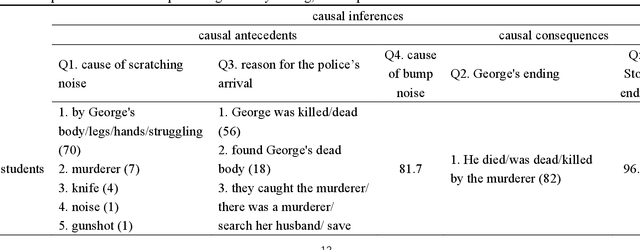
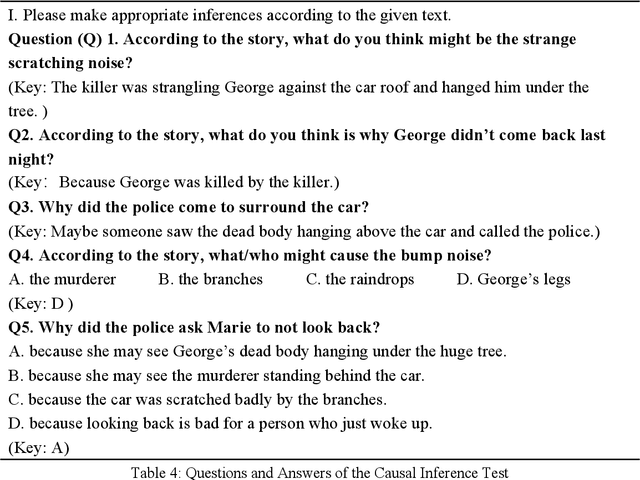
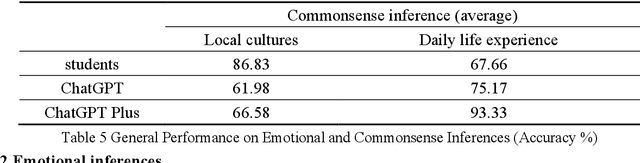
ChatGPT has shown its great power in text processing, including its reasoning ability from text reading. However, there has not been any direct comparison between human readers and ChatGPT in reasoning ability related to text reading. This study was undertaken to investigate how ChatGPTs (i.e., ChatGPT and ChatGPT Plus) and Chinese senior school students as ESL learners exhibited their reasoning ability from English narrative texts. Additionally, we compared the two ChatGPTs in the reasoning performances when commands were updated elaborately. The whole study was composed of three reasoning tests: Test 1 for commonsense inference, Test 2 for emotional inference, and Test 3 for causal inference. The results showed that in Test 1, the students outdid the two ChatGPT versions in local-culture-related inferences but performed worse than the chatbots in daily-life inferences. In Test 2, ChatGPT Plus excelled whereas ChatGPT lagged behind in accuracy. In association with both accuracy and frequency of correct responses, the students were inferior to the two chatbots. Compared with ChatGPTs' better performance in positive emotions, the students showed their superiority in inferring negative emotions. In Test 3, the students demonstrated better logical analysis, outdoing both chatbots. In updating command condition, ChatGPT Plus displayed good causal reasoning ability while ChatGPT kept unchanged. Our study reveals that human readers and ChatGPTs have their respective advantages and disadvantages in drawing inferences from text reading comprehension, unlocking a complementary relationship in text-based reasoning.
Learning Decentralized Traffic Signal Controllers with Multi-Agent Graph Reinforcement Learning
Nov 07, 2023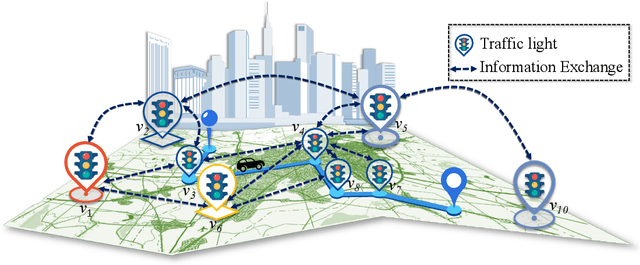
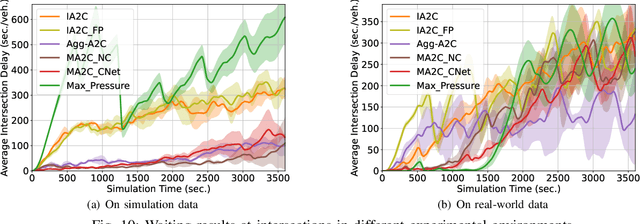
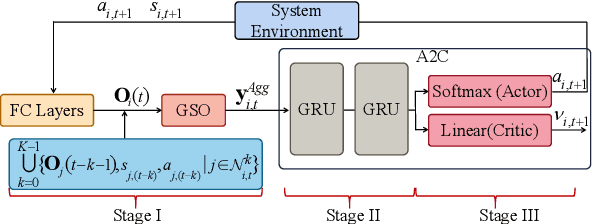
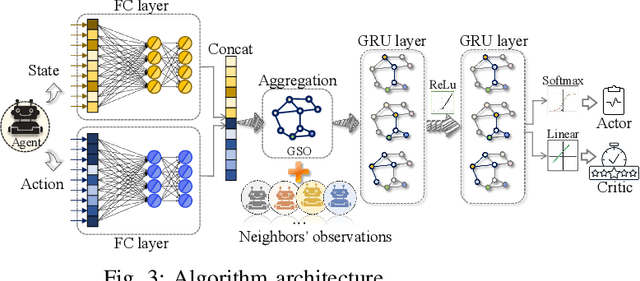
This paper considers optimal traffic signal control in smart cities, which has been taken as a complex networked system control problem. Given the interacting dynamics among traffic lights and road networks, attaining controller adaptivity and scalability stands out as a primary challenge. Capturing the spatial-temporal correlation among traffic lights under the framework of Multi-Agent Reinforcement Learning (MARL) is a promising solution. Nevertheless, existing MARL algorithms ignore effective information aggregation which is fundamental for improving the learning capacity of decentralized agents. In this paper, we design a new decentralized control architecture with improved environmental observability to capture the spatial-temporal correlation. Specifically, we first develop a topology-aware information aggregation strategy to extract correlation-related information from unstructured data gathered in the road network. Particularly, we transfer the road network topology into a graph shift operator by forming a diffusion process on the topology, which subsequently facilitates the construction of graph signals. A diffusion convolution module is developed, forming a new MARL algorithm, which endows agents with the capabilities of graph learning. Extensive experiments based on both synthetic and real-world datasets verify that our proposal outperforms existing decentralized algorithms.
Integrating Summarization and Retrieval for Enhanced Personalization via Large Language Models
Oct 30, 2023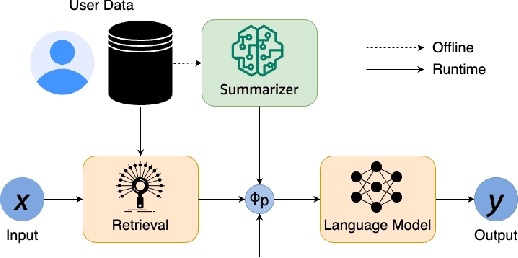
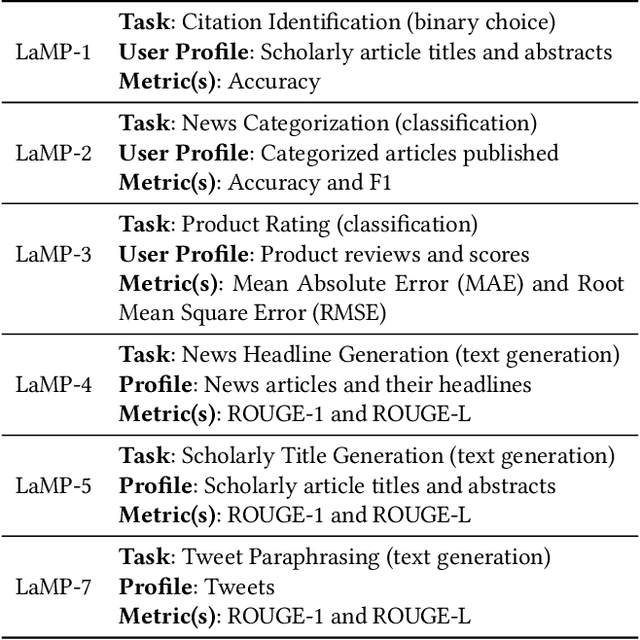
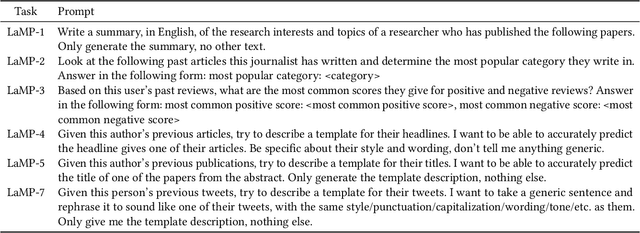
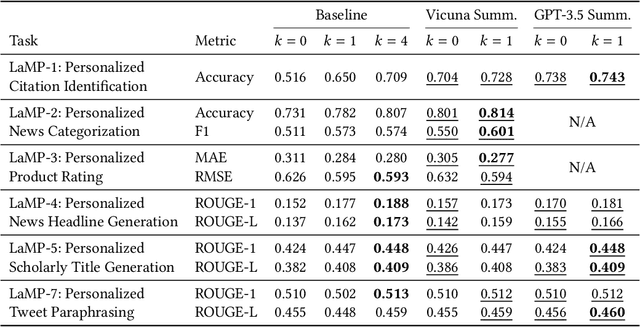
Personalization, the ability to tailor a system to individual users, is an essential factor in user experience with natural language processing (NLP) systems. With the emergence of Large Language Models (LLMs), a key question is how to leverage these models to better personalize user experiences. To personalize a language model's output, a straightforward approach is to incorporate past user data into the language model prompt, but this approach can result in lengthy inputs exceeding limitations on input length and incurring latency and cost issues. Existing approaches tackle such challenges by selectively extracting relevant user data (i.e. selective retrieval) to construct a prompt for downstream tasks. However, retrieval-based methods are limited by potential information loss, lack of more profound user understanding, and cold-start challenges. To overcome these limitations, we propose a novel summary-augmented approach by extending retrieval-augmented personalization with task-aware user summaries generated by LLMs. The summaries can be generated and stored offline, enabling real-world systems with runtime constraints like voice assistants to leverage the power of LLMs. Experiments show our method with 75% less of retrieved user data is on-par or outperforms retrieval augmentation on most tasks in the LaMP personalization benchmark. We demonstrate that offline summarization via LLMs and runtime retrieval enables better performance for personalization on a range of tasks under practical constraints.