 Add to Chrome
 Add to Firefox
 Add to Edge
Trends in AI and Human-AI Interaction in Clinical Trials -- A Hybrid Human-AI Exploration
May 27, 2026
This paper examines records retrieved from the ClinicalTrials.gov registry to characterize temporal trends in AI terminology and the geographical distribution of AI trials. The work also reports on an exploratory hybrid human-AI approach to analyzing human-AI interaction trends in registered clinical trials. The hybrid workflow comprised a frontier generative AI model (GPT-5.5) and human review to screen and categorize records returned by an AI-focused search. The findings indicate a marked increase in AI-related trials over time, with recent growth in references to machine learning, deep learning, chatbots, GPTs, and large language models. Geographically, China and the United States accounted for the largest numbers of AI-related trials, with notable recent increases in several other countries including Italy, France, Spain, the UK and Turkey (Türkiye). In a random sample of 100 records, human and AI classifiers showed good agreement in identifying studies not substantively using AI, but lower agreement in classifying human-AI interaction, particularly where health professional interaction was ambiguous or insufficiently described. Overall, the results suggest that hybrid human-AI screening of clinical trial records is potentially viable, but clearer trial reporting and more precise interaction definitions will benefit the process.

Integrating Summarization and Retrieval for Enhanced Personalization via Large Language Models
Oct 30, 2023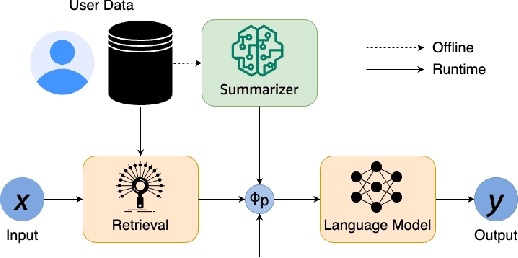
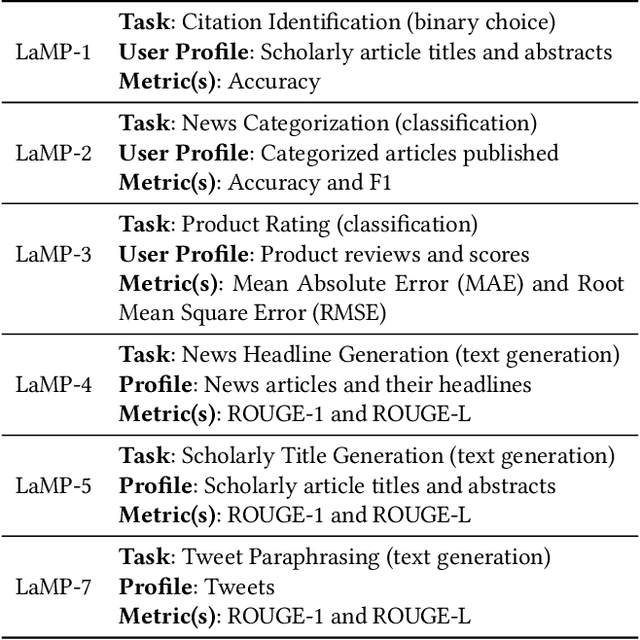
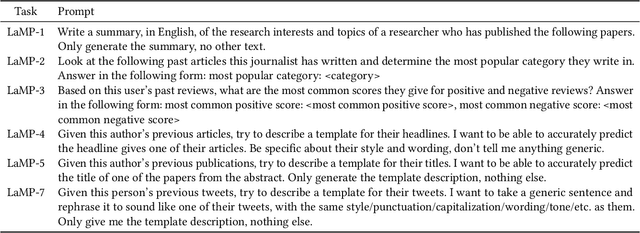
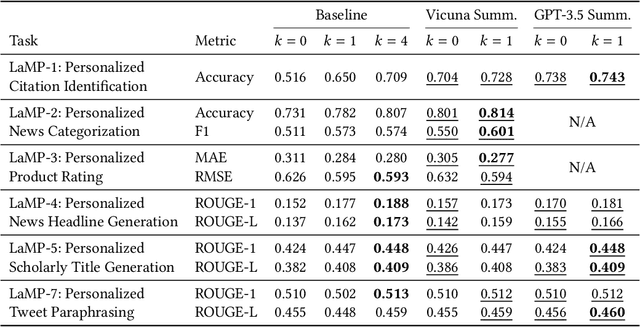
Personalization, the ability to tailor a system to individual users, is an essential factor in user experience with natural language processing (NLP) systems. With the emergence of Large Language Models (LLMs), a key question is how to leverage these models to better personalize user experiences. To personalize a language model's output, a straightforward approach is to incorporate past user data into the language model prompt, but this approach can result in lengthy inputs exceeding limitations on input length and incurring latency and cost issues. Existing approaches tackle such challenges by selectively extracting relevant user data (i.e. selective retrieval) to construct a prompt for downstream tasks. However, retrieval-based methods are limited by potential information loss, lack of more profound user understanding, and cold-start challenges. To overcome these limitations, we propose a novel summary-augmented approach by extending retrieval-augmented personalization with task-aware user summaries generated by LLMs. The summaries can be generated and stored offline, enabling real-world systems with runtime constraints like voice assistants to leverage the power of LLMs. Experiments show our method with 75% less of retrieved user data is on-par or outperforms retrieval augmentation on most tasks in the LaMP personalization benchmark. We demonstrate that offline summarization via LLMs and runtime retrieval enables better performance for personalization on a range of tasks under practical constraints.