 Add to Chrome
 Add to Firefox
 Add to Edge
Pushing Auto-regressive Models for 3D Shape Generation at Capacity and Scalability
Feb 19, 2024
Auto-regressive models have achieved impressive results in 2D image generation by modeling joint distributions in grid space. In this paper, we extend auto-regressive models to 3D domains, and seek a stronger ability of 3D shape generation by improving auto-regressive models at capacity and scalability simultaneously. Firstly, we leverage an ensemble of publicly available 3D datasets to facilitate the training of large-scale models. It consists of a comprehensive collection of approximately 900,000 objects, with multiple properties of meshes, points, voxels, rendered images, and text captions. This diverse labeled dataset, termed Objaverse-Mix, empowers our model to learn from a wide range of object variations. However, directly applying 3D auto-regression encounters critical challenges of high computational demands on volumetric grids and ambiguous auto-regressive order along grid dimensions, resulting in inferior quality of 3D shapes. To this end, we then present a novel framework Argus3D in terms of capacity. Concretely, our approach introduces discrete representation learning based on a latent vector instead of volumetric grids, which not only reduces computational costs but also preserves essential geometric details by learning the joint distributions in a more tractable order. The capacity of conditional generation can thus be realized by simply concatenating various conditioning inputs to the latent vector, such as point clouds, categories, images, and texts. In addition, thanks to the simplicity of our model architecture, we naturally scale up our approach to a larger model with an impressive 3.6 billion parameters, further enhancing the quality of versatile 3D generation. Extensive experiments on four generation tasks demonstrate that Argus3D can synthesize diverse and faithful shapes across multiple categories, achieving remarkable performance.

Cross-Domain Few-Shot Object Detection via Enhanced Open-Set Object Detector
Feb 05, 2024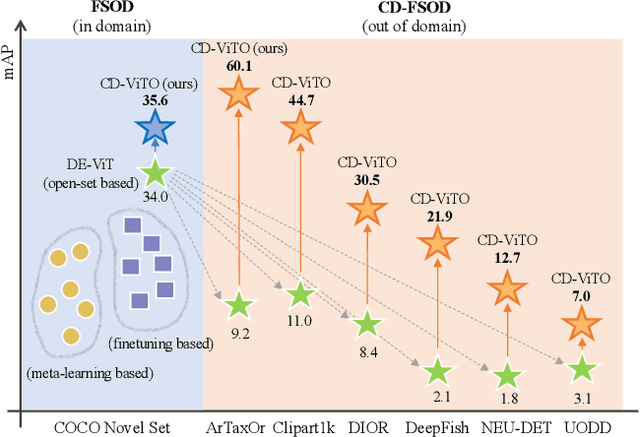
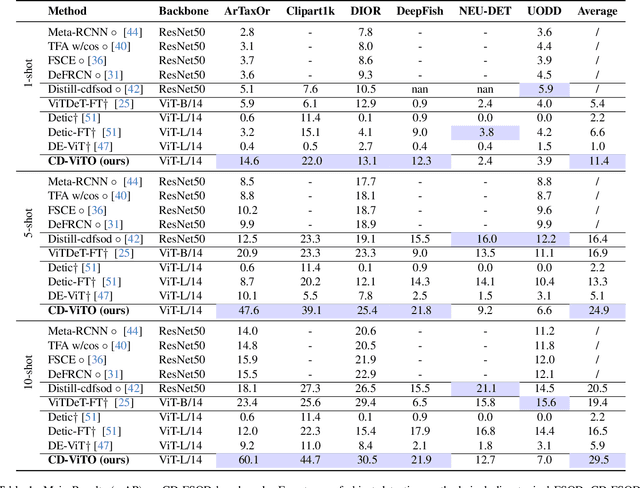
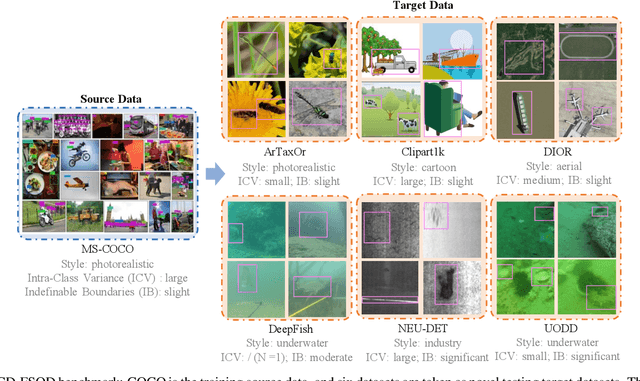
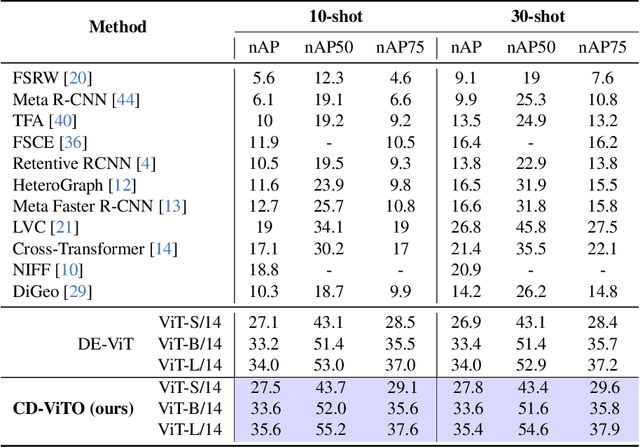
This paper addresses the challenge of cross-domain few-shot object detection (CD-FSOD), aiming to develop an accurate object detector for novel domains with minimal labeled examples. While transformer-based open-set detectors e.g., DE-ViT~\cite{zhang2023detect} have excelled in both open-vocabulary object detection and traditional few-shot object detection, detecting categories beyond those seen during training, we thus naturally raise two key questions: 1) can such open-set detection methods easily generalize to CD-FSOD? 2) If no, how to enhance the results of open-set methods when faced with significant domain gaps? To address the first question, we introduce several metrics to quantify domain variances and establish a new CD-FSOD benchmark with diverse domain metric values. Some State-Of-The-Art (SOTA) open-set object detection methods are evaluated on this benchmark, with evident performance degradation observed across out-of-domain datasets. This indicates the failure of adopting open-set detectors directly for CD-FSOD. Sequentially, to overcome the performance degradation issue and also to answer the second proposed question, we endeavor to enhance the vanilla DE-ViT. With several novel components including finetuning, a learnable prototype module, and a lightweight attention module, we present an improved Cross-Domain Vision Transformer for CD-FSOD (CD-ViTO). Experiments show that our CD-ViTO achieves impressive results on both out-of-domain and in-domain target datasets, establishing new SOTAs for both CD-FSOD and FSOD. All the datasets, codes, and models will be released to the community.
Repositioning the Subject within Image
Jan 30, 2024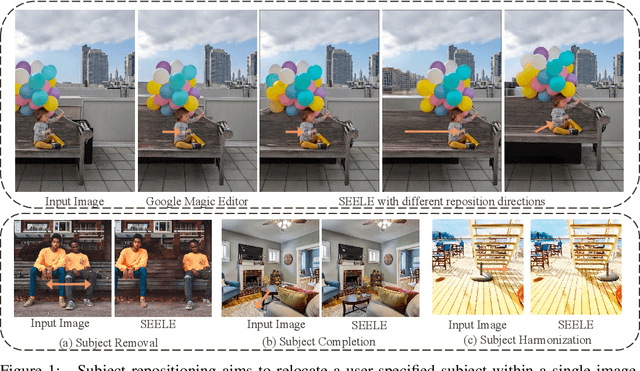


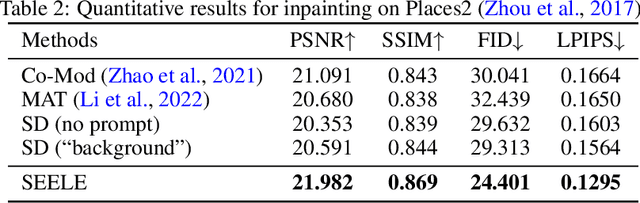
Current image manipulation primarily centers on static manipulation, such as replacing specific regions within an image or altering its overall style. In this paper, we introduce an innovative dynamic manipulation task, subject repositioning. This task involves relocating a user-specified subject to a desired position while preserving the image's fidelity. Our research reveals that the fundamental sub-tasks of subject repositioning, which include filling the void left by the repositioned subject, reconstructing obscured portions of the subject and blending the subject to be consistent with surrounding areas, can be effectively reformulated as a unified, prompt-guided inpainting task. Consequently, we can employ a single diffusion generative model to address these sub-tasks using various task prompts learned through our proposed task inversion technique. Additionally, we integrate pre-processing and post-processing techniques to further enhance the quality of subject repositioning. These elements together form our SEgment-gEnerate-and-bLEnd (SEELE) framework. To assess SEELE's effectiveness in subject repositioning, we assemble a real-world subject repositioning dataset called ReS. Our results on ReS demonstrate the quality of repositioned image generation.
MVSFormer++: Revealing the Devil in Transformer's Details for Multi-View Stereo
Jan 22, 2024Recent advancements in learning-based Multi-View Stereo (MVS) methods have prominently featured transformer-based models with attention mechanisms. However, existing approaches have not thoroughly investigated the profound influence of transformers on different MVS modules, resulting in limited depth estimation capabilities. In this paper, we introduce MVSFormer++, a method that prudently maximizes the inherent characteristics of attention to enhance various components of the MVS pipeline. Formally, our approach involves infusing cross-view information into the pre-trained DINOv2 model to facilitate MVS learning. Furthermore, we employ different attention mechanisms for the feature encoder and cost volume regularization, focusing on feature and spatial aggregations respectively. Additionally, we uncover that some design details would substantially impact the performance of transformer modules in MVS, including normalized 3D positional encoding, adaptive attention scaling, and the position of layer normalization. Comprehensive experiments on DTU, Tanks-and-Temples, BlendedMVS, and ETH3D validate the effectiveness of the proposed method. Notably, MVSFormer++ achieves state-of-the-art performance on the challenging DTU and Tanks-and-Temples benchmarks.
* Accepted to ICLR2024
HybridGait: A Benchmark for Spatial-Temporal Cloth-Changing Gait Recognition with Hybrid Explorations
Dec 30, 2023Existing gait recognition benchmarks mostly include minor clothing variations in the laboratory environments, but lack persistent changes in appearance over time and space. In this paper, we propose the first in-the-wild benchmark CCGait for cloth-changing gait recognition, which incorporates diverse clothing changes, indoor and outdoor scenes, and multi-modal statistics over 92 days. To further address the coupling effect of clothing and viewpoint variations, we propose a hybrid approach HybridGait that exploits both temporal dynamics and the projected 2D information of 3D human meshes. Specifically, we introduce a Canonical Alignment Spatial-Temporal Transformer (CA-STT) module to encode human joint position-aware features, and fully exploit 3D dense priors via a Silhouette-guided Deformation with 3D-2D Appearance Projection (SilD) strategy. Our contributions are twofold: we provide a challenging benchmark CCGait that captures realistic appearance changes across an expanded and space, and we propose a hybrid framework HybridGait that outperforms prior works on CCGait and Gait3D benchmarks. Our project page is available at https://github.com/HCVLab/HybridGait.
MinD-3D: Reconstruct High-quality 3D objects in Human Brain
Dec 12, 2023In this paper, we introduce Recon3DMind, a groundbreaking task focused on reconstructing 3D visuals from Functional Magnetic Resonance Imaging (fMRI) signals. This represents a major step forward in cognitive neuroscience and computer vision. To support this task, we present the fMRI-Shape dataset, utilizing 360-degree view videos of 3D objects for comprehensive fMRI signal capture. Containing 55 categories of common objects from daily life, this dataset will bolster future research endeavors. We also propose MinD-3D, a novel and effective three-stage framework that decodes and reconstructs the brain's 3D visual information from fMRI signals. This method starts by extracting and aggregating features from fMRI frames using a neuro-fusion encoder, then employs a feature bridge diffusion model to generate corresponding visual features, and ultimately recovers the 3D object through a generative transformer decoder. Our experiments demonstrate that this method effectively extracts features that are valid and highly correlated with visual regions of interest (ROIs) in fMRI signals. Notably, it not only reconstructs 3D objects with high semantic relevance and spatial similarity but also significantly deepens our understanding of the human brain's 3D visual processing capabilities. Project page at: https://jianxgao.github.io/MinD-3D.
Towards Stable and Faithful Inpainting
Dec 08, 2023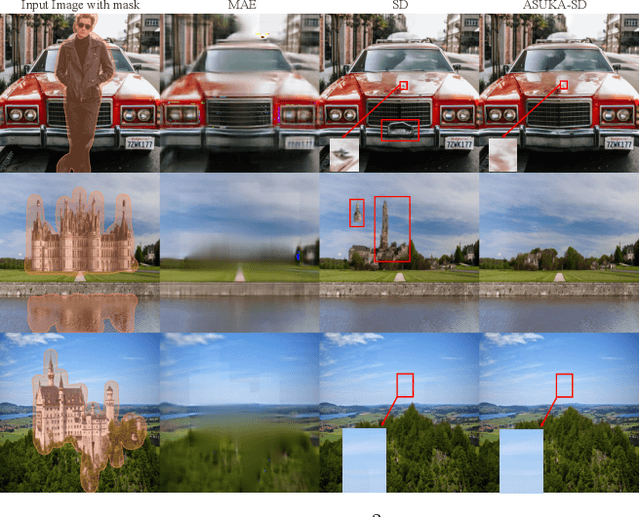
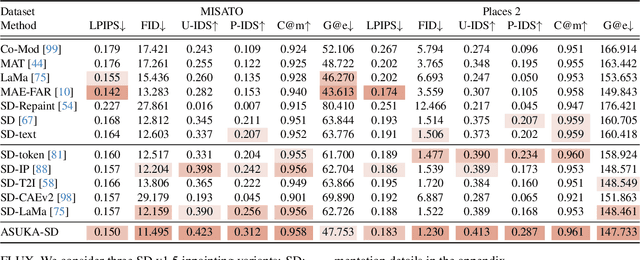
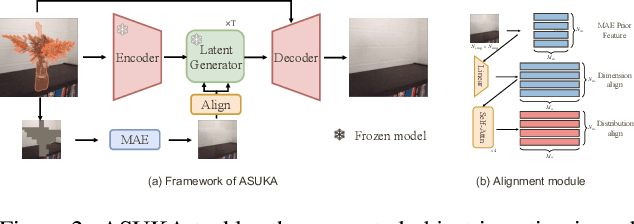

Recent progress in inpainting increasingly relies on generative models, leveraging their strong generation capabilities for addressing ill-conditioned problems. However, this enhanced generation often introduces instability, leading to arbitrary object generation within masked regions. This paper proposes a balanced solution, emphasizing the importance of unmasked regions in guiding inpainting while preserving generative capacity. Our approach, Aligned Stable Inpainting with UnKnown Areas Prior (ASUKA), employs a reconstruction-based masked auto-encoder (MAE) as a stable prior. Aligned with the robust Stable Diffusion inpainting model (SD), ASUKA significantly improves inpainting stability. ASUKA further aligns masked and unmasked regions through an inpainting-specialized decoder, ensuring more faithful inpainting. To validate effectiveness across domains and masking scenarios, we evaluate on MISATO, a collection of several existing dataset. Results confirm ASUKA's efficacy in both stability and fidelity compared to SD and other inpainting algorithms.
Open-DDVM: A Reproduction and Extension of Diffusion Model for Optical Flow Estimation
Dec 04, 2023Recently, Google proposes DDVM which for the first time demonstrates that a general diffusion model for image-to-image translation task works impressively well on optical flow estimation task without any specific designs like RAFT. However, DDVM is still a closed-source model with the expensive and private Palette-style pretraining. In this technical report, we present the first open-source DDVM by reproducing it. We study several design choices and find those important ones. By training on 40k public data with 4 GPUs, our reproduction achieves comparable performance to the closed-source DDVM. The code and model have been released in https://github.com/DQiaole/FlowDiffusion_pytorch.
fMRI-PTE: A Large-scale fMRI Pretrained Transformer Encoder for Multi-Subject Brain Activity Decoding
Nov 01, 2023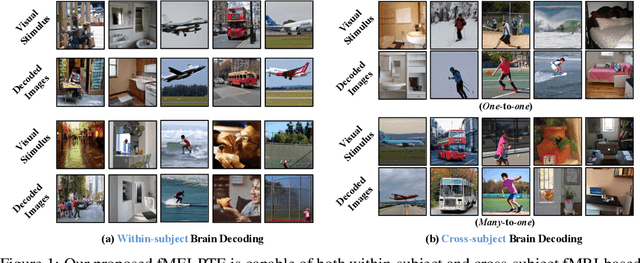
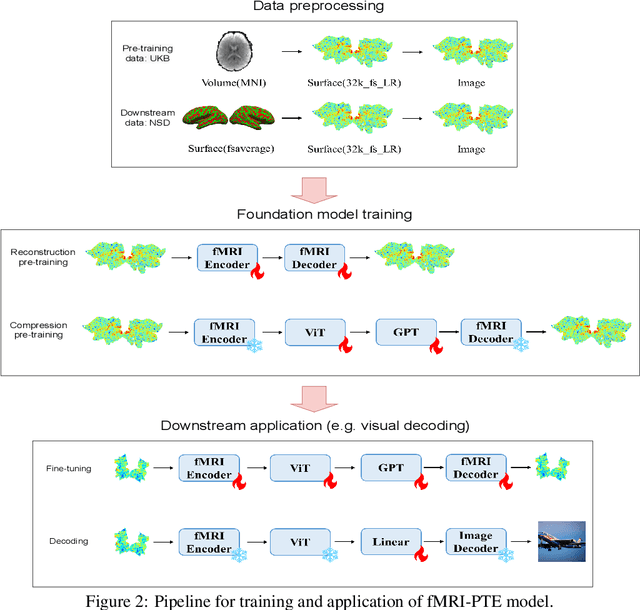
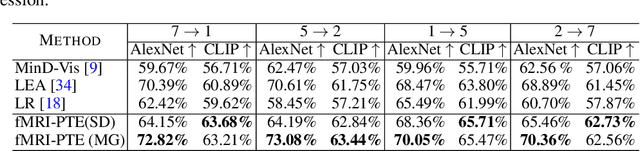
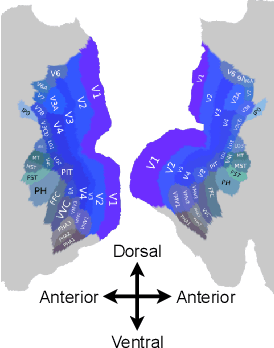
The exploration of brain activity and its decoding from fMRI data has been a longstanding pursuit, driven by its potential applications in brain-computer interfaces, medical diagnostics, and virtual reality. Previous approaches have primarily focused on individual subject analysis, highlighting the need for a more universal and adaptable framework, which is the core motivation behind our work. In this work, we propose fMRI-PTE, an innovative auto-encoder approach for fMRI pre-training, with a focus on addressing the challenges of varying fMRI data dimensions due to individual brain differences. Our approach involves transforming fMRI signals into unified 2D representations, ensuring consistency in dimensions and preserving distinct brain activity patterns. We introduce a novel learning strategy tailored for pre-training 2D fMRI images, enhancing the quality of reconstruction. fMRI-PTE's adaptability with image generators enables the generation of well-represented fMRI features, facilitating various downstream tasks, including within-subject and cross-subject brain activity decoding. Our contributions encompass introducing fMRI-PTE, innovative data transformation, efficient training, a novel learning strategy, and the universal applicability of our approach. Extensive experiments validate and support our claims, offering a promising foundation for further research in this domain.
The Blessings of Multiple Treatments and Outcomes in Treatment Effect Estimation
Oct 14, 2023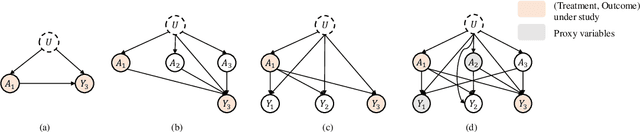
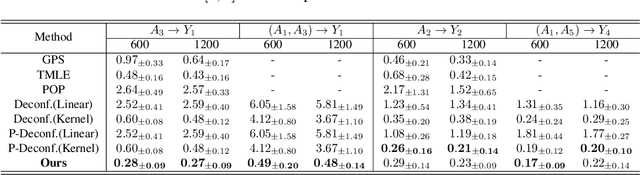
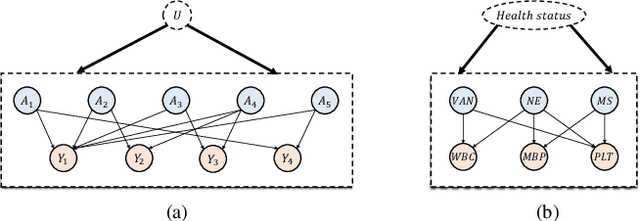
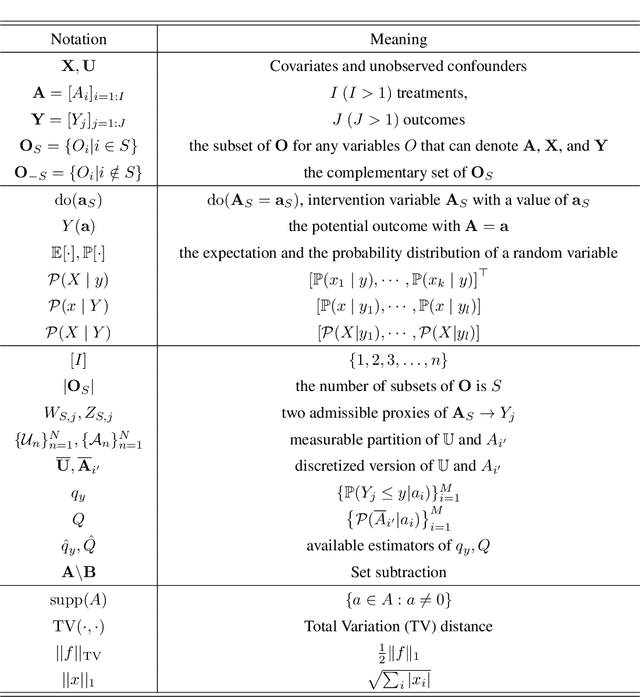
Assessing causal effects in the presence of unobserved confounding is a challenging problem. Existing studies leveraged proxy variables or multiple treatments to adjust for the confounding bias. In particular, the latter approach attributes the impact on a single outcome to multiple treatments, allowing estimating latent variables for confounding control. Nevertheless, these methods primarily focus on a single outcome, whereas in many real-world scenarios, there is greater interest in studying the effects on multiple outcomes. Besides, these outcomes are often coupled with multiple treatments. Examples include the intensive care unit (ICU), where health providers evaluate the effectiveness of therapies on multiple health indicators. To accommodate these scenarios, we consider a new setting dubbed as multiple treatments and multiple outcomes. We then show that parallel studies of multiple outcomes involved in this setting can assist each other in causal identification, in the sense that we can exploit other treatments and outcomes as proxies for each treatment effect under study. We proceed with a causal discovery method that can effectively identify such proxies for causal estimation. The utility of our method is demonstrated in synthetic data and sepsis disease.