 Add to Chrome
 Add to Firefox
 Add to Edge
Robotic Grasping and Placement Controlled by EEG-Based Hybrid Visual and Motor Imagery
Mar 03, 2026
We present a framework that integrates EEG-based visual and motor imagery (VI/MI) with robotic control to enable real-time, intention-driven grasping and placement. Motivated by the promise of BCI-driven robotics to enhance human-robot interaction, this system bridges neural signals with physical control by deploying offline-pretrained decoders in a zero-shot manner within an online streaming pipeline. This establishes a dual-channel intent interface that translates visual intent into robotic actions, with VI identifying objects for grasping and MI determining placement poses, enabling intuitive control over both what to grasp and where to place. The system operates solely on EEG via a cue-free imagery protocol, achieving integration and online validation. Implemented on a Base robotic platform and evaluated across diverse scenarios, including occluded targets or varying participant postures, the system achieves online decoding accuracies of 40.23% (VI) and 62.59% (MI), with an end-to-end task success rate of 20.88%. These results demonstrate that high-level visual cognition can be decoded in real time and translated into executable robot commands, bridging the gap between neural signals and physical interaction, and validating the flexibility of a purely imagery-based BCI paradigm for practical human-robot collaboration.

The Blessings of Multiple Treatments and Outcomes in Treatment Effect Estimation
Oct 14, 2023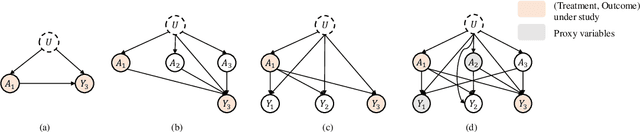
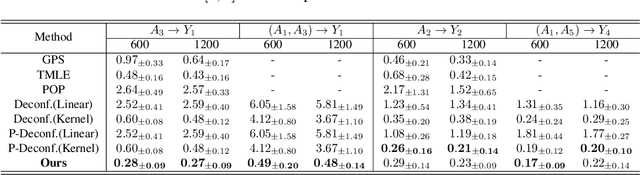
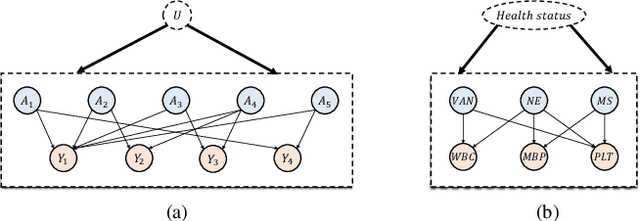
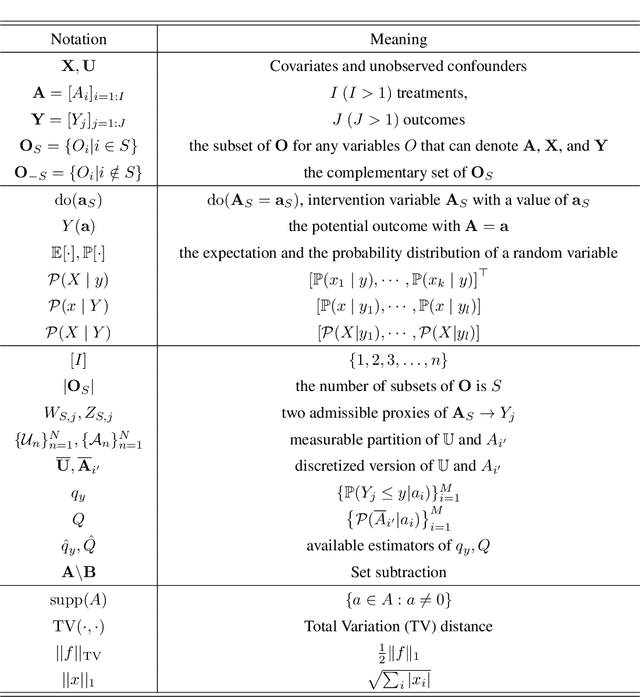
Assessing causal effects in the presence of unobserved confounding is a challenging problem. Existing studies leveraged proxy variables or multiple treatments to adjust for the confounding bias. In particular, the latter approach attributes the impact on a single outcome to multiple treatments, allowing estimating latent variables for confounding control. Nevertheless, these methods primarily focus on a single outcome, whereas in many real-world scenarios, there is greater interest in studying the effects on multiple outcomes. Besides, these outcomes are often coupled with multiple treatments. Examples include the intensive care unit (ICU), where health providers evaluate the effectiveness of therapies on multiple health indicators. To accommodate these scenarios, we consider a new setting dubbed as multiple treatments and multiple outcomes. We then show that parallel studies of multiple outcomes involved in this setting can assist each other in causal identification, in the sense that we can exploit other treatments and outcomes as proxies for each treatment effect under study. We proceed with a causal discovery method that can effectively identify such proxies for causal estimation. The utility of our method is demonstrated in synthetic data and sepsis disease.
Doubly Robust Proximal Causal Learning for Continuous Treatments
Sep 22, 2023
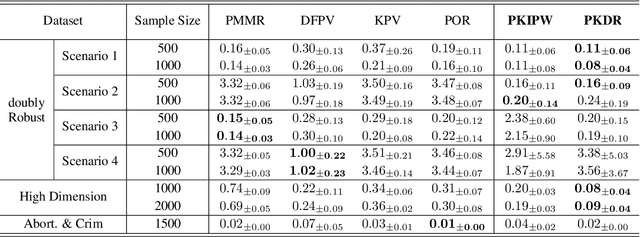

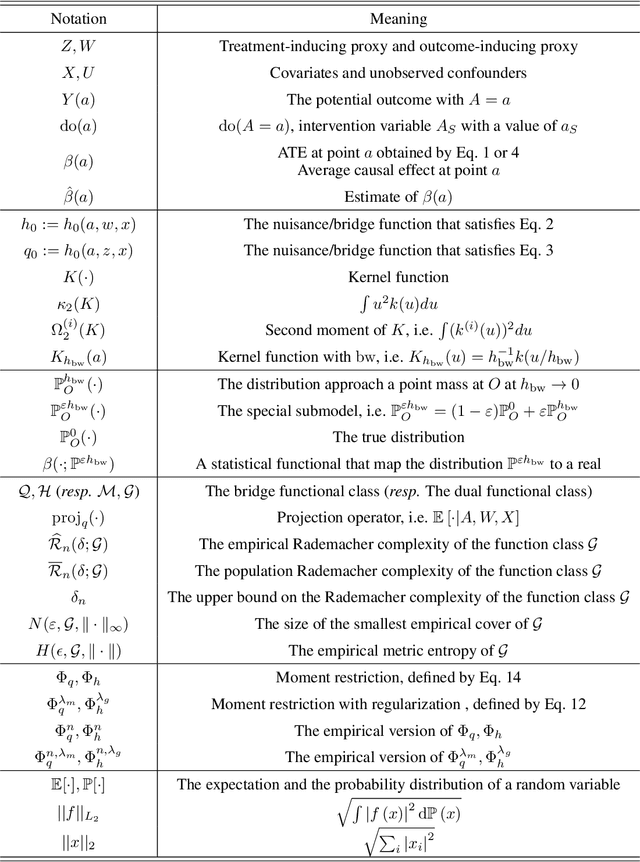
Proximal causal learning is a promising framework for identifying the causal effect under the existence of unmeasured confounders. Within this framework, the doubly robust (DR) estimator was derived and has shown its effectiveness in estimation, especially when the model assumption is violated. However, the current form of the DR estimator is restricted to binary treatments, while the treatment can be continuous in many real-world applications. The primary obstacle to continuous treatments resides in the delta function present in the original DR estimator, making it infeasible in causal effect estimation and introducing a heavy computational burden in nuisance function estimation. To address these challenges, we propose a kernel-based DR estimator that can well handle continuous treatments. Equipped with its smoothness, we show that its oracle form is a consistent approximation of the influence function. Further, we propose a new approach to efficiently solve the nuisance functions. We then provide a comprehensive convergence analysis in terms of the mean square error. We demonstrate the utility of our estimator on synthetic datasets and real-world applications.