 Add to Chrome
 Add to Firefox
 Add to Edge
URGENT Challenge: Universality, Robustness, and Generalizability For Speech Enhancement
Jun 07, 2024
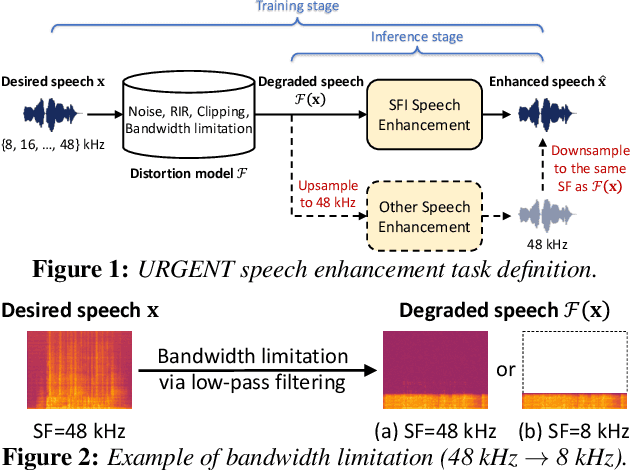


The last decade has witnessed significant advancements in deep learning-based speech enhancement (SE). However, most existing SE research has limitations on the coverage of SE sub-tasks, data diversity and amount, and evaluation metrics. To fill this gap and promote research toward universal SE, we establish a new SE challenge, named URGENT, to focus on the universality, robustness, and generalizability of SE. We aim to extend the SE definition to cover different sub-tasks to explore the limits of SE models, starting from denoising, dereverberation, bandwidth extension, and declipping. A novel framework is proposed to unify all these sub-tasks in a single model, allowing the use of all existing SE approaches. We collected public speech and noise data from different domains to construct diverse evaluation data. Finally, we discuss the insights gained from our preliminary baseline experiments based on both generative and discriminative SE methods with 12 curated metrics.

Beyond Performance Plateaus: A Comprehensive Study on Scalability in Speech Enhancement
Jun 06, 2024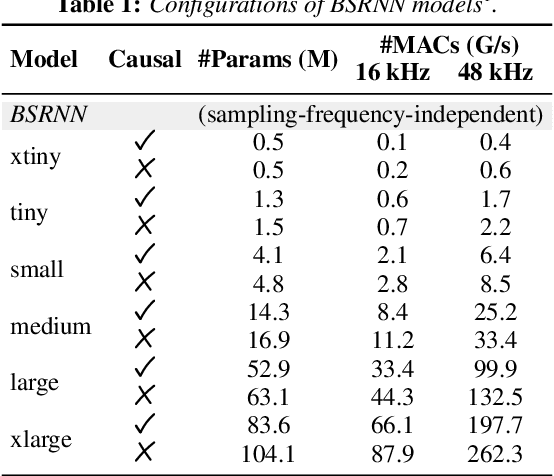


Deep learning-based speech enhancement (SE) models have achieved impressive performance in the past decade. Numerous advanced architectures have been designed to deliver state-of-the-art performance; however, their scalability potential remains unrevealed. Meanwhile, the majority of research focuses on small-sized datasets with restricted diversity, leading to a plateau in performance improvement. In this paper, we aim to provide new insights for addressing the above issues by exploring the scalability of SE models in terms of architectures, model sizes, compute budgets, and dataset sizes. Our investigation involves several popular SE architectures and speech data from different domains. Experiments reveal both similarities and distinctions between the scaling effects in SE and other tasks such as speech recognition. These findings further provide insights into the under-explored SE directions, e.g., larger-scale multi-domain corpora and efficiently scalable architectures.
TransVIP: Speech to Speech Translation System with Voice and Isochrony Preservation
May 28, 2024There is a rising interest and trend in research towards directly translating speech from one language to another, known as end-to-end speech-to-speech translation. However, most end-to-end models struggle to outperform cascade models, i.e., a pipeline framework by concatenating speech recognition, machine translation and text-to-speech models. The primary challenges stem from the inherent complexities involved in direct translation tasks and the scarcity of data. In this study, we introduce a novel model framework TransVIP that leverages diverse datasets in a cascade fashion yet facilitates end-to-end inference through joint probability. Furthermore, we propose two separated encoders to preserve the speaker's voice characteristics and isochrony from the source speech during the translation process, making it highly suitable for scenarios such as video dubbing. Our experiments on the French-English language pair demonstrate that our model outperforms the current state-of-the-art speech-to-speech translation model.
CLAQ: Pushing the Limits of Low-Bit Post-Training Quantization for LLMs
May 27, 2024Parameter quantization for Large Language Models (LLMs) has attracted increasing attentions recently in reducing memory costs and improving computational efficiency. Early approaches have been widely adopted. However, the existing methods suffer from poor performance in low-bit (such as 2 to 3 bits) scenarios. In this paper, we present a novel and effective Column-Level Adaptive weight Quantization (CLAQ) framework by introducing three different types of adaptive strategies for LLM quantization. Firstly, a K-Means clustering based algorithm is proposed that allows dynamic generation of quantization centroids for each column of a parameter matrix. Secondly, we design an outlier-guided adaptive precision search strategy which can dynamically assign varying bit-widths to different columns. Finally, a dynamic outlier reservation scheme is developed to retain some parameters in their original float point precision, in trade off of boosted model performance. Experiments on various mainstream open source LLMs including LLaMA-1, LLaMA-2 and Yi demonstrate that our methods achieve the state-of-the-art results across different bit settings, especially in extremely low-bit scenarios. Code will be released soon.
GSTalker: Real-time Audio-Driven Talking Face Generation via Deformable Gaussian Splatting
Apr 29, 2024We present GStalker, a 3D audio-driven talking face generation model with Gaussian Splatting for both fast training (40 minutes) and real-time rendering (125 FPS) with a 3$\sim$5 minute video for training material, in comparison with previous 2D and 3D NeRF-based modeling frameworks which require hours of training and seconds of rendering per frame. Specifically, GSTalker learns an audio-driven Gaussian deformation field to translate and transform 3D Gaussians to synchronize with audio information, in which multi-resolution hashing grid-based tri-plane and temporal smooth module are incorporated to learn accurate deformation for fine-grained facial details. In addition, a pose-conditioned deformation field is designed to model the stabilized torso. To enable efficient optimization of the condition Gaussian deformation field, we initialize 3D Gaussians by learning a coarse static Gaussian representation. Extensive experiments in person-specific videos with audio tracks validate that GSTalker can generate high-fidelity and audio-lips synchronized results with fast training and real-time rendering speed.
CoVoMix: Advancing Zero-Shot Speech Generation for Human-like Multi-talker Conversations
Apr 10, 2024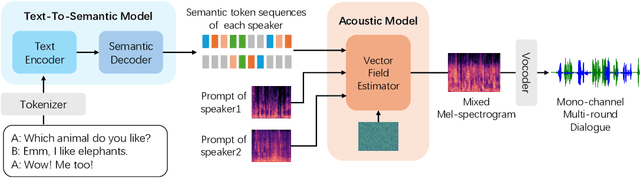
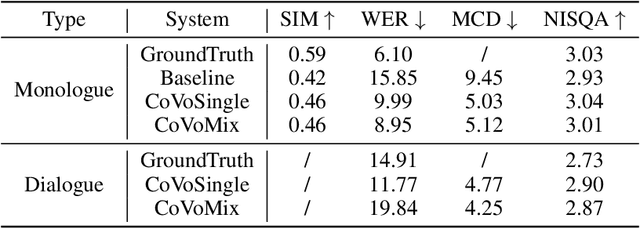
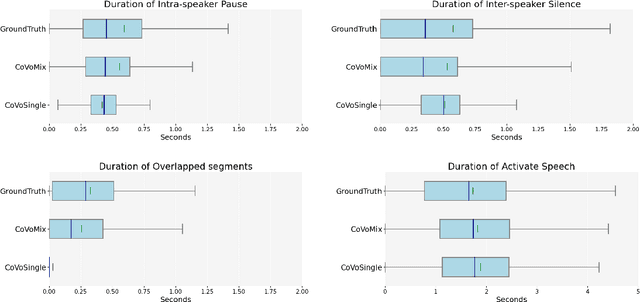
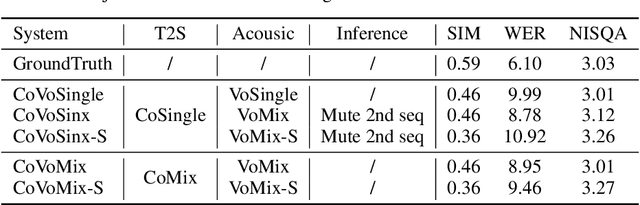
Recent advancements in zero-shot text-to-speech (TTS) modeling have led to significant strides in generating high-fidelity and diverse speech. However, dialogue generation, along with achieving human-like naturalness in speech, continues to be a challenge in the field. In this paper, we introduce CoVoMix: Conversational Voice Mixture Generation, a novel model for zero-shot, human-like, multi-speaker, multi-round dialogue speech generation. CoVoMix is capable of first converting dialogue text into multiple streams of discrete tokens, with each token stream representing semantic information for individual talkers. These token streams are then fed into a flow-matching based acoustic model to generate mixed mel-spectrograms. Finally, the speech waveforms are produced using a HiFi-GAN model. Furthermore, we devise a comprehensive set of metrics for measuring the effectiveness of dialogue modeling and generation. Our experimental results show that CoVoMix can generate dialogues that are not only human-like in their naturalness and coherence but also involve multiple talkers engaging in multiple rounds of conversation. These dialogues, generated within a single channel, are characterized by seamless speech transitions, including overlapping speech, and appropriate paralinguistic behaviors such as laughter. Audio samples are available at https://aka.ms/covomix.
Advanced Long-Content Speech Recognition With Factorized Neural Transducer
Mar 20, 2024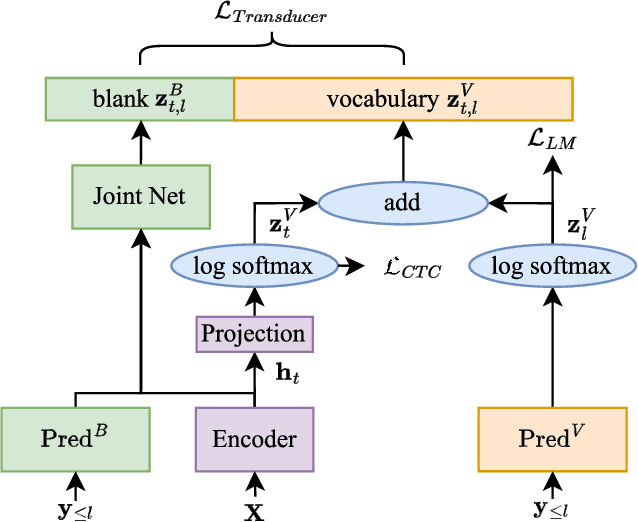
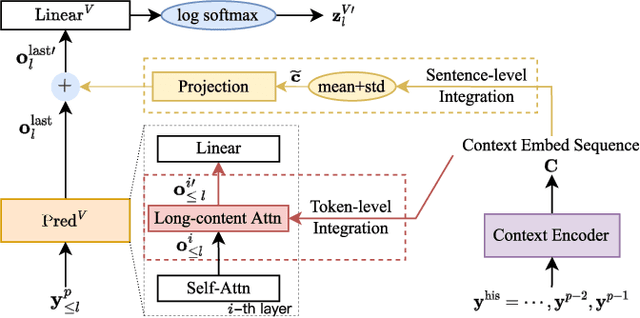
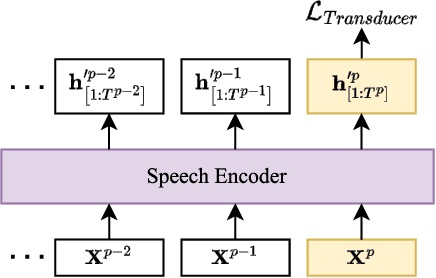
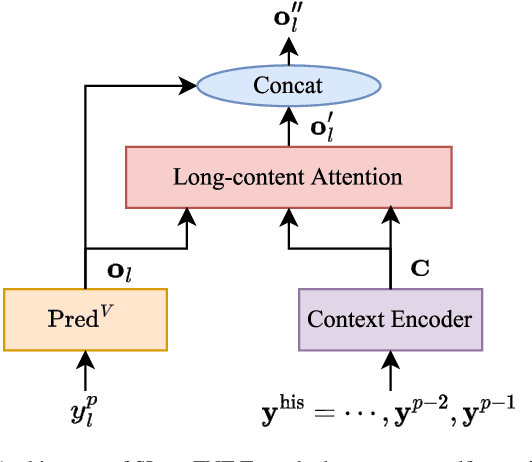
In this paper, we propose two novel approaches, which integrate long-content information into the factorized neural transducer (FNT) based architecture in both non-streaming (referred to as LongFNT ) and streaming (referred to as SLongFNT ) scenarios. We first investigate whether long-content transcriptions can improve the vanilla conformer transducer (C-T) models. Our experiments indicate that the vanilla C-T models do not exhibit improved performance when utilizing long-content transcriptions, possibly due to the predictor network of C-T models not functioning as a pure language model. Instead, FNT shows its potential in utilizing long-content information, where we propose the LongFNT model and explore the impact of long-content information in both text (LongFNT-Text) and speech (LongFNT-Speech). The proposed LongFNT-Text and LongFNT-Speech models further complement each other to achieve better performance, with transcription history proving more valuable to the model. The effectiveness of our LongFNT approach is evaluated on LibriSpeech and GigaSpeech corpora, and obtains relative 19% and 12% word error rate reduction, respectively. Furthermore, we extend the LongFNT model to the streaming scenario, which is named SLongFNT , consisting of SLongFNT-Text and SLongFNT-Speech approaches to utilize long-content text and speech information. Experiments show that the proposed SLongFNT model achieves relative 26% and 17% WER reduction on LibriSpeech and GigaSpeech respectively while keeping a good latency, compared to the FNT baseline. Overall, our proposed LongFNT and SLongFNT highlight the significance of considering long-content speech and transcription knowledge for improving both non-streaming and streaming speech recognition systems.
* Accepted by TASLP 2024
Improving Design of Input Condition Invariant Speech Enhancement
Jan 25, 2024Building a single universal speech enhancement (SE) system that can handle arbitrary input is a demanded but underexplored research topic. Towards this ultimate goal, one direction is to build a single model that handles diverse audio duration, sampling frequencies, and microphone variations in noisy and reverberant scenarios, which we define here as "input condition invariant SE". Such a model was recently proposed showing promising performance; however, its multi-channel performance degraded severely in real conditions. In this paper we propose novel architectures to improve the input condition invariant SE model so that performance in simulated conditions remains competitive while real condition degradation is much mitigated. For this purpose, we redesign the key components that comprise such a system. First, we identify that the channel-modeling module's generalization to unseen scenarios can be sub-optimal and redesign this module. We further introduce a two-stage training strategy to enhance training efficiency. Second, we propose two novel dual-path time-frequency blocks, demonstrating superior performance with fewer parameters and computational costs compared to the existing method. All proposals combined, experiments on various public datasets validate the efficacy of the proposed model, with significantly improved performance on real conditions. Recipe with full model details is released at https://github.com/espnet/espnet.
FAT-HuBERT: Front-end Adaptive Training of Hidden-unit BERT for Distortion-Invariant Robust Speech Recognition
Nov 29, 2023
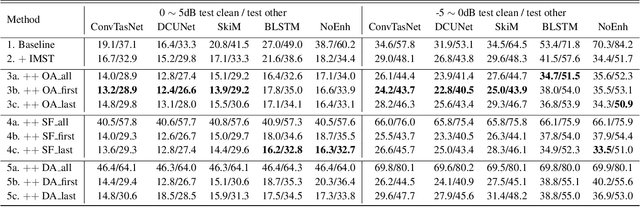
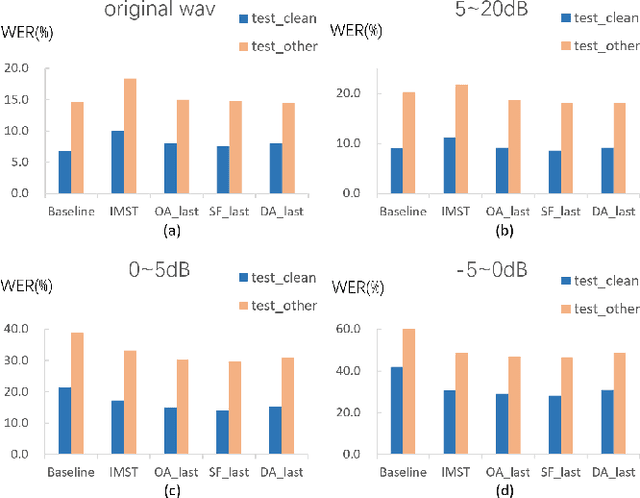
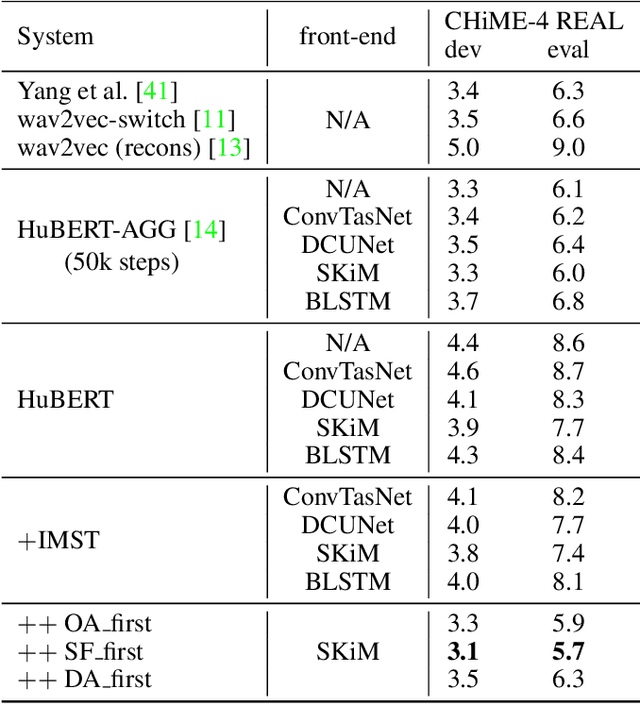
Advancements in monaural speech enhancement (SE) techniques have greatly improved the perceptual quality of speech. However, integrating these techniques into automatic speech recognition (ASR) systems has not yielded the expected performance gains, primarily due to the introduction of distortions during the SE process. In this paper, we propose a novel approach called FAT-HuBERT, which leverages distortion-invariant self-supervised learning (SSL) to enhance the robustness of ASR. To address the distortions introduced by the SE frontends, we introduce layer-wise fusion modules that incorporate features extracted from both observed noisy signals and enhanced signals. During training, the SE frontend is randomly selected from a pool of models. We evaluate the performance of FAT-HuBERT on simulated noisy speech generated from LibriSpeech as well as real-world noisy speech from the CHiME-4 1-channel dataset. The experimental results demonstrate a significant relative reduction in word error rate (WER).
Prompt-driven Target Speech Diarization
Oct 23, 2023We introduce a novel task named `target speech diarization', which seeks to determine `when target event occurred' within an audio signal. We devise a neural architecture called Prompt-driven Target Speech Diarization (PTSD), that works with diverse prompts that specify the target speech events of interest. We train and evaluate PTSD using sim2spk, sim3spk and sim4spk datasets, which are derived from the Librispeech. We show that the proposed framework accurately localizes target speech events. Furthermore, our framework exhibits versatility through its impressive performance in three diarization-related tasks: target speaker voice activity detection, overlapped speech detection and gender diarization. In particular, PTSD achieves comparable performance to specialized models across these tasks on both real and simulated data. This work serves as a reference benchmark and provides valuable insights into prompt-driven target speech processing.