 Add to Chrome
 Add to Firefox
 Add to Edge
Think Thrice Before You Act: Progressive Thought Refinement in Large Language Models
Oct 17, 2024
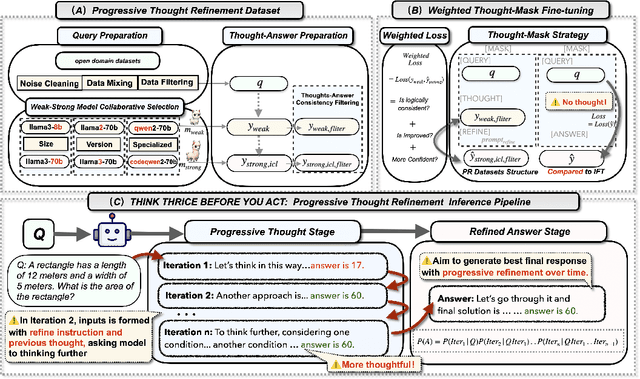
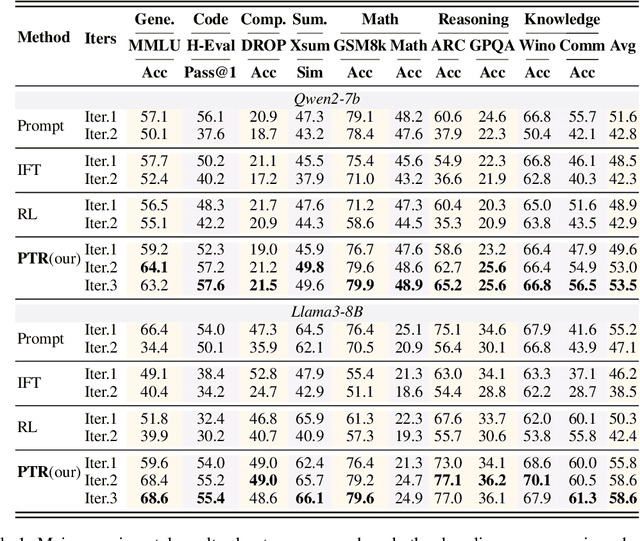
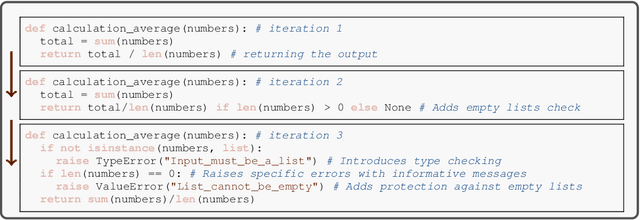
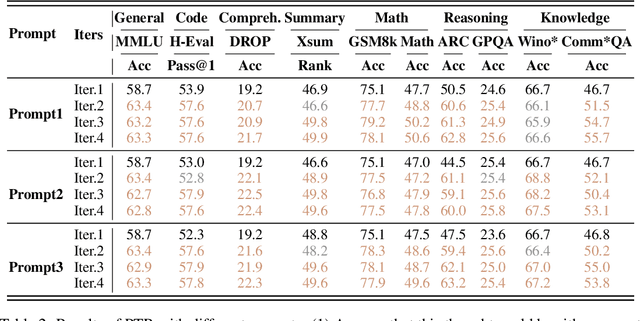
Recent advancements in large language models (LLMs) have demonstrated that progressive refinement, rather than providing a single answer, results in more accurate and thoughtful outputs. However, existing methods often rely heavily on supervision signals to evaluate previous responses, making it difficult to assess output quality in more open-ended scenarios effectively. Additionally, these methods are typically designed for specific tasks, which limits their generalization to new domains. To address these limitations, we propose Progressive Thought Refinement (PTR), a framework that enables LLMs to refine their responses progressively. PTR operates in two phases: (1) Thought data construction stage: We propose a weak and strong model collaborative selection strategy to build a high-quality progressive refinement dataset to ensure logical consistency from thought to answers, and the answers are gradually refined in each round. (2) Thought-Mask Fine-Tuning Phase: We design a training structure to mask the "thought" and adjust loss weights to encourage LLMs to refine prior thought, teaching them to implicitly understand "how to improve" rather than "what is correct." Experimental results show that PTR significantly enhances LLM performance across ten diverse tasks (avg. from 49.6% to 53.5%) without task-specific fine-tuning. Notably, in more open-ended tasks, LLMs also demonstrate substantial improvements in the quality of responses beyond mere accuracy, suggesting that PTR truly teaches LLMs to self-improve over time.

Revealing the Barriers of Language Agents in Planning
Oct 16, 2024
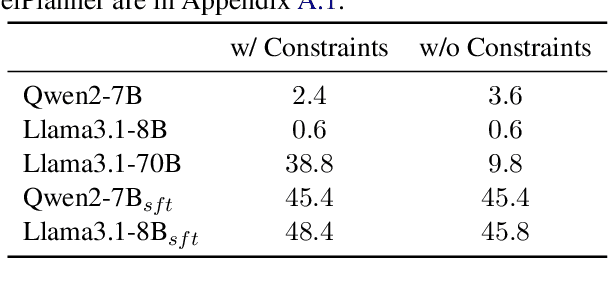


Autonomous planning has been an ongoing pursuit since the inception of artificial intelligence. Based on curated problem solvers, early planning agents could deliver precise solutions for specific tasks but lacked generalization. The emergence of large language models (LLMs) and their powerful reasoning capabilities has reignited interest in autonomous planning by automatically generating reasonable solutions for given tasks. However, prior research and our experiments show that current language agents still lack human-level planning abilities. Even the state-of-the-art reasoning model, OpenAI o1, achieves only 15.6% on one of the complex real-world planning benchmarks. This highlights a critical question: What hinders language agents from achieving human-level planning? Although existing studies have highlighted weak performance in agent planning, the deeper underlying issues and the mechanisms and limitations of the strategies proposed to address them remain insufficiently understood. In this work, we apply the feature attribution study and identify two key factors that hinder agent planning: the limited role of constraints and the diminishing influence of questions. We also find that although current strategies help mitigate these challenges, they do not fully resolve them, indicating that agents still have a long way to go before reaching human-level intelligence.
Evaluating Semantic Variation in Text-to-Image Synthesis: A Causal Perspective
Oct 14, 2024

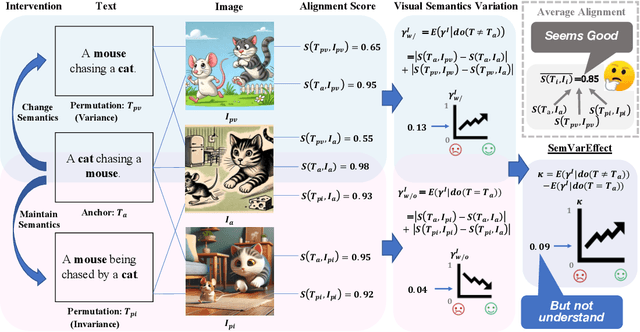

Accurate interpretation and visualization of human instructions are crucial for text-to-image (T2I) synthesis. However, current models struggle to capture semantic variations from word order changes, and existing evaluations, relying on indirect metrics like text-image similarity, fail to reliably assess these challenges. This often obscures poor performance on complex or uncommon linguistic patterns by the focus on frequent word combinations. To address these deficiencies, we propose a novel metric called SemVarEffect and a benchmark named SemVarBench, designed to evaluate the causality between semantic variations in inputs and outputs in T2I synthesis. Semantic variations are achieved through two types of linguistic permutations, while avoiding easily predictable literal variations. Experiments reveal that the CogView-3-Plus and Ideogram 2 performed the best, achieving a score of 0.2/1. Semantic variations in object relations are less understood than attributes, scoring 0.07/1 compared to 0.17-0.19/1. We found that cross-modal alignment in UNet or Transformers plays a crucial role in handling semantic variations, a factor previously overlooked by a focus on textual encoders. Our work establishes an effective evaluation framework that advances the T2I synthesis community's exploration of human instruction understanding.
SEGMENT+: Long Text Processing with Short-Context Language Models
Oct 09, 2024


There is a growing interest in expanding the input capacity of language models (LMs) across various domains. However, simply increasing the context window does not guarantee robust performance across diverse long-input processing tasks, such as understanding extensive documents and extracting detailed information from lengthy and noisy data. In response, we introduce SEGMENT+, a general framework that enables LMs to handle extended inputs within limited context windows efficiently. SEGMENT+ utilizes structured notes and a filtering module to manage information flow, resulting in a system that is both controllable and interpretable. Our extensive experiments across various model sizes, focusing on long-document question-answering and Needle-in-a-Haystack tasks, demonstrate the effectiveness of SEGMENT+ in improving performance.
TravelAgent: An AI Assistant for Personalized Travel Planning
Sep 12, 2024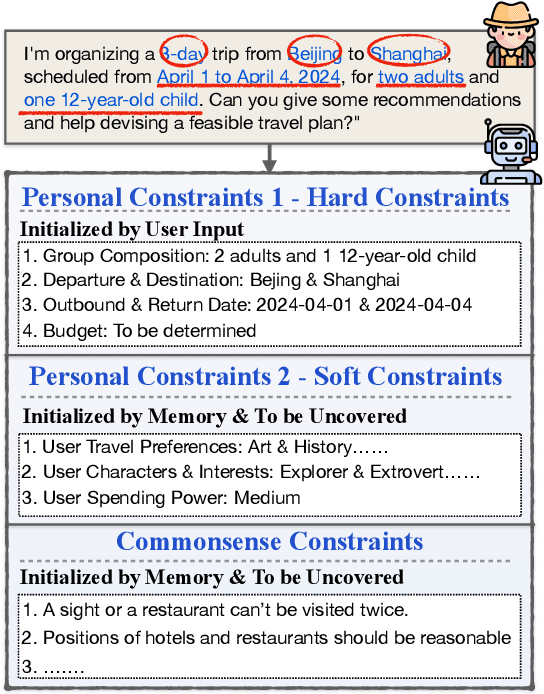

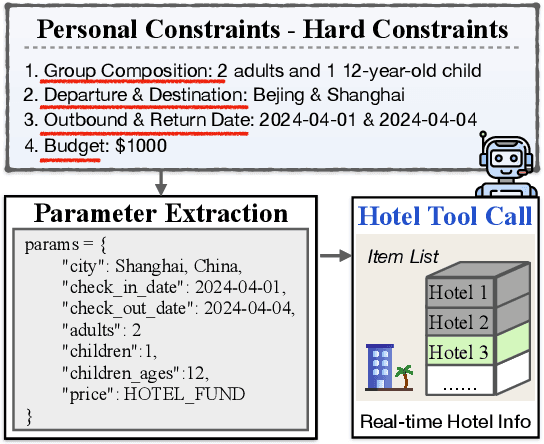

As global tourism expands and artificial intelligence technology advances, intelligent travel planning services have emerged as a significant research focus. Within dynamic real-world travel scenarios with multi-dimensional constraints, services that support users in automatically creating practical and customized travel itineraries must address three key objectives: Rationality, Comprehensiveness, and Personalization. However, existing systems with rule-based combinations or LLM-based planning methods struggle to fully satisfy these criteria. To overcome the challenges, we introduce TravelAgent, a travel planning system powered by large language models (LLMs) designed to provide reasonable, comprehensive, and personalized travel itineraries grounded in dynamic scenarios. TravelAgent comprises four modules: Tool-usage, Recommendation, Planning, and Memory Module. We evaluate TravelAgent's performance with human and simulated users, demonstrating its overall effectiveness in three criteria and confirming the accuracy of personalized recommendations.
LLM-GAN: Construct Generative Adversarial Network Through Large Language Models For Explainable Fake News Detection
Sep 03, 2024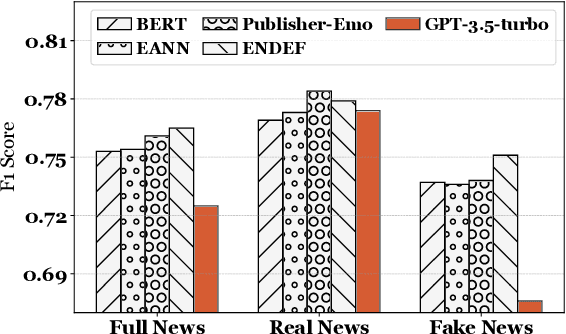


Explainable fake news detection predicts the authenticity of news items with annotated explanations. Today, Large Language Models (LLMs) are known for their powerful natural language understanding and explanation generation abilities. However, presenting LLMs for explainable fake news detection remains two main challenges. Firstly, fake news appears reasonable and could easily mislead LLMs, leaving them unable to understand the complex news-faking process. Secondly, utilizing LLMs for this task would generate both correct and incorrect explanations, which necessitates abundant labor in the loop. In this paper, we propose LLM-GAN, a novel framework that utilizes prompting mechanisms to enable an LLM to become Generator and Detector and for realistic fake news generation and detection. Our results demonstrate LLM-GAN's effectiveness in both prediction performance and explanation quality. We further showcase the integration of LLM-GAN to a cloud-native AI platform to provide better fake news detection service in the cloud.
LUK: Empowering Log Understanding with Expert Knowledge from Large Language Models
Sep 03, 2024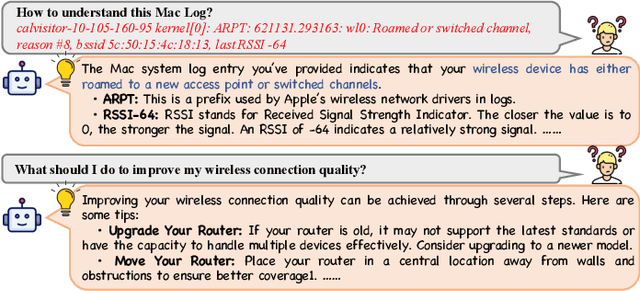
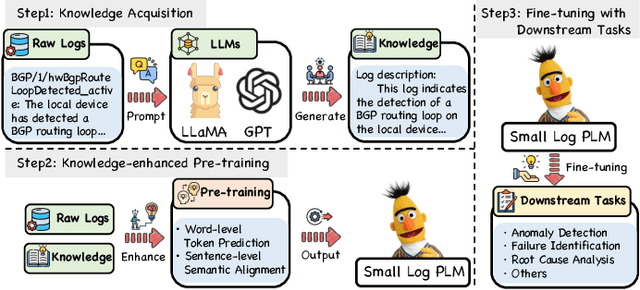
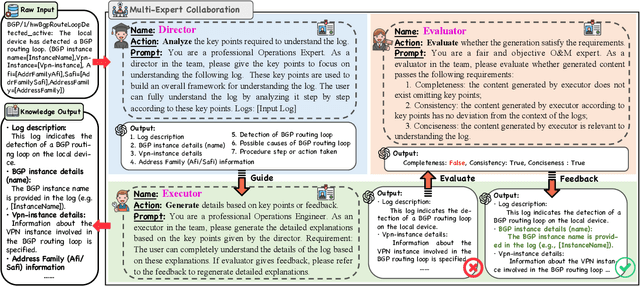
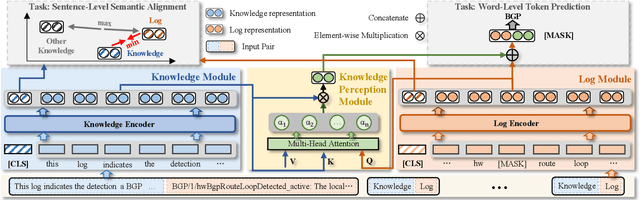
Logs play a critical role in providing essential information for system monitoring and troubleshooting. Recently, with the success of pre-trained language models (PLMs) and large language models (LLMs) in natural language processing (NLP), smaller PLMs (such as BERT) and LLMs (like ChatGPT) have become the current mainstream approaches for log analysis. While LLMs possess rich knowledge, their high computational costs and unstable performance make LLMs impractical for analyzing logs directly. In contrast, smaller PLMs can be fine-tuned for specific tasks even with limited computational resources, making them more practical. However, these smaller PLMs face challenges in understanding logs comprehensively due to their limited expert knowledge. To better utilize the knowledge embedded within LLMs for log understanding, this paper introduces a novel knowledge enhancement framework, called LUK, which acquires expert knowledge from LLMs to empower log understanding on a smaller PLM. Specifically, we design a multi-expert collaboration framework based on LLMs consisting of different roles to acquire expert knowledge. In addition, we propose two novel pre-training tasks to enhance the log pre-training with expert knowledge. LUK achieves state-of-the-art results on different log analysis tasks and extensive experiments demonstrate expert knowledge from LLMs can be utilized more effectively to understand logs.
Dr.Academy: A Benchmark for Evaluating Questioning Capability in Education for Large Language Models
Aug 20, 2024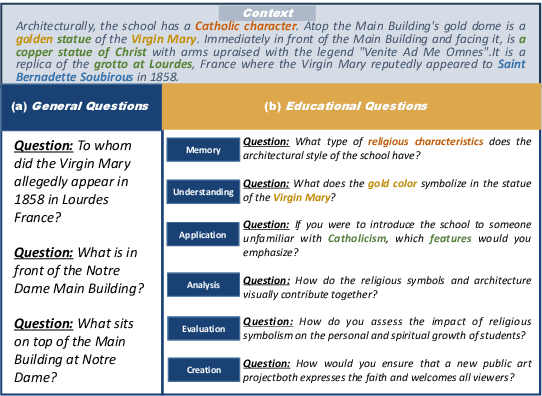

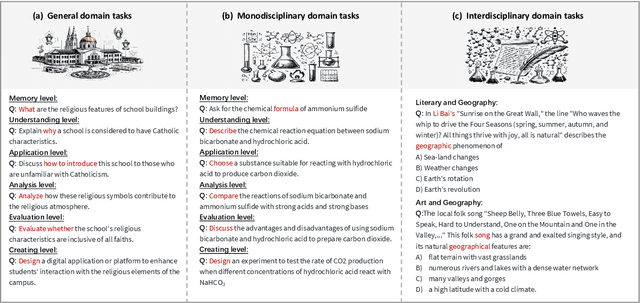

Teachers are important to imparting knowledge and guiding learners, and the role of large language models (LLMs) as potential educators is emerging as an important area of study. Recognizing LLMs' capability to generate educational content can lead to advances in automated and personalized learning. While LLMs have been tested for their comprehension and problem-solving skills, their capability in teaching remains largely unexplored. In teaching, questioning is a key skill that guides students to analyze, evaluate, and synthesize core concepts and principles. Therefore, our research introduces a benchmark to evaluate the questioning capability in education as a teacher of LLMs through evaluating their generated educational questions, utilizing Anderson and Krathwohl's taxonomy across general, monodisciplinary, and interdisciplinary domains. We shift the focus from LLMs as learners to LLMs as educators, assessing their teaching capability through guiding them to generate questions. We apply four metrics, including relevance, coverage, representativeness, and consistency, to evaluate the educational quality of LLMs' outputs. Our results indicate that GPT-4 demonstrates significant potential in teaching general, humanities, and science courses; Claude2 appears more apt as an interdisciplinary teacher. Furthermore, the automatic scores align with human perspectives.
XMeCap: Meme Caption Generation with Sub-Image Adaptability
Jul 24, 2024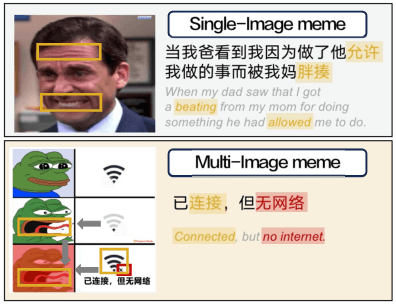
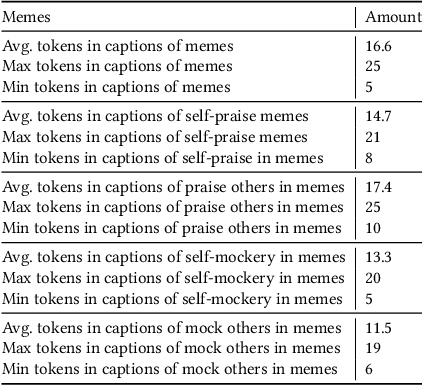
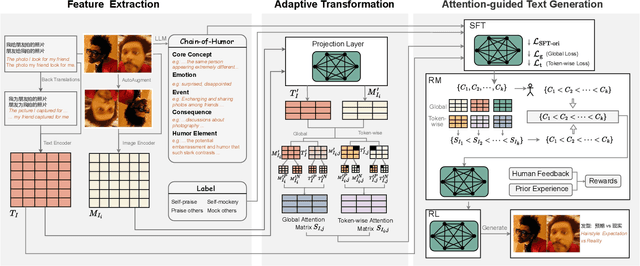
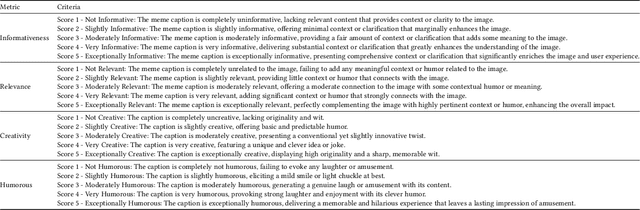
Humor, deeply rooted in societal meanings and cultural details, poses a unique challenge for machines. While advances have been made in natural language processing, real-world humor often thrives in a multi-modal context, encapsulated distinctively by memes. This paper poses a particular emphasis on the impact of multi-images on meme captioning. After that, we introduce the \textsc{XMeCap} framework, a novel approach that adopts supervised fine-tuning and reinforcement learning based on an innovative reward model, which factors in both global and local similarities between visuals and text. Our results, benchmarked against contemporary models, manifest a marked improvement in caption generation for both single-image and multi-image memes, as well as different meme categories. \textsc{XMeCap} achieves an average evaluation score of 75.85 for single-image memes and 66.32 for multi-image memes, outperforming the best baseline by 3.71\% and 4.82\%, respectively. This research not only establishes a new frontier in meme-related studies but also underscores the potential of machines in understanding and generating humor in a multi-modal setting.
MAPO: Boosting Large Language Model Performance with Model-Adaptive Prompt Optimization
Jul 04, 2024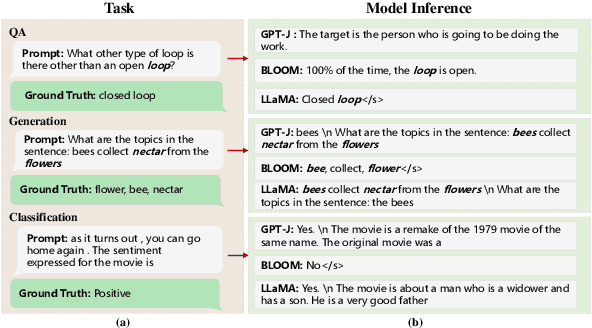
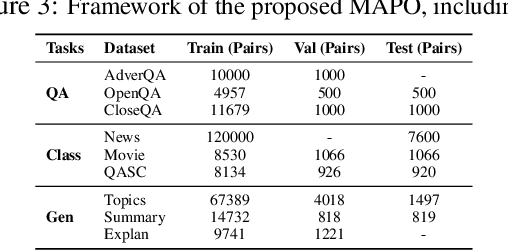


Prompt engineering, as an efficient and effective way to leverage Large Language Models (LLM), has drawn a lot of attention from the research community. The existing research primarily emphasizes the importance of adapting prompts to specific tasks, rather than specific LLMs. However, a good prompt is not solely defined by its wording, but also binds to the nature of the LLM in question. In this work, we first quantitatively demonstrate that different prompts should be adapted to different LLMs to enhance their capabilities across various downstream tasks in NLP. Then we novelly propose a model-adaptive prompt optimizer (MAPO) method that optimizes the original prompts for each specific LLM in downstream tasks. Extensive experiments indicate that the proposed method can effectively refine prompts for an LLM, leading to significant improvements over various downstream tasks.