 Add to Chrome
 Add to Firefox
 Add to Edge
From Isolated Tasks to Structured Capabilities: A Multilayer Taxonomy for Large Language Models
Jul 24, 2026
Large language model (LLM) evaluation spans diverse tasks and benchmarks, yet evidence remains organized around tasks rather than the capabilities they probe. This fragmentation limits cross-study comparison, obscures capabilities tasks recruit, and makes coverage gaps difficult to identify. We introduce a multi-layer taxonomy of 14 capability domains and 91 subskills across Primitive, Constructed, and Integrative layers. Human cognitive science guides capability definition and organization, not LLM architecture. Layer assignments draw on developmental precedence and hypothesized functional support, while human-origin constructs are adapted to observable model behavior. To demonstrate operational utility, we screened 31,505 papers from ACL, AAAI, ICML, and NeurIPS between 2023 and 2025 and mapped 15,934 LLM-focused papers through multi-model annotation, consensus, and arbitration. Direct research attention concentrated on Language-Semantic Competence (3,551; 22.3%), Reasoning (3,388; 21.3%), Planning and Decision-Making (2,149; 13.5%), and Perception (1,954; 12.3%), whereas six domains appeared in fewer than 2% of papers. Within domains, the most frequent subskill had a median prevalence of 97.9% and appeared in at least 90% of papers in 10 of 14 domains. Language-Semantic Competence and Reasoning formed the highest-volume pair (n = 1,864; 11.7%; lift = 2.47), whereas Theory of Mind and Social Reasoning and Interaction showed the highest lift among pairs with at least 20 co-occurrences (n = 62; lift = 30.84). By shifting the unit of analysis from isolated tasks to structured capabilities, the taxonomy supports research organization, coverage audits, evaluation interpretation, and testable hypotheses for diagnosis, training, and transfer.

When RAG Meets Query Planning: Logical Query Trees for Resolving Exploratory Reasoning Problems
Jul 01, 2026Retrieval-Augmented Generation (RAG) effectively grounds large language models (LLMs) in external knowledge but struggles with \textbf{exploratory reasoning problems (ERPs)} that are the complex queries involving high uncertainty and ambiguity. Resolving ERPs requires complex reasoning with unclear paths, tending to result in retrieval noise and error accumulation. Furthermore, the absence of an end-to-end planning mechanism makes it difficult to generate effective trajectories for ERPs. Motivated by database query planning, we introduce \emph{PlanRAG}, an RAG framework that models ERPs of natural language as \textbf{logical query trees (LQTs)}. However, translating ERPs into LQTs is non-trivial due to representation and optimization gaps between structured SQL and unstructured natural language, making it highly challenging to construct high-quality LQTs. To address these problems, we first decompose ERPs into atomic queries and then organize them into LQTs using dynamic programming guided by a cost model involving multiple complementary dimensions. Finally, we execute iterative aggregation, rewriting, retrieval, and generation over LQTs, processing nodes concurrently and propagating intermediate results upward, with further parallelization across multiple threads for efficiency. Our experimental results show that PlanRAG outperforms state-of-the-art iteration-based and graph-based RAG systems on our newly constructed dataset, \textbf{WikiWeb-ERP}, thereby providing a new formulation for optimizing natural language queries. Our source code and dataset are available at https://anonymous.4open.science/r/PlanRAG-main-B2C8/.
ADaPT: Token-Level Decoupling for Efficient Large Reasoning Models
Jun 18, 2026Large reasoning models rely on long chain-of-thought to achieve strong performance, but applying such reasoning uniformly incurs high computational cost. Existing efficiency-oriented methods attempt to shorten or mix reasoning strategies, yet often degrade reasoning capability. We identify the root cause as sequence-level coupling between efficiency incentives and correctness optimization, which implicitly penalizes long but correct reasoning trajectories. To address this issue, we propose Adaptive Dual-Process Thinking (ADaPT), a token-level dual-process framework that explicitly decouples efficiency and correctness signals during training. ADaPT introduces a mode-selection token to control fast and slow reasoning, applying efficiency-related rewards exclusively to this token to avoid penalizing correct long reasoning while encouraging efficiency when appropriate. Moreover, ADaPT enables precise and continuous control over the efficiency-performance trade-off at inference time: by adjusting the generation probability of the mode-selection token, a single trained model can smoothly move along the efficiency-performance Pareto frontier. Extensive experiments demonstrate that ADaPT significantly reduces inference cost while maintaining strong reasoning performance across multiple benchmarks.
SEA-Eval: A Benchmark for Evaluating Self-Evolving Agents Beyond Episodic Assessment
Apr 14, 2026Current LLM-based agents demonstrate strong performance in episodic task execution but remain constrained by static toolsets and episodic amnesia, failing to accumulate experience across task boundaries. This paper presents the first formal definition of the Self-Evolving Agent (SEA), formalizes the Evolutionary Flywheel as its minimal sufficient architecture, and introduces SEA-Eval -- the first benchmark designed specifically for evaluating SEAs. Grounded in Flywheel theory, SEA-Eval establishes $SR$ and $T$ as primary metrics and enables through sequential task stream design the independent quantification of evolutionary gain, evolutionary stability, and implicit alignment convergence. Empirical evaluation reveals that under identical success rates, token consumption differs by up to 31.2$\times$ across frameworks, with divergent evolutionary trajectories under sequential analysis -- demonstrating that success rate alone creates a capability illusion and that the sequential convergence of $T$ is the key criterion for distinguishing genuine evolution from pseudo-evolution.
ComLQ: Benchmarking Complex Logical Queries in Information Retrieval
Nov 15, 2025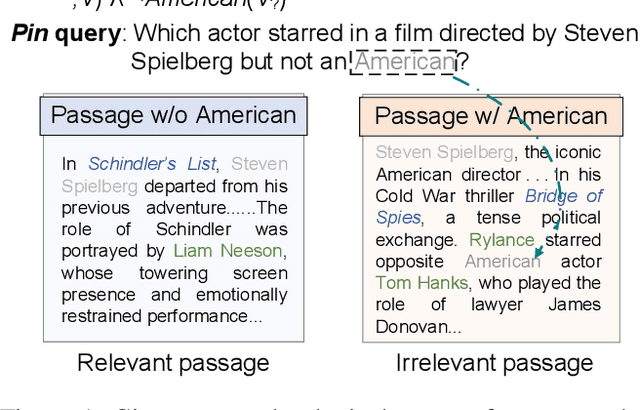

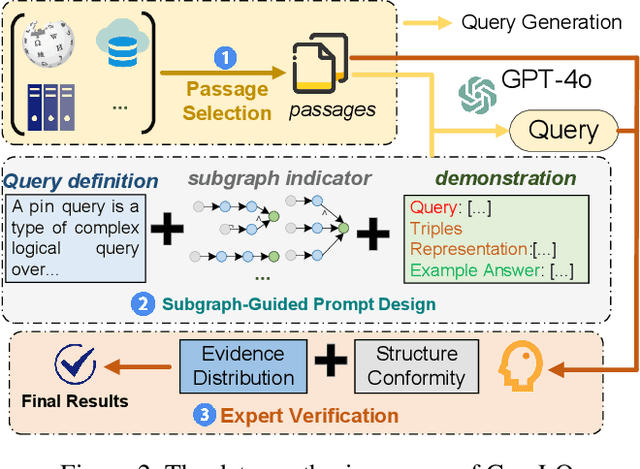
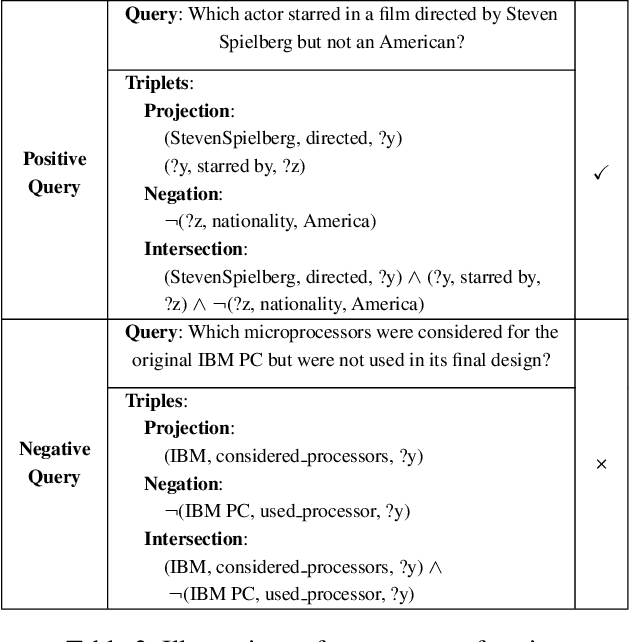
Information retrieval (IR) systems play a critical role in navigating information overload across various applications. Existing IR benchmarks primarily focus on simple queries that are semantically analogous to single- and multi-hop relations, overlooking \emph{complex logical queries} involving first-order logic operations such as conjunction ($\land$), disjunction ($\lor$), and negation ($\lnot$). Thus, these benchmarks can not be used to sufficiently evaluate the performance of IR models on complex queries in real-world scenarios. To address this problem, we propose a novel method leveraging large language models (LLMs) to construct a new IR dataset \textbf{ComLQ} for \textbf{Com}plex \textbf{L}ogical \textbf{Q}ueries, which comprises 2,909 queries and 11,251 candidate passages. A key challenge in constructing the dataset lies in capturing the underlying logical structures within unstructured text. Therefore, by designing the subgraph-guided prompt with the subgraph indicator, an LLM (such as GPT-4o) is guided to generate queries with specific logical structures based on selected passages. All query-passage pairs in ComLQ are ensured \emph{structure conformity} and \emph{evidence distribution} through expert annotation. To better evaluate whether retrievers can handle queries with negation, we further propose a new evaluation metric, \textbf{Log-Scaled Negation Consistency} (\textbf{LSNC@$K$}). As a supplement to standard relevance-based metrics (such as nDCG and mAP), LSNC@$K$ measures whether top-$K$ retrieved passages violate negation conditions in queries. Our experimental results under zero-shot settings demonstrate existing retrieval models' limited performance on complex logical queries, especially on queries with negation, exposing their inferior capabilities of modeling exclusion.
Why Did Apple Fall To The Ground: Evaluating Curiosity In Large Language Model
Oct 23, 2025Curiosity serves as a pivotal conduit for human beings to discover and learn new knowledge. Recent advancements of large language models (LLMs) in natural language processing have sparked discussions regarding whether these models possess capability of curiosity-driven learning akin to humans. In this paper, starting from the human curiosity assessment questionnaire Five-Dimensional Curiosity scale Revised (5DCR), we design a comprehensive evaluation framework that covers dimensions such as Information Seeking, Thrill Seeking, and Social Curiosity to assess the extent of curiosity exhibited by LLMs. The results demonstrate that LLMs exhibit a stronger thirst for knowledge than humans but still tend to make conservative choices when faced with uncertain environments. We further investigated the relationship between curiosity and thinking of LLMs, confirming that curious behaviors can enhance the model's reasoning and active learning abilities. These findings suggest that LLMs have the potential to exhibit curiosity similar to that of humans, providing experimental support for the future development of learning capabilities and innovative research in LLMs.
HINT: Helping Ineffective Rollouts Navigate Towards Effectiveness
Oct 10, 2025Reinforcement Learning (RL) has become a key driver for enhancing the long chain-of-thought (CoT) reasoning capabilities of Large Language Models (LLMs). However, prevalent methods like GRPO often fail when task difficulty exceeds the model's capacity, leading to reward sparsity and inefficient training. While prior work attempts to mitigate this using off-policy data, such as mixing RL with Supervised Fine-Tuning (SFT) or using hints, they often misguide policy updates In this work, we identify a core issue underlying these failures, which we term low training affinity. This condition arises from a large distributional mismatch between external guidance and the model's policy. To diagnose this, we introduce Affinity, the first quantitative metric for monitoring exploration efficiency and training stability. To improve Affinity, we propose HINT: Helping Ineffective rollouts Navigate Towards effectiveness, an adaptive hinting framework. Instead of providing direct answers, HINT supplies heuristic hints that guide the model to discover solutions on its own, preserving its autonomous reasoning capabilities. Extensive experiments on mathematical reasoning tasks show that HINT consistently outperforms existing methods, achieving state-of-the-art results with models of various scales, while also demonstrating significantly more stable learning and greater data efficiency.Code is available on Github.
CultureScope: A Dimensional Lens for Probing Cultural Understanding in LLMs
Sep 19, 2025As large language models (LLMs) are increasingly deployed in diverse cultural environments, evaluating their cultural understanding capability has become essential for ensuring trustworthy and culturally aligned applications. However, most existing benchmarks lack comprehensiveness and are challenging to scale and adapt across different cultural contexts, because their frameworks often lack guidance from well-established cultural theories and tend to rely on expert-driven manual annotations. To address these issues, we propose CultureScope, the most comprehensive evaluation framework to date for assessing cultural understanding in LLMs. Inspired by the cultural iceberg theory, we design a novel dimensional schema for cultural knowledge classification, comprising 3 layers and 140 dimensions, which guides the automated construction of culture-specific knowledge bases and corresponding evaluation datasets for any given languages and cultures. Experimental results demonstrate that our method can effectively evaluate cultural understanding. They also reveal that existing large language models lack comprehensive cultural competence, and merely incorporating multilingual data does not necessarily enhance cultural understanding. All code and data files are available at https://github.com/HoganZinger/Culture
AdaptiveLog: An Adaptive Log Analysis Framework with the Collaboration of Large and Small Language Model
Jan 19, 2025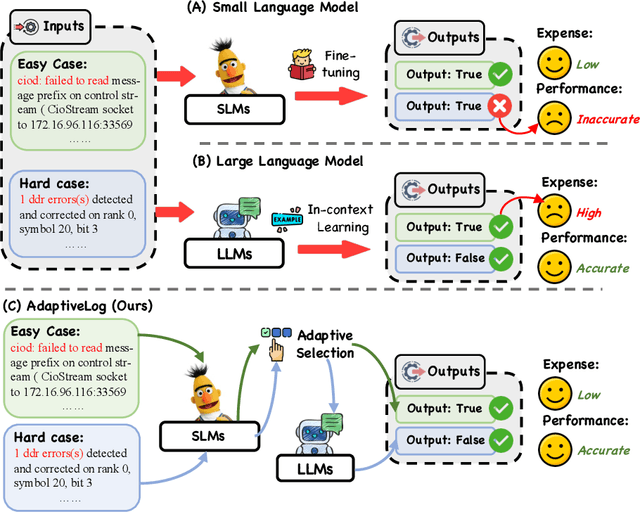
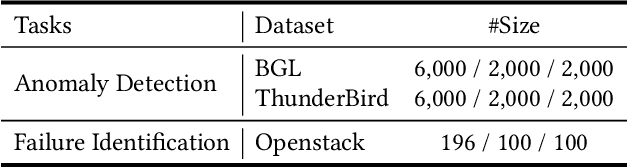
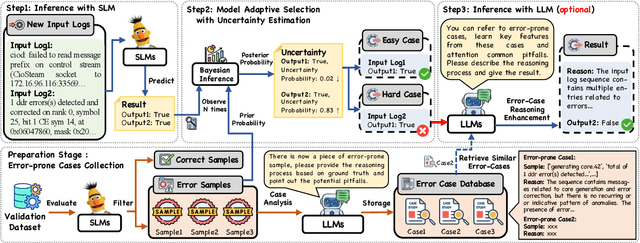
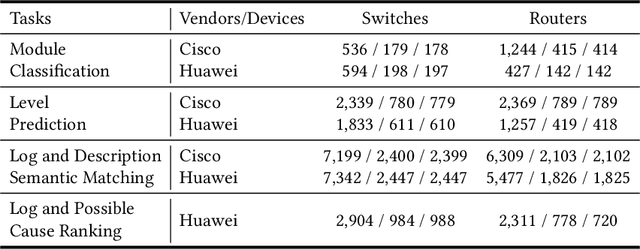
Automated log analysis is crucial to ensure high availability and reliability of complex systems. The advent of LLMs in NLP has ushered in a new era of language model-driven automated log analysis, garnering significant interest. Within this field, two primary paradigms based on language models for log analysis have become prominent. Small Language Models (SLMs) follow the pre-train and fine-tune paradigm, focusing on the specific log analysis task through fine-tuning on supervised datasets. On the other hand, LLMs following the in-context learning paradigm, analyze logs by providing a few examples in prompt contexts without updating parameters. Despite their respective strengths, we notice that SLMs are more cost-effective but less powerful, whereas LLMs with large parameters are highly powerful but expensive and inefficient. To trade-off between the performance and inference costs of both models in automated log analysis, this paper introduces an adaptive log analysis framework known as AdaptiveLog, which effectively reduces the costs associated with LLM while ensuring superior results. This framework collaborates an LLM and a small language model, strategically allocating the LLM to tackle complex logs while delegating simpler logs to the SLM. Specifically, to efficiently query the LLM, we propose an adaptive selection strategy based on the uncertainty estimation of the SLM, where the LLM is invoked only when the SLM is uncertain. In addition, to enhance the reasoning ability of the LLM in log analysis tasks, we propose a novel prompt strategy by retrieving similar error-prone cases as the reference, enabling the model to leverage past error experiences and learn solutions from these cases. Extensive experiments demonstrate that AdaptiveLog achieves state-of-the-art results across different tasks, elevating the overall accuracy of log analysis while maintaining cost efficiency.
EDGE: Enhanced Grounded GUI Understanding with Enriched Multi-Granularity Synthetic Data
Oct 25, 2024Autonomous agents operating on the graphical user interfaces (GUIs) of various applications hold immense practical value. Unlike the large language model (LLM)-based methods which rely on structured texts and customized backends, the approaches using large vision-language models (LVLMs) are more intuitive and adaptable as they can visually perceive and directly interact with screens, making them indispensable in general scenarios without text metadata and tailored backends. Given the lack of high-quality training data for GUI-related tasks in existing work, this paper aims to enhance the GUI understanding and interacting capabilities of LVLMs through a data-driven approach. We propose EDGE, a general data synthesis framework that automatically generates large-scale, multi-granularity training data from webpages across the Web. Evaluation results on various GUI and agent benchmarks demonstrate that the model trained with the dataset generated through EDGE exhibits superior webpage understanding capabilities, which can then be easily transferred to previously unseen desktop and mobile environments. Our approach significantly reduces the dependence on manual annotations, empowering researchers to harness the vast public resources available on the Web to advance their work. Our source code, the dataset and the model are available at https://anonymous.4open.science/r/EDGE-1CDB.