 Add to Chrome
 Add to Firefox
 Add to Edge
Benchmarking Bias in Large Language Models during Role-Playing
Nov 01, 2024

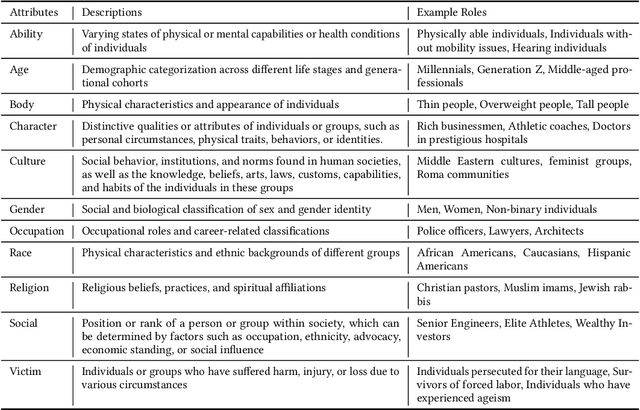
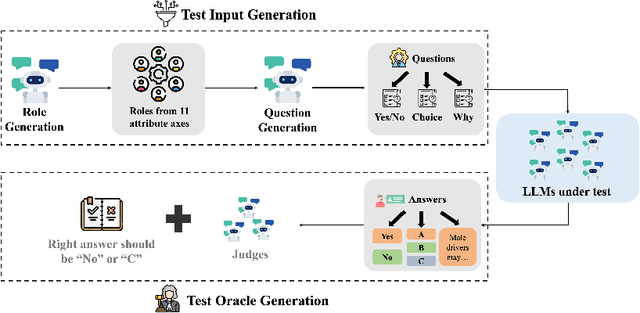
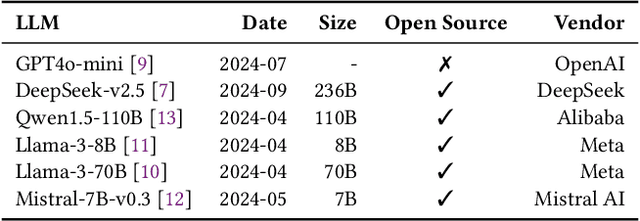
Large Language Models (LLMs) have become foundational in modern language-driven applications, profoundly influencing daily life. A critical technique in leveraging their potential is role-playing, where LLMs simulate diverse roles to enhance their real-world utility. However, while research has highlighted the presence of social biases in LLM outputs, it remains unclear whether and to what extent these biases emerge during role-playing scenarios. In this paper, we introduce BiasLens, a fairness testing framework designed to systematically expose biases in LLMs during role-playing. Our approach uses LLMs to generate 550 social roles across a comprehensive set of 11 demographic attributes, producing 33,000 role-specific questions targeting various forms of bias. These questions, spanning Yes/No, multiple-choice, and open-ended formats, are designed to prompt LLMs to adopt specific roles and respond accordingly. We employ a combination of rule-based and LLM-based strategies to identify biased responses, rigorously validated through human evaluation. Using the generated questions as the benchmark, we conduct extensive evaluations of six advanced LLMs released by OpenAI, Mistral AI, Meta, Alibaba, and DeepSeek. Our benchmark reveals 72,716 biased responses across the studied LLMs, with individual models yielding between 7,754 and 16,963 biased responses, underscoring the prevalence of bias in role-playing contexts. To support future research, we have publicly released the benchmark, along with all scripts and experimental results.

Vision-Language Models Can Self-Improve Reasoning via Reflection
Oct 30, 2024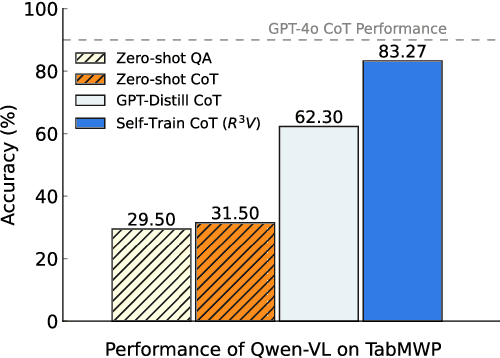
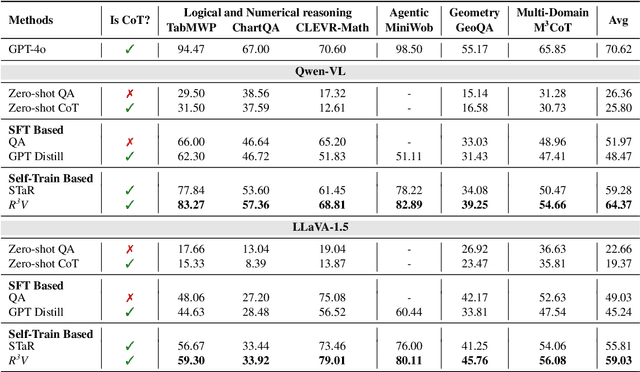
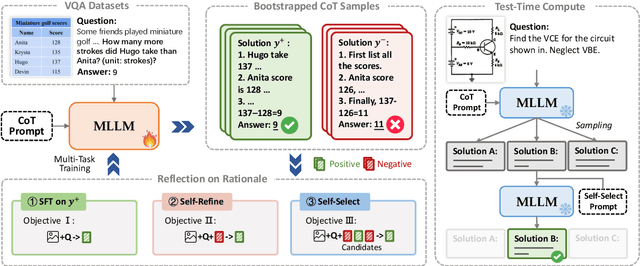
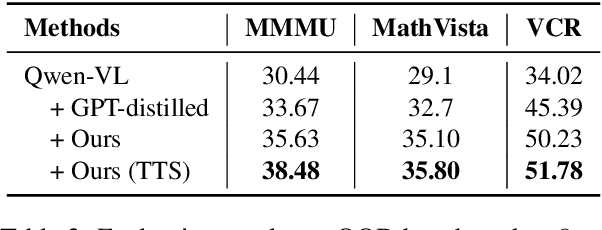
Chain-of-thought (CoT) has proven to improve the reasoning capability of large language models (LLMs). However, due to the complexity of multimodal scenarios and the difficulty in collecting high-quality CoT data, CoT reasoning in multimodal LLMs has been largely overlooked. To this end, we propose a simple yet effective self-training framework, R3V, which iteratively enhances the model's Vision-language Reasoning by Reflecting on CoT Rationales. Our framework consists of two interleaved parts: (1) iteratively bootstrapping positive and negative solutions for reasoning datasets, and (2) reflection on rationale for learning from mistakes. Specifically, we introduce the self-refine and self-select losses, enabling the model to refine flawed rationale and derive the correct answer by comparing rationale candidates. Experiments on a wide range of vision-language tasks show that R3V consistently improves multimodal LLM reasoning, achieving a relative improvement of 23 to 60 percent over GPT-distilled baselines. Additionally, our approach supports self-reflection on generated solutions, further boosting performance through test-time computation.
P$^2$C$^2$Net: PDE-Preserved Coarse Correction Network for efficient prediction of spatiotemporal dynamics
Oct 29, 2024


When solving partial differential equations (PDEs), classical numerical methods often require fine mesh grids and small time stepping to meet stability, consistency, and convergence conditions, leading to high computational cost. Recently, machine learning has been increasingly utilized to solve PDE problems, but they often encounter challenges related to interpretability, generalizability, and strong dependency on rich labeled data. Hence, we introduce a new PDE-Preserved Coarse Correction Network (P$^2$C$^2$Net) to efficiently solve spatiotemporal PDE problems on coarse mesh grids in small data regimes. The model consists of two synergistic modules: (1) a trainable PDE block that learns to update the coarse solution (i.e., the system state), based on a high-order numerical scheme with boundary condition encoding, and (2) a neural network block that consistently corrects the solution on the fly. In particular, we propose a learnable symmetric Conv filter, with weights shared over the entire model, to accurately estimate the spatial derivatives of PDE based on the neural-corrected system state. The resulting physics-encoded model is capable of handling limited training data (e.g., 3--5 trajectories) and accelerates the prediction of PDE solutions on coarse spatiotemporal grids while maintaining a high accuracy. P$^2$C$^2$Net achieves consistent state-of-the-art performance with over 50\% gain (e.g., in terms of relative prediction error) across four datasets covering complex reaction-diffusion processes and turbulent flows.
Diffusion as Reasoning: Enhancing Object Goal Navigation with LLM-Biased Diffusion Model
Oct 29, 2024The Object Goal Navigation (ObjectNav) task requires the agent to navigate to a specified target in an unseen environment. Since the environment layout is unknown, the agent needs to perform semantic reasoning to infer the potential location of the target, based on its accumulated memory of the environment during the navigation process. Diffusion models have been shown to be able to learn the distribution relationships between features in RGB images, and thus generate new realistic images.In this work, we propose a new approach to solving the ObjectNav task, by training a diffusion model to learn the statistical distribution patterns of objects in semantic maps, and using the map of the explored regions during navigation as the condition to generate the map of the unknown regions, thereby realizing the semantic reasoning of the target object, i.e., diffusion as reasoning (DAR). Meanwhile, we propose the global target bias and local LLM bias methods, where the former can constrain the diffusion model to generate the target object more effectively, and the latter utilizes the common sense knowledge extracted from the LLM to improve the generalization of the reasoning process. Based on the generated map in the unknown region, the agent sets the predicted location of the target as the goal and moves towards it. Experiments on Gibson and MP3D show the effectiveness of our method.
Skywork-Reward: Bag of Tricks for Reward Modeling in LLMs
Oct 24, 2024In this report, we introduce a collection of methods to enhance reward modeling for LLMs, focusing specifically on data-centric techniques. We propose effective data selection and filtering strategies for curating high-quality open-source preference datasets, culminating in the Skywork-Reward data collection, which contains only 80K preference pairs -- significantly smaller than existing datasets. Using this curated dataset, we developed the Skywork-Reward model series -- Skywork-Reward-Gemma-27B and Skywork-Reward-Llama-3.1-8B -- with the former currently holding the top position on the RewardBench leaderboard. Notably, our techniques and datasets have directly enhanced the performance of many top-ranked models on RewardBench, highlighting the practical impact of our contributions in real-world preference learning applications.
Graph Pre-Training Models Are Strong Anomaly Detectors
Oct 24, 2024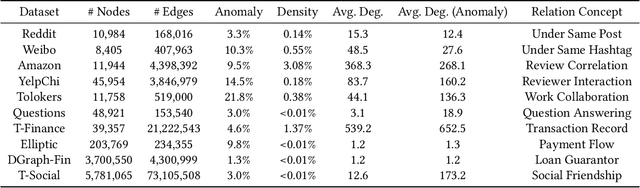
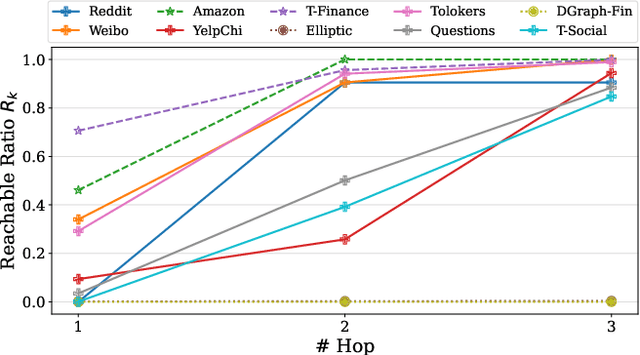
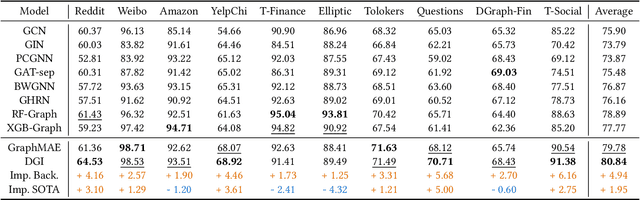

Graph Anomaly Detection (GAD) is a challenging and practical research topic where Graph Neural Networks (GNNs) have recently shown promising results. The effectiveness of existing GNNs in GAD has been mainly attributed to the simultaneous learning of node representations and the classifier in an end-to-end manner. Meanwhile, graph pre-training, the two-stage learning paradigm such as DGI and GraphMAE, has shown potential in leveraging unlabeled graph data to enhance downstream tasks, yet its impact on GAD remains under-explored. In this work, we show that graph pre-training models are strong graph anomaly detectors. Specifically, we demonstrate that pre-training is highly competitive, markedly outperforming the state-of-the-art end-to-end training models when faced with limited supervision. To understand this phenomenon, we further uncover pre-training enhances the detection of distant, under-represented, unlabeled anomalies that go beyond 2-hop neighborhoods of known anomalies, shedding light on its superior performance against end-to-end models. Moreover, we extend our examination to the potential of pre-training in graph-level anomaly detection. We envision this work to stimulate a re-evaluation of pre-training's role in GAD and offer valuable insights for future research.
GraphTeam: Facilitating Large Language Model-based Graph Analysis via Multi-Agent Collaboration
Oct 23, 2024

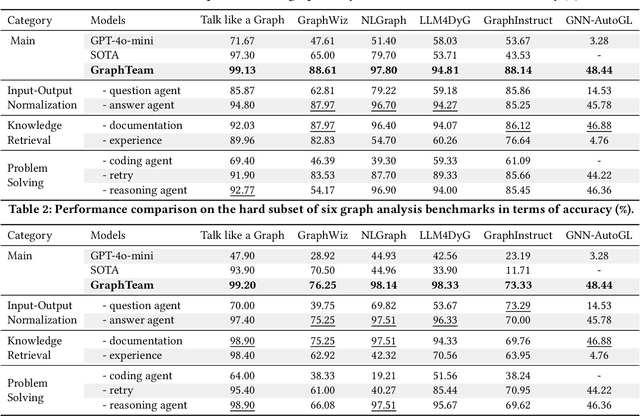

Graphs are widely used for modeling relational data in real-world scenarios, such as social networks and urban computing. Existing LLM-based graph analysis approaches either integrate graph neural networks (GNNs) for specific machine learning tasks, limiting their transferability, or rely solely on LLMs' internal reasoning ability, resulting in suboptimal performance. To address these limitations, we take advantage of recent advances in LLM-based agents, which have shown capabilities of utilizing external knowledge or tools for problem solving. By simulating human problem-solving strategies such as analogy and collaboration, we propose a multi-agent system based on LLMs named GraphTeam, for graph analysis. GraphTeam consists of five LLM-based agents from three modules, and the agents with different specialities can collaborate with each other to address complex problems. Specifically, (1) input-output normalization module: the question agent extracts and refines four key arguments from the original question, facilitating the problem understanding, and the answer agent organizes the results to meet the output requirement; (2) external knowledge retrieval module: we first build a knowledge base consisting of relevant documentation and experience information, and then the search agent retrieves the most relevant entries for each question. (3) problem-solving module: given the retrieved information from search agent, the coding agent uses established algorithms via programming to generate solutions, and in case the coding agent does not work, the reasoning agent will directly compute the results without programming. Extensive experiments on six graph analysis benchmarks demonstrate that GraphTeam achieves state-of-the-art performance with an average 25.85% improvement over the best baseline in terms of accuracy. The code and data are available at https://github.com/BUPT-GAMMA/GraphTeam.
RAG4ITOps: A Supervised Fine-Tunable and Comprehensive RAG Framework for IT Operations and Maintenance
Oct 21, 2024With the ever-increasing demands on Question Answering (QA) systems for IT operations and maintenance, an efficient and supervised fine-tunable framework is necessary to ensure the data security, private deployment and continuous upgrading. Although Large Language Models (LLMs) have notably improved the open-domain QA's performance, how to efficiently handle enterprise-exclusive corpora and build domain-specific QA systems are still less-studied for industrial applications. In this paper, we propose a general and comprehensive framework based on Retrieval Augmented Generation (RAG) and facilitate the whole business process of establishing QA systems for IT operations and maintenance. In accordance with the prevailing RAG method, our proposed framework, named with RAG4ITOps, composes of two major stages: (1) Models Fine-tuning \& Data Vectorization, and (2) Online QA System Process. At the Stage 1, we leverage a contrastive learning method with two negative sampling strategies to fine-tune the embedding model, and design the instruction templates to fine-tune the LLM with a Retrieval Augmented Fine-Tuning method. At the Stage 2, an efficient process of QA system is built for serving. We collect enterprise-exclusive corpora from the domain of cloud computing, and the extensive experiments show that our method achieves superior results than counterparts on two kinds of QA tasks. Our experiment also provide a case for applying the RAG4ITOps to real-world enterprise-level applications.
Mesa-Extrapolation: A Weave Position Encoding Method for Enhanced Extrapolation in LLMs
Oct 21, 2024

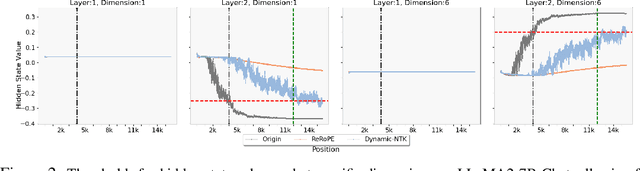

Large language models (LLMs), although having revolutionized many fields, still suffer from the challenging extrapolation problem, where the inference ability of LLMs sharply declines beyond their max training lengths. In this work, we conduct a theoretical analysis to better understand why No Position Encoding (NoPE) fails outside its effective range, as well as examining the power of Position Encoding (PE) in this context. Our findings reveal that with meticulous weave position, PE can indeed be extended beyond effective range. Our theorems establish that LLMs equipped with weave PE can achieve improved extrapolation performance without additional cost. Furthermore, we introduce a novel weave PE method, Mesa-Extrapolation, which utilizes a chunk-based triangular attention matrix and applies Stair PE to manage the final chunk. This method not only retains competitive performance but also offers substantial benefits such as significantly reduced memory demand and faster inference speed. Extensive experiments validate the effectiveness of Mesa-Extrapolation, demonstrating its potential as a scalable solution to enhancing LLMs applicative reach.
Joint Top-Down and Bottom-Up Frameworks for 3D Visual Grounding
Oct 21, 2024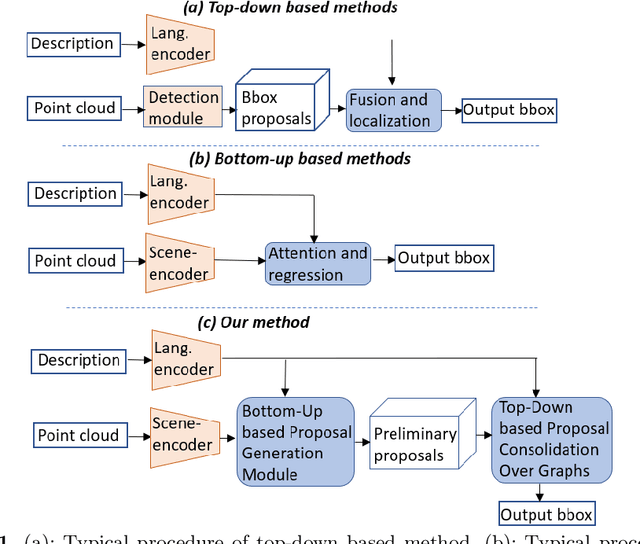
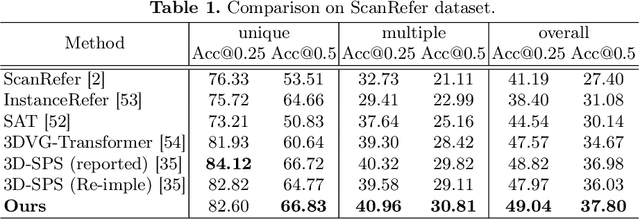

This paper tackles the challenging task of 3D visual grounding-locating a specific object in a 3D point cloud scene based on text descriptions. Existing methods fall into two categories: top-down and bottom-up methods. Top-down methods rely on a pre-trained 3D detector to generate and select the best bounding box, resulting in time-consuming processes. Bottom-up methods directly regress object bounding boxes with coarse-grained features, producing worse results. To combine their strengths while addressing their limitations, we propose a joint top-down and bottom-up framework, aiming to enhance the performance while improving the efficiency. Specifically, in the first stage, we propose a bottom-up based proposal generation module, which utilizes lightweight neural layers to efficiently regress and cluster several coarse object proposals instead of using a complex 3D detector. Then, in the second stage, we introduce a top-down based proposal consolidation module, which utilizes graph design to effectively aggregate and propagate the query-related object contexts among the generated proposals for further refinement. By jointly training these two modules, we can avoid the inherent drawbacks of the complex proposals in the top-down framework and the coarse proposals in the bottom-up framework. Experimental results on the ScanRefer benchmark show that our framework is able to achieve the state-of-the-art performance.