 Add to Chrome
 Add to Firefox
 Add to Edge
OpenVisTool: An Open Recipe for Synthesizing Instructive Visual Tool-Use Trajectories
Aug 11, 2026
Visual tool use has emerged as a fundamental capability for multimodal agents to actively acquire evidence beyond a fixed image encoding. The prevailing recipe learns this capability from teacher-generated trajectories filtered for answer correctness, implicitly assuming that every successful demonstration provides effective supervision. We argue this assumption is flawed: a strong teacher often reaches the correct answer without needing its tool calls, and imitating such trajectories teaches a student that tool calls accompany correct answers, not that tool observations ground them. We present OpenVisTool, an open framework for constructing instructive visual tool-use trajectories that provide effective supervision for tool learning. The key insight is that a trajectory should be retained only if its answer is correct (outcome validity) and its tool observations causally contribute to that answer (causal utility). The framework operates in three stages: difficulty screening to select queries that are not reliably answerable without tools, domain-specific trajectory synthesis to elicit coherent tool-use trajectories, and supervision verification to jointly test both conditions. Rather than encouraging models to imitate tool calls, the resulting supervision teaches when and how visual evidence should be acquired. Using this framework, we construct OpenVisTool-42K, a dataset spanning five visual reasoning domains, together with OpenVisTool-Bench, a benchmark covering the same domains. Across four backbones (4B-27B), fine-tuning on OpenVisTool-42K consistently improves visual tool-use performance and yields gains on two out-of-distribution benchmarks; the larger models approach leading closed-source systems. The evidence suggests that effective visual tool use is learned from causally grounded supervision rather than tool-calling patterns.

MultiModal Code-Switching: Interleaving Visual Objects into Language for Explicit Object-Level Alignment
Aug 11, 2026Existing Multimodal Large Language Models (MLLMs) predominantly rely on image-text pairs for modality alignment pretraining, mapping global image representations to long textual descriptions. However, this image-level alignment suffers from referential ambiguity: models struggle to infer the correspondences between multiple visual objects and textual entities from the global representation, leading to data inefficiency and suboptimal semantic grounding. To address this, we propose MultiModal Code-Switching (MMCS), a novel pretraining paradigm that provides explicit object-level supervision. Inspired by the linguistic phenomenon of code-switching, MMCS interleaves vision and language by replacing textual entities with their corresponding visual objects, enforcing local vision-language grounding. We further develop a scalable data synthesis pipeline to generate a pretraining dataset of 773K samples with accurate object-entity correspondences. Experiments show that MMCS is highly data-efficient: with only 50K samples, it matches or surpasses models trained on 600K image-text pairs. Furthermore, MMCS consistently improves visual grounding and perception capabilities across varying model scales.
OSReward: Instituting Standardized Evaluation for Cross-Platform Computer-Use Reward Models
Jul 30, 2026Computer-using agents (CUAs) are advancing rapidly across the digital world. A CUA trajectory records the agent's actions, states, and reasoning. Verifying whether it fulfilled the task instruction is central to CUA evaluation, data curation, and reinforcement learning. Neither human-written verifiers nor human annotators can provide such verification at scale, so the field increasingly turns to vision-language models (VLMs) as judges of CUA trajectories. But a fundamental question has long gone unexamined: are these VLM judges reliable enough? To study it systematically, we introduce OSReward, a realistic, high-quality benchmark that evaluates VLM judges on CUA trajectories. The trajectories come from diverse agent backbones executing human-verified instructions across platforms, then rigorously labeled with ground-truth verdicts through multi-stage human annotation. Building on it, we derive OSReward-Hard, a challenge set concentrating genuinely hard cases, and OSReward-Multi for fine-grained efficiency and alignment scoring. The most comprehensive evaluation of VLM judges to date finds even state-of-the-art models fall short of an ideal judge, sharing a systematic leniency bias that mislabels failed runs as successes. The few reliable enough to trust are too expensive to run at scale, while affordable open models trail far behind. To close this gap, we construct and release OS-Shepherd-100K, an open corpus of reasoning-annotated trajectory judgments for the CUA community. On it, we train OS-Shepherd (9B and 35B), open reward models that supply low-cost, stable, and reliable reward signals, matching commercial judges at 30-60% lower cost than the frontier. Extensive analyses further inform the design of reliable CUA reward at scale. Our code, benchmark, dataset, and model checkpoints are available at https://os-copilot.github.io/OSReward-Home/.
OpenMobile: Building Open Mobile Agents with Task and Trajectory Synthesis
Apr 16, 2026Mobile agents powered by vision-language models have demonstrated impressive capabilities in automating mobile tasks, with recent leading models achieving a marked performance leap, e.g., nearly 70% success on AndroidWorld. However, these systems keep their training data closed and remain opaque about their task and trajectory synthesis recipes. We present OpenMobile, an open-source framework that synthesizes high-quality task instructions and agent trajectories, with two key components: (1) The first is a scalable task synthesis pipeline that constructs a global environment memory from exploration, then leverages it to generate diverse and grounded instructions. and (2) a policy-switching strategy for trajectory rollout. By alternating between learner and expert models, it captures essential error-recovery data often missing in standard imitation learning. Agents trained on our data achieve competitive results across three dynamic mobile agent benchmarks: notably, our fine-tuned Qwen2.5-VL and Qwen3-VL reach 51.7% and 64.7% on AndroidWorld, far surpassing existing open-data approaches. Furthermore, we conduct transparent analyses on the overlap between our synthetic instructions and benchmark test sets, and verify that performance gains stem from broad functionality coverage rather than benchmark overfitting. We release data and code at https://njucckevin.github.io/openmobile/ to bridge the data gap and facilitate broader mobile agent research.
GRRM: Group Relative Reward Modeling for Machine Translation
Feb 15, 2026While Group Relative Policy Optimization (GRPO) offers a powerful framework for LLM post-training, its effectiveness in open-ended domains like Machine Translation hinges on accurate intra-group ranking. We identify that standard Scalar Quality Metrics (SQM) fall short in this context; by evaluating candidates in isolation, they lack the comparative context necessary to distinguish fine-grained linguistic nuances. To address this, we introduce the Group Quality Metric (GQM) paradigm and instantiate it via the Group Relative Reward Model (GRRM). Unlike traditional independent scorers, GRRM processes the entire candidate group jointly, leveraging comparative analysis to rigorously resolve relative quality and adaptive granularity. Empirical evaluations confirm that GRRM achieves competitive ranking accuracy among all baselines. Building on this foundation, we integrate GRRM into the GRPO training loop to optimize the translation policy. Experimental results demonstrate that our framework not only improves general translation quality but also unlocks reasoning capabilities comparable to state-of-the-art reasoning models. We release codes, datasets, and model checkpoints at https://github.com/NJUNLP/GRRM.
Enhancing Spatial Reasoning in Large Language Models for Metal-Organic Frameworks Structure Prediction
Jan 14, 2026Metal-organic frameworks (MOFs) are porous crystalline materials with broad applications such as carbon capture and drug delivery, yet accurately predicting their 3D structures remains a significant challenge. While Large Language Models (LLMs) have shown promise in generating crystals, their application to MOFs is hindered by MOFs' high atomic complexity. Inspired by the success of block-wise paradigms in deep generative models, we pioneer the use of LLMs in this domain by introducing MOF-LLM, the first LLM framework specifically adapted for block-level MOF structure prediction. To effectively harness LLMs for this modular assembly task, our training paradigm integrates spatial-aware continual pre-training (CPT), structural supervised fine-tuning (SFT), and matching-driven reinforcement learning (RL). By incorporating explicit spatial priors and optimizing structural stability via Soft Adaptive Policy Optimization (SAPO), our approach substantially enhances the spatial reasoning capability of a Qwen-3 8B model for accurate MOF structure prediction. Comprehensive experiments demonstrate that MOF-LLM outperforms state-of-the-art denoising-based and LLM-based methods while exhibiting superior sampling efficiency.
CapArena: Benchmarking and Analyzing Detailed Image Captioning in the LLM Era
Mar 16, 2025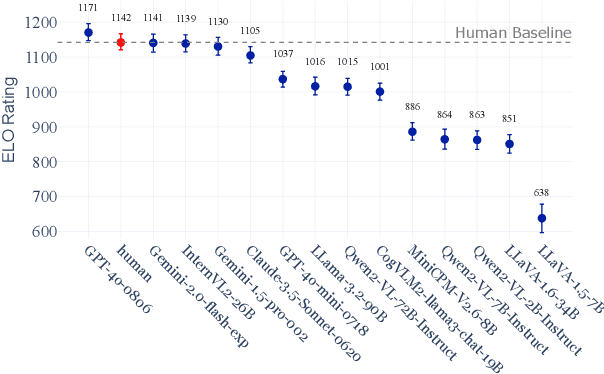
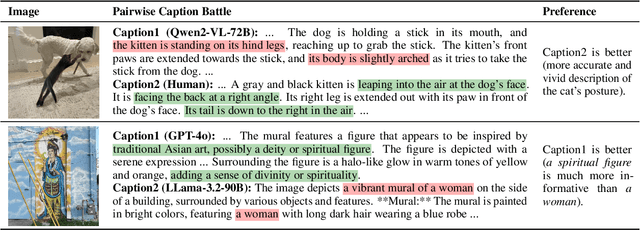
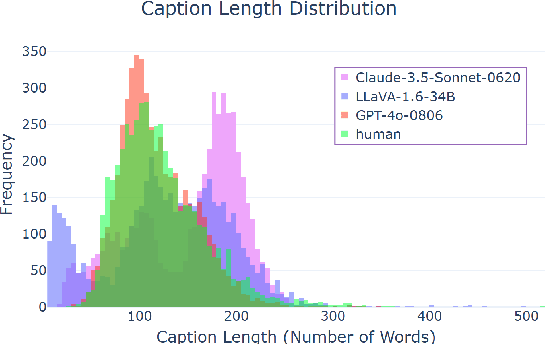
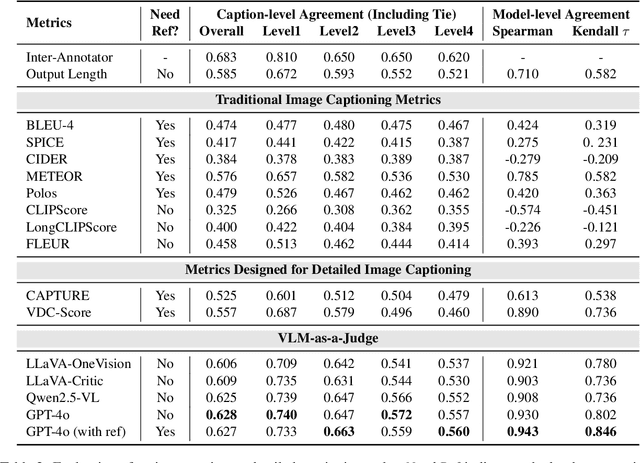
Image captioning has been a longstanding challenge in vision-language research. With the rise of LLMs, modern Vision-Language Models (VLMs) generate detailed and comprehensive image descriptions. However, benchmarking the quality of such captions remains unresolved. This paper addresses two key questions: (1) How well do current VLMs actually perform on image captioning, particularly compared to humans? We built CapArena, a platform with over 6000 pairwise caption battles and high-quality human preference votes. Our arena-style evaluation marks a milestone, showing that leading models like GPT-4o achieve or even surpass human performance, while most open-source models lag behind. (2) Can automated metrics reliably assess detailed caption quality? Using human annotations from CapArena, we evaluate traditional and recent captioning metrics, as well as VLM-as-a-Judge. Our analysis reveals that while some metrics (e.g., METEOR) show decent caption-level agreement with humans, their systematic biases lead to inconsistencies in model ranking. In contrast, VLM-as-a-Judge demonstrates robust discernment at both the caption and model levels. Building on these insights, we release CapArena-Auto, an accurate and efficient automated benchmark for detailed captioning, achieving 94.3% correlation with human rankings at just $4 per test. Data and resources will be open-sourced at https://caparena.github.io.
MoMa: A Modular Deep Learning Framework for Material Property Prediction
Feb 21, 2025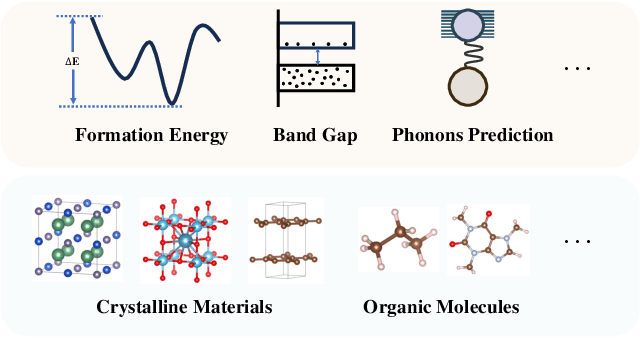
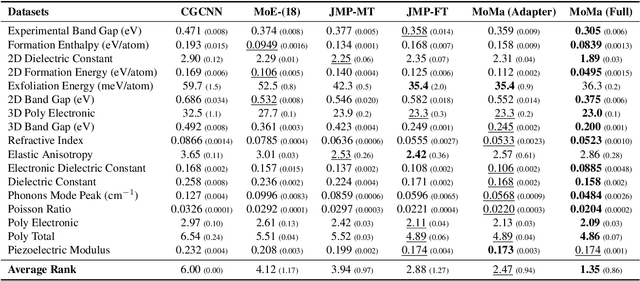
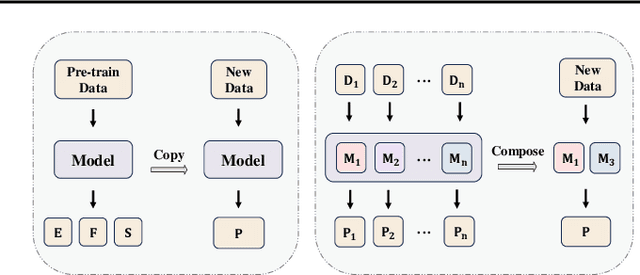
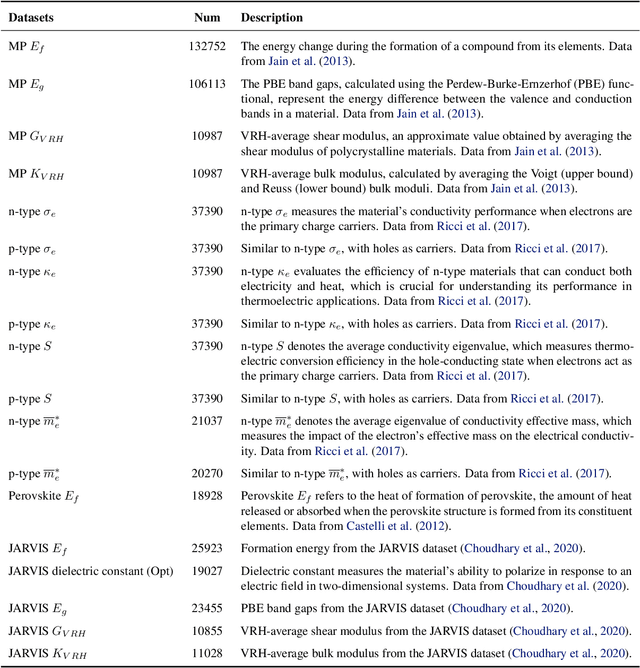
Deep learning methods for material property prediction have been widely explored to advance materials discovery. However, the prevailing pre-train then fine-tune paradigm often fails to address the inherent diversity and disparity of material tasks. To overcome these challenges, we introduce MoMa, a Modular framework for Materials that first trains specialized modules across a wide range of tasks and then adaptively composes synergistic modules tailored to each downstream scenario. Evaluation across 17 datasets demonstrates the superiority of MoMa, with a substantial 14% average improvement over the strongest baseline. Few-shot and continual learning experiments further highlight MoMa's potential for real-world applications. Pioneering a new paradigm of modular material learning, MoMa will be open-sourced to foster broader community collaboration.
A Periodic Bayesian Flow for Material Generation
Feb 04, 2025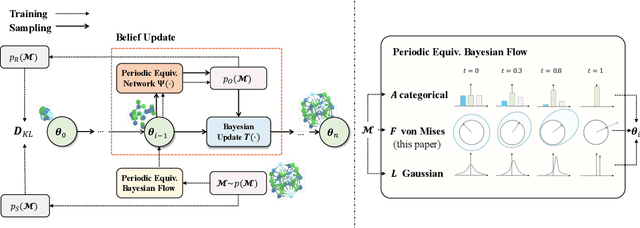

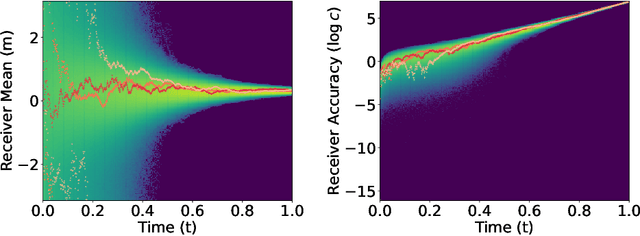

Generative modeling of crystal data distribution is an important yet challenging task due to the unique periodic physical symmetry of crystals. Diffusion-based methods have shown early promise in modeling crystal distribution. More recently, Bayesian Flow Networks were introduced to aggregate noisy latent variables, resulting in a variance-reduced parameter space that has been shown to be advantageous for modeling Euclidean data distributions with structural constraints (Song et al., 2023). Inspired by this, we seek to unlock its potential for modeling variables located in non-Euclidean manifolds e.g. those within crystal structures, by overcoming challenging theoretical issues. We introduce CrysBFN, a novel crystal generation method by proposing a periodic Bayesian flow, which essentially differs from the original Gaussian-based BFN by exhibiting non-monotonic entropy dynamics. To successfully realize the concept of periodic Bayesian flow, CrysBFN integrates a new entropy conditioning mechanism and empirically demonstrates its significance compared to time-conditioning. Extensive experiments over both crystal ab initio generation and crystal structure prediction tasks demonstrate the superiority of CrysBFN, which consistently achieves new state-of-the-art on all benchmarks. Surprisingly, we found that CrysBFN enjoys a significant improvement in sampling efficiency, e.g., ~100x speedup 10 v.s. 2000 steps network forwards) compared with previous diffusion-based methods on MP-20 dataset. Code is available at https://github.com/wu-han-lin/CrysBFN.
Rethinking Relation Extraction: Beyond Shortcuts to Generalization with a Debiased Benchmark
Jan 02, 2025

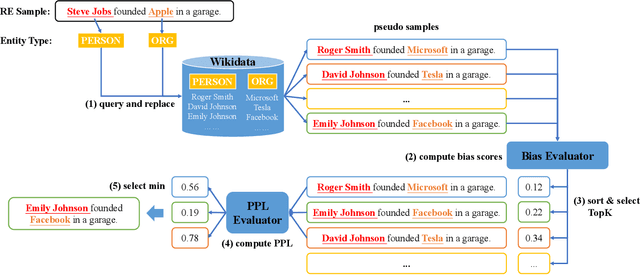
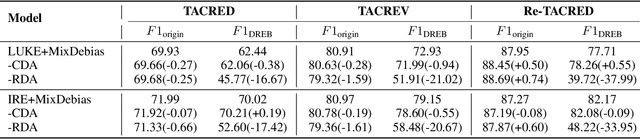
Benchmarks are crucial for evaluating machine learning algorithm performance, facilitating comparison and identifying superior solutions. However, biases within datasets can lead models to learn shortcut patterns, resulting in inaccurate assessments and hindering real-world applicability. This paper addresses the issue of entity bias in relation extraction tasks, where models tend to rely on entity mentions rather than context. We propose a debiased relation extraction benchmark DREB that breaks the pseudo-correlation between entity mentions and relation types through entity replacement. DREB utilizes Bias Evaluator and PPL Evaluator to ensure low bias and high naturalness, providing a reliable and accurate assessment of model generalization in entity bias scenarios. To establish a new baseline on DREB, we introduce MixDebias, a debiasing method combining data-level and model training-level techniques. MixDebias effectively improves model performance on DREB while maintaining performance on the original dataset. Extensive experiments demonstrate the effectiveness and robustness of MixDebias compared to existing methods, highlighting its potential for improving the generalization ability of relation extraction models. We will release DREB and MixDebias publicly.