 Add to Chrome
 Add to Firefox
 Add to Edge
Grounding latent algorithm routing in transformer reasoning
Jul 27, 2026
A central question in the in-context learning literature is whether transformers can organize episode-level adaptation around different inductive-bias families. We study this question in a controlled setting through latent algorithm routing: route-like behavior in which the solver-family preference changes with the latent data-generating regime while prompt form is held fixed, remains stable under nuisance perturbations, and is selectively influenced by targeted activation interventions without large losses in answer quality. We introduce ROUTEBENCH, a diagnostic benchmark whose regimes differentially favor global shrinkage, sparsity, robustness, and locality, operationalized by ridge-like, lasso-like, Huber-like, and kNN-like family representatives. Across dense decoder-only transformers trained from scratch at 44M-612M parameters, a 306M model closes 80.9 percent of the oracle-routing gap and achieves route F1 of 84.1. The effect remains substantial under natural-language renderings, shuffled supports, lexical paraphrases, and a unified four-way routing setting. Stronger adaptive alternatives, including an input-conditioned soft mixture and an unsupervised Gumbel router, narrow the gap but remain below the 306M and 612M models on route F1 and OOD performance. Probe controls and matched activation-patching controls further show that route-relevant internal directions are decodable and functionally involved in solver-family-consistent output behavior. These results provide controlled evidence that dense transformers trained on ROUTEBENCH can develop route-like internal variables, but they do not establish universal routing in pretrained language models or unrestricted natural-language reasoning.

Attribute-Prompted Kernel Hashing for Unsupervised Data-Efficient Cross-Modal Retrieval
Jul 01, 2026Unsupervised cross-modal hashing enables efficient retrieval of semantically related instances across different modalities without requiring manual semantic annotation. However, existing unsupervised methods rely heavily on large-scale image-text pairs. Collecting such data can be costly, particularly in scenarios where well-aligned pairs are scarce due to privacy and specialized constraints. More critically, existing methods tend to overfit to seen training data, restricting their generalization performance on unseen categories that the constrained training data cannot cover. To address these limitations, we propose Attribute-Prompted Kernel Hashing (APKH), a novel data-efficient approach that constructs a compact, modality-aligned Hamming space driven by the generalized attribute priors of vision-language foundation models. Specifically, APKH introduces two core modules: Context-optimized Attribute Kernel Mapping (CAKM) and Kernel-Smoothed Contrastive Alignment (KSCA). CAKM formulates cross-modal alignment through hyperspherical Radial Basis Function kernel mapping, optimizing dynamic attribute kernels via prompt learning to capture modality-invariant semantics. Furthermore, KSCA extends conventional point-to-point contrastive learning by modeling limited paired data as continuous kernel distributions. This explicit smoothing of the modality gap alleviates overfitting to sparse pairwise correlations. Extensive experiments demonstrate that APKH outperforms state-of-the-art hashing methods in the challenging cross-modal retrieval tasks from seen to unseen categories under data-constrained scenarios.
Unsupervised Data-Efficient Cross-Modal Retrieval with Global-Neighborhood Alignment Hashing
Jun 30, 2026Compared to supervised cross-modal hashing (CMH), unsupervised CMH reduces the reliance on manual labeling by learning binary codes from unlabeled image-text pairs. However, existing unsupervised CMH methods often rely on large-scale image-text pairs, which are costly to collect. To address this limitation, we propose Global-Neighborhood Alignment Hashing (GNAH), a novel approach that preserves the semantic structure of vision-language foundation models within a compact binary Hamming space using only a limited number of image-text pairs. Specifically, GNAH captures global structural information from the continuous latent space and transfers it into the binary Hamming space through a Prototype-Anchored Global Alignment module. In addition, GNAH extends conventional pairwise contrastive learning by modeling stochastic neighborhood relationships via a Contrastive Stochastic Neighborhood Alignment module, thereby alleviating overfitting to sparse pairwise correlations. Extensive experiments demonstrate that GNAH consistently outperforms existing unsupervised cross-modal retrieval methods under data-constrained settings, offering a practical solution for real-world CMH applications.
UniHash: Unifying Pointwise and Pairwise Hashing Paradigms for Seen and Unseen Category Retrieval
Jan 14, 2026Effective retrieval across both seen and unseen categories is crucial for modern image retrieval systems. Retrieval on seen categories ensures precise recognition of known classes, while retrieval on unseen categories promotes generalization to novel classes with limited supervision. However, most existing deep hashing methods are confined to a single training paradigm, either pointwise or pairwise, where the former excels on seen categories and the latter generalizes better to unseen ones. To overcome this limitation, we propose Unified Hashing (UniHash), a dual-branch framework that unifies the strengths of both paradigms to achieve balanced retrieval performance across seen and unseen categories. UniHash consists of two complementary branches: a center-based branch following the pointwise paradigm and a pairwise branch following the pairwise paradigm. A novel hash code learning method is introduced to enable bidirectional knowledge transfer between branches, improving hash code discriminability and generalization. It employs a mutual learning loss to align hash representations and introduces a Split-Merge Mixture of Hash Experts (SM-MoH) module to enhance cross-branch exchange of hash representations. Theoretical analysis substantiates the effectiveness of UniHash, and extensive experiments on CIFAR-10, MSCOCO, and ImageNet demonstrate that UniHash consistently achieves state-of-the-art performance in both seen and unseen image retrieval scenarios.
Stable and Explainable Personality Trait Evaluation in Large Language Models with Internal Activations
Jan 14, 2026Evaluating personality traits in Large Language Models (LLMs) is key to model interpretation, comparison, and responsible deployment. However, existing questionnaire-based evaluation methods exhibit limited stability and offer little explainability, as their results are highly sensitive to minor variations in prompt phrasing or role-play configurations. To address these limitations, we propose an internal-activation-based approach, termed Persona-Vector Neutrality Interpolation (PVNI), for stable and explainable personality trait evaluation in LLMs. PVNI extracts a persona vector associated with a target personality trait from the model's internal activations using contrastive prompts. It then estimates the corresponding neutral score by interpolating along the persona vector as an anchor axis, enabling an interpretable comparison between the neutral prompt representation and the persona direction. We provide a theoretical analysis of the effectiveness and generalization properties of PVNI. Extensive experiments across diverse LLMs demonstrate that PVNI yields substantially more stable personality trait evaluations than existing methods, even under questionnaire and role-play variants.
Mutual Learning for Hashing: Unlocking Strong Hash Functions from Weak Supervision
Oct 09, 2025Deep hashing has been widely adopted for large-scale image retrieval, with numerous strategies proposed to optimize hash function learning. Pairwise-based methods are effective in learning hash functions that preserve local similarity relationships, whereas center-based methods typically achieve superior performance by more effectively capturing global data distributions. However, the strength of center-based methods in modeling global structures often comes at the expense of underutilizing important local similarity information. To address this limitation, we propose Mutual Learning for Hashing (MLH), a novel weak-to-strong framework that enhances a center-based hashing branch by transferring knowledge from a weaker pairwise-based branch. MLH consists of two branches: a strong center-based branch and a weaker pairwise-based branch. Through an iterative mutual learning process, the center-based branch leverages local similarity cues learned by the pairwise-based branch. Furthermore, inspired by the mixture-of-experts paradigm, we introduce a novel mixture-of-hash-experts module that enables effective cross-branch interaction, further enhancing the performance of both branches. Extensive experiments demonstrate that MLH consistently outperforms state-of-the-art hashing methods across multiple benchmark datasets.
Hypergraph-Based Dynamic Graph Node Classification
Dec 29, 2024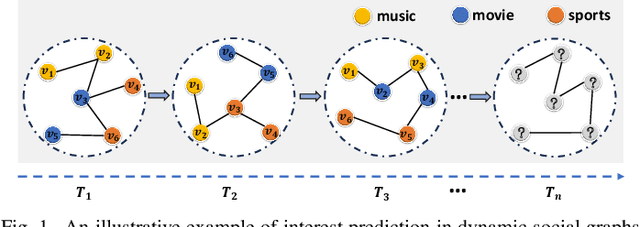
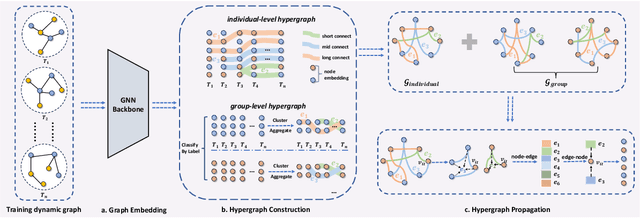
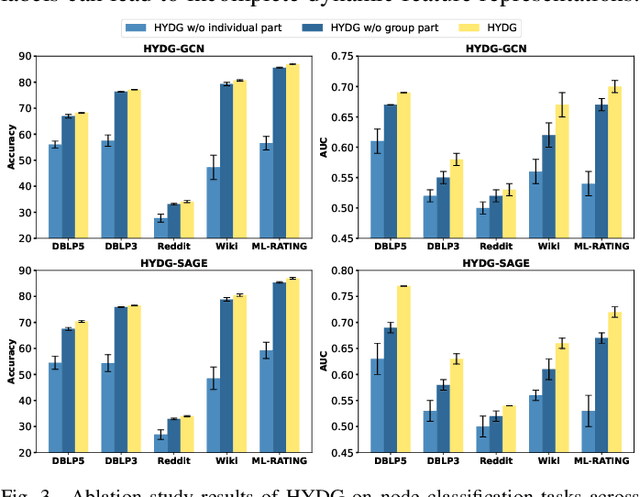
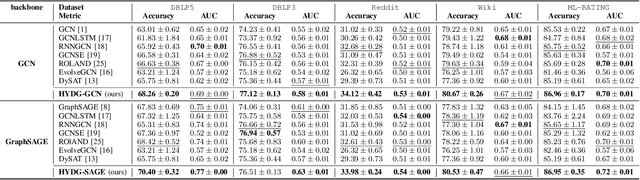
Node classification on static graphs has achieved significant success, but achieving accurate node classification on dynamic graphs where node topology, attributes, and labels change over time has not been well addressed. Existing methods based on RNNs and self-attention only aggregate features of the same node across different time slices, which cannot adequately address and capture the diverse dynamic changes in dynamic graphs. Therefore, we propose a novel model named Hypergraph-Based Multi-granularity Dynamic Graph Node Classification (HYDG). After obtaining basic node representations for each slice through a GNN backbone, HYDG models the representations of each node in the dynamic graph through two modules. The individual-level hypergraph captures the spatio-temporal node representations between individual nodes, while the group-level hypergraph captures the multi-granularity group temporal representations among nodes of the same class. Each hyperedge captures different temporal dependencies of varying lengths by connecting multiple nodes within specific time ranges. More accurate representations are obtained through weighted information propagation and aggregation by the hypergraph neural network. Extensive experiments on five real dynamic graph datasets using two GNN backbones demonstrate the superiority of our proposed framework.
Mesa-Extrapolation: A Weave Position Encoding Method for Enhanced Extrapolation in LLMs
Oct 21, 2024

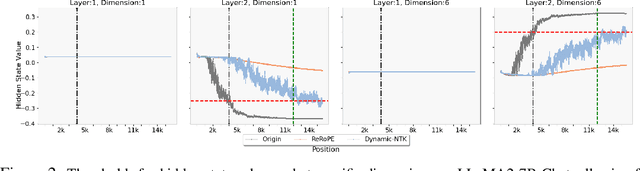

Large language models (LLMs), although having revolutionized many fields, still suffer from the challenging extrapolation problem, where the inference ability of LLMs sharply declines beyond their max training lengths. In this work, we conduct a theoretical analysis to better understand why No Position Encoding (NoPE) fails outside its effective range, as well as examining the power of Position Encoding (PE) in this context. Our findings reveal that with meticulous weave position, PE can indeed be extended beyond effective range. Our theorems establish that LLMs equipped with weave PE can achieve improved extrapolation performance without additional cost. Furthermore, we introduce a novel weave PE method, Mesa-Extrapolation, which utilizes a chunk-based triangular attention matrix and applies Stair PE to manage the final chunk. This method not only retains competitive performance but also offers substantial benefits such as significantly reduced memory demand and faster inference speed. Extensive experiments validate the effectiveness of Mesa-Extrapolation, demonstrating its potential as a scalable solution to enhancing LLMs applicative reach.