 Add to Chrome
 Add to Firefox
 Add to Edge
VisAidMath: Benchmarking Visual-Aided Mathematical Reasoning
Oct 30, 2024


Although previous research on large language models (LLMs) and large multi-modal models (LMMs) has systematically explored mathematical problem-solving (MPS) within visual contexts, the analysis of how these models process visual information during problem-solving remains insufficient. To address this gap, we present VisAidMath, a benchmark for evaluating the MPS process related to visual information. We follow a rigorous data curation pipeline involving both automated processes and manual annotations to ensure data quality and reliability. Consequently, this benchmark includes 1,200 challenging problems from various mathematical branches, vision-aid formulations, and difficulty levels, collected from diverse sources such as textbooks, examination papers, and Olympiad problems. Based on the proposed benchmark, we conduct comprehensive evaluations on ten mainstream LLMs and LMMs, highlighting deficiencies in the visual-aided reasoning process. For example, GPT-4V only achieves 45.33% accuracy in the visual-aided reasoning task, even with a drop of 2 points when provided with golden visual aids. In-depth analysis reveals that the main cause of deficiencies lies in hallucination regarding the implicit visual reasoning process, shedding light on future research directions in the visual-aided MPS process.

SimRAG: Self-Improving Retrieval-Augmented Generation for Adapting Large Language Models to Specialized Domains
Oct 23, 2024

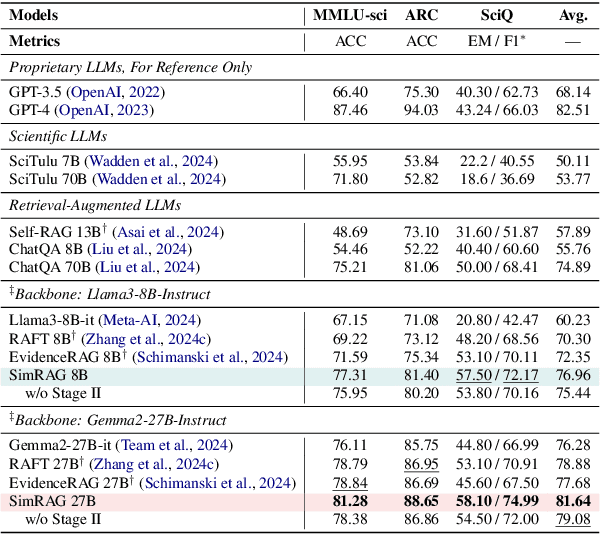

Retrieval-augmented generation (RAG) enhances the question-answering (QA) abilities of large language models (LLMs) by integrating external knowledge. However, adapting general-purpose RAG systems to specialized fields such as science and medicine poses unique challenges due to distribution shifts and limited access to domain-specific data. To tackle this, we propose SimRAG, a self-training approach that equips the LLM with joint capabilities of question answering and question generation for domain adaptation. Our method first fine-tunes the LLM on instruction-following, question-answering, and search-related data. Then, it prompts the same LLM to generate diverse domain-relevant questions from unlabeled corpora, with an additional filtering strategy to retain high-quality synthetic examples. By leveraging these synthetic examples, the LLM can improve their performance on domain-specific RAG tasks. Experiments on 11 datasets, spanning two backbone sizes and three domains, demonstrate that SimRAG outperforms baselines by 1.2\%--8.6\%.
Influential Language Data Selection via Gradient Trajectory Pursuit
Oct 22, 2024Curating a desirable dataset for training has been the core of building highly capable large language models (Touvron et al., 2023; Achiam et al., 2023; Team et al.,2024). Gradient influence scores (Pruthi et al., 2020; Xia et al., 2024) are shown to be correlated with model performance and are commonly used as the criterion for data selection. However, existing methods are built upon either individual sample rankings or inefficient matching process, leading to suboptimal performance or scaling up issues.In this paper, we propose Gradient Trajectory Pursuit (GTP), an algorithm that performs pursuit of gradient trajectories via jointly selecting data points under an L0-norm regularized objective. The proposed algorithm highlights: (1) joint selection instead of independent top-k selection, which automatically de-duplicates samples; (2) higher efficiency with compressive sampling processes, which can be further sped up using a distributed framework. In the experiments, we demonstrate the algorithm in both in-domain and target-domain selection benchmarks and show that it outperforms top-k selection and competitive algorithms consistently, for example, our algorithm chooses as low as 0.5% data to achieve full performance on the targeted instruction tuning tasks
Estimating Individual Dose-Response Curves under Unobserved Confounders from Observational Data
Oct 21, 2024


Estimating an individual's potential response to continuously varied treatments is crucial for addressing causal questions across diverse domains, from healthcare to social sciences. However, existing methods are limited either to estimating causal effects of binary treatments, or scenarios where all confounding variables are measurable. In this work, we present ContiVAE, a novel framework for estimating causal effects of continuous treatments, measured by individual dose-response curves, considering the presence of unobserved confounders using observational data. Leveraging a variational auto-encoder with a Tilted Gaussian prior distribution, ContiVAE models the hidden confounders as latent variables, and is able to predict the potential outcome of any treatment level for each individual while effectively capture the heterogeneity among individuals. Experiments on semi-synthetic datasets show that ContiVAE outperforms existing methods by up to 62%, demonstrating its robustness and flexibility. Application on a real-world dataset illustrates its practical utility.
SRAP-Agent: Simulating and Optimizing Scarce Resource Allocation Policy with LLM-based Agent
Oct 18, 2024


Public scarce resource allocation plays a crucial role in economics as it directly influences the efficiency and equity in society. Traditional studies including theoretical model-based, empirical study-based and simulation-based methods encounter limitations due to the idealized assumption of complete information and individual rationality, as well as constraints posed by limited available data. In this work, we propose an innovative framework, SRAP-Agent (Simulating and Optimizing Scarce Resource Allocation Policy with LLM-based Agent), which integrates Large Language Models (LLMs) into economic simulations, aiming to bridge the gap between theoretical models and real-world dynamics. Using public housing allocation scenarios as a case study, we conduct extensive policy simulation experiments to verify the feasibility and effectiveness of the SRAP-Agent and employ the Policy Optimization Algorithm with certain optimization objectives. The source code can be found in https://github.com/jijiarui-cather/SRAPAgent_Framework
Detecting Training Data of Large Language Models via Expectation Maximization
Oct 10, 2024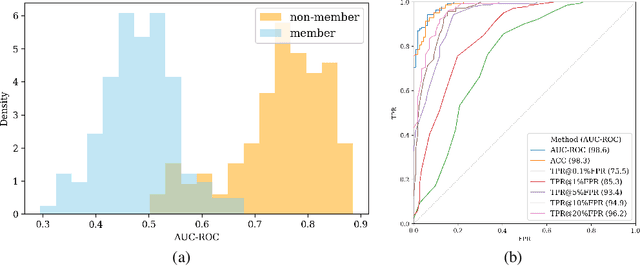



The widespread deployment of large language models (LLMs) has led to impressive advancements, yet information about their training data, a critical factor in their performance, remains undisclosed. Membership inference attacks (MIAs) aim to determine whether a specific instance was part of a target model's training data. MIAs can offer insights into LLM outputs and help detect and address concerns such as data contamination and compliance with privacy and copyright standards. However, applying MIAs to LLMs presents unique challenges due to the massive scale of pre-training data and the ambiguous nature of membership. Additionally, creating appropriate benchmarks to evaluate MIA methods is not straightforward, as training and test data distributions are often unknown. In this paper, we introduce EM-MIA, a novel MIA method for LLMs that iteratively refines membership scores and prefix scores via an expectation-maximization algorithm, leveraging the duality that the estimates of these scores can be improved by each other. Membership scores and prefix scores assess how each instance is likely to be a member and discriminative as a prefix, respectively. Our method achieves state-of-the-art results on the WikiMIA dataset. To further evaluate EM-MIA, we present OLMoMIA, a benchmark built from OLMo resources, which allows us to control the difficulty of MIA tasks with varying degrees of overlap between training and test data distributions. We believe that EM-MIA serves as a robust MIA method for LLMs and that OLMoMIA provides a valuable resource for comprehensively evaluating MIA approaches, thereby driving future research in this critical area.
Selecting the Best Sequential Transfer Path for Medical Image Segmentation with Limited Labeled Data
Oct 09, 2024The medical image processing field often encounters the critical issue of scarce annotated data. Transfer learning has emerged as a solution, yet how to select an adequate source task and effectively transfer the knowledge to the target task remains challenging. To address this, we propose a novel sequential transfer scheme with a task affinity metric tailored for medical images. Considering the characteristics of medical image segmentation tasks, we analyze the image and label similarity between tasks and compute the task affinity scores, which assess the relatedness among tasks. Based on this, we select appropriate source tasks and develop an effective sequential transfer strategy by incorporating intermediate source tasks to gradually narrow the domain discrepancy and minimize the transfer cost. Thereby we identify the best sequential transfer path for the given target task. Extensive experiments on three MRI medical datasets, FeTS 2022, iSeg-2019, and WMH, demonstrate the efficacy of our method in finding the best source sequence. Compared with directly transferring from a single source task, the sequential transfer results underline a significant improvement in target task performance, achieving an average of 2.58% gain in terms of segmentation Dice score, notably, 6.00% for FeTS 2022. Code is available at the git repository.
Gradual Learning: Optimizing Fine-Tuning with Partially Mastered Knowledge in Large Language Models
Oct 08, 2024
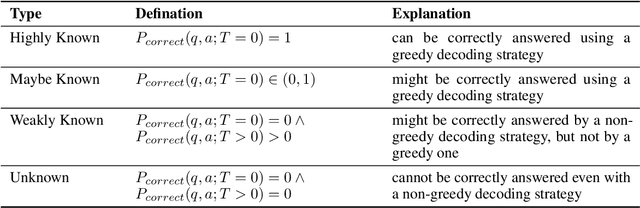

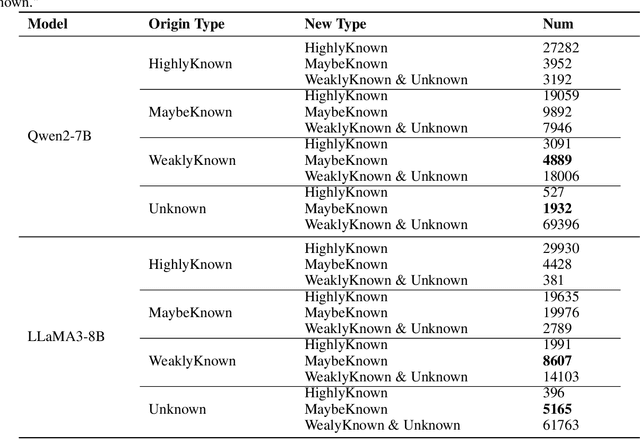
During the pretraining phase, large language models (LLMs) acquire vast amounts of knowledge from extensive text corpora. Nevertheless, in later stages such as fine-tuning and inference, the model may encounter knowledge not covered in the initial training, which can lead to hallucinations and degraded performance. This issue has a profound impact on the model's capabilities, as it will inevitably face out-of-scope knowledge after pretraining. Furthermore, fine-tuning is often required to adapt LLMs to domain-specific tasks. However, this phenomenon limits the model's ability to learn and integrate new information during fine-tuning. The effectiveness of fine-tuning largely depends on the type of knowledge involved. Existing research suggests that fine-tuning the model on partially mastered knowledge-for instance, question-answer pairs where the model has a chance of providing correct responses under non-greedy decoding-can enable the model to acquire new knowledge while mitigating hallucination. Notably, this approach can still lead to the forgetting of fully mastered knowledge, constraining the fine-tuning dataset to a narrower range and limiting the model's overall potential for improvement. Given the model's intrinsic reasoning abilities and the interconnectedness of different knowledge areas, it is likely that as the model's capacity to utilize existing knowledge improves during fine-tuning, previously unmastered knowledge may become more understandable. To explore this hypothesis, we conducted experiments and, based on the results, proposed a two-stage fine-tuning strategy. This approach not only improves the model's overall test accuracy and knowledge retention but also preserves its accuracy on previously mastered content. When fine-tuning on the WikiQA dataset, our method increases the amount of knowledge acquired by the model in this stage by 24%.
Active Evaluation Acquisition for Efficient LLM Benchmarking
Oct 08, 2024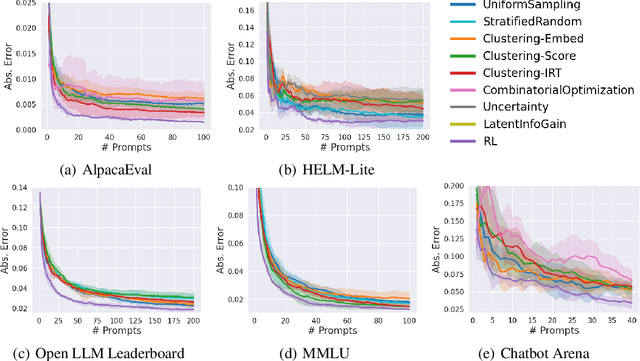
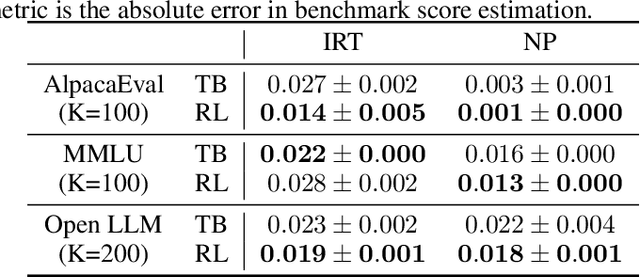
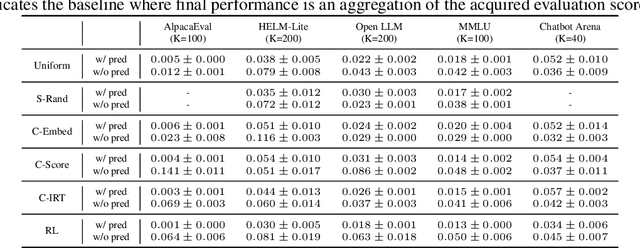
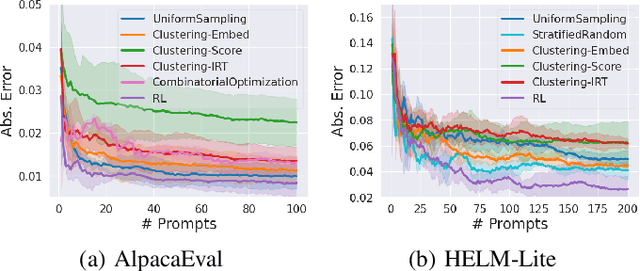
As large language models (LLMs) become increasingly versatile, numerous large scale benchmarks have been developed to thoroughly assess their capabilities. These benchmarks typically consist of diverse datasets and prompts to evaluate different aspects of LLM performance. However, comprehensive evaluations on hundreds or thousands of prompts incur tremendous costs in terms of computation, money, and time. In this work, we investigate strategies to improve evaluation efficiency by selecting a subset of examples from each benchmark using a learned policy. Our approach models the dependencies across test examples, allowing accurate prediction of the evaluation outcomes for the remaining examples based on the outcomes of the selected ones. Consequently, we only need to acquire the actual evaluation outcomes for the selected subset. We rigorously explore various subset selection policies and introduce a novel RL-based policy that leverages the captured dependencies. Empirical results demonstrate that our approach significantly reduces the number of evaluation prompts required while maintaining accurate performance estimates compared to previous methods.
AIM 2024 Challenge on Video Super-Resolution Quality Assessment: Methods and Results
Oct 05, 2024
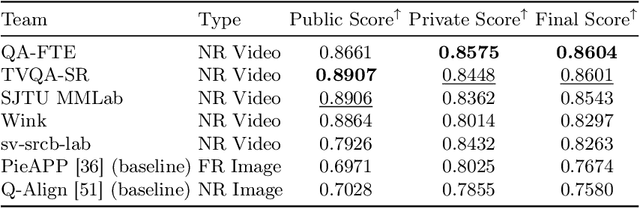
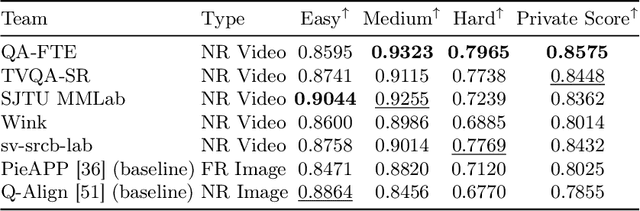
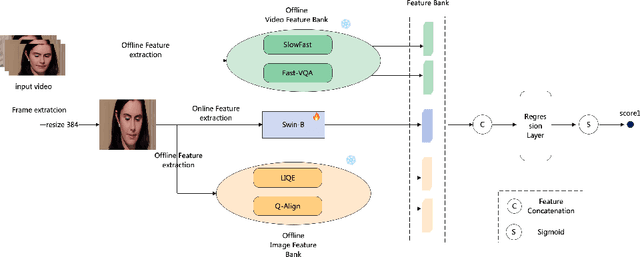
This paper presents the Video Super-Resolution (SR) Quality Assessment (QA) Challenge that was part of the Advances in Image Manipulation (AIM) workshop, held in conjunction with ECCV 2024. The task of this challenge was to develop an objective QA method for videos upscaled 2x and 4x by modern image- and video-SR algorithms. QA methods were evaluated by comparing their output with aggregate subjective scores collected from >150,000 pairwise votes obtained through crowd-sourced comparisons across 52 SR methods and 1124 upscaled videos. The goal was to advance the state-of-the-art in SR QA, which had proven to be a challenging problem with limited applicability of traditional QA methods. The challenge had 29 registered participants, and 5 teams had submitted their final results, all outperforming the current state-of-the-art. All data, including the private test subset, has been made publicly available on the challenge homepage at https://challenges.videoprocessing.ai/challenges/super-resolution-metrics-challenge.html