 Add to Chrome
 Add to Firefox
 Add to Edge
SR-Ground: Image Quality Grounding for Super-Resolved Content
May 20, 2026
Super-Resolution (SR) has advanced rapidly in recent years, with diffusion-based models achieving unprecedented fidelity at the cost of introducing new types of visual artifacts. While existing Image Quality Assessment (IQA) methods provide holistic quality scores, they lack interpretability and fail to distinguish between different artifact types arising from modern SR approaches. To address this gap, we introduce SR-Ground, a large-scale dataset specifically designed for fine-grained artifact segmentation in super-resolved images. The dataset comprises images processed by a diverse set of state-of-the-art SR models, with pixel-level annotations for multiple artifact categories. We conduct a large-scale crowdsourcing study involving 1,062 participants to validate and refine automatically generated segmentations, resulting in a high-quality dataset of 63,000 images spanning 6 distinct artifact types. We demonstrate that training IQA models with grounding capabilities on SR-Ground significantly improves performance on downstream tasks. Furthermore, we introduce a fine-tuning pipeline that leverages our grounding model to reduce perceptible artifacts in SR outputs, showcasing the practical utility of our dataset.

AIM 2024 Challenge on Video Super-Resolution Quality Assessment: Methods and Results
Oct 05, 2024
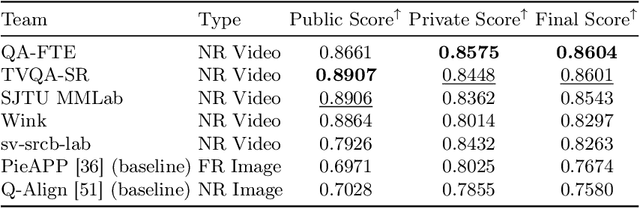
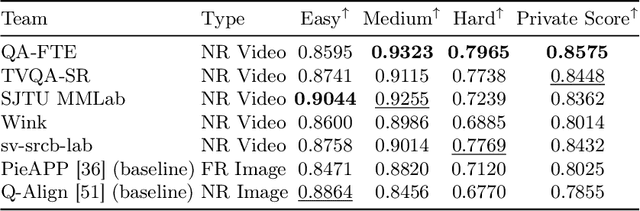
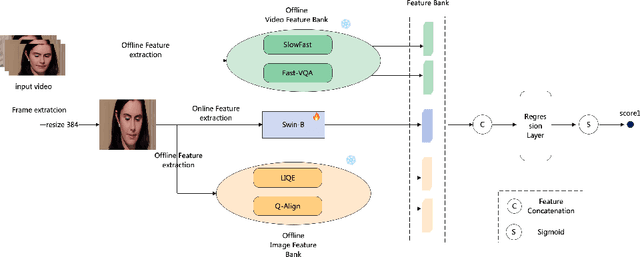
This paper presents the Video Super-Resolution (SR) Quality Assessment (QA) Challenge that was part of the Advances in Image Manipulation (AIM) workshop, held in conjunction with ECCV 2024. The task of this challenge was to develop an objective QA method for videos upscaled 2x and 4x by modern image- and video-SR algorithms. QA methods were evaluated by comparing their output with aggregate subjective scores collected from >150,000 pairwise votes obtained through crowd-sourced comparisons across 52 SR methods and 1124 upscaled videos. The goal was to advance the state-of-the-art in SR QA, which had proven to be a challenging problem with limited applicability of traditional QA methods. The challenge had 29 registered participants, and 5 teams had submitted their final results, all outperforming the current state-of-the-art. All data, including the private test subset, has been made publicly available on the challenge homepage at https://challenges.videoprocessing.ai/challenges/super-resolution-metrics-challenge.html