 Add to Chrome
 Add to Firefox
 Add to Edge
JTPRO: A Joint Tool-Prompt Reflective Optimization Framework for Language Agents
Apr 20, 2026
Large language model (LLM) agents augmented with external tools often struggle as number of tools grow large and become domain-specific. In such settings, ambiguous tool descriptions and under-specified agent instructions frequently lead to tool mis-selection and incorrect slot/value instantiation. We hypothesize that this is due to two root causes: generic, one-size-fits-all prompts that ignore tool-specific nuances, and underspecified tool schemas that lack clear guidance on when and how to use each tool and how to format its parameters. We introduce Joint Tool-Prompt Reflective Optimization (JTPRO), a framework for improving tool-calling reliability in trace-supervised settings by iteratively using rollout-driven reflection to co-optimize global instructions and per-tool schema/argument descriptions for accurate tool selection and argument instantiation in large tool inventories. JTPRO is designed to preserve only tool-local cues needed for correct disambiguation and slot filling. We evaluate JTPRO across multi-tool benchmarks, which account for different number of tools using three metrics: Tool Selection Accuracy (TSA), Slot Filling Accuracy(SFA), and Overall Success Rate(OSR) (correct tool + correct slots + correct values). JTPRO consistently outperforms strong baselines, including CoT-style agents, and reflective prompt optimizers such as GEPA by 5%-20% (relative) on OSR. Ablations show that joint optimization of instructions and tool schemas is more effective and robust than optimizing either component in isolation.

MT-OSC: Path for LLMs that Get Lost in Multi-Turn Conversation
Apr 09, 2026Large language models (LLMs) suffer significant performance degradation when user instructions and context are distributed over multiple conversational turns, yet multi-turn (MT) interactions dominate chat interfaces. The routine approach of appending full chat history to prompts rapidly exhausts context windows, leading to increased latency, higher computational costs, and diminishing returns as conversations extend. We introduce MT-OSC, a One-off Sequential Condensation framework that efficiently and automatically condenses chat history in the background without disrupting the user experience. MT-OSC employs a Condenser Agent that uses a few-shot inference-based Condenser and a lightweight Decider to selectively retain essential information, reducing token counts by up to 72% in 10-turn dialogues. Evaluated across 13 state-of-the-art LLMs and diverse multi-turn benchmarks, MT-OSC consistently narrows the multi-turn performance gap - yielding improved or preserved accuracy across datasets while remaining robust to distractors and irrelevant turns. Our results establish MT-OSC as a scalable solution for multi-turn chats, enabling richer context within constrained input spaces, reducing latency and operational cost, while balancing performance.
Budget-Aware Anytime Reasoning with LLM-Synthesized Preference Data
Jan 16, 2026We study the reasoning behavior of large language models (LLMs) under limited computation budgets. In such settings, producing useful partial solutions quickly is often more practical than exhaustive reasoning, which incurs high inference costs. Many real-world tasks, such as trip planning, require models to deliver the best possible output within a fixed reasoning budget. We introduce an anytime reasoning framework and the Anytime Index, a metric that quantifies how effectively solution quality improves as reasoning tokens increase. To further enhance efficiency, we propose an inference-time self-improvement method using LLM-synthesized preference data, where models learn from their own reasoning comparisons to produce better intermediate solutions. Experiments on NaturalPlan (Trip), AIME, and GPQA datasets show consistent gains across Grok-3, GPT-oss, GPT-4.1/4o, and LLaMA models, improving both reasoning quality and efficiency under budget constraints.
Tree-based Dialogue Reinforced Policy Optimization for Red-Teaming Attacks
Oct 02, 2025Despite recent rapid progress in AI safety, current large language models remain vulnerable to adversarial attacks in multi-turn interaction settings, where attackers strategically adapt their prompts across conversation turns and pose a more critical yet realistic challenge. Existing approaches that discover safety vulnerabilities either rely on manual red-teaming with human experts or employ automated methods using pre-defined templates and human-curated attack data, with most focusing on single-turn attacks. However, these methods did not explore the vast space of possible multi-turn attacks, failing to consider novel attack trajectories that emerge from complex dialogue dynamics and strategic conversation planning. This gap is particularly critical given recent findings that LLMs exhibit significantly higher vulnerability to multi-turn attacks compared to single-turn attacks. We propose DialTree-RPO, an on-policy reinforcement learning framework integrated with tree search that autonomously discovers diverse multi-turn attack strategies by treating the dialogue as a sequential decision-making problem, enabling systematic exploration without manually curated data. Through extensive experiments, our approach not only achieves more than 25.9% higher ASR across 10 target models compared to previous state-of-the-art approaches, but also effectively uncovers new attack strategies by learning optimal dialogue policies that maximize attack success across multiple turns.
MetaSynth: Meta-Prompting-Driven Agentic Scaffolds for Diverse Synthetic Data Generation
Apr 17, 2025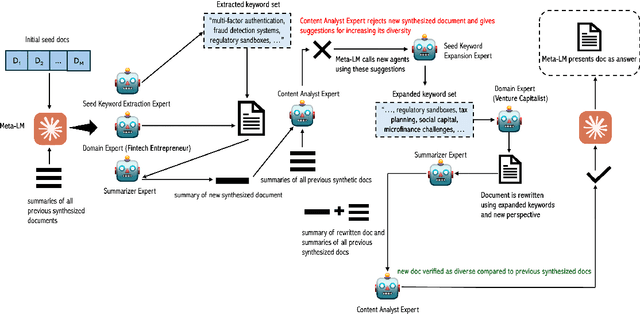
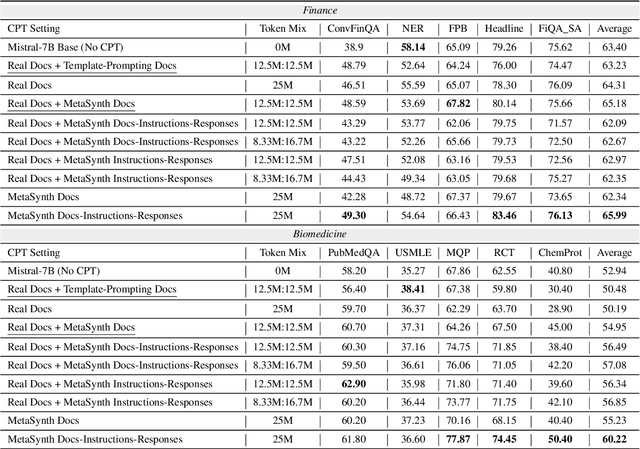
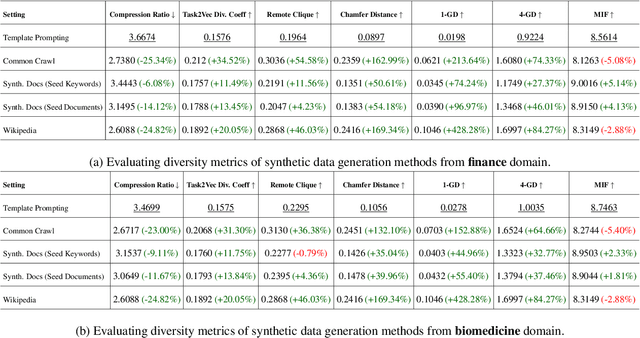
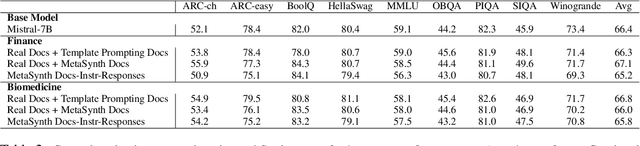
Recent smaller language models such Phi-3.5 and Phi-4 rely on synthetic data generated using larger Language models. Questions remain about leveraging synthetic data for other use cases, such as adapting LLMs to specific domains. A key limitation of synthetic data is low diversity, which negatively impacts its downstream applicability for improving other models. To address this, we propose MetaSynth, a method for generating synthetic data that enhances diversity through meta-prompting, where a language model orchestrates multiple "expert" LLM agents to collaboratively generate data. Using only 25 million tokens of synthetic data generated with MetaSynth, we successfully adapt a well-trained LLM (Mistral-7B-v0.3) to two specialized domains-Finance and Biomedicine-without compromising the capabilities of the resulting model in general tasks. In addition, we evaluate the diversity of our synthetic data using seven automated metrics, and find that it approaches the diversity of LLM pre-training corpora. Continually pre-training Mistral-7B-v0.3 with MetaSynth notably outperforms the base LLM, showing improvements of up to 4.08% in Finance and 13.75% in Biomedicine. The same model shows degraded performance when trained on data generated using a template prompt, even when the template includes prior generations and varying In-Context exemplars of real data. Our findings suggest that a few million tokens of diverse synthetic data without mixing any real data, is sufficient for effective domain adaptation when using MetaSynth.
Unraveling and Mitigating Safety Alignment Degradation of Vision-Language Models
Oct 11, 2024
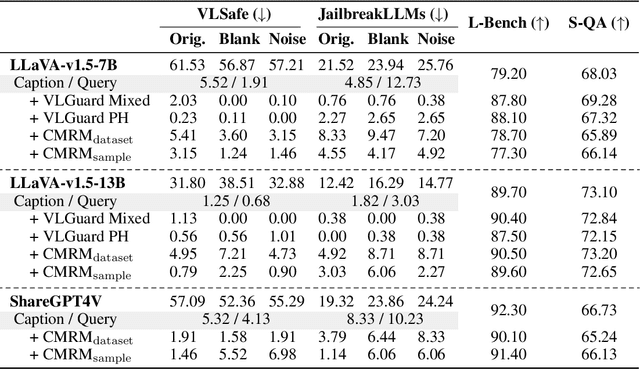
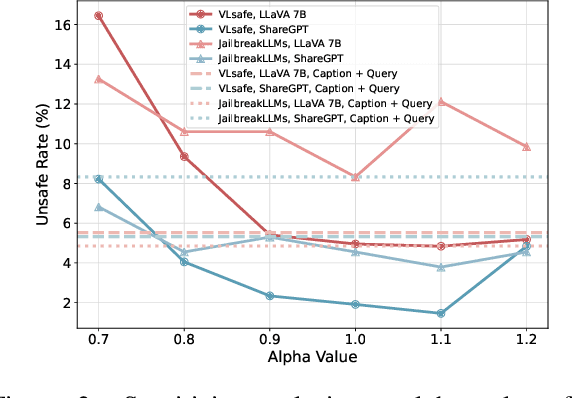

The safety alignment ability of Vision-Language Models (VLMs) is prone to be degraded by the integration of the vision module compared to its LLM backbone. We investigate this phenomenon, dubbed as ''safety alignment degradation'' in this paper, and show that the challenge arises from the representation gap that emerges when introducing vision modality to VLMs. In particular, we show that the representations of multi-modal inputs shift away from that of text-only inputs which represent the distribution that the LLM backbone is optimized for. At the same time, the safety alignment capabilities, initially developed within the textual embedding space, do not successfully transfer to this new multi-modal representation space. To reduce safety alignment degradation, we introduce Cross-Modality Representation Manipulation (CMRM), an inference time representation intervention method for recovering the safety alignment ability that is inherent in the LLM backbone of VLMs, while simultaneously preserving the functional capabilities of VLMs. The empirical results show that our framework significantly recovers the alignment ability that is inherited from the LLM backbone with minimal impact on the fluency and linguistic capabilities of pre-trained VLMs even without additional training. Specifically, the unsafe rate of LLaVA-7B on multi-modal input can be reduced from 61.53% to as low as 3.15% with only inference-time intervention. WARNING: This paper contains examples of toxic or harmful language.
Detecting Training Data of Large Language Models via Expectation Maximization
Oct 10, 2024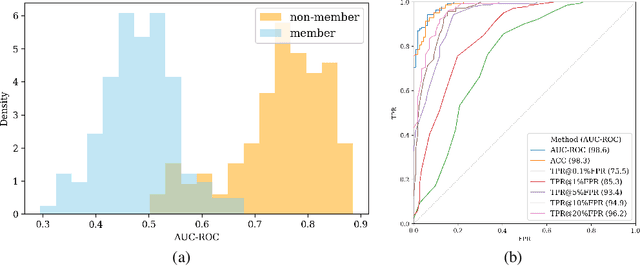



The widespread deployment of large language models (LLMs) has led to impressive advancements, yet information about their training data, a critical factor in their performance, remains undisclosed. Membership inference attacks (MIAs) aim to determine whether a specific instance was part of a target model's training data. MIAs can offer insights into LLM outputs and help detect and address concerns such as data contamination and compliance with privacy and copyright standards. However, applying MIAs to LLMs presents unique challenges due to the massive scale of pre-training data and the ambiguous nature of membership. Additionally, creating appropriate benchmarks to evaluate MIA methods is not straightforward, as training and test data distributions are often unknown. In this paper, we introduce EM-MIA, a novel MIA method for LLMs that iteratively refines membership scores and prefix scores via an expectation-maximization algorithm, leveraging the duality that the estimates of these scores can be improved by each other. Membership scores and prefix scores assess how each instance is likely to be a member and discriminative as a prefix, respectively. Our method achieves state-of-the-art results on the WikiMIA dataset. To further evaluate EM-MIA, we present OLMoMIA, a benchmark built from OLMo resources, which allows us to control the difficulty of MIA tasks with varying degrees of overlap between training and test data distributions. We believe that EM-MIA serves as a robust MIA method for LLMs and that OLMoMIA provides a valuable resource for comprehensively evaluating MIA approaches, thereby driving future research in this critical area.
Active Evaluation Acquisition for Efficient LLM Benchmarking
Oct 08, 2024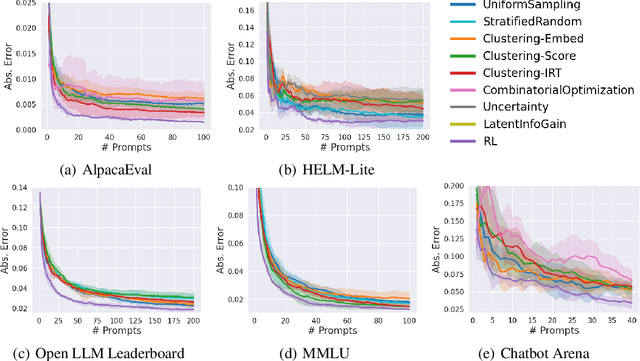
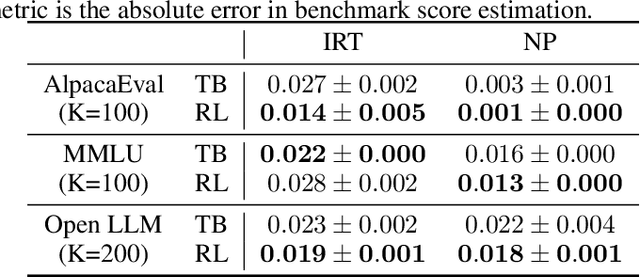
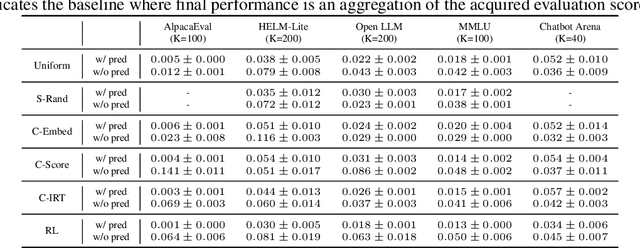
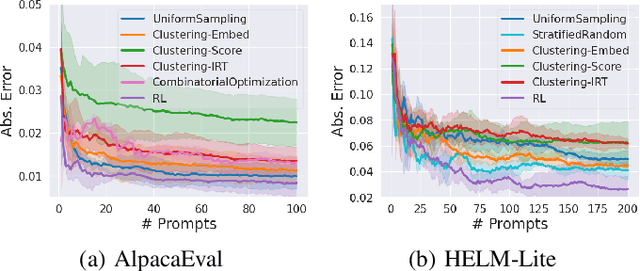
As large language models (LLMs) become increasingly versatile, numerous large scale benchmarks have been developed to thoroughly assess their capabilities. These benchmarks typically consist of diverse datasets and prompts to evaluate different aspects of LLM performance. However, comprehensive evaluations on hundreds or thousands of prompts incur tremendous costs in terms of computation, money, and time. In this work, we investigate strategies to improve evaluation efficiency by selecting a subset of examples from each benchmark using a learned policy. Our approach models the dependencies across test examples, allowing accurate prediction of the evaluation outcomes for the remaining examples based on the outcomes of the selected ones. Consequently, we only need to acquire the actual evaluation outcomes for the selected subset. We rigorously explore various subset selection policies and introduce a novel RL-based policy that leverages the captured dependencies. Empirical results demonstrate that our approach significantly reduces the number of evaluation prompts required while maintaining accurate performance estimates compared to previous methods.
General Purpose Verification for Chain of Thought Prompting
Apr 30, 2024

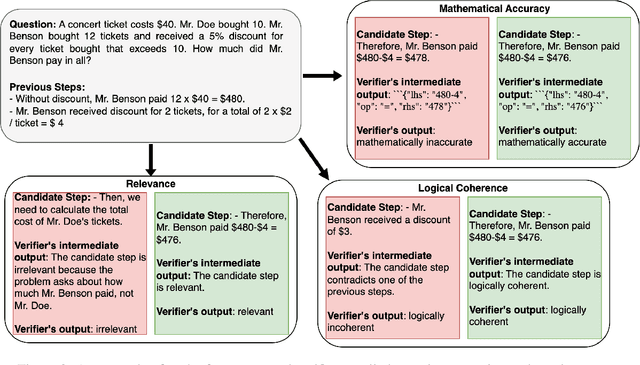

Many of the recent capabilities demonstrated by Large Language Models (LLMs) arise primarily from their ability to exploit contextual information. In this paper, we explore ways to improve reasoning capabilities of LLMs through (1) exploration of different chains of thought and (2) validation of the individual steps of the reasoning process. We propose three general principles that a model should adhere to while reasoning: (i) Relevance, (ii) Mathematical Accuracy, and (iii) Logical Consistency. We apply these constraints to the reasoning steps generated by the LLM to improve the accuracy of the final generation. The constraints are applied in the form of verifiers: the model itself is asked to verify if the generated steps satisfy each constraint. To further steer the generations towards high-quality solutions, we use the perplexity of the reasoning steps as an additional verifier. We evaluate our method on 4 distinct types of reasoning tasks, spanning a total of 9 different datasets. Experiments show that our method is always better than vanilla generation, and, in 6 out of the 9 datasets, it is better than best-of N sampling which samples N reasoning chains and picks the lowest perplexity generation.
NewsQs: Multi-Source Question Generation for the Inquiring Mind
Feb 28, 2024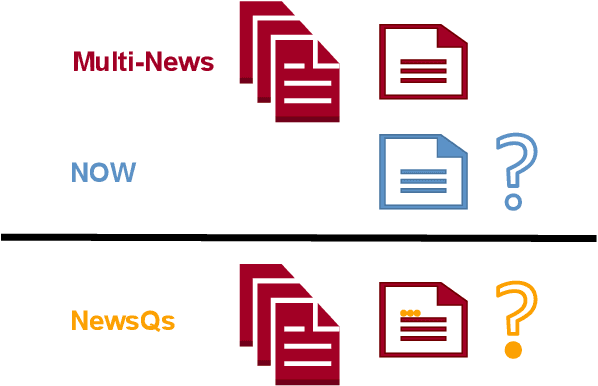
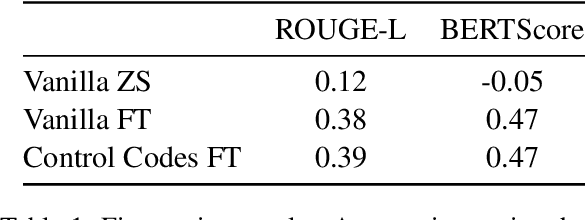
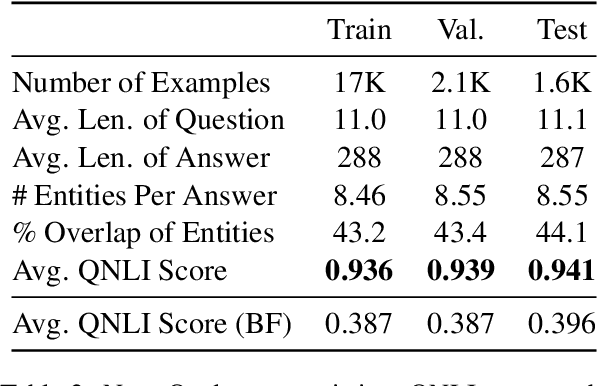
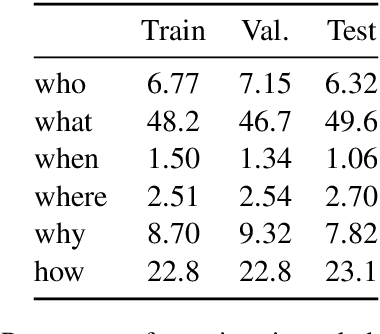
We present NewsQs (news-cues), a dataset that provides question-answer pairs for multiple news documents. To create NewsQs, we augment a traditional multi-document summarization dataset with questions automatically generated by a T5-Large model fine-tuned on FAQ-style news articles from the News On the Web corpus. We show that fine-tuning a model with control codes produces questions that are judged acceptable more often than the same model without them as measured through human evaluation. We use a QNLI model with high correlation with human annotations to filter our data. We release our final dataset of high-quality questions, answers, and document clusters as a resource for future work in query-based multi-document summarization.