 Add to Chrome
 Add to Firefox
 Add to Edge
From Atomic Actions to Standard Operating Procedures: Iterative Tool Optimization for Self-Evolving LLM Agents
Jul 08, 2026
Tool utilization enables Large Language Model (LLM) agents to interact with the real world and resolve complex tasks. However, existing agent frameworks predominantly rely on static toolsets composed of granular atomic actions (e.g., basic file I/O or single-turn search), which forces agents to reinvent low-level logic for every recurring workflow, leading to increased reasoning overhead and failure rates. In this study, we propose that agents can achieve self-evolution by synthesizing these atomic actions into reusable Standard Operating Procedures (SOPs), which function as callable higher-order tools that encapsulate multi-step logic. We further introduce EvoSOP, a framework that empowers agents to extract SOPs from execution trajectories and iteratively optimize the toolset through a systematic lifecycle of construction, merging, evaluation, and pruning. Extensive experiments demonstrate that EvoSOP significantly boosts task success rates while substantially reducing the number of interaction rounds compared to baselines. Our analysis also reveals that iterative tool optimization fosters reliable and efficient tool-use patterns, providing a scalable pathway for the development of self-evolving agents.

Back to Basics: Improving Molecular Understanding in LLMs via SMILES-Graph Translation
Jul 03, 2026Recent advances in molecular large language models have led to strong performance on molecular understanding and generation tasks, yet these gains often come without reliable structural grounding. In particular, existing approaches conflict with the chemistry principle that structure determines function: despite their downstream success, current molecular LLMs perform poorly on basic structure recognition, suggesting that they fail to capture molecular graphs from canonical SMILES. To remedy this, we propose MolBasic, a structure-first framework that strengthens structural comprehension via SMILES-Graph translation. MolBasic is built around a multi-level structure perception benchmark, where bidirectional SMILES-Graph conversion serves as the core task to align sequential and topological representations. On top of this foundation, we employ a progressive learning scheme with a standardized Chain-of-Thought (CoT) to steer models from structure acquisition toward higher-level molecular reasoning. Experiments show that MolBasic substantially improves structural understanding and yields robust gains on downstream tasks, including property prediction and objective optimization, supporting our structure-first paradigm.
MolSight: A Graph-Aware Vision-Language Model for Unified Chemical Image Understanding
Jul 02, 2026Using molecular large language models (LLMs) as a unified framework for understanding molecular structures and functions is emerging as a new trend in tasks such as molecular design and drug discovery. However, these models struggle to fully capture the visual representation of molecular structures, limiting their potential. While existing molecular vision-language models (VLMs) show promise, they still face challenges in structural alignment and lack the necessary topological modeling for accurate molecular understanding. To address this, we propose MolSight, a graph-aware vision-language model framework designed to enhance the understanding of molecular images by VLMs. MolSight integrates a Molecular Topology Module to inject chemical-bond adjacency information into vision tokens, and a Molecular Grounding Module to align visual features with chemical symbolic semantics. Our experiments demonstrate that MolSight significantly outperforms existing VLMs, molecular LLMs, and specialized tools across multiple chemical visual understanding tasks, achieving a new level of molecular image reasoning.
Visual Graph Scaffolds for Structural Reasoning in Large Language Models
Jun 01, 2026Graphs have been used to enhance large language models (LLMs) for structured reasoning, mostly as external knowledge sources are provided to models at test time. In this paper, we take a different view: the value of graphs for LLMs lie not only in supplying information, but also in organizing reasoning. Inspired by how humans use graph-structured mind maps to organize branching and converging thoughts, we ask whether graphs can serve as an internal form of reasoning assistance. We study this question on multi-hop question answering tasks, where teacher-provided reasoning traces are rewritten as graph mind maps and used to guide a student model. Our experiments reveal a clear modality gap. When graph structures are flattened into text, their benefits become limited once direct answer hints are removed. Under this abstract guidance setting, both reasoning efficiency and answer quality degrade substantially. In contrast, visual graph guidance remains effective without direct answer clues, and its advantage persists after supervised fine-tuning and KL-based distillation. The above findings support the claim that graphs should be studied not only as external knowledge structures for LLMs, but also as visual scaffolds for organizing reasoning.
Learning Agent-Compatible Context Management for Long-Horizon Tasks
May 29, 2026LLM agents increasingly face long-horizon tasks such as web search and deep research in real-world applications, where accumulated context can cause long-context degradation and reasoning failures. Prior work mitigates this through context management with agent-side context control or fixed strategies such as summarization, which require training the agent itself for adaptation - making it impractical for closed-source agents and ignoring that different agents may require different strategies. We introduce Adaptive Context Management (AdaCoM), which trains an external LLM to manage the context of a frozen agent through flexible modification actions and end-to-end reinforcement learning. Across diverse agents on web search and deep research benchmarks, AdaCoM substantially improves performance by preserving task constraints and progress while pruning stale content. The learned strategies reveal a Fidelity-Reliability Trade-off: agents with higher vanilla ReAct performance benefit from higher-fidelity context preservation, whereas lower-performing agents require more aggressive compression to stay within a reliable reasoning regime. Transfer experiments show that AdaCoM generalizes most effectively across agents with similar capability (measured by vanilla ReAct performance), suggesting a practical path toward reusable context managers for agent systems.
Position: The Turing-Completeness of Real-World Autoregressive Transformers Relies Heavily on Context Management
May 19, 2026Many works make the eye-catching claim that Transformers are Turing-complete. However, the literature often conflates two distinct settings: (i) a fixed Transformer system setting, in which a fixed autoregressive Transformer is coupled with a fixed context-management method to process inputs of different lengths step by step, and (ii) a scaling-family setting, in which a family of different models (with increasing context-window length or numerical precision) is used to handle different input lengths. Existing proofs of Transformer Turing-completeness are frequently established in setting (ii), whereas real-world LLM deployment and the standard notion of Turing-completeness correspond more naturally to setting (i). In this paper, we first formalize the fixed-system setting, thereby providing a concrete characterization of how real-world LLMs operate. We then argue that results proved in the scaling-family setting provide theoretically meaningful resource bounds but do not establish Turing-completeness, thereby clarifying a common misinterpretation of existing results. Finally, we show that different context-management methods can yield sharply different computational power, and we advocate the position that context management is a central component that critically determines the computational power of real-world autoregressive Transformers.
AbFlow : End-to-end Paratope-Centric Antibody Design by Interaction Enhanced Flow Matching
Feb 06, 2026Antigen-antibody binding is a critical process in the immune response. Although recent progress has advanced antibody design, current methods lack a generative framework for end-to-end modeling of full-atom antibody structures and struggle to fully exploit antigen-specific geometric information for optimizing local binding interfaces and global structures. To overcome these limitations, we introduce AbFlow, a flow-matching framework that leverages optimal transport to design full-atom antibodies end-to-end. AbFlow incorporates an extended velocity field network featuring an equivariant Surface Multi-channel Encoder, which uses surface-level antigen interaction data to refine the antibody structure, particularly the CDR-H3 region. Extensive experiments in paratoep-centric antibody design, multi-CDRs and full-atom antibody design, binding affinity optimization, and complex structure prediction show that AbFlow produces superior antigen-antibody complexes, especially at the contact interface, and markedly improves the binding affinity of generated antibodies.
Fused Gromov-Wasserstein Contrastive Learning for Effective Enzyme-Reaction Screening
Dec 09, 2025Enzymes are crucial catalysts that enable a wide range of biochemical reactions. Efficiently identifying specific enzymes from vast protein libraries is essential for advancing biocatalysis. Traditional computational methods for enzyme screening and retrieval are time-consuming and resource-intensive. Recently, deep learning approaches have shown promise. However, these methods focus solely on the interaction between enzymes and reactions, overlooking the inherent hierarchical relationships within each domain. To address these limitations, we introduce FGW-CLIP, a novel contrastive learning framework based on optimizing the fused Gromov-Wasserstein distance. FGW-CLIP incorporates multiple alignments, including inter-domain alignment between reactions and enzymes and intra-domain alignment within enzymes and reactions. By introducing a tailored regularization term, our method minimizes the Gromov-Wasserstein distance between enzyme and reaction spaces, which enhances information integration across these domains. Extensive evaluations demonstrate the superiority of FGW-CLIP in challenging enzyme-reaction tasks. On the widely-used EnzymeMap benchmark, FGW-CLIP achieves state-of-the-art performance in enzyme virtual screening, as measured by BEDROC and EF metrics. Moreover, FGW-CLIP consistently outperforms across all three splits of ReactZyme, the largest enzyme-reaction benchmark, demonstrating robust generalization to novel enzymes and reactions. These results position FGW-CLIP as a promising framework for enzyme discovery in complex biochemical settings, with strong adaptability across diverse screening scenarios.
Future Link Prediction Without Memory or Aggregation
May 26, 2025Future link prediction on temporal graphs is a fundamental task with wide applicability in real-world dynamic systems. These scenarios often involve both recurring (seen) and novel (unseen) interactions, requiring models to generalize effectively across both types of edges. However, existing methods typically rely on complex memory and aggregation modules, yet struggle to handle unseen edges. In this paper, we revisit the architecture of existing temporal graph models and identify two essential but overlooked modeling requirements for future link prediction: representing nodes with unique identifiers and performing target-aware matching between source and destination nodes. To this end, we propose Cross-Attention based Future Link Predictor on Temporal Graphs (CRAFT), a simple yet effective architecture that discards memory and aggregation modules and instead builds on two components: learnable node embeddings and cross-attention between the destination and the source's recent interactions. This design provides strong expressive power and enables target-aware modeling of the compatibility between candidate destinations and the source's interaction patterns. Extensive experiments on diverse datasets demonstrate that CRAFT consistently achieves superior performance with high efficiency, making it well-suited for large-scale real-world applications.
Rethinking Link Prediction for Directed Graphs
Feb 08, 2025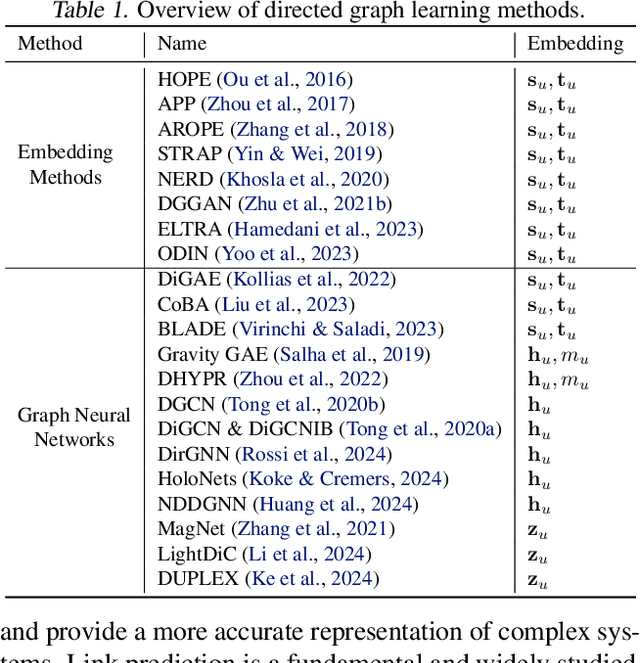
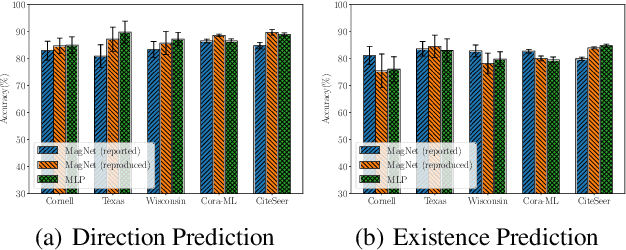

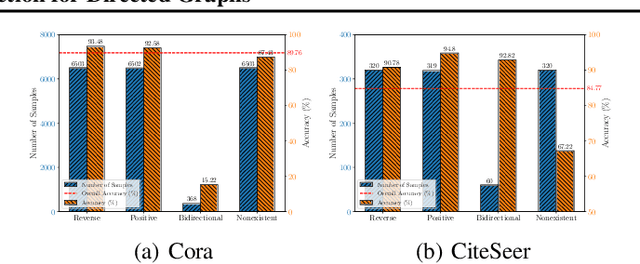
Link prediction for directed graphs is a crucial task with diverse real-world applications. Recent advances in embedding methods and Graph Neural Networks (GNNs) have shown promising improvements. However, these methods often lack a thorough analysis of embedding expressiveness and suffer from ineffective benchmarks for a fair evaluation. In this paper, we propose a unified framework to assess the expressiveness of existing methods, highlighting the impact of dual embeddings and decoder design on performance. To address limitations in current experimental setups, we introduce DirLinkBench, a robust new benchmark with comprehensive coverage and standardized evaluation. The results show that current methods struggle to achieve strong performance on the new benchmark, while DiGAE outperforms others overall. We further revisit DiGAE theoretically, showing its graph convolution aligns with GCN on an undirected bipartite graph. Inspired by these insights, we propose a novel spectral directed graph auto-encoder SDGAE that achieves SOTA results on DirLinkBench. Finally, we analyze key factors influencing directed link prediction and highlight open challenges.