 Add to Chrome
 Add to Firefox
 Add to Edge
Hierarchical Feature Learning for Medical Point Clouds via State Space Model
Apr 17, 2025
Deep learning-based point cloud modeling has been widely investigated as an indispensable component of general shape analysis. Recently, transformer and state space model (SSM) have shown promising capacities in point cloud learning. However, limited research has been conducted on medical point clouds, which have great potential in disease diagnosis and treatment. This paper presents an SSM-based hierarchical feature learning framework for medical point cloud understanding. Specifically, we down-sample input into multiple levels through the farthest point sampling. At each level, we perform a series of k-nearest neighbor (KNN) queries to aggregate multi-scale structural information. To assist SSM in processing point clouds, we introduce coordinate-order and inside-out scanning strategies for efficient serialization of irregular points. Point features are calculated progressively from short neighbor sequences and long point sequences through vanilla and group Point SSM blocks, to capture both local patterns and long-range dependencies. To evaluate the proposed method, we build a large-scale medical point cloud dataset named MedPointS for anatomy classification, completion, and segmentation. Extensive experiments conducted on MedPointS demonstrate that our method achieves superior performance across all tasks. The dataset is available at https://flemme-docs.readthedocs.io/en/latest/medpoints.html. Code is merged to a public medical imaging platform: https://github.com/wlsdzyzl/flemme.

Unveiling Hidden Collaboration within Mixture-of-Experts in Large Language Models
Apr 16, 2025

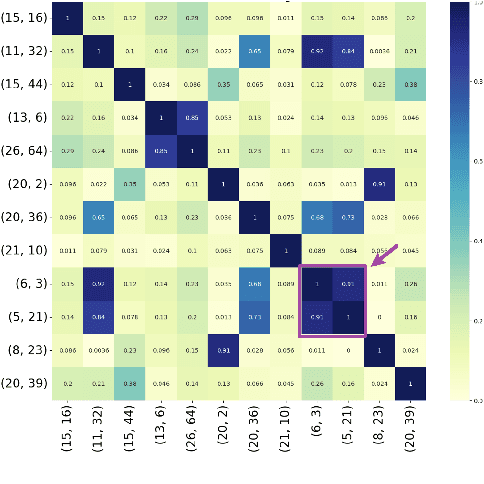

Mixture-of-Experts based large language models (MoE LLMs) have shown significant promise in multitask adaptability by dynamically routing inputs to specialized experts. Despite their success, the collaborative mechanisms among experts are still not well understood, limiting both the interpretability and optimization of these models. In this paper, we focus on two critical issues: (1) identifying expert collaboration patterns, and (2) optimizing MoE LLMs through expert pruning. To address the first issue, we propose a hierarchical sparse dictionary learning (HSDL) method that uncovers the collaboration patterns among experts. For the second issue, we introduce the Contribution-Aware Expert Pruning (CAEP) algorithm, which effectively prunes low-contribution experts. Our extensive experiments demonstrate that expert collaboration patterns are closely linked to specific input types and exhibit semantic significance across various tasks. Moreover, pruning experiments show that our approach improves overall performance by 2.5\% on average, outperforming existing methods. These findings offer valuable insights into enhancing the efficiency and interpretability of MoE LLMs, offering a clearer understanding of expert interactions and improving model optimization.
UXAgent: A System for Simulating Usability Testing of Web Design with LLM Agents
Apr 13, 2025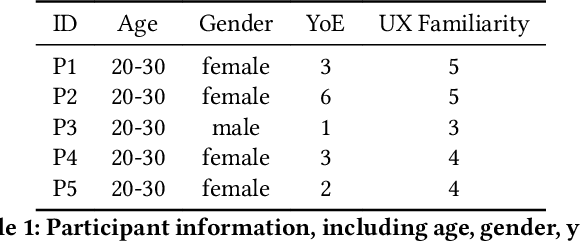
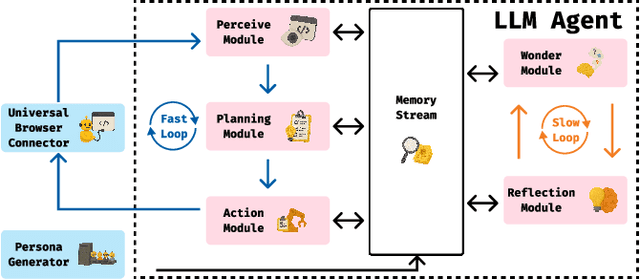
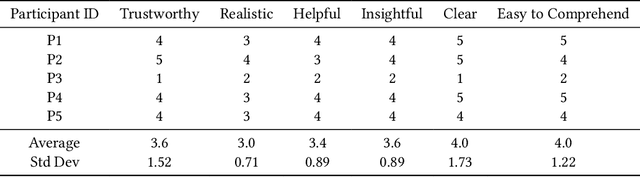
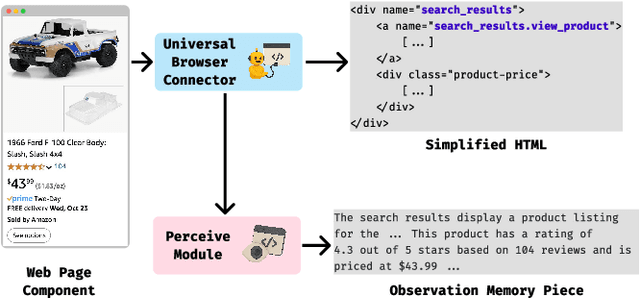
Usability testing is a fundamental research method that user experience (UX) researchers use to evaluate and iterate a web design, but\textbf{ how to evaluate and iterate the usability testing study design } itself? Recent advances in Large Language Model-simulated Agent (\textbf{LLM Agent}) research inspired us to design \textbf{UXAgent} to support UX researchers in evaluating and reiterating their usability testing study design before they conduct the real human-subject study. Our system features a Persona Generator module, an LLM Agent module, and a Universal Browser Connector module to automatically generate thousands of simulated users to interactively test the target website. The system also provides an Agent Interview Interface and a Video Replay Interface so that the UX researchers can easily review and analyze the generated qualitative and quantitative log data. Through a heuristic evaluation, five UX researcher participants praised the innovation of our system but also expressed concerns about the future of LLM Agent usage in UX studies.
Kimi-VL Technical Report
Apr 10, 2025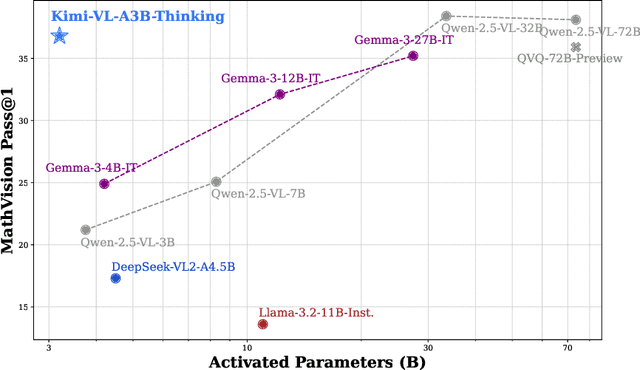
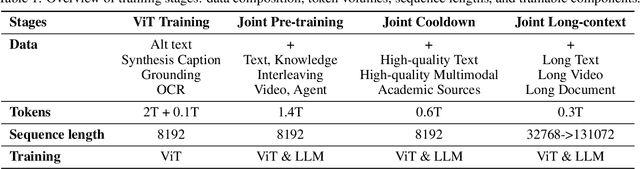
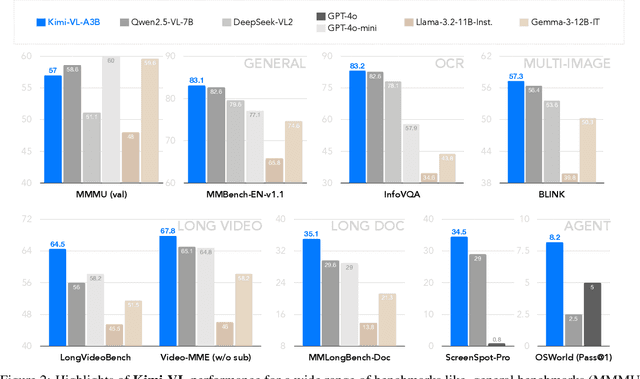

We present Kimi-VL, an efficient open-source Mixture-of-Experts (MoE) vision-language model (VLM) that offers advanced multimodal reasoning, long-context understanding, and strong agent capabilities - all while activating only 2.8B parameters in its language decoder (Kimi-VL-A3B). Kimi-VL demonstrates strong performance across challenging domains: as a general-purpose VLM, Kimi-VL excels in multi-turn agent tasks (e.g., OSWorld), matching flagship models. Furthermore, it exhibits remarkable capabilities across diverse challenging vision language tasks, including college-level image and video comprehension, OCR, mathematical reasoning, and multi-image understanding. In comparative evaluations, it effectively competes with cutting-edge efficient VLMs such as GPT-4o-mini, Qwen2.5-VL-7B, and Gemma-3-12B-IT, while surpassing GPT-4o in several key domains. Kimi-VL also advances in processing long contexts and perceiving clearly. With a 128K extended context window, Kimi-VL can process diverse long inputs, achieving impressive scores of 64.5 on LongVideoBench and 35.1 on MMLongBench-Doc. Its native-resolution vision encoder, MoonViT, further allows it to see and understand ultra-high-resolution visual inputs, achieving 83.2 on InfoVQA and 34.5 on ScreenSpot-Pro, while maintaining lower computational cost for common tasks. Building upon Kimi-VL, we introduce an advanced long-thinking variant: Kimi-VL-Thinking. Developed through long chain-of-thought (CoT) supervised fine-tuning (SFT) and reinforcement learning (RL), this model exhibits strong long-horizon reasoning capabilities. It achieves scores of 61.7 on MMMU, 36.8 on MathVision, and 71.3 on MathVista while maintaining the compact 2.8B activated LLM parameters, setting a new standard for efficient multimodal thinking models. Code and models are publicly accessible at https://github.com/MoonshotAI/Kimi-VL.
Transferable Mask Transformer: Cross-domain Semantic Segmentation with Region-adaptive Transferability Estimation
Apr 08, 2025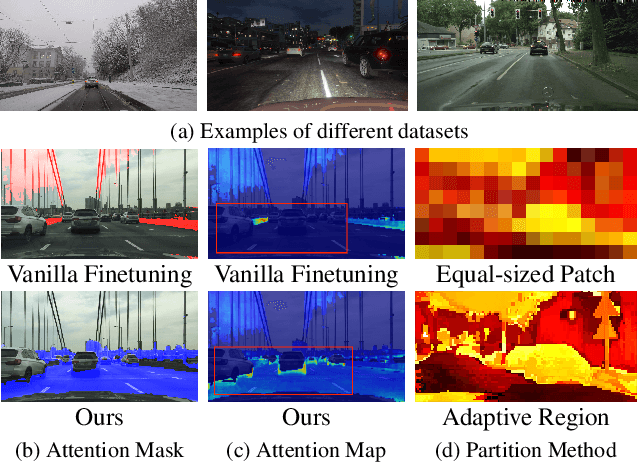
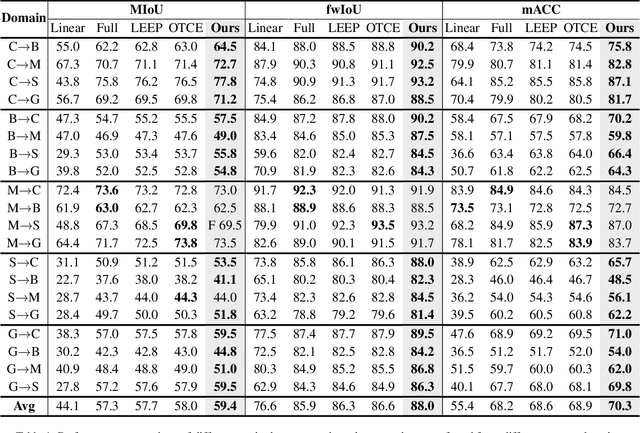
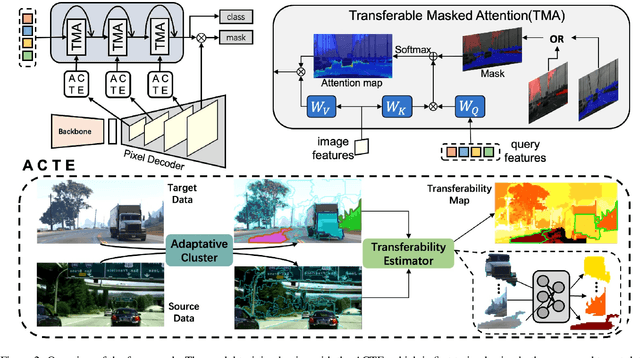
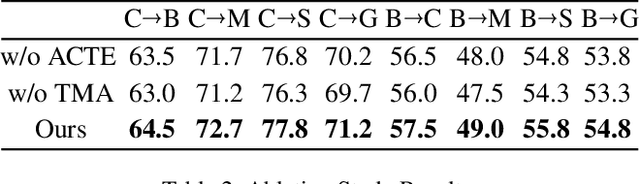
Recent advances in Vision Transformers (ViTs) have set new benchmarks in semantic segmentation. However, when adapting pretrained ViTs to new target domains, significant performance degradation often occurs due to distribution shifts, resulting in suboptimal global attention. Since self-attention mechanisms are inherently data-driven, they may fail to effectively attend to key objects when source and target domains exhibit differences in texture, scale, or object co-occurrence patterns. While global and patch-level domain adaptation methods provide partial solutions, region-level adaptation with dynamically shaped regions is crucial due to spatial heterogeneity in transferability across different image areas. We present Transferable Mask Transformer (TMT), a novel region-level adaptation framework for semantic segmentation that aligns cross-domain representations through spatial transferability analysis. TMT consists of two key components: (1) An Adaptive Cluster-based Transferability Estimator (ACTE) that dynamically segments images into structurally and semantically coherent regions for localized transferability assessment, and (2) A Transferable Masked Attention (TMA) module that integrates region-specific transferability maps into ViTs' attention mechanisms, prioritizing adaptation in regions with low transferability and high semantic uncertainty. Comprehensive evaluations across 20 cross-domain pairs demonstrate TMT's superiority, achieving an average 2% MIoU improvement over vanilla fine-tuning and a 1.28% increase compared to state-of-the-art baselines. The source code will be publicly available.
SkyReels-A2: Compose Anything in Video Diffusion Transformers
Apr 03, 2025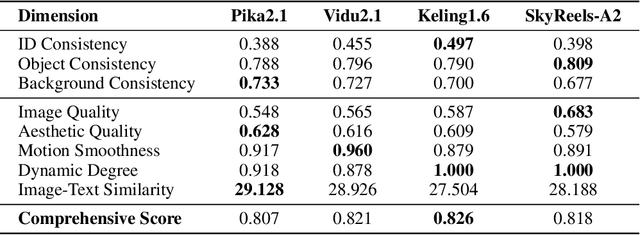
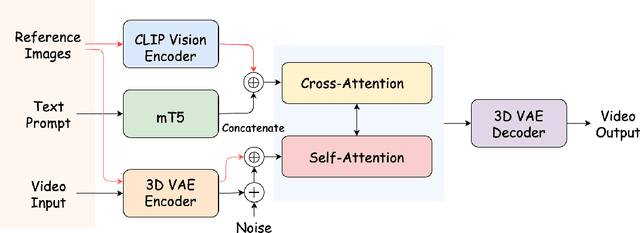
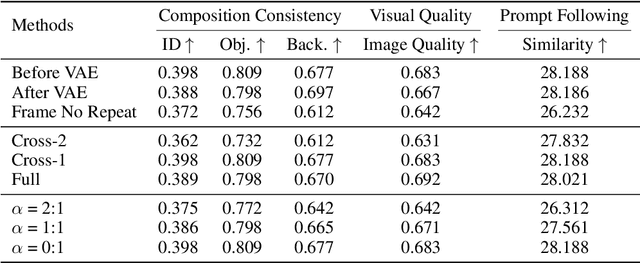
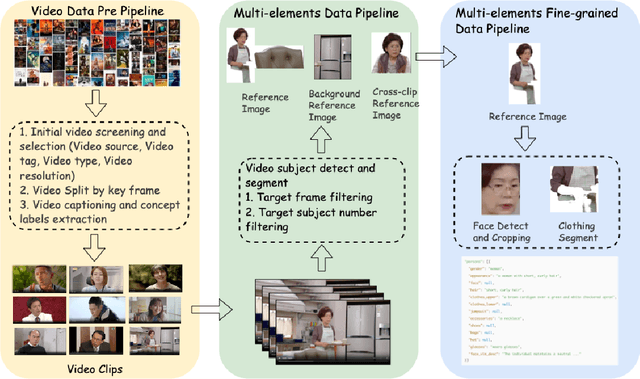
This paper presents SkyReels-A2, a controllable video generation framework capable of assembling arbitrary visual elements (e.g., characters, objects, backgrounds) into synthesized videos based on textual prompts while maintaining strict consistency with reference images for each element. We term this task elements-to-video (E2V), whose primary challenges lie in preserving the fidelity of each reference element, ensuring coherent composition of the scene, and achieving natural outputs. To address these, we first design a comprehensive data pipeline to construct prompt-reference-video triplets for model training. Next, we propose a novel image-text joint embedding model to inject multi-element representations into the generative process, balancing element-specific consistency with global coherence and text alignment. We also optimize the inference pipeline for both speed and output stability. Moreover, we introduce a carefully curated benchmark for systematic evaluation, i.e, A2 Bench. Experiments demonstrate that our framework can generate diverse, high-quality videos with precise element control. SkyReels-A2 is the first open-source commercial grade model for the generation of E2V, performing favorably against advanced closed-source commercial models. We anticipate SkyReels-A2 will advance creative applications such as drama and virtual e-commerce, pushing the boundaries of controllable video generation.
ABC-GS: Alignment-Based Controllable Style Transfer for 3D Gaussian Splatting
Mar 28, 20253D scene stylization approaches based on Neural Radiance Fields (NeRF) achieve promising results by optimizing with Nearest Neighbor Feature Matching (NNFM) loss. However, NNFM loss does not consider global style information. In addition, the implicit representation of NeRF limits their fine-grained control over the resulting scenes. In this paper, we introduce ABC-GS, a novel framework based on 3D Gaussian Splatting to achieve high-quality 3D style transfer. To this end, a controllable matching stage is designed to achieve precise alignment between scene content and style features through segmentation masks. Moreover, a style transfer loss function based on feature alignment is proposed to ensure that the outcomes of style transfer accurately reflect the global style of the reference image. Furthermore, the original geometric information of the scene is preserved with the depth loss and Gaussian regularization terms. Extensive experiments show that our ABC-GS provides controllability of style transfer and achieves stylization results that are more faithfully aligned with the global style of the chosen artistic reference. Our homepage is available at https://vpx-ecnu.github.io/ABC-GS-website.
Analyzable Chain-of-Musical-Thought Prompting for High-Fidelity Music Generation
Mar 25, 2025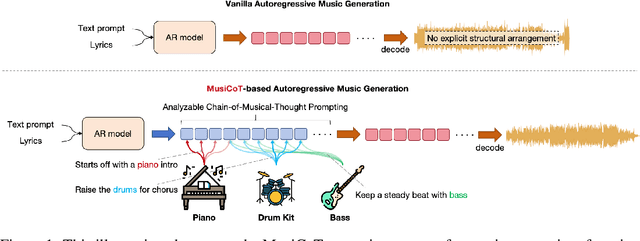
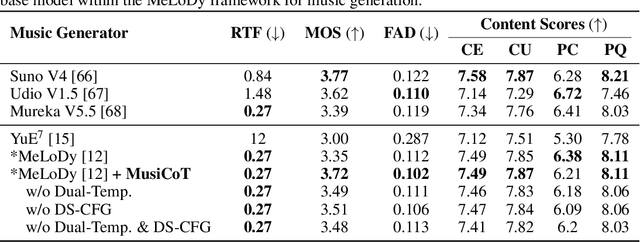
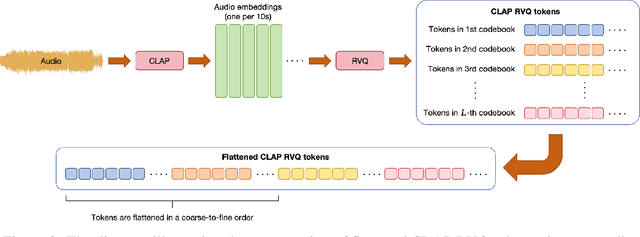
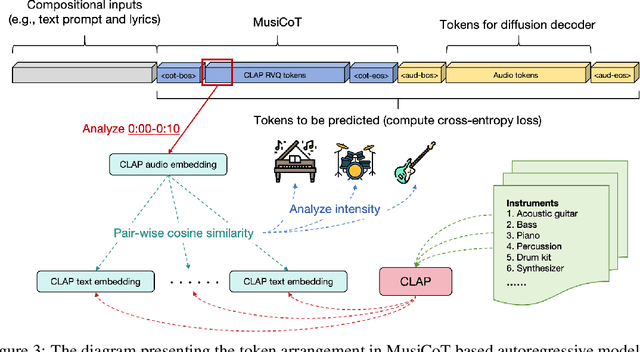
Autoregressive (AR) models have demonstrated impressive capabilities in generating high-fidelity music. However, the conventional next-token prediction paradigm in AR models does not align with the human creative process in music composition, potentially compromising the musicality of generated samples. To overcome this limitation, we introduce MusiCoT, a novel chain-of-thought (CoT) prompting technique tailored for music generation. MusiCoT empowers the AR model to first outline an overall music structure before generating audio tokens, thereby enhancing the coherence and creativity of the resulting compositions. By leveraging the contrastive language-audio pretraining (CLAP) model, we establish a chain of "musical thoughts", making MusiCoT scalable and independent of human-labeled data, in contrast to conventional CoT methods. Moreover, MusiCoT allows for in-depth analysis of music structure, such as instrumental arrangements, and supports music referencing -- accepting variable-length audio inputs as optional style references. This innovative approach effectively addresses copying issues, positioning MusiCoT as a vital practical method for music prompting. Our experimental results indicate that MusiCoT consistently achieves superior performance across both objective and subjective metrics, producing music quality that rivals state-of-the-art generation models. Our samples are available at https://MusiCoT.github.io/.
UltraFlwr -- An Efficient Federated Medical and Surgical Object Detection Framework
Mar 19, 2025Object detection shows promise for medical and surgical applications such as cell counting and tool tracking. However, its faces multiple real-world edge deployment challenges including limited high-quality annotated data, data sharing restrictions, and computational constraints. In this work, we introduce UltraFlwr, a framework for federated medical and surgical object detection. By leveraging Federated Learning (FL), UltraFlwr enables decentralized model training across multiple sites without sharing raw data. To further enhance UltraFlwr's efficiency, we propose YOLO-PA, a set of novel Partial Aggregation (PA) strategies specifically designed for YOLO models in FL. YOLO-PA significantly reduces communication overhead by up to 83% per round while maintaining performance comparable to Full Aggregation (FA) strategies. Our extensive experiments on BCCD and m2cai16-tool-locations datasets demonstrate that YOLO-PA not only provides better client models compared to client-wise centralized training and FA strategies, but also facilitates efficient training and deployment across resource-constrained edge devices. Further, we also establish one of the first benchmarks in federated medical and surgical object detection. This paper advances the feasibility of training and deploying detection models on the edge, making federated object detection more practical for time-critical and resource-constrained medical and surgical applications. UltraFlwr is publicly available at https://github.com/KCL-BMEIS/UltraFlwr.
SpaceVLLM: Endowing Multimodal Large Language Model with Spatio-Temporal Video Grounding Capability
Mar 18, 2025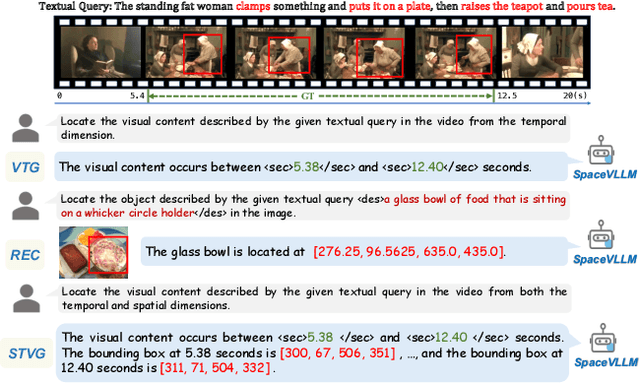

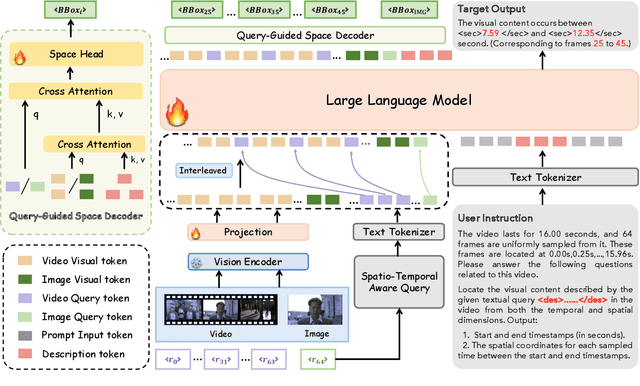
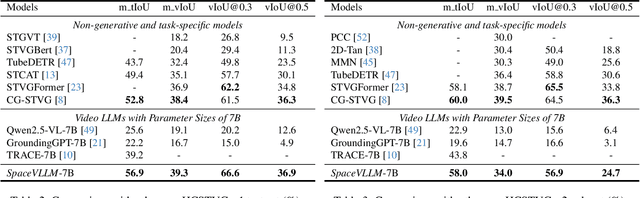
Multimodal large language models (MLLMs) have made remarkable progress in either temporal or spatial localization. However, they struggle to perform spatio-temporal video grounding. This limitation stems from two major challenges. Firstly, it is difficult to extract accurate spatio-temporal information of each frame in the video. Secondly, the substantial number of visual tokens makes it challenging to precisely map visual tokens of each frame to their corresponding spatial coordinates. To address these issues, we introduce SpaceVLLM, a MLLM endowed with spatio-temporal video grounding capability. Specifically, we adopt a set of interleaved Spatio-Temporal Aware Queries to capture temporal perception and dynamic spatial information. Moreover, we propose a Query-Guided Space Decoder to establish a corresponding connection between the queries and spatial coordinates. Additionally, due to the lack of spatio-temporal datasets, we construct the Unified Spatio-Temporal Grounding (Uni-STG) dataset, comprising 480K instances across three tasks. This dataset fully exploits the potential of MLLM to simultaneously facilitate localization in both temporal and spatial dimensions. Extensive experiments demonstrate that SpaceVLLM achieves the state-of-the-art performance across 11 benchmarks covering temporal, spatial, spatio-temporal and video understanding tasks, highlighting the effectiveness of our approach. Our code, datasets and model will be released.