 Add to Chrome
 Add to Firefox
 Add to Edge
CORE-MTL: Rethinking Gradient Balancing via Causal Orthogonal Representations
Jun 01, 2026
Multi-task learning (MTL) aims to construct a joint model for multiple tasks by sharing a common representation across domains. To achieve this goal, existing optimization-centric methods either balance task gradients or modify the shared architecture. However, as these approaches remain agnostic to the content of the shared representation, they fail to disentangle task-relevant structure from spurious context, leading to negative transfer and poor generalization. To overcome this limitation, we propose Causal Orthogonal Representations for Multi-Task Learning (CORE-MTL), a causally motivated representation-centric framework that encourages a structured semantic-residual factorization of the shared representation, concentrating task-relevant structure in the semantic stream while relegating nuisance variation to the residual stream. We instantiate this framework in the visual domain by leveraging physical priors for structured scenes and statistical constraints for attributes. Theoretically, our method enjoys a tighter out-of-distribution generalization bound than optimization-centric methods and reduces task gradient interference without explicit gradient projection or reweighting. Empirically, CORE-MTL consistently outperforms existing methods on visual multi-task benchmarks in both in-distribution and out-of-distribution settings. Code is publicly available at https://github.com/Hope-Rita/CORE-MTL.

Heterogeneity-Aware Dataset Scheduling for Efficient Audio Large Language Model Training
May 18, 2026Training general-purpose Audio Large Language Models (ALLMs) across diverse datasets is essential for holistic audio understanding, yet it faces significant challenges due to dataset heterogeneity, which often leads to conflicting gradients and slow convergence. Despite its impact, how to explicitly manage this heterogeneity during training remains underexplored, with current practices relying primarily on uniform mixture. In this work, we analyze multi-dataset AudioQA training from a convergence perspective and propose Grouped Sequential Training (GST). GST strategically organizes datasets into affinity-aware groups and introduces them via a progressive scheduling protocol, effectively balancing the stability of parallel training with the efficiency of sequential optimization. To ensure scalability, we develop gradient-based affinity metrics that capture inter-dataset relationships without the prohibitive cost of empirical transferability estimation. Extensive evaluations on 14 AudioQA datasets spanning speech, music, and environmental sounds demonstrate that GST achieves 30--40\% faster convergence than standard parallel training while maintaining or even surpassing the performance of mix-all training. Our results provide both theoretical insights and a practical, model-agnostic framework for efficient large-scale ALLM optimization.
Large Reward Models: Generalizable Online Robot Reward Generation with Vision-Language Models
Mar 17, 2026Reinforcement Learning (RL) has shown great potential in refining robotic manipulation policies, yet its efficacy remains strongly bottlenecked by the difficulty of designing generalizable reward functions. In this paper, we propose a framework for online policy refinement by adapting foundation VLMs into online reward generators. We develop a robust, scalable reward model based on a state-of-the-art VLM, trained on a large-scale, multi-source dataset encompassing real-world robot trajectories, human-object interactions, and diverse simulated environments. Unlike prior approaches that evaluate entire trajectories post-hoc, our method leverages the VLM to formulate a multifaceted reward signal comprising process, completion, and temporal contrastive rewards based on current visual observations. Initializing with a base policy trained via Imitation Learning (IL), we employ these VLM rewards to guide the model to correct sub-optimal behaviors in a closed-loop manner. We evaluate our framework on challenging long-horizon manipulation benchmarks requiring sequential execution and precise control. Crucially, our reward model operates in a purely zero-shot manner within these test environments. Experimental results demonstrate that our method significantly improves the success rate of the initial IL policy within just 30 RL iterations, demonstrating remarkable sample efficiency. This empirical evidence highlights that VLM-generated signals can provide reliable feedback to resolve execution errors, effectively eliminating the need for manual reward engineering and facilitating efficient online refinement for robot learning.
Geo-ATBench: A Benchmark for Geospatial Audio Tagging with Geospatial Semantic Context
Mar 11, 2026Environmental sound understanding in computational auditory scene analysis (CASA) is often formulated as an audio-only recognition problem. This formulation leaves a persistent drawback in multi-label audio tagging (AT): acoustic similarity can make certain events difficult to separate from waveforms alone. In such cases, disambiguating cues often lie outside the waveform. Geospatial semantic context (GSC), derived from geographic information system data, e.g., points of interest (POI), provides location-tied environmental priors that can help reduce this ambiguity. A systematic study of this direction is enabled through the proposed geospatial audio tagging (Geo-AT) task, which conditions multi-label sound event tagging on GSC alongside audio. To benchmark Geo-AT, Geo-ATBench is introduced as a polyphonic audio benchmark with geographical annotations, containing 10.71 hours of audio across 28 event categories; each clip is paired with a GSC representation from 11 semantic context categories. GeoFusion-AT is proposed as a unified geo-audio fusion framework that evaluates feature-, representation-, and decision-level fusion on representative audio backbones, with audio- and GSC-only baselines. Results show that incorporating GSC improves AT performance, especially on acoustically confounded labels, indicating geospatial semantics provide effective priors beyond audio alone. A crowdsourced listening study with 10 participants on 579 samples shows that there is no significant difference in performance between models on Geo-ATBench labels and aggregated human labels, supporting Geo-ATBench as a human-aligned benchmark. The Geo-AT task, benchmark Geo-ATBench, and reproducible geo-audio fusion framework GeoFusion-AT provide a foundation for studying AT with geospatial semantic context within the CASA community. Dataset, code, models are on homepage (https://github.com/WuYanru2002/Geo-ATBench).
Evolving Prompt Adaptation for Vision-Language Models
Mar 10, 2026The adaptation of large-scale vision-language models (VLMs) to downstream tasks with limited labeled data remains a significant challenge. While parameter-efficient prompt learning methods offer a promising path, they often suffer from catastrophic forgetting of pre-trained knowledge. Toward addressing this limitation, our work is grounded in the insight that governing the evolutionary path of prompts is essential for forgetting-free adaptation. To this end, we propose EvoPrompt, a novel framework designed to explicitly steer the prompt trajectory for stable, knowledge-preserving fine-tuning. Specifically, our approach employs a Modality-Shared Prompt Projector (MPP) to generate hierarchical prompts from a unified embedding space. Critically, an evolutionary training strategy decouples low-rank updates into directional and magnitude components, preserving early-learned semantic directions while only adapting their magnitude, thus enabling prompts to evolve without discarding foundational knowledge. This process is further stabilized by Feature Geometric Regularization (FGR), which enforces feature decorrelation to prevent representation collapse. Extensive experiments demonstrate that EvoPrompt achieves state-of-the-art performance in few-shot learning while robustly preserving the original zero-shot capabilities of pre-trained VLMs.
Unified Optimization of Source Weights and Transfer Quantities in Multi-Source Transfer Learning: An Asymptotic Framework
Jan 15, 2026Transfer learning plays a vital role in improving model performance in data-scarce scenarios. However, naive uniform transfer from multiple source tasks may result in negative transfer, highlighting the need to properly balance the contributions of heterogeneous sources. Moreover, existing transfer learning methods typically focus on optimizing either the source weights or the amount of transferred samples, while largely neglecting the joint consideration of the other. In this work, we propose a theoretical framework, Unified Optimization of Weights and Quantities (UOWQ), which formulates multi-source transfer learning as a parameter estimation problem grounded in an asymptotic analysis of a Kullback-Leibler divergence-based generalization error measure. The proposed framework jointly determines the optimal source weights and optimal transfer quantities for each source task. Firstly, we prove that using all available source samples is always optimal once the weights are properly adjusted, and we provide a theoretical explanation for this phenomenon. Moreover, to determine the optimal transfer weights, our analysis yields closed-form solutions in the single-source setting and develops a convex optimization-based numerical procedure for the multi-source case. Building on the theoretical results, we further propose practical algorithms for both multi-source transfer learning and multi-task learning settings. Extensive experiments on real-world benchmarks, including DomainNet and Office-Home, demonstrate that UOWQ consistently outperforms strong baselines. The results validate both the theoretical predictions and the practical effectiveness of our framework.
TreeReview: A Dynamic Tree of Questions Framework for Deep and Efficient LLM-based Scientific Peer Review
Jun 09, 2025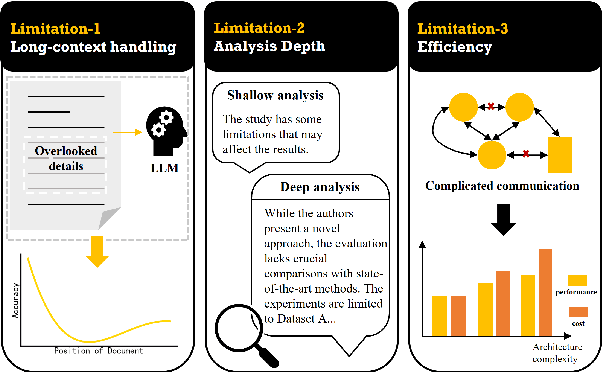
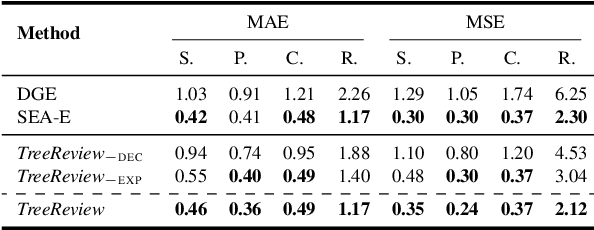
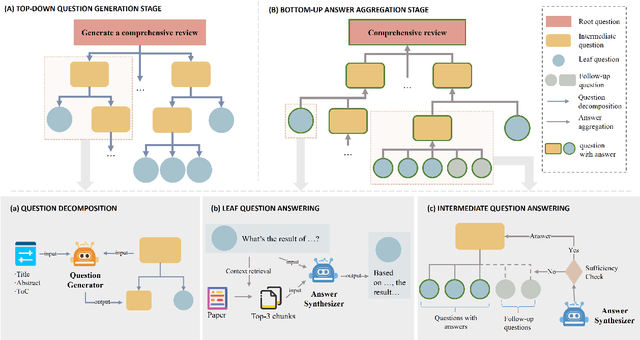
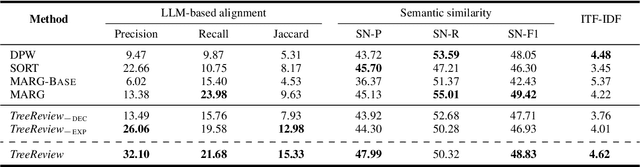
While Large Language Models (LLMs) have shown significant potential in assisting peer review, current methods often struggle to generate thorough and insightful reviews while maintaining efficiency. In this paper, we propose TreeReview, a novel framework that models paper review as a hierarchical and bidirectional question-answering process. TreeReview first constructs a tree of review questions by recursively decomposing high-level questions into fine-grained sub-questions and then resolves the question tree by iteratively aggregating answers from leaf to root to get the final review. Crucially, we incorporate a dynamic question expansion mechanism to enable deeper probing by generating follow-up questions when needed. We construct a benchmark derived from ICLR and NeurIPS venues to evaluate our method on full review generation and actionable feedback comments generation tasks. Experimental results of both LLM-based and human evaluation show that TreeReview outperforms strong baselines in providing comprehensive, in-depth, and expert-aligned review feedback, while reducing LLM token usage by up to 80% compared to computationally intensive approaches. Our code and benchmark dataset are available at https://github.com/YuanChang98/tree-review.
Transferable Mask Transformer: Cross-domain Semantic Segmentation with Region-adaptive Transferability Estimation
Apr 08, 2025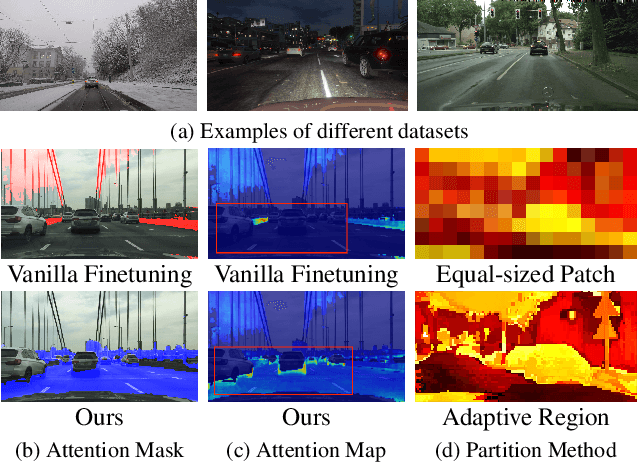
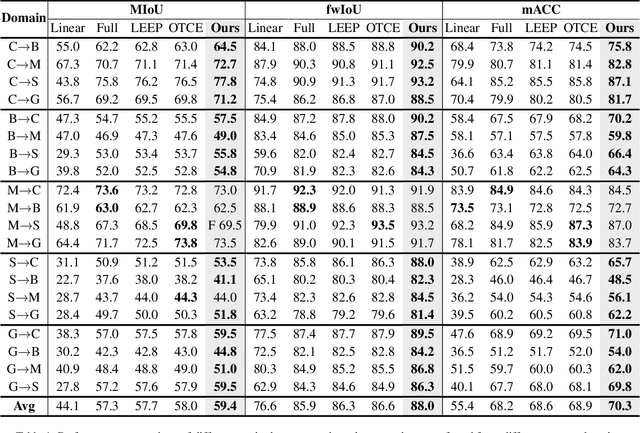
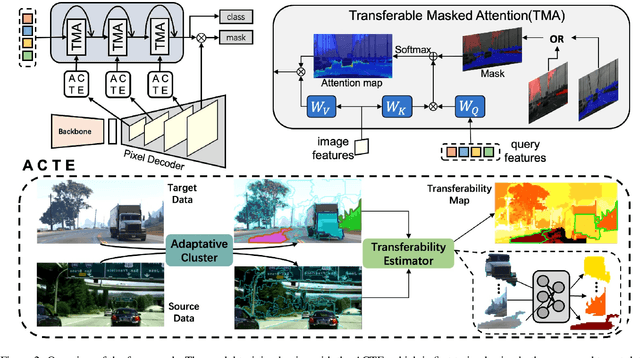
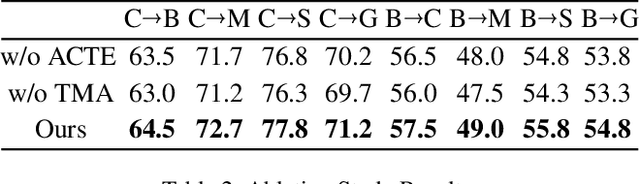
Recent advances in Vision Transformers (ViTs) have set new benchmarks in semantic segmentation. However, when adapting pretrained ViTs to new target domains, significant performance degradation often occurs due to distribution shifts, resulting in suboptimal global attention. Since self-attention mechanisms are inherently data-driven, they may fail to effectively attend to key objects when source and target domains exhibit differences in texture, scale, or object co-occurrence patterns. While global and patch-level domain adaptation methods provide partial solutions, region-level adaptation with dynamically shaped regions is crucial due to spatial heterogeneity in transferability across different image areas. We present Transferable Mask Transformer (TMT), a novel region-level adaptation framework for semantic segmentation that aligns cross-domain representations through spatial transferability analysis. TMT consists of two key components: (1) An Adaptive Cluster-based Transferability Estimator (ACTE) that dynamically segments images into structurally and semantically coherent regions for localized transferability assessment, and (2) A Transferable Masked Attention (TMA) module that integrates region-specific transferability maps into ViTs' attention mechanisms, prioritizing adaptation in regions with low transferability and high semantic uncertainty. Comprehensive evaluations across 20 cross-domain pairs demonstrate TMT's superiority, achieving an average 2% MIoU improvement over vanilla fine-tuning and a 1.28% increase compared to state-of-the-art baselines. The source code will be publicly available.
Exploiting Task Relationships for Continual Learning Using Transferability-Aware Task Embeddings
Feb 17, 2025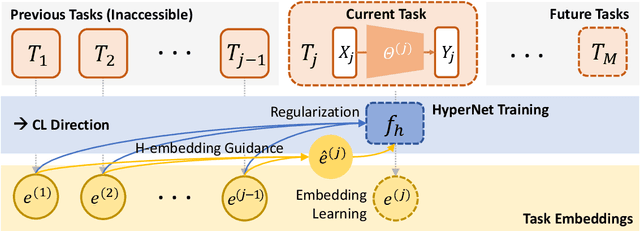
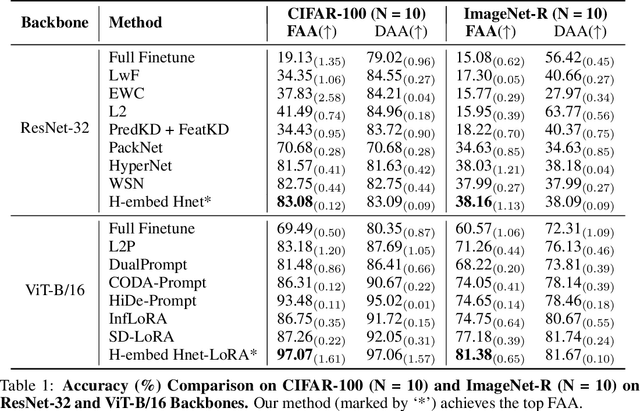
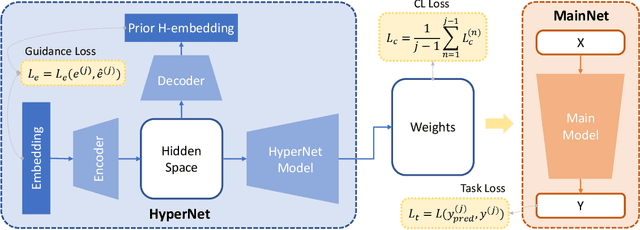
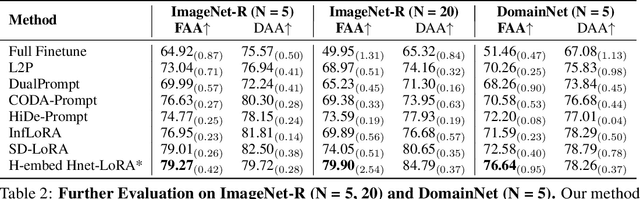
Continual learning (CL) has been an essential topic in the contemporary application of deep neural networks, where catastrophic forgetting (CF) can impede a model's ability to acquire knowledge progressively. Existing CL strategies primarily address CF by regularizing model updates or separating task-specific and shared components. However, these methods focus on task model elements while overlooking the potential of leveraging inter-task relationships for learning enhancement. To address this, we propose a transferability-aware task embedding named H-embedding and train a hypernet under its guidance to learn task-conditioned model weights for CL tasks. Particularly, H-embedding is introduced based on an information theoretical transferability measure and is designed to be online and easy to compute. The framework is also characterized by notable practicality, which only requires storing a low-dimensional task embedding for each task, and can be efficiently trained in an end-to-end way. Extensive evaluations and experimental analyses on datasets including Permuted MNIST, Cifar10/100, and ImageNet-R demonstrate that our framework performs prominently compared to various baseline methods, displaying great potential in exploiting intrinsic task relationships.
A Theoretical Framework for Data Efficient Multi-Source Transfer Learning Based on Cramér-Rao Bound
Feb 06, 2025


Multi-source transfer learning provides an effective solution to data scarcity in real-world supervised learning scenarios by leveraging multiple source tasks. In this field, existing works typically use all available samples from sources in training, which constrains their training efficiency and may lead to suboptimal results. To address this, we propose a theoretical framework that answers the question: what is the optimal quantity of source samples needed from each source task to jointly train the target model? Specifically, we introduce a generalization error measure that aligns with cross-entropy loss, and minimize it based on the Cram\'er-Rao Bound to determine the optimal transfer quantity for each source task. Additionally, we develop an architecture-agnostic and data-efficient algorithm OTQMS to implement our theoretical results for training deep multi-source transfer learning models. Experimental studies on diverse architectures and two real-world benchmark datasets show that our proposed algorithm significantly outperforms state-of-the-art approaches in both accuracy and data efficiency. The code and supplementary materials are available in https://anonymous.4open.science/r/Materials.