 Add to Chrome
 Add to Firefox
 Add to Edge
Multi-level context Modeling for consistent expert selection in Mixture-of-Experts
Jul 17, 2026
Mixture-of-Experts (MoE) enables efficient scaling of Transformer models by routing tokens to a small subset of experts. However, existing routers typically condition expert selection on shallow or isolated token representations, which often produce unstable and semantically inconsistent routing decisions across layers. In this work, we revisit expert selection from a representation perspective and identify context incompleteness as a key bottleneck limiting effective expert specialization. To address this issue, we propose Multi-level Context Fusion MOE (MCF-MOE), a framework that constructs context-aware representations by integrating complementary signals from cross-layer semantic aggregation and local token-level interactions, enabling more informative and consistent expert selection. Experiments on language modeling and understanding benchmarks demonstrate that MCF-MOE consistently improves routing consistency and downstream performance over strong MoE baselines, highlighting the importance of contextual completeness in expert routing. The code is available at https://anonymous.4open.science/r/MCFMOE.

On the Sparsity-Storage-Accuracy Tradeoff in Parsimoniously Activated Dictionary Learning
Jun 21, 2026Dictionary learning has long been studied from both optimization and probabilistic perspectives. While formulations with element-wise sparsity regularization (e.g., L1-based sparse coding) admit well-established probabilistic interpretations, many structured variants that impose global constraints lack a clear and tractable generative view. In this paper, we revisit a class of practically effective yet theoretically under-explored dictionary learning methods that impose a simple global regularization on the number of activated dictionary atoms, which we term parsimoniously activated dictionary learning (PADL). We show that PADL admits an equivalent formulation as maximum a posteriori estimation under a structured generative model, with auxiliary latent variables that govern global activation patterns. This formulation allows us to derive generalization guarantees that are difficult to obtain under the original formulation. More importantly, it yields an analytical characterization of the tradeoff between sparsity, storage cost, and reconstruction accuracy, enabling data-driven estimation of optimal hyperparameters. Based on this connection, we develop an efficient and interpretable PADL algorithm that eliminates manual hyperparameter tuning, achieving improved reconstruction performance under comparable sparsity levels on visual benchmarks. We further demonstrate its practical utility in accelerating inference for vision-language models.
Sparse Compositional Flow Matching by geometric assembly from motion primitives
May 22, 2026Embodied trajectories, such as the executable motion sequences of robotic manipulators, underwater vehicles, and mobile robots, are a fundamental output of embodied AI. Modern generative models often treat them as a dense, monolithic signal generated point by point, fitting an intricate high-dimensional posterior while leaving the data's latent structure unmodeled, the same sample inefficiency long identified by the structured generative model literature. We argue that a compositional latent structure is a natural choice: many embodied tasks share recurring motion fragments that can be made explicit as a finite repertoire of reusable motion primitives, and compositional units naturally align with subtask boundaries to support task decomposition. Existing compositional generators, however, compose in a latent space and rely on post-hoc decoding to relate sampled units to actual trajectory segments. We instead compose directly in the physical trajectory space through a flow-matching framework with two coupled designs. Motion-Primitive Dictionary Learning equips each atom with a learnable length mask and binary starting indicators so the atom itself is the primitive, reused verbatim wherever it is placed. Structural Sparse Flow Matching with Geometric Constraints then generates a binary placement matrix using duration-aware tokenization and a differentiable geometric loss that enforces spatial continuity and temporal contiguity where adjacent primitives meet. On Open X-Embodiment and 3DMoTraj, the framework attains state-of-the-art accuracy and reduces the FDE/ADE ratio from 1.8 to 1.07, improving ADE by 19.2% and FDE by 21.0% over the strongest baseline.
Unveiling Hidden Collaboration within Mixture-of-Experts in Large Language Models
Apr 16, 2025

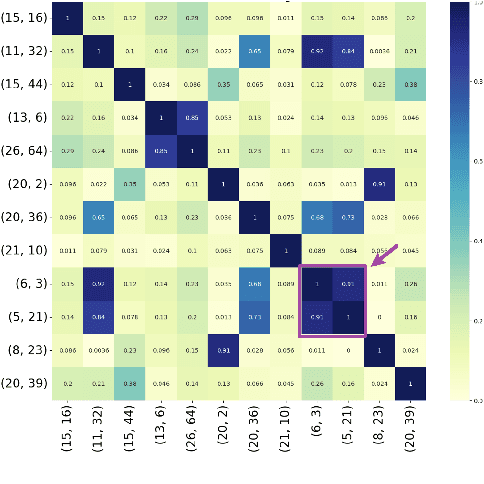

Mixture-of-Experts based large language models (MoE LLMs) have shown significant promise in multitask adaptability by dynamically routing inputs to specialized experts. Despite their success, the collaborative mechanisms among experts are still not well understood, limiting both the interpretability and optimization of these models. In this paper, we focus on two critical issues: (1) identifying expert collaboration patterns, and (2) optimizing MoE LLMs through expert pruning. To address the first issue, we propose a hierarchical sparse dictionary learning (HSDL) method that uncovers the collaboration patterns among experts. For the second issue, we introduce the Contribution-Aware Expert Pruning (CAEP) algorithm, which effectively prunes low-contribution experts. Our extensive experiments demonstrate that expert collaboration patterns are closely linked to specific input types and exhibit semantic significance across various tasks. Moreover, pruning experiments show that our approach improves overall performance by 2.5\% on average, outperforming existing methods. These findings offer valuable insights into enhancing the efficiency and interpretability of MoE LLMs, offering a clearer understanding of expert interactions and improving model optimization.
Explainable Trajectory Representation through Dictionary Learning
Dec 13, 2023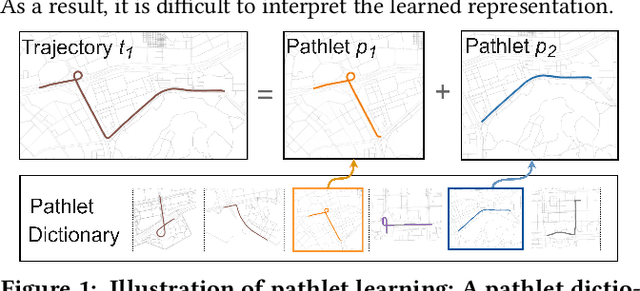

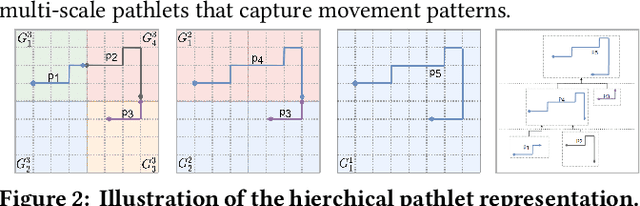
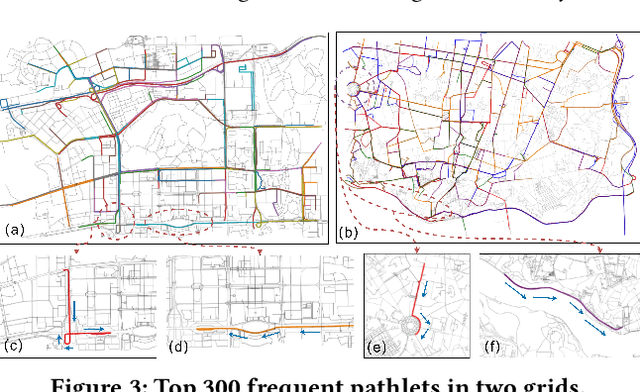
Trajectory representation learning on a network enhances our understanding of vehicular traffic patterns and benefits numerous downstream applications. Existing approaches using classic machine learning or deep learning embed trajectories as dense vectors, which lack interpretability and are inefficient to store and analyze in downstream tasks. In this paper, an explainable trajectory representation learning framework through dictionary learning is proposed. Given a collection of trajectories on a network, it extracts a compact dictionary of commonly used subpaths called "pathlets", which optimally reconstruct each trajectory by simple concatenations. The resulting representation is naturally sparse and encodes strong spatial semantics. Theoretical analysis of our proposed algorithm is conducted to provide a probabilistic bound on the estimation error of the optimal dictionary. A hierarchical dictionary learning scheme is also proposed to ensure the algorithm's scalability on large networks, leading to a multi-scale trajectory representation. Our framework is evaluated on two large-scale real-world taxi datasets. Compared to previous work, the dictionary learned by our method is more compact and has better reconstruction rate for new trajectories. We also demonstrate the promising performance of this method in downstream tasks including trip time prediction task and data compression.