 Add to Chrome
 Add to Firefox
 Add to Edge
HUNTER: Unsupervised Human-centric 3D Detection via Transferring Knowledge from Synthetic Instances to Real Scenes
Mar 15, 2024
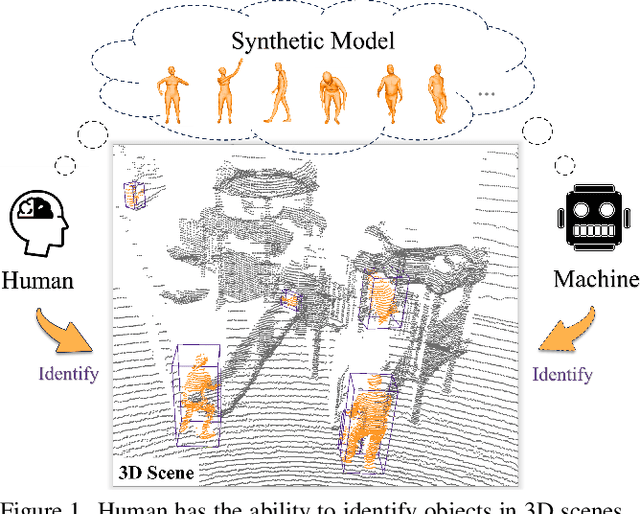

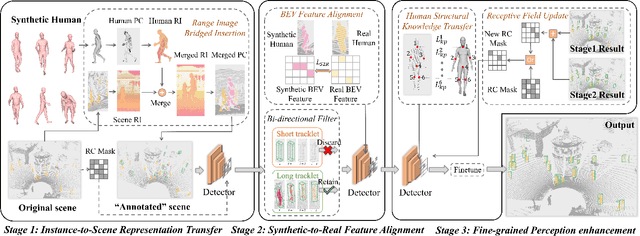

Human-centric 3D scene understanding has recently drawn increasing attention, driven by its critical impact on robotics. However, human-centric real-life scenarios are extremely diverse and complicated, and humans have intricate motions and interactions. With limited labeled data, supervised methods are difficult to generalize to general scenarios, hindering real-life applications. Mimicking human intelligence, we propose an unsupervised 3D detection method for human-centric scenarios by transferring the knowledge from synthetic human instances to real scenes. To bridge the gap between the distinct data representations and feature distributions of synthetic models and real point clouds, we introduce novel modules for effective instance-to-scene representation transfer and synthetic-to-real feature alignment. Remarkably, our method exhibits superior performance compared to current state-of-the-art techniques, achieving 87.8% improvement in mAP and closely approaching the performance of fully supervised methods (62.15 mAP vs. 69.02 mAP) on HuCenLife Dataset.

OctreeOcc: Efficient and Multi-Granularity Occupancy Prediction Using Octree Queries
Dec 09, 2023Occupancy prediction has increasingly garnered attention in recent years for its fine-grained understanding of 3D scenes. Traditional approaches typically rely on dense, regular grid representations, which often leads to excessive computational demands and a loss of spatial details for small objects. This paper introduces OctreeOcc, an innovative 3D occupancy prediction framework that leverages the octree representation to adaptively capture valuable information in 3D, offering variable granularity to accommodate object shapes and semantic regions of varying sizes and complexities. In particular, we incorporate image semantic information to improve the accuracy of initial octree structures and design an effective rectification mechanism to refine the octree structure iteratively. Our extensive evaluations show that OctreeOcc not only surpasses state-of-the-art methods in occupancy prediction, but also achieves a 15%-24% reduction in computational overhead compared to dense-grid-based methods.
SAM-guided Unsupervised Domain Adaptation for 3D Segmentation
Oct 16, 2023Unsupervised domain adaptation (UDA) in 3D segmentation tasks presents a formidable challenge, primarily stemming from the sparse and unordered nature of point cloud data. Especially for LiDAR point clouds, the domain discrepancy becomes obvious across varying capture scenes, fluctuating weather conditions, and the diverse array of LiDAR devices in use. While previous UDA methodologies have often sought to mitigate this gap by aligning features between source and target domains, this approach falls short when applied to 3D segmentation due to the substantial domain variations. Inspired by the remarkable generalization capabilities exhibited by the vision foundation model, SAM, in the realm of image segmentation, our approach leverages the wealth of general knowledge embedded within SAM to unify feature representations across diverse 3D domains and further solves the 3D domain adaptation problem. Specifically, we harness the corresponding images associated with point clouds to facilitate knowledge transfer and propose an innovative hybrid feature augmentation methodology, which significantly enhances the alignment between the 3D feature space and SAM's feature space, operating at both the scene and instance levels. Our method is evaluated on many widely-recognized datasets and achieves state-of-the-art performance.
Model2Scene: Learning 3D Scene Representation via Contrastive Language-CAD Models Pre-training
Sep 29, 2023Current successful methods of 3D scene perception rely on the large-scale annotated point cloud, which is tedious and expensive to acquire. In this paper, we propose Model2Scene, a novel paradigm that learns free 3D scene representation from Computer-Aided Design (CAD) models and languages. The main challenges are the domain gaps between the CAD models and the real scene's objects, including model-to-scene (from a single model to the scene) and synthetic-to-real (from synthetic model to real scene's object). To handle the above challenges, Model2Scene first simulates a crowded scene by mixing data-augmented CAD models. Next, we propose a novel feature regularization operation, termed Deep Convex-hull Regularization (DCR), to project point features into a unified convex hull space, reducing the domain gap. Ultimately, we impose contrastive loss on language embedding and the point features of CAD models to pre-train the 3D network. Extensive experiments verify the learned 3D scene representation is beneficial for various downstream tasks, including label-free 3D object salient detection, label-efficient 3D scene perception and zero-shot 3D semantic segmentation. Notably, Model2Scene yields impressive label-free 3D object salient detection with an average mAP of 46.08\% and 55.49\% on the ScanNet and S3DIS datasets, respectively. The code will be publicly available.
Cross-modal and Cross-domain Knowledge Transfer for Label-free 3D Segmentation
Sep 19, 2023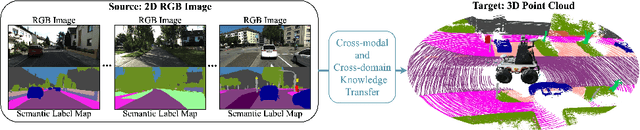
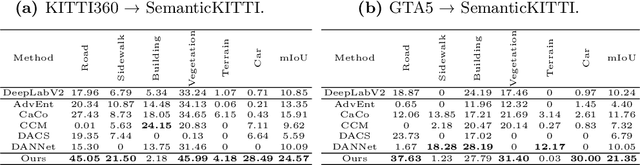
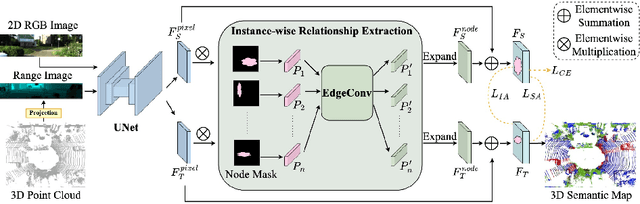
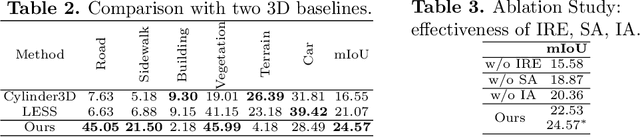
Current state-of-the-art point cloud-based perception methods usually rely on large-scale labeled data, which requires expensive manual annotations. A natural option is to explore the unsupervised methodology for 3D perception tasks. However, such methods often face substantial performance-drop difficulties. Fortunately, we found that there exist amounts of image-based datasets and an alternative can be proposed, i.e., transferring the knowledge in the 2D images to 3D point clouds. Specifically, we propose a novel approach for the challenging cross-modal and cross-domain adaptation task by fully exploring the relationship between images and point clouds and designing effective feature alignment strategies. Without any 3D labels, our method achieves state-of-the-art performance for 3D point cloud semantic segmentation on SemanticKITTI by using the knowledge of KITTI360 and GTA5, compared to existing unsupervised and weakly-supervised baselines.
* 12 pages,4 figures,accepted
UniSeg: A Unified Multi-Modal LiDAR Segmentation Network and the OpenPCSeg Codebase
Sep 11, 2023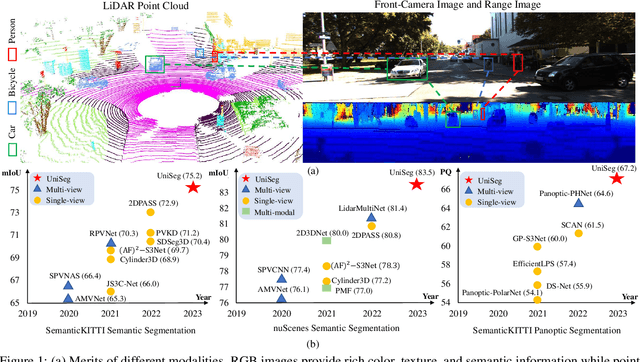
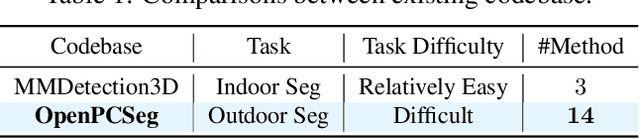
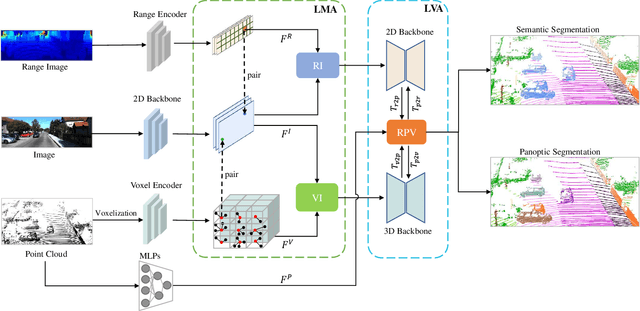
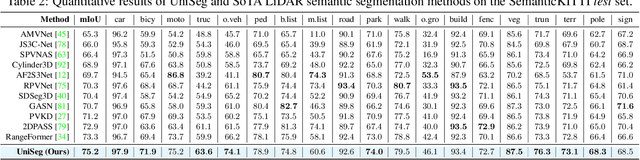
Point-, voxel-, and range-views are three representative forms of point clouds. All of them have accurate 3D measurements but lack color and texture information. RGB images are a natural complement to these point cloud views and fully utilizing the comprehensive information of them benefits more robust perceptions. In this paper, we present a unified multi-modal LiDAR segmentation network, termed UniSeg, which leverages the information of RGB images and three views of the point cloud, and accomplishes semantic segmentation and panoptic segmentation simultaneously. Specifically, we first design the Learnable cross-Modal Association (LMA) module to automatically fuse voxel-view and range-view features with image features, which fully utilize the rich semantic information of images and are robust to calibration errors. Then, the enhanced voxel-view and range-view features are transformed to the point space,where three views of point cloud features are further fused adaptively by the Learnable cross-View Association module (LVA). Notably, UniSeg achieves promising results in three public benchmarks, i.e., SemanticKITTI, nuScenes, and Waymo Open Dataset (WOD); it ranks 1st on two challenges of two benchmarks, including the LiDAR semantic segmentation challenge of nuScenes and panoptic segmentation challenges of SemanticKITTI. Besides, we construct the OpenPCSeg codebase, which is the largest and most comprehensive outdoor LiDAR segmentation codebase. It contains most of the popular outdoor LiDAR segmentation algorithms and provides reproducible implementations. The OpenPCSeg codebase will be made publicly available at https://github.com/PJLab-ADG/PCSeg.
PARTNER: Level up the Polar Representation for LiDAR 3D Object Detection
Aug 08, 2023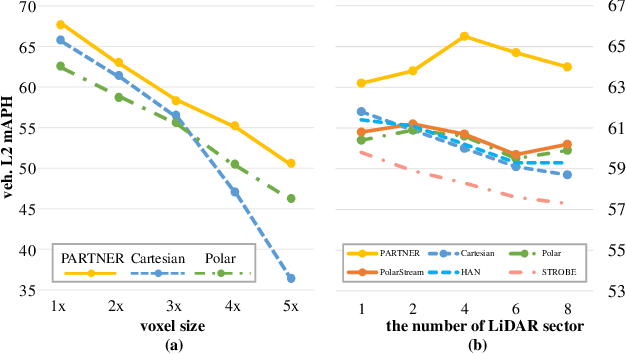
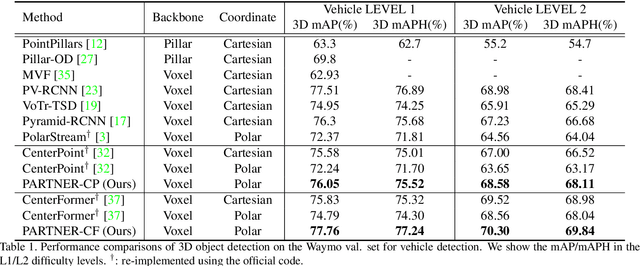
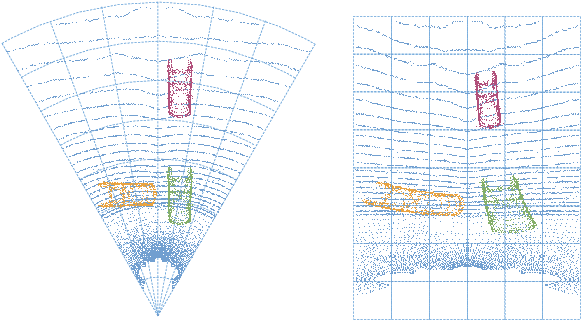

Recently, polar-based representation has shown promising properties in perceptual tasks. In addition to Cartesian-based approaches, which separate point clouds unevenly, representing point clouds as polar grids has been recognized as an alternative due to (1) its advantage in robust performance under different resolutions and (2) its superiority in streaming-based approaches. However, state-of-the-art polar-based detection methods inevitably suffer from the feature distortion problem because of the non-uniform division of polar representation, resulting in a non-negligible performance gap compared to Cartesian-based approaches. To tackle this issue, we present PARTNER, a novel 3D object detector in the polar coordinate. PARTNER alleviates the dilemma of feature distortion with global representation re-alignment and facilitates the regression by introducing instance-level geometric information into the detection head. Extensive experiments show overwhelming advantages in streaming-based detection and different resolutions. Furthermore, our method outperforms the previous polar-based works with remarkable margins of 3.68% and 9.15% on Waymo and ONCE validation set, thus achieving competitive results over the state-of-the-art methods.
Human-centric Scene Understanding for 3D Large-scale Scenarios
Jul 26, 2023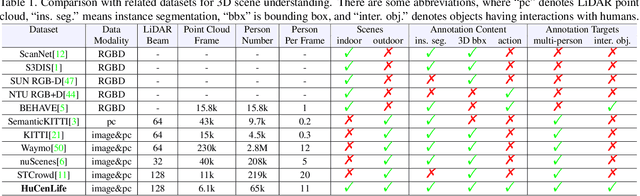
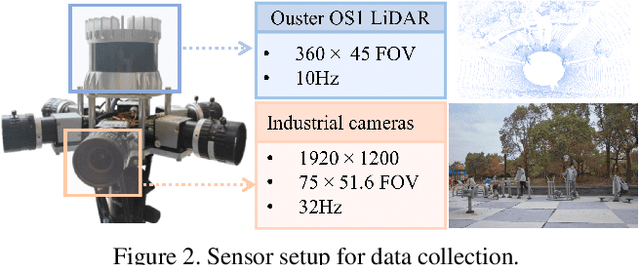

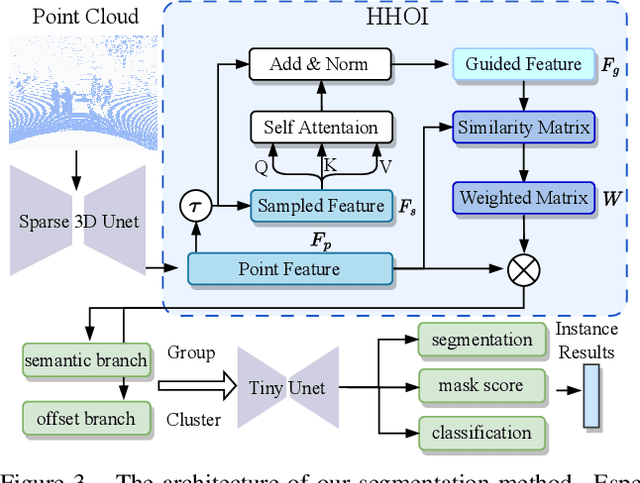
Human-centric scene understanding is significant for real-world applications, but it is extremely challenging due to the existence of diverse human poses and actions, complex human-environment interactions, severe occlusions in crowds, etc. In this paper, we present a large-scale multi-modal dataset for human-centric scene understanding, dubbed HuCenLife, which is collected in diverse daily-life scenarios with rich and fine-grained annotations. Our HuCenLife can benefit many 3D perception tasks, such as segmentation, detection, action recognition, etc., and we also provide benchmarks for these tasks to facilitate related research. In addition, we design novel modules for LiDAR-based segmentation and action recognition, which are more applicable for large-scale human-centric scenarios and achieve state-of-the-art performance.
See More and Know More: Zero-shot Point Cloud Segmentation via Multi-modal Visual Data
Jul 20, 2023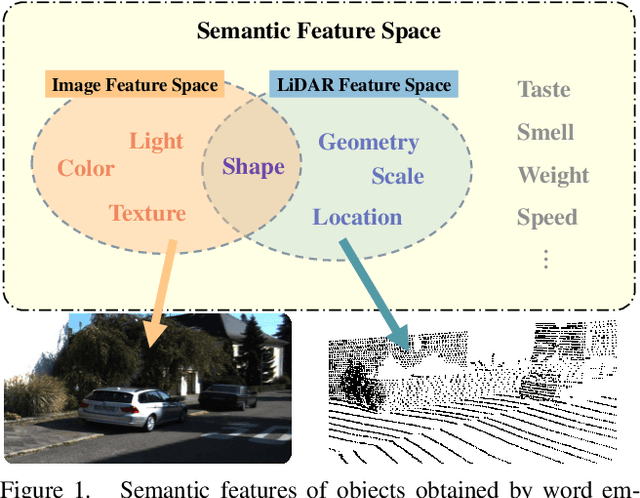


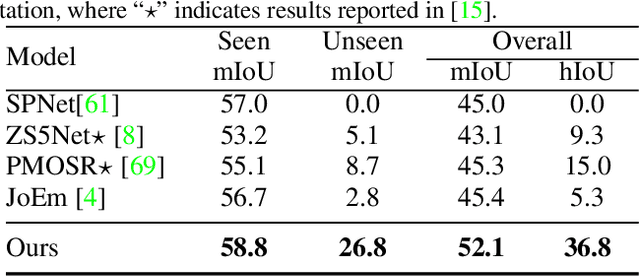
Zero-shot point cloud segmentation aims to make deep models capable of recognizing novel objects in point cloud that are unseen in the training phase. Recent trends favor the pipeline which transfers knowledge from seen classes with labels to unseen classes without labels. They typically align visual features with semantic features obtained from word embedding by the supervision of seen classes' annotations. However, point cloud contains limited information to fully match with semantic features. In fact, the rich appearance information of images is a natural complement to the textureless point cloud, which is not well explored in previous literature. Motivated by this, we propose a novel multi-modal zero-shot learning method to better utilize the complementary information of point clouds and images for more accurate visual-semantic alignment. Extensive experiments are performed in two popular benchmarks, i.e., SemanticKITTI and nuScenes, and our method outperforms current SOTA methods with 52% and 49% improvement on average for unseen class mIoU, respectively.
Towards Label-free Scene Understanding by Vision Foundation Models
Jun 06, 2023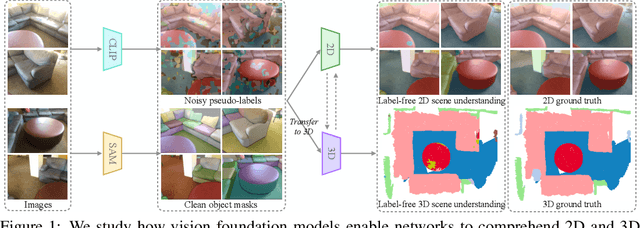
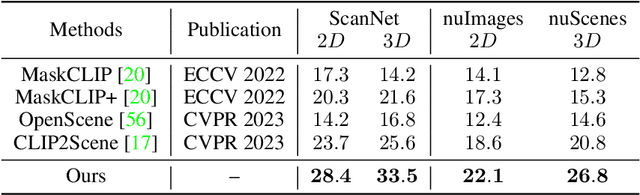
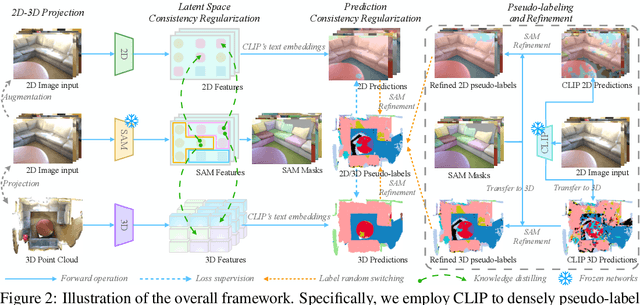
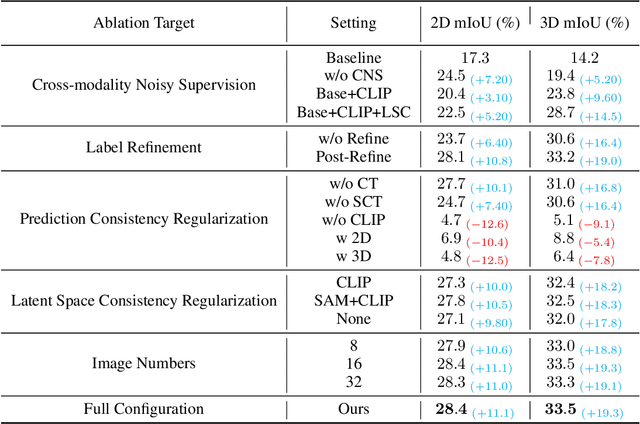
Vision foundation models such as Contrastive Vision-Language Pre-training (CLIP) and Segment Anything (SAM) have demonstrated impressive zero-shot performance on image classification and segmentation tasks. However, the incorporation of CLIP and SAM for label-free scene understanding has yet to be explored. In this paper, we investigate the potential of vision foundation models in enabling networks to comprehend 2D and 3D worlds without labelled data. The primary challenge lies in effectively supervising networks under extremely noisy pseudo labels, which are generated by CLIP and further exacerbated during the propagation from the 2D to the 3D domain. To tackle these challenges, we propose a novel Cross-modality Noisy Supervision (CNS) method that leverages the strengths of CLIP and SAM to supervise 2D and 3D networks simultaneously. In particular, we introduce a prediction consistency regularization to co-train 2D and 3D networks, then further impose the networks' latent space consistency using the SAM's robust feature representation. Experiments conducted on diverse indoor and outdoor datasets demonstrate the superior performance of our method in understanding 2D and 3D open environments. Our 2D and 3D network achieves label-free semantic segmentation with 28.4% and 33.5% mIoU on ScanNet, improving 4.7% and 7.9%, respectively. And for nuScenes dataset, our performance is 26.8% with an improvement of 6%. Code will be released (https://github.com/runnanchen/Label-Free-Scene-Understanding).