 Add to Chrome
 Add to Firefox
 Add to Edge
Feature engineering vs. deep learning for paper section identification: Toward applications in Chinese medical literature
Dec 15, 2024
Section identification is an important task for library science, especially knowledge management. Identifying the sections of a paper would help filter noise in entity and relation extraction. In this research, we studied the paper section identification problem in the context of Chinese medical literature analysis, where the subjects, methods, and results are more valuable from a physician's perspective. Based on previous studies on English literature section identification, we experiment with the effective features to use with classic machine learning algorithms to tackle the problem. It is found that Conditional Random Fields, which consider sentence interdependency, is more effective in combining different feature sets, such as bag-of-words, part-of-speech, and headings, for Chinese literature section identification. Moreover, we find that classic machine learning algorithms are more effective than generic deep learning models for this problem. Based on these observations, we design a novel deep learning model, the Structural Bidirectional Long Short-Term Memory (SLSTM) model, which models word and sentence interdependency together with the contextual information. Experiments on a human-curated asthma literature dataset show that our approach outperforms the traditional machine learning methods and other deep learning methods and achieves close to 90% precision and recall in the task. The model shows good potential for use in other text mining tasks. The research has significant methodological and practical implications.

Modeling the Heterogeneous Duration of User Interest in Time-Dependent Recommendation: A Hidden Semi-Markov Approach
Dec 15, 2024


Recommender systems are widely used for suggesting books, education materials, and products to users by exploring their behaviors. In reality, users' preferences often change over time, leading to studies on time-dependent recommender systems. However, most existing approaches that deal with time information remain primitive. In this paper, we extend existing methods and propose a hidden semi-Markov model to track the change of users' interests. Particularly, this model allows for capturing the different durations of user stays in a (latent) interest state, which can better model the heterogeneity of user interests and focuses. We derive an expectation maximization algorithm to estimate the parameters of the framework and predict users' actions. Experiments on three real-world datasets show that our model significantly outperforms the state-of-the-art time-dependent and static benchmark methods. Further analyses of the experiment results indicate that the performance improvement is related to the heterogeneity of state durations and the drift of user interests in the dataset.
A multi-theoretical kernel-based approach to social network-based recommendation
Dec 15, 2024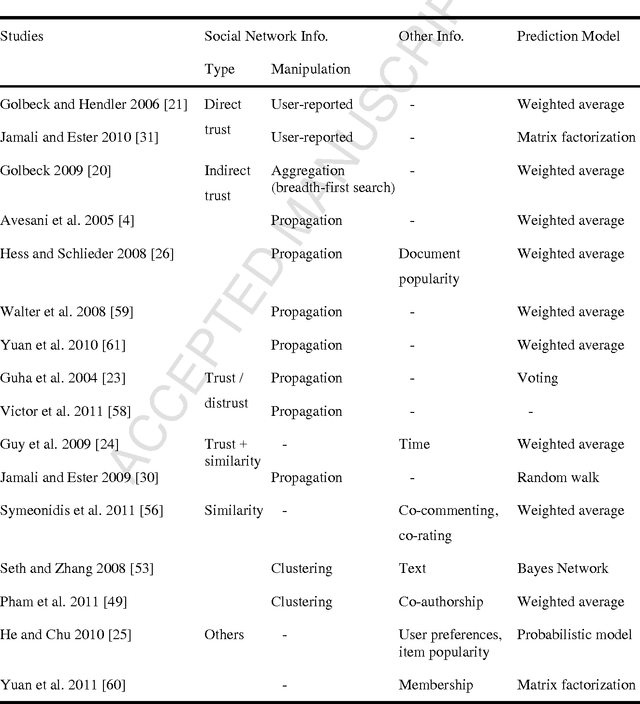
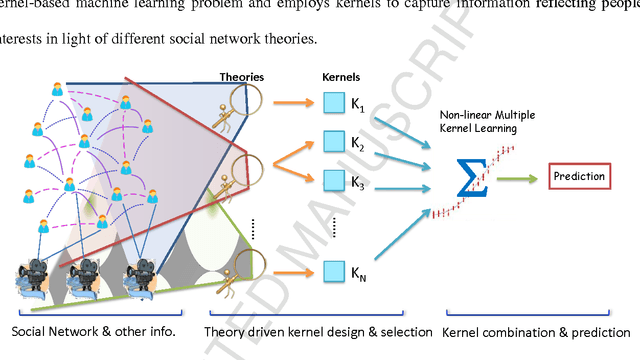
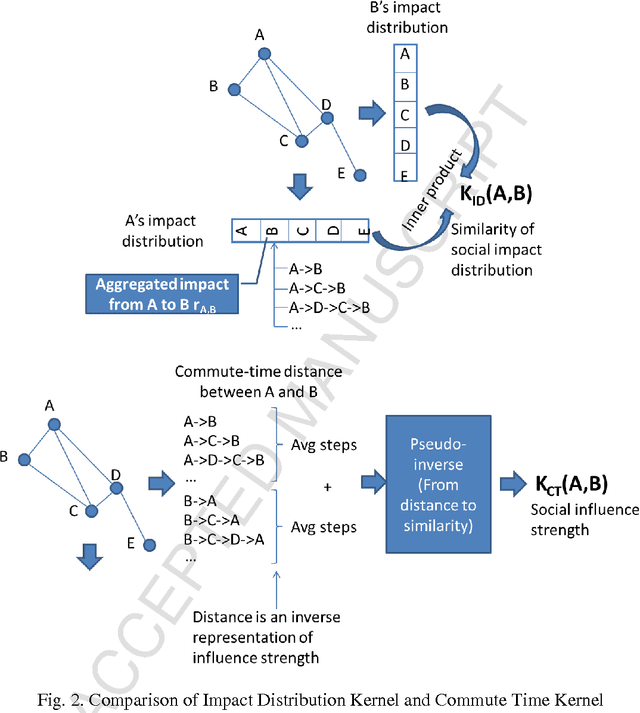
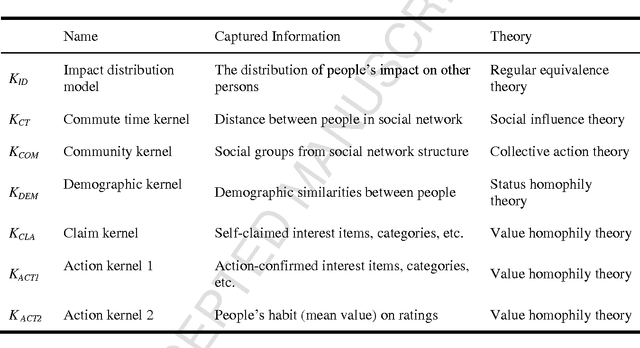
Recommender systems are a critical component of e-commercewebsites. The rapid development of online social networking services provides an opportunity to explore social networks together with information used in traditional recommender systems, such as customer demographics, product characteristics, and transactions. It also provides more applications for recommender systems. To tackle this social network-based recommendation problem, previous studies generally built trust models in light of the social influence theory. This study inspects a spectrumof social network theories to systematicallymodel themultiple facets of a social network and infer user preferences. In order to effectively make use of these heterogonous theories, we take a kernel-based machine learning paradigm, design and select kernels describing individual similarities according to social network theories, and employ a non-linear multiple kernel learning algorithm to combine the kernels into a unified model. This design also enables us to consider multiple theories' interactions in assessing individual behaviors. We evaluate our proposed approach on a real-world movie review data set. The experiments show that our approach provides more accurate recommendations than trust-based methods and the collaborative filtering approach. Further analysis shows that kernels derived from contagion theory and homophily theory contribute a larger portion of the model.
TIV-Diffusion: Towards Object-Centric Movement for Text-driven Image to Video Generation
Dec 13, 2024

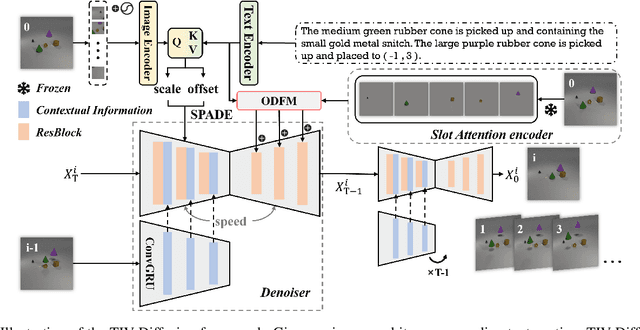
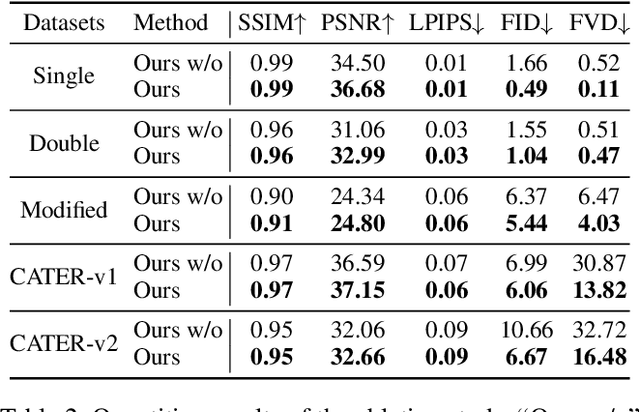
Text-driven Image to Video Generation (TI2V) aims to generate controllable video given the first frame and corresponding textual description. The primary challenges of this task lie in two parts: (i) how to identify the target objects and ensure the consistency between the movement trajectory and the textual description. (ii) how to improve the subjective quality of generated videos. To tackle the above challenges, we propose a new diffusion-based TI2V framework, termed TIV-Diffusion, via object-centric textual-visual alignment, intending to achieve precise control and high-quality video generation based on textual-described motion for different objects. Concretely, we enable our TIV-Diffuion model to perceive the textual-described objects and their motion trajectory by incorporating the fused textual and visual knowledge through scale-offset modulation. Moreover, to mitigate the problems of object disappearance and misaligned objects and motion, we introduce an object-centric textual-visual alignment module, which reduces the risk of misaligned objects/motion by decoupling the objects in the reference image and aligning textual features with each object individually. Based on the above innovations, our TIV-Diffusion achieves state-of-the-art high-quality video generation compared with existing TI2V methods.
Towards Long Video Understanding via Fine-detailed Video Story Generation
Dec 09, 2024


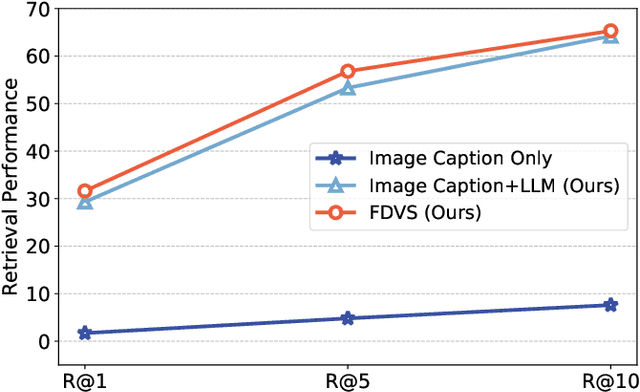
Long video understanding has become a critical task in computer vision, driving advancements across numerous applications from surveillance to content retrieval. Existing video understanding methods suffer from two challenges when dealing with long video understanding: intricate long-context relationship modeling and interference from redundancy. To tackle these challenges, we introduce Fine-Detailed Video Story generation (FDVS), which interprets long videos into detailed textual representations. Specifically, to achieve fine-grained modeling of long-temporal content, we propose a Bottom-up Video Interpretation Mechanism that progressively interprets video content from clips to video. To avoid interference from redundant information in videos, we introduce a Semantic Redundancy Reduction mechanism that removes redundancy at both the visual and textual levels. Our method transforms long videos into hierarchical textual representations that contain multi-granularity information of the video. With these representations, FDVS is applicable to various tasks without any fine-tuning. We evaluate the proposed method across eight datasets spanning three tasks. The performance demonstrates the effectiveness and versatility of our method.
UniMIC: Towards Universal Multi-modality Perceptual Image Compression
Dec 09, 2024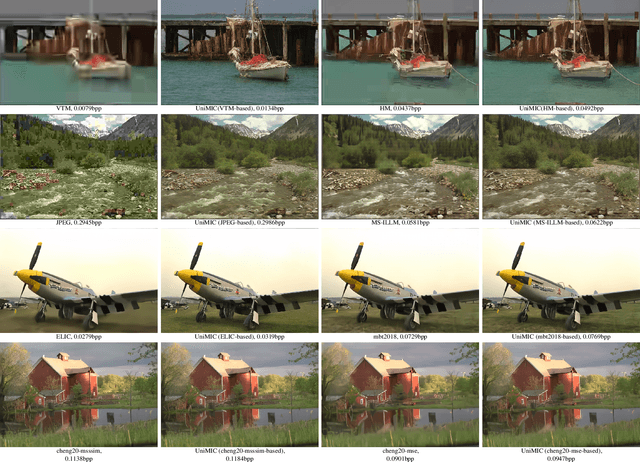


We present UniMIC, a universal multi-modality image compression framework, intending to unify the rate-distortion-perception (RDP) optimization for multiple image codecs simultaneously through excavating cross-modality generative priors. Unlike most existing works that need to design and optimize image codecs from scratch, our UniMIC introduces the visual codec repository, which incorporates amounts of representative image codecs and directly uses them as the basic codecs for various practical applications. Moreover, we propose multi-grained textual coding, where variable-length content prompt and compression prompt are designed and encoded to assist the perceptual reconstruction through the multi-modality conditional generation. In particular, a universal perception compensator is proposed to improve the perception quality of decoded images from all basic codecs at the decoder side by reusing text-assisted diffusion priors from stable diffusion. With the cooperation of the above three strategies, our UniMIC achieves a significant improvement of RDP optimization for different compression codecs, e.g., traditional and learnable codecs, and different compression costs, e.g., ultra-low bitrates. The code will be available in https://github.com/Amygyx/UniMIC .
LossAgent: Towards Any Optimization Objectives for Image Processing with LLM Agents
Dec 05, 2024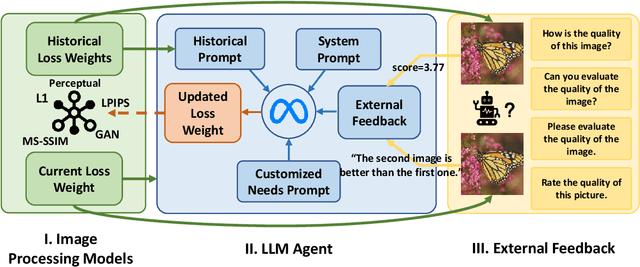
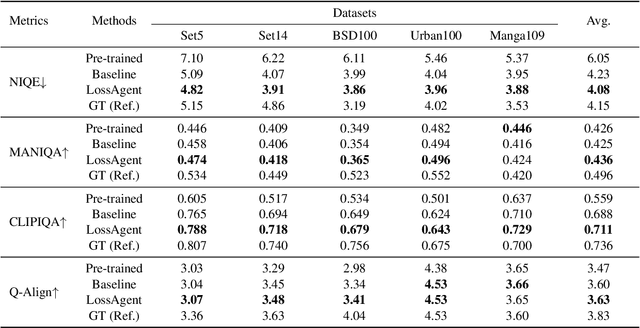
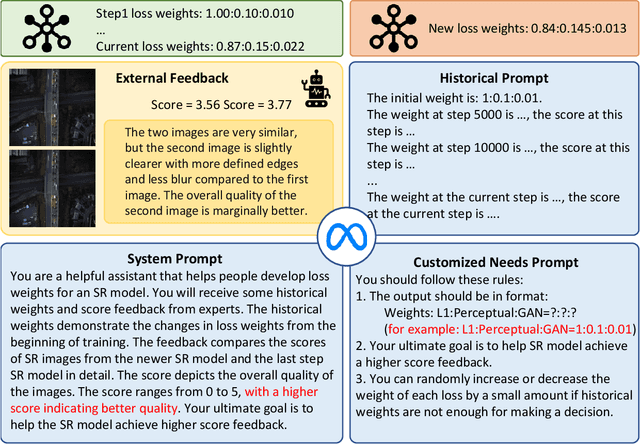
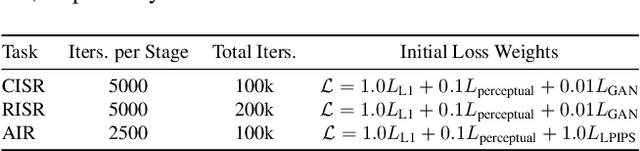
We present the first loss agent, dubbed LossAgent, for low-level image processing tasks, e.g., image super-resolution and restoration, intending to achieve any customized optimization objectives of low-level image processing in different practical applications. Notably, not all optimization objectives, such as complex hand-crafted perceptual metrics, text description, and intricate human feedback, can be instantiated with existing low-level losses, e.g., MSE loss. which presents a crucial challenge in optimizing image processing networks in an end-to-end manner. To eliminate this, our LossAgent introduces the powerful large language model (LLM) as the loss agent, where the rich textual understanding of prior knowledge empowers the loss agent with the potential to understand complex optimization objectives, trajectory, and state feedback from external environments in the optimization process of the low-level image processing networks. In particular, we establish the loss repository by incorporating existing loss functions that support the end-to-end optimization for low-level image processing. Then, we design the optimization-oriented prompt engineering for the loss agent to actively and intelligently decide the compositional weights for each loss in the repository at each optimization interaction, thereby achieving the required optimization trajectory for any customized optimization objectives. Extensive experiments on three typical low-level image processing tasks and multiple optimization objectives have shown the effectiveness and applicability of our proposed LossAgent. Code and pre-trained models will be available at https://github.com/lbc12345/LossAgent.
Many-MobileNet: Multi-Model Augmentation for Robust Retinal Disease Classification
Dec 03, 2024
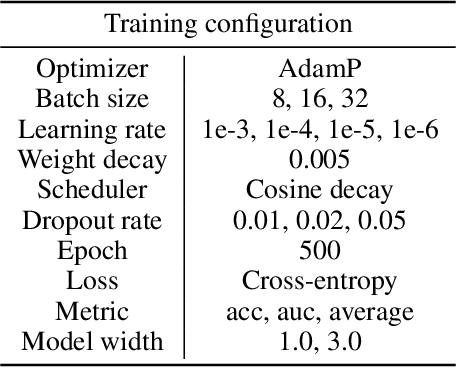


In this work, we propose Many-MobileNet, an efficient model fusion strategy for retinal disease classification using lightweight CNN architecture. Our method addresses key challenges such as overfitting and limited dataset variability by training multiple models with distinct data augmentation strategies and different model complexities. Through this fusion technique, we achieved robust generalization in data-scarce domains while balancing computational efficiency with feature extraction capabilities.
HunyuanVideo: A Systematic Framework For Large Video Generative Models
Dec 03, 2024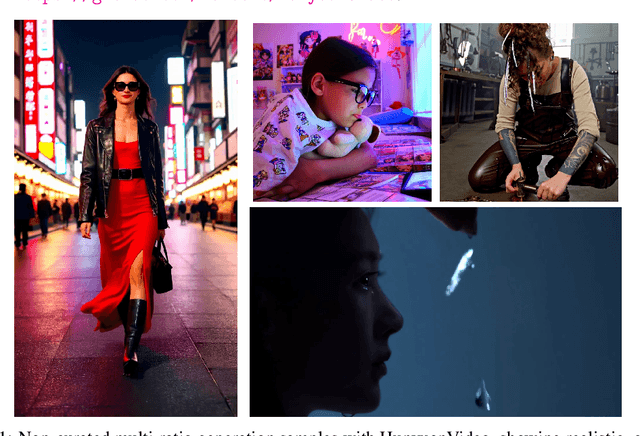
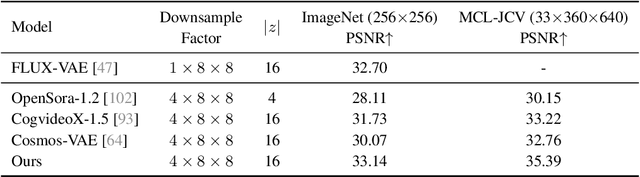
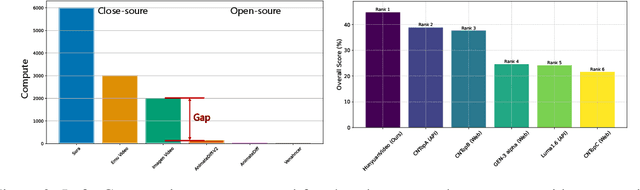

Recent advancements in video generation have significantly impacted daily life for both individuals and industries. However, the leading video generation models remain closed-source, resulting in a notable performance gap between industry capabilities and those available to the public. In this report, we introduce HunyuanVideo, an innovative open-source video foundation model that demonstrates performance in video generation comparable to, or even surpassing, that of leading closed-source models. HunyuanVideo encompasses a comprehensive framework that integrates several key elements, including data curation, advanced architectural design, progressive model scaling and training, and an efficient infrastructure tailored for large-scale model training and inference. As a result, we successfully trained a video generative model with over 13 billion parameters, making it the largest among all open-source models. We conducted extensive experiments and implemented a series of targeted designs to ensure high visual quality, motion dynamics, text-video alignment, and advanced filming techniques. According to evaluations by professionals, HunyuanVideo outperforms previous state-of-the-art models, including Runway Gen-3, Luma 1.6, and three top-performing Chinese video generative models. By releasing the code for the foundation model and its applications, we aim to bridge the gap between closed-source and open-source communities. This initiative will empower individuals within the community to experiment with their ideas, fostering a more dynamic and vibrant video generation ecosystem. The code is publicly available at https://github.com/Tencent/HunyuanVideo.
GausSurf: Geometry-Guided 3D Gaussian Splatting for Surface Reconstruction
Dec 02, 2024

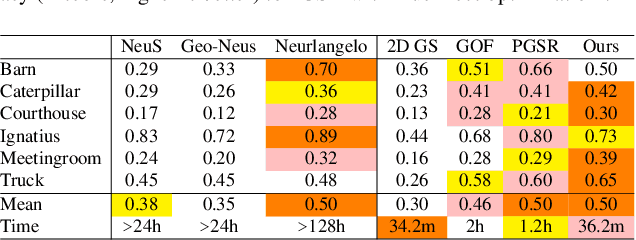

3D Gaussian Splatting has achieved impressive performance in novel view synthesis with real-time rendering capabilities. However, reconstructing high-quality surfaces with fine details using 3D Gaussians remains a challenging task. In this work, we introduce GausSurf, a novel approach to high-quality surface reconstruction by employing geometry guidance from multi-view consistency in texture-rich areas and normal priors in texture-less areas of a scene. We observe that a scene can be mainly divided into two primary regions: 1) texture-rich and 2) texture-less areas. To enforce multi-view consistency at texture-rich areas, we enhance the reconstruction quality by incorporating a traditional patch-match based Multi-View Stereo (MVS) approach to guide the geometry optimization in an iterative scheme. This scheme allows for mutual reinforcement between the optimization of Gaussians and patch-match refinement, which significantly improves the reconstruction results and accelerates the training process. Meanwhile, for the texture-less areas, we leverage normal priors from a pre-trained normal estimation model to guide optimization. Extensive experiments on the DTU and Tanks and Temples datasets demonstrate that our method surpasses state-of-the-art methods in terms of reconstruction quality and computation time.