 Add to Chrome
 Add to Firefox
 Add to Edge
MOSAIC: Orchestrating Collaborative Knowledge Tracing with Hierarchical Semantic Alignment
Jun 27, 2026
Knowledge Tracing (KT) is important for personalized education but traditionally suffers from two key limitations: a reliance on shallow ID-based representations that neglect semantic depth and a restriction to single-granularity mastery estimation that overlooks hierarchical knowledge dependencies. To address these challenges, we propose MOSAIC (Multi-granularity Online Semantic AI for Collaborative Knowledge), a novel framework that orchestrates LLM-driven semantic alignment with sequential modeling. Unlike methods that use LLMs solely as predictors, MOSAIC leverages a frozen LLM to generate dynamic, context-aware embeddings and hierarchical prediction prompts, explicitly capturing collaborative signals and peer interactions. Furthermore, we introduce a cross-granularity consistency objective that jointly regularizes mastery estimation across concept, topic-cluster, and global proficiency levels. Extensive experiments on ASSISTments, EdNet, and a newly collected large-scale MOOC dataset demonstrate that MOSAIC establishes new state-of-the-art results. Specifically, our method achieves AUC improvements of up to 3.4\% and Accuracy gains of up to 2.5 \% across all benchmarks. Notably, MOSAIC exhibits superior robustness in collaboration-rich environments and long-sequence scenarios (AUC 0.862 on MOOC), offering both high predictive precision and semantically grounded interpretability.

FAST: A Synergistic Framework of Attention and State-space Models for Spatiotemporal Traffic Prediction
Apr 15, 2026Traffic forecasting requires modeling complex temporal dynamics and long-range spatial dependencies over large sensor networks. Existing methods typically face a trade-off between expressiveness and efficiency: Transformer-based models capture global dependencies well but suffer from quadratic complexity, while recent selective state-space models are computationally efficient yet less effective at modeling spatial interactions in graph-structured traffic data. We propose FAST, a unified framework that combines attention and state-space modeling for scalable spatiotemporal traffic forecasting. FAST adopts a Temporal-Spatial-Temporal architecture, where temporal attention modules capture both short- and long-term temporal patterns, and a Mamba-based spatial module models long-range inter-sensor dependencies with linear complexity. To better represent heterogeneous traffic contexts, FAST further introduces a learnable multi-source spatiotemporal embedding that integrates historical traffic flow, temporal context, and node-level information, together with a multi-level skip prediction mechanism for hierarchical feature fusion. Experiments on PeMS04, PeMS07, and PeMS08 show that FAST consistently outperforms strong baselines from Transformer-, GNN-, attention-, and Mamba-based families. In particular, FAST achieves the best MAE and RMSE on all three benchmarks, with up to 4.3\% lower RMSE and 2.8\% lower MAE than the strongest baseline, demonstrating a favorable balance between accuracy, scalability, and generalization.
A multi-theoretical kernel-based approach to social network-based recommendation
Dec 15, 2024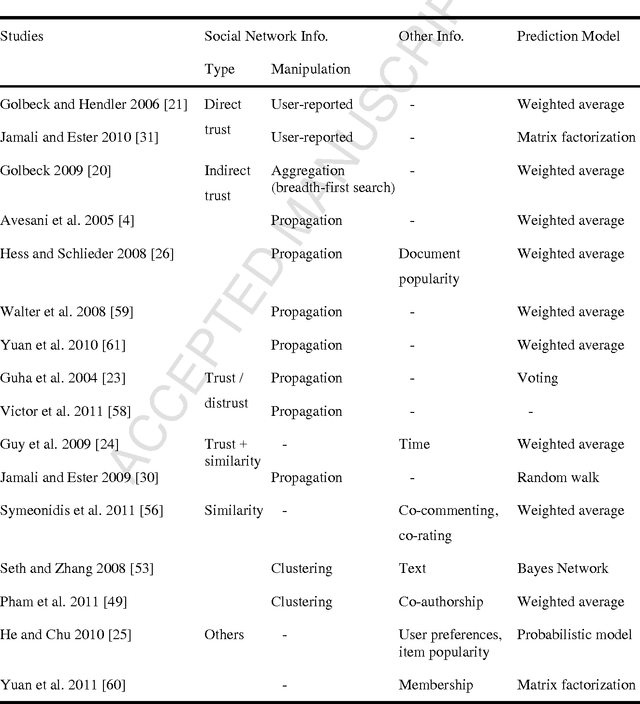
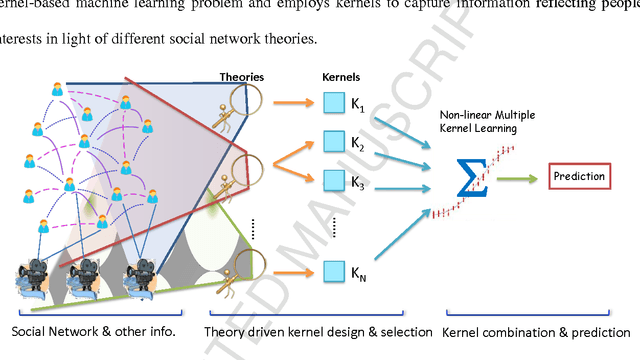
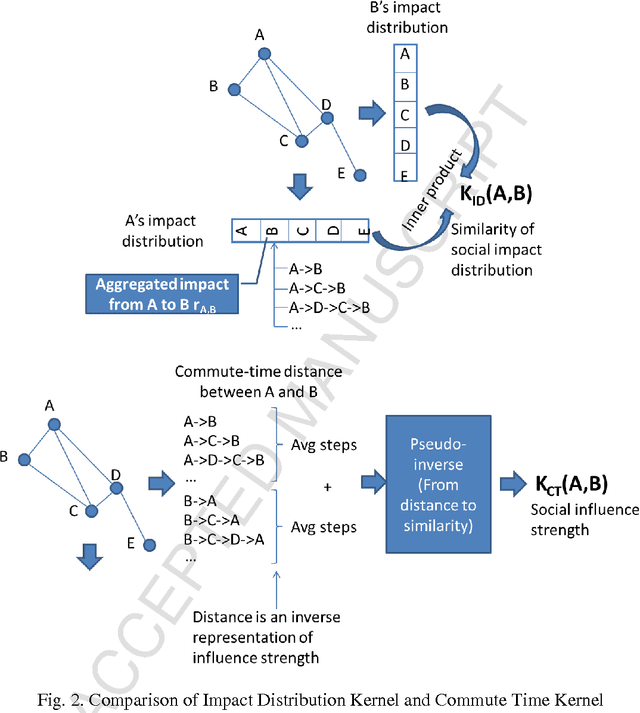
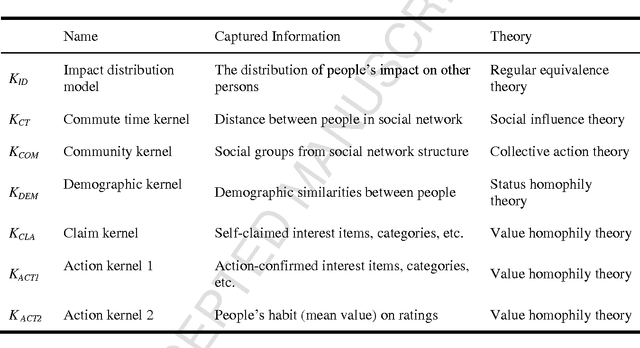
Recommender systems are a critical component of e-commercewebsites. The rapid development of online social networking services provides an opportunity to explore social networks together with information used in traditional recommender systems, such as customer demographics, product characteristics, and transactions. It also provides more applications for recommender systems. To tackle this social network-based recommendation problem, previous studies generally built trust models in light of the social influence theory. This study inspects a spectrumof social network theories to systematicallymodel themultiple facets of a social network and infer user preferences. In order to effectively make use of these heterogonous theories, we take a kernel-based machine learning paradigm, design and select kernels describing individual similarities according to social network theories, and employ a non-linear multiple kernel learning algorithm to combine the kernels into a unified model. This design also enables us to consider multiple theories' interactions in assessing individual behaviors. We evaluate our proposed approach on a real-world movie review data set. The experiments show that our approach provides more accurate recommendations than trust-based methods and the collaborative filtering approach. Further analysis shows that kernels derived from contagion theory and homophily theory contribute a larger portion of the model.