 Add to Chrome
 Add to Firefox
 Add to Edge
Mage-VL: An Efficient Codec-Native Streaming Multimodal Foundation Model
Jul 27, 2026
Standard vision-language models (VLMs) suffer from Moravec's paradox: they excel at complex offline visual reasoning but struggle with simple streaming perception tasks and process them inefficiently. We present Mage-VL, an efficient codec-native streaming foundation model for real-time multimodal understanding and interaction. At its core, our custom tokenizer, Mage-ViT, replaces uniform frame sampling by selectively encoding dynamic, entropy-rich regions using motion vectors and residual energy across sparse anchor (I) and predicted (P) frames. Operating at a 16 x 16 patch level, this reduces visual token consumption by over 75% while preserving spatiotemporal context. Trained from scratch on approximately 560M unlabeled images and 100M unlabeled video frames, Mage-ViT matches or outperforms flagship encoders trained on billions of image-text pairs. We establish AI4AI data pipelines encompassing prompt-code joint optimization for multimodal captioning and AI-driven performance diagnosis to guide training recipes. Furthermore, through a bio-inspired dual-system architecture - a lightweight System 1 event gate and a causal System 2 decoder - Mage-VL enables proactive streaming perception. Extensive evaluations show that Mage-VL-4B matches Qwen3-VL-4B on static tasks while achieving strong gains in video understanding and 2D/3D spatial reasoning, with up to a 3.5x wall-clock inference speedup, and comprehensively surpasses the 15B Phi-4-reasoning-vision baseline. Beyond model artifacts, we deliver seven key empirical findings covering pre-training data efficiency, variable-resolution scaling, codec system acceleration, VideoQA SFT redundancy, motion-spatial synergy, AI4AI data pipelines, and Zero-Vision SFT for multimodal RL.

Mage-Flow: An Efficient Native-Resolution Foundation Model for Image Generation and Editing
Jul 21, 2026Large-scale visual generators are increasingly capable but costly to train, fine-tune, and deploy. We introduce Mage-Flow, a compact 4B-scale generative stack for efficient text-to-image generation and instruction-based image editing. The stack is built from two co-designed components: Mage-VAE, a lightweight high-fidelity latent tokenizer, and a Native-Resolution Multimodal Diffusion Transformer trained with rectified flow matching. Mage-VAE uses one-step diffusion-style encoding and decoding with anchor-latent regularization, preserving the reconstruction quality of strong public VAEs while reducing tokenization cost by more than an order of magnitude. Together with native-resolution packing and stack-level CUDA kernel fusion, the stack supports flexible-resolution training and improves end-to-end training throughput by about $2.5\times$. Built on this foundation, we develop a complete model family with Base, RL-aligned, and Turbo variants for both generation and editing. Diffusion-NFT improves prompt following, text rendering, aesthetic quality, and editing fidelity, while few-step distillation with adversarial perceptual guidance produces 4-step Turbo models for low-latency inference. Despite its compact scale, Mage-Flow and Mage-Flow-Edit achieves competitive performance across standard generation and editing benchmarks. More importantly, the Turbo variants make high-resolution generation and editing practical for interactive use: at $1024^2$ resolution on a single NVIDIA A100 GPU, Mage-Flow-Turbo generates an image in 0.59s, and Mage-Flow-Edit-Turbo edits an image in 1.02s, while maintaining a small memory footprint. These results show that careful tokenizer--backbone--system co-design can deliver strong high-resolution generation and editing within an efficient 4B model family.
From Content to Knowledge: Lightning Fast Long-Video Understanding with Neural Knowledge Representations
Jun 10, 2026We propose a new paradigm for long video understanding by treating a long video as a Neural Knowledge Representation (NKR). NKR represents video contents neither as a stream of tokens nor pre-organized databases, but as an individual small portion of network weights attached to the VLM backbone. The NKR weights are optimized to encapsulate the video's semantic content via a novel Agentic Knowledge Distillation (AKD) process, where an agent automatically synthesizes dense descriptions and question-answer pairs to distill the video's knowledge into the NKR. While AKD serves as a comprehensive, one-time encoding phase, the resulting NKR transforms the video into a portable, reusable asset. At inference, the lightweight NKR is mounted onto a frozen Vision-Language Model (VLM), enabling direct, query-based understanding without reloading or re-encoding the original video. This approach decouples video length from inference cost, offering high amortized efficiency for multi-turn video understanding. Experiments on the LVBench benchmark show our method achieves performance comparable to state-of-the-art approaches while reducing end-to-end latency by over two orders of magnitude, opening new possibilities for interactive long-video understanding.
Ultra-Fast Neural Video Compression
Jun 03, 2026While neural video codecs (NVCs) have demonstrated superior compression ratio, their prohibitive computational complexity remains a critical barrier to real-world deployment. This paper introduces a chunk-based coding framework designed to significantly improve the rate-distortion-complexity trade-off. Instead of processing frames sequentially, our approach encodes a chunk of multiple frames into a single compact latent representation and decodes them simultaneously. This is enabled by cross-frame interaction modules for joint spatial-temporal modeling and frame-specific decoders for parallel reconstruction. This paradigm not only dramatically enhances coding throughput but also facilitates more effective modeling of long-term temporal correlations. To further boost speed, we propose a streamlined entropy coding mechanism that consolidates bit-stream interactions into a single step, substantially reducing decoding overhead. Building on these innovations, we present DCVC-UF (Ultra-Fast), a new NVC that sets a new SOTA in performance. Our experiments show that DCVC-UF can achieve ultra-fast encoding and decoding speeds, significantly outperforming previous leading codecs. DCVC-UF serves as a notable landmark in the journey of NVC evolution. The code is at https://github.com/microsoft/DCVC.
CoD-Lite: Real-Time Diffusion-Based Generative Image Compression
Apr 14, 2026Recent advanced diffusion methods typically derive strong generative priors by scaling diffusion transformers. However, scaling fails to generalize when adapted for real-time compression scenarios that demand lightweight models. In this paper, we explore the design of real-time and lightweight diffusion codecs by addressing two pivotal questions. First, does diffusion pre-training benefit lightweight diffusion codecs? Through systematic analysis, we find that generation-oriented pre-training is less effective at small model scales whereas compression-oriented pre-training yields consistently better performance. Second, are transformers essential? We find that while global attention is crucial for standard generation, lightweight convolutions suffice for compression-oriented diffusion when paired with distillation. Guided by these findings, we establish a one-step lightweight convolution diffusion codec that achieves real-time $60$~FPS encoding and $42$~FPS decoding at 1080p. Further enhanced by distillation and adversarial learning, the proposed codec reduces bitrate by 85\% at a comparable FID to MS-ILLM, bridging the gap between generative compression and practical real-time deployment. Codes are released at https://github.com/microsoft/GenCodec/CoD_Lite
Generative Video Compression with One-Dimensional Latent Representation
Mar 16, 2026Recent advancements in generative video codec (GVC) typically encode video into a 2D latent grid and employ high-capacity generative decoders for reconstruction. However, this paradigm still leaves two key challenges in fully exploiting spatial-temporal redundancy: Spatially, the 2D latent grid inevitably preserves intra-frame redundancy due to its rigid structure, where adjacent patches remain highly similar, thereby necessitating a higher bitrate. Temporally, the 2D latent grid is less effective for modeling long-term correlations in a compact and semantically coherent manner, as it hinders the aggregation of common contents across frames. To address these limitations, we introduce Generative Video Compression with One-Dimensional (1D) Latent Representation (GVC1D). GVC1D encodes the video data into extreme compact 1D latent tokens conditioned on both short- and long-term contexts. Without the rigid 2D spatial correspondence, these 1D latent tokens can adaptively attend to semantic regions and naturally facilitate token reduction, thereby reducing spatial redundancy. Furthermore, the proposed 1D memory provides semantically rich long-term context while maintaining low computational cost, thereby further reducing temporal redundancy. Experimental results indicate that GVC1D attains superior compression efficiency, where it achieves bitrate reductions of 60.4\% under LPIPS and 68.8\% under DISTS on the HEVC Class B dataset, surpassing the previous video compression methods.Project: https://gvc1d.github.io/
Compression as Adaptation: Implicit Visual Representation with Diffusion Foundation Models
Mar 08, 2026Modern visual generative models acquire rich visual knowledge through large-scale training, yet existing visual representations (such as pixels, latents, or tokens) remain external to the model and cannot directly exploit this knowledge for compact storage or reuse. In this work, we introduce a new visual representation framework that encodes a signal as a function, which is parametrized by low-rank adaptations attached to a frozen visual generative model. Such implicit representations of visual signals, \textit{e.g.}, an 81-frame video, can further be hashed into a single compact vector, achieving strong perceptual video compression at extremely low bitrates. Beyond basic compression, the functional nature of this representation enables inference-time scaling and control, allowing additional refinement on the compression performance. More broadly, as the implicit representations directly act as a function of the generation process, this suggests a unified framework bridging visual compression and generation.
InfiniteWeb: Scalable Web Environment Synthesis for GUI Agent Training
Jan 08, 2026GUI agents that interact with graphical interfaces on behalf of users represent a promising direction for practical AI assistants. However, training such agents is hindered by the scarcity of suitable environments. We present InfiniteWeb, a system that automatically generates functional web environments at scale for GUI agent training. While LLMs perform well on generating a single webpage, building a realistic and functional website with many interconnected pages faces challenges. We address these challenges through unified specification, task-centric test-driven development, and a combination of website seed with reference design image to ensure diversity. Our system also generates verifiable task evaluators enabling dense reward signals for reinforcement learning. Experiments show that InfiniteWeb surpasses commercial coding agents at realistic website construction, and GUI agents trained on our generated environments achieve significant performance improvements on OSWorld and Online-Mind2Web, demonstrating the effectiveness of proposed system.
Deep Video Discovery: Agentic Search with Tool Use for Long-form Video Understanding
May 23, 2025Long-form video understanding presents significant challenges due to extensive temporal-spatial complexity and the difficulty of question answering under such extended contexts. While Large Language Models (LLMs) have demonstrated considerable advancements in video analysis capabilities and long context handling, they continue to exhibit limitations when processing information-dense hour-long videos. To overcome such limitations, we propose the Deep Video Discovery agent to leverage an agentic search strategy over segmented video clips. Different from previous video agents manually designing a rigid workflow, our approach emphasizes the autonomous nature of agents. By providing a set of search-centric tools on multi-granular video database, our DVD agent leverages the advanced reasoning capability of LLM to plan on its current observation state, strategically selects tools, formulates appropriate parameters for actions, and iteratively refines its internal reasoning in light of the gathered information. We perform comprehensive evaluation on multiple long video understanding benchmarks that demonstrates the advantage of the entire system design. Our DVD agent achieves SOTA performance, significantly surpassing prior works by a large margin on the challenging LVBench dataset. Comprehensive ablation studies and in-depth tool analyses are also provided, yielding insights to further advance intelligent agents tailored for long-form video understanding tasks. The code will be released later.
UniMIC: Towards Universal Multi-modality Perceptual Image Compression
Dec 09, 2024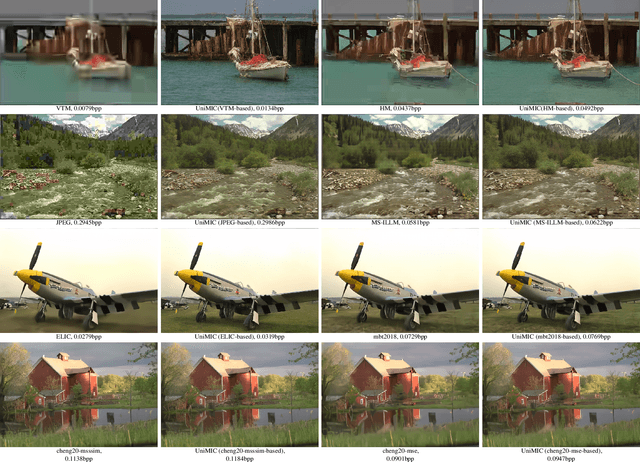


We present UniMIC, a universal multi-modality image compression framework, intending to unify the rate-distortion-perception (RDP) optimization for multiple image codecs simultaneously through excavating cross-modality generative priors. Unlike most existing works that need to design and optimize image codecs from scratch, our UniMIC introduces the visual codec repository, which incorporates amounts of representative image codecs and directly uses them as the basic codecs for various practical applications. Moreover, we propose multi-grained textual coding, where variable-length content prompt and compression prompt are designed and encoded to assist the perceptual reconstruction through the multi-modality conditional generation. In particular, a universal perception compensator is proposed to improve the perception quality of decoded images from all basic codecs at the decoder side by reusing text-assisted diffusion priors from stable diffusion. With the cooperation of the above three strategies, our UniMIC achieves a significant improvement of RDP optimization for different compression codecs, e.g., traditional and learnable codecs, and different compression costs, e.g., ultra-low bitrates. The code will be available in https://github.com/Amygyx/UniMIC .