 Add to Chrome
 Add to Firefox
 Add to Edge
Expert Streaming: Accelerating Low-Batch MoE Inference via Multi-chiplet Architecture and Dynamic Expert Trajectory Scheduling
Mar 29, 2026
Mixture-of-Experts is a promising approach for edge AI with low-batch inference. Yet, on-device deployments often face limited on-chip memory and severe workload imbalance; the prevalent use of offloading further incurs off-chip memory access bottlenecks. Moreover, MoE sparsity and dynamic gating shift distributed strategies toward much finer granularity and introduce runtime scheduling considerations. Recently, high die-to-die bandwidth chiplet interconnects have created new opportunities for multi-chiplet systems to address workload imbalance and offloading bottlenecks with fine-grained scheduling. In this paper, we propose Fully Sharded Expert Data Parallelism, a parallelization paradigm specifically architected for low-batch MoE inference on multi-chiplet accelerators. FSE-DP attains adaptive computation-communication overlap and balanced load by orchestrating fine-grained, complementary expert streams along dynamic trajectories across high-bandwidth D2D links. The attendant dataflow complexity is tamed by a minimal, hardware-amenable set of virtualization rules and a lightweight scheduling algorithm. Our approach achieves 1.22 to 2.00 times speedup over state-of-the-art baselines and saves up to 78.8 percent on-chip memory.

A 28nm 0.22 μJ/token memory-compute-intensity-aware CNN-Transformer accelerator with hybrid-attention-based layer-fusion and cascaded pruning for semanticsegmentation
Dec 19, 2025This work presents a 28nm 13.93mm2 CNN-Transformer accelerator for semantic segmentation, achieving 3.86-to-10.91x energy reduction over previous designs. It features a hybrid attention unit, layer-fusion scheduler, and cascaded feature-map pruner, with peak energy efficiency of 52.90TOPS/W (INT8).
* 3 pages,7 pages, 2025 IEEE International Solid-State Circuits Conference (ISSCC)
A 10.60 $μ$W 150 GOPS Mixed-Bit-Width Sparse CNN Accelerator for Life-Threatening Ventricular Arrhythmia Detection
Oct 22, 2024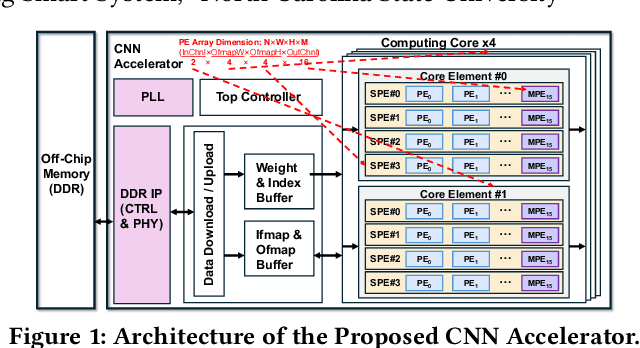
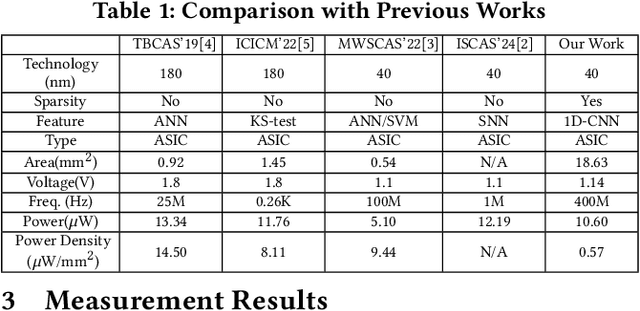
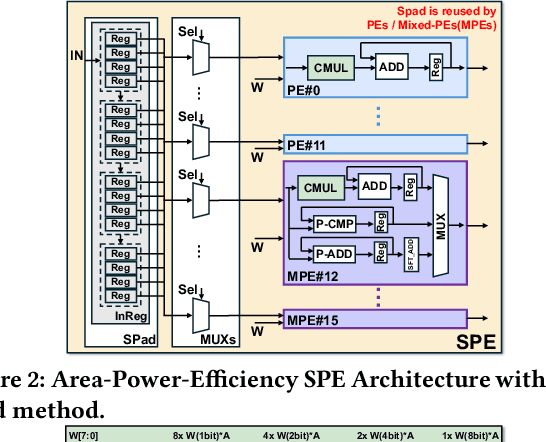
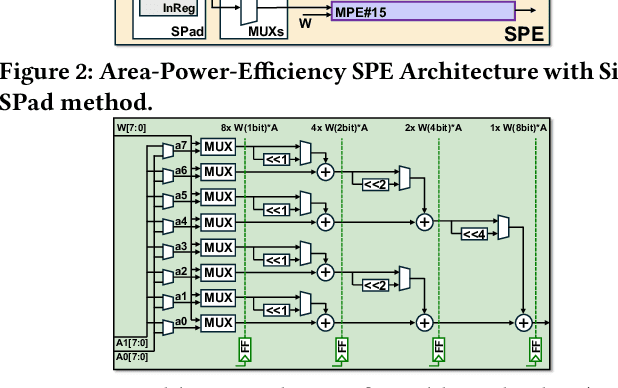
This paper proposes an ultra-low power, mixed-bit-width sparse convolutional neural network (CNN) accelerator to accelerate ventricular arrhythmia (VA) detection. The chip achieves 50% sparsity in a quantized 1D CNN using a sparse processing element (SPE) architecture. Measurement on the prototype chip TSMC 40nm CMOS low-power (LP) process for the VA classification task demonstrates that it consumes 10.60 $\mu$W of power while achieving a performance of 150 GOPS and a diagnostic accuracy of 99.95%. The computation power density is only 0.57 $\mu$W/mm$^2$, which is 14.23X smaller than state-of-the-art works, making it highly suitable for implantable and wearable medical devices.
Genetic Quantization-Aware Approximation for Non-Linear Operations in Transformers
Mar 29, 2024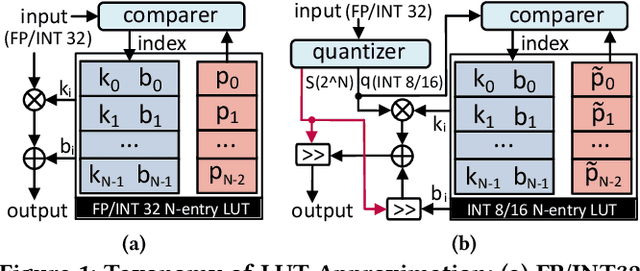


Non-linear functions are prevalent in Transformers and their lightweight variants, incurring substantial and frequently underestimated hardware costs. Previous state-of-the-art works optimize these operations by piece-wise linear approximation and store the parameters in look-up tables (LUT), but most of them require unfriendly high-precision arithmetics such as FP/INT 32 and lack consideration of integer-only INT quantization. This paper proposed a genetic LUT-Approximation algorithm namely GQA-LUT that can automatically determine the parameters with quantization awareness. The results demonstrate that GQA-LUT achieves negligible degradation on the challenging semantic segmentation task for both vanilla and linear Transformer models. Besides, proposed GQA-LUT enables the employment of INT8-based LUT-Approximation that achieves an area savings of 81.3~81.7% and a power reduction of 79.3~80.2% compared to the high-precision FP/INT 32 alternatives. Code is available at https:// github.com/PingchengDong/GQA-LUT.