 Add to Chrome
 Add to Firefox
 Add to Edge
Improving DNN Fault Tolerance using Weight Pruning and Differential Crossbar Mapping for ReRAM-based Edge AI
Jun 18, 2021
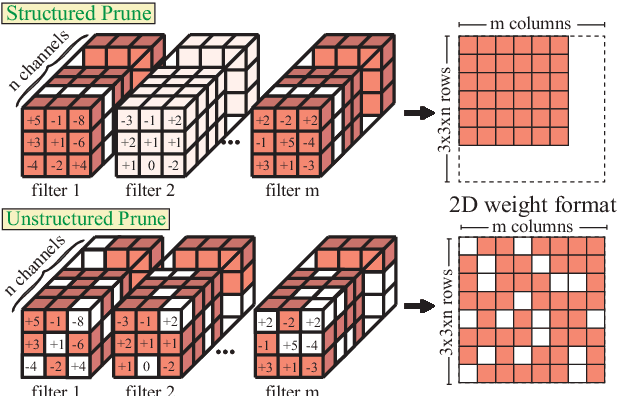
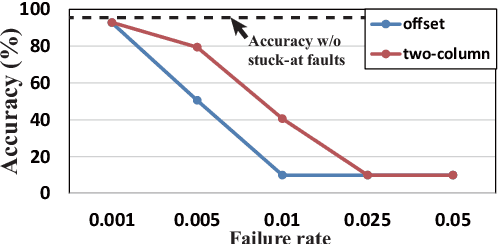
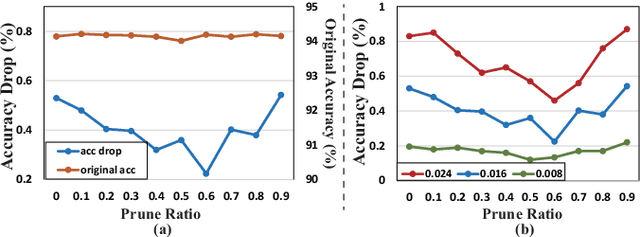
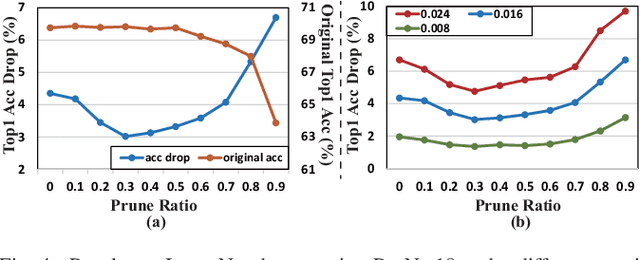
Recent research demonstrated the promise of using resistive random access memory (ReRAM) as an emerging technology to perform inherently parallel analog domain in-situ matrix-vector multiplication -- the intensive and key computation in deep neural networks (DNNs). However, hardware failure, such as stuck-at-fault defects, is one of the main concerns that impedes the ReRAM devices to be a feasible solution for real implementations. The existing solutions to address this issue usually require an optimization to be conducted for each individual device, which is impractical for mass-produced products (e.g., IoT devices). In this paper, we rethink the value of weight pruning in ReRAM-based DNN design from the perspective of model fault tolerance. And a differential mapping scheme is proposed to improve the fault tolerance under a high stuck-on fault rate. Our method can tolerate almost an order of magnitude higher failure rate than the traditional two-column method in representative DNN tasks. More importantly, our method does not require extra hardware cost compared to the traditional two-column mapping scheme. The improvement is universal and does not require the optimization process for each individual device.

Effective Model Sparsification by Scheduled Grow-and-Prune Methods
Jun 18, 2021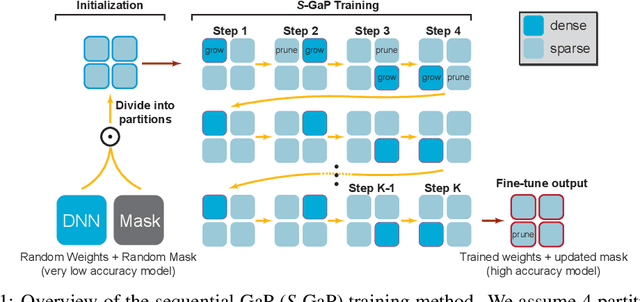
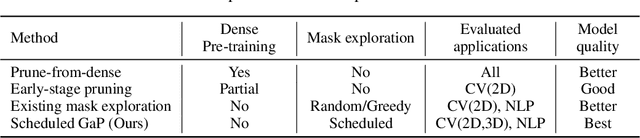
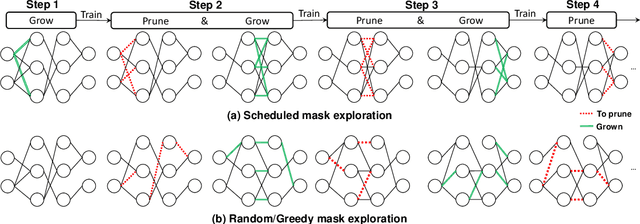
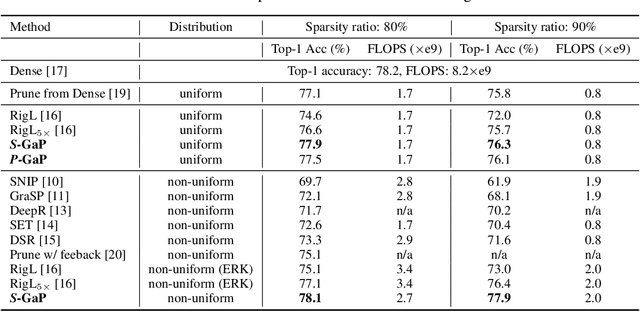
Deep neural networks (DNNs) are effective in solving many real-world problems. Larger DNN models usually exhibit better quality (e.g., accuracy) but their excessive computation results in long training and inference time. Model sparsification can reduce the computation and memory cost while maintaining model quality. Most existing sparsification algorithms unidirectionally remove weights, while others randomly or greedily explore a small subset of weights in each layer. The inefficiency of the algorithms reduces the achievable sparsity level. In addition, many algorithms still require pre-trained dense models and thus suffer from large memory footprint and long training time. In this paper, we propose a novel scheduled grow-and-prune (GaP) methodology without pre-training the dense models. It addresses the shortcomings of the previous works by repeatedly growing a subset of layers to dense and then pruning back to sparse after some training. Experiments have shown that such models can match or beat the quality of highly optimized dense models at 80% sparsity on a variety of tasks, such as image classification, objective detection, 3D object part segmentation, and translation. They also outperform other state-of-the-art (SOTA) pruning methods, including pruning from pre-trained dense models. As an example, a 90% sparse ResNet-50 obtained via GaP achieves 77.9% top-1 accuracy on ImageNet, improving the SOTA results by 1.5%.
FORMS: Fine-grained Polarized ReRAM-based In-situ Computation for Mixed-signal DNN Accelerator
Jun 16, 2021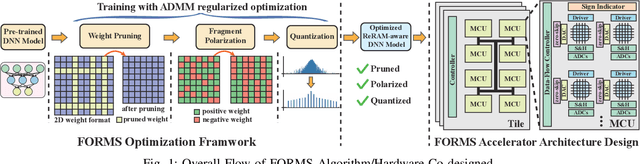
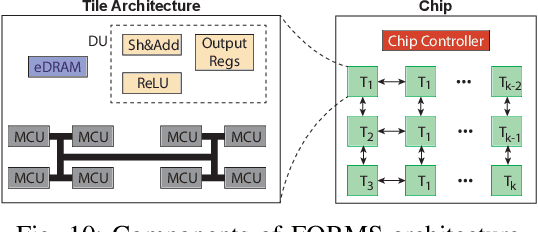
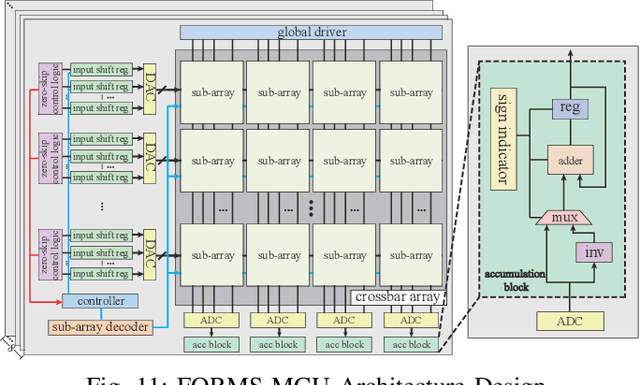

Recent works demonstrated the promise of using resistive random access memory (ReRAM) as an emerging technology to perform inherently parallel analog domain in-situ matrix-vector multiplication -- the intensive and key computation in DNNs. With weights stored in the ReRAM crossbar cells as conductance, when the input vector is applied to word lines, the matrix-vector multiplication results can be generated as the current in bit lines. A key problem is that the weight can be either positive or negative, but the in-situ computation assumes all cells on each crossbar column with the same sign. The current architectures either use two ReRAM crossbars for positive and negative weights, or add an offset to weights so that all values become positive. Neither solution is ideal: they either double the cost of crossbars, or incur extra offset circuity. To better solve this problem, this paper proposes FORMS, a fine-grained ReRAM-based DNN accelerator with polarized weights. Instead of trying to represent the positive/negative weights, our key design principle is to enforce exactly what is assumed in the in-situ computation -- ensuring that all weights in the same column of a crossbar have the same sign. It naturally avoids the cost of an additional crossbar. Such weights can be nicely generated using alternating direction method of multipliers (ADMM) regularized optimization, which can exactly enforce certain patterns in DNN weights. To achieve high accuracy, we propose to use fine-grained sub-array columns, which provide a unique opportunity for input zero-skipping, significantly avoiding unnecessary computations. It also makes the hardware much easier to implement. Putting all together, with the same optimized models, FORMS achieves significant throughput improvement and speed up in frame per second over ISAAC with similar area cost.
Towards Fast and Accurate Multi-Person Pose Estimation on Mobile Devices
Jun 06, 2021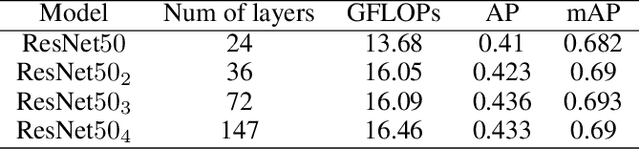

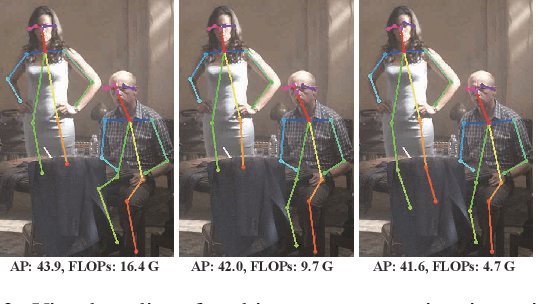
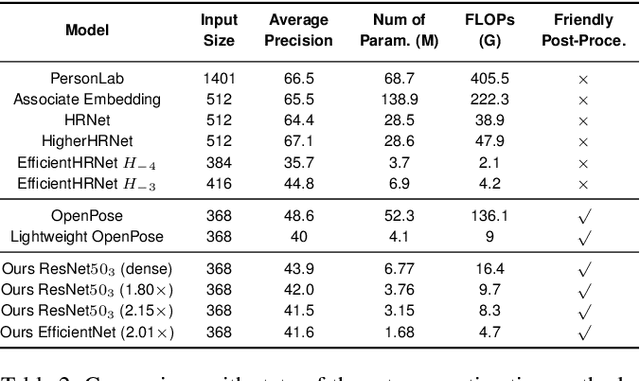
The rapid development of autonomous driving, abnormal behavior detection, and behavior recognition makes an increasing demand for multi-person pose estimation-based applications, especially on mobile platforms. However, to achieve high accuracy, state-of-the-art methods tend to have a large model size and complex post-processing algorithm, which costs intense computation and long end-to-end latency. To solve this problem, we propose an architecture optimization and weight pruning framework to accelerate inference of multi-person pose estimation on mobile devices. With our optimization framework, we achieve up to 2.51x faster model inference speed with higher accuracy compared to representative lightweight multi-person pose estimator.
Lottery Ticket Implies Accuracy Degradation, Is It a Desirable Phenomenon?
Feb 19, 2021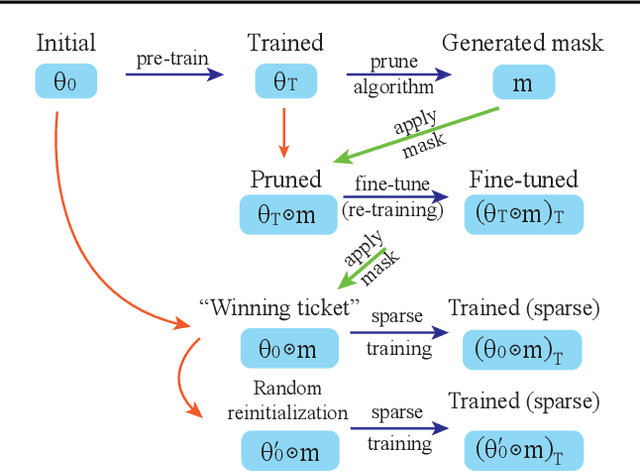
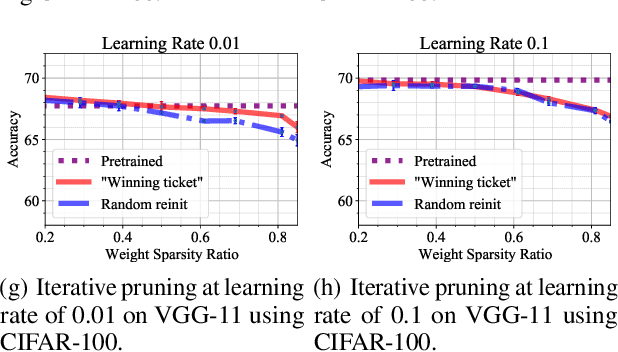
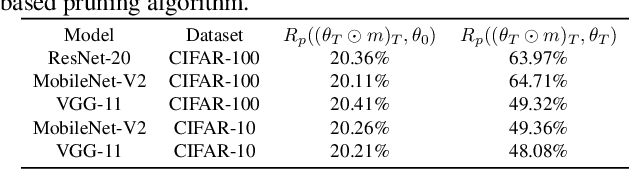
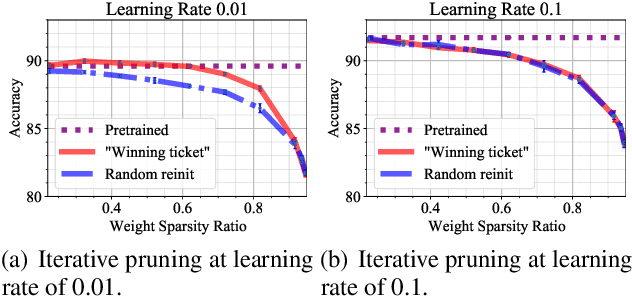
In deep model compression, the recent finding "Lottery Ticket Hypothesis" (LTH) (Frankle & Carbin, 2018) pointed out that there could exist a winning ticket (i.e., a properly pruned sub-network together with original weight initialization) that can achieve competitive performance than the original dense network. However, it is not easy to observe such winning property in many scenarios, where for example, a relatively large learning rate is used even if it benefits training the original dense model. In this work, we investigate the underlying condition and rationale behind the winning property, and find that the underlying reason is largely attributed to the correlation between initialized weights and final-trained weights when the learning rate is not sufficiently large. Thus, the existence of winning property is correlated with an insufficient DNN pretraining, and is unlikely to occur for a well-trained DNN. To overcome this limitation, we propose the "pruning & fine-tuning" method that consistently outperforms lottery ticket sparse training under the same pruning algorithm and the same total training epochs. Extensive experiments over multiple deep models (VGG, ResNet, MobileNet-v2) on different datasets have been conducted to justify our proposals.
A Unified DNN Weight Compression Framework Using Reweighted Optimization Methods
Apr 12, 2020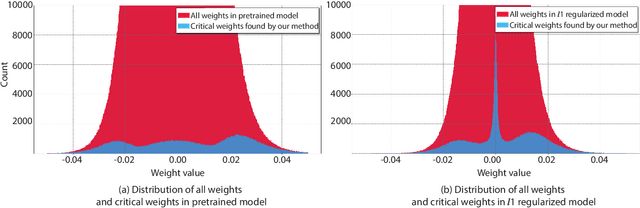

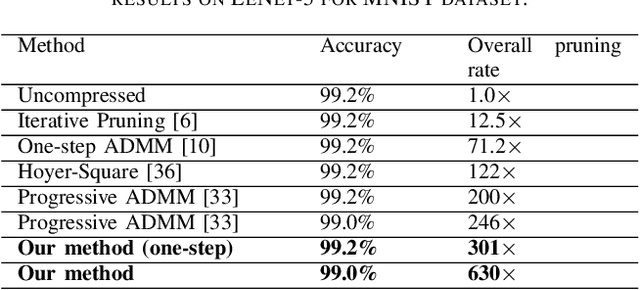
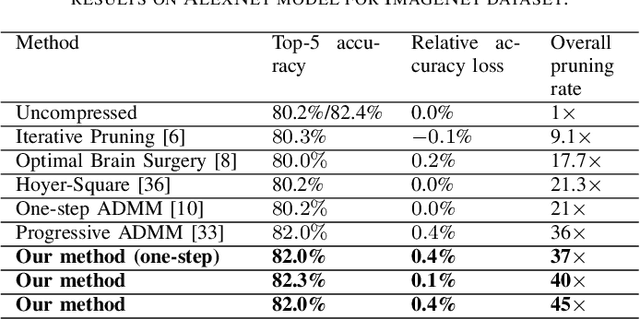
To address the large model size and intensive computation requirement of deep neural networks (DNNs), weight pruning techniques have been proposed and generally fall into two categories, i.e., static regularization-based pruning and dynamic regularization-based pruning. However, the former method currently suffers either complex workloads or accuracy degradation, while the latter one takes a long time to tune the parameters to achieve the desired pruning rate without accuracy loss. In this paper, we propose a unified DNN weight pruning framework with dynamically updated regularization terms bounded by the designated constraint, which can generate both non-structured sparsity and different kinds of structured sparsity. We also extend our method to an integrated framework for the combination of different DNN compression tasks.
A Privacy-Preserving DNN Pruning and Mobile Acceleration Framework
Mar 13, 2020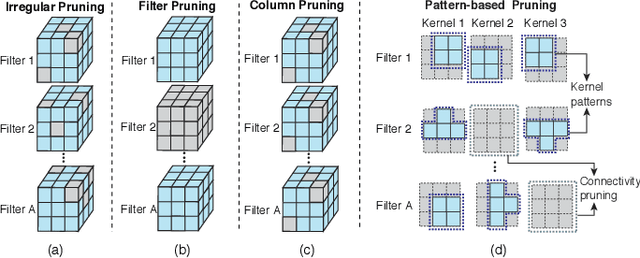
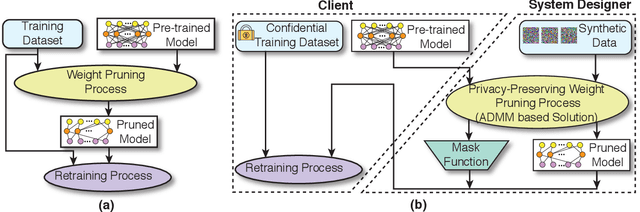
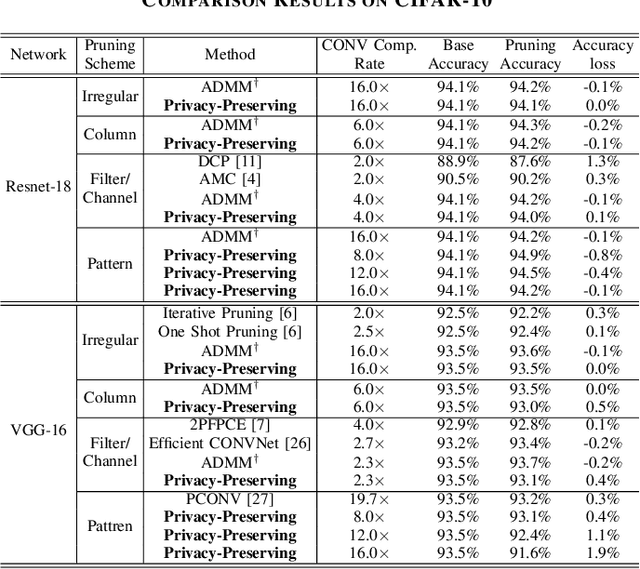
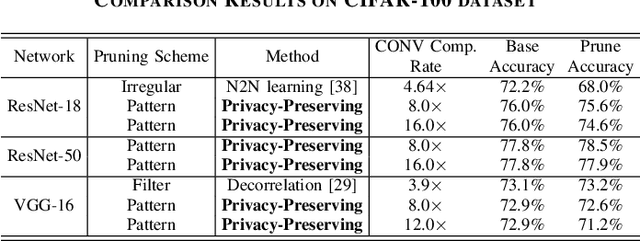
To facilitate the deployment of deep neural networks (DNNs) on resource-constrained computing systems, DNN model compression methods have been proposed. However, previous methods mainly focus on reducing the model size and/or improving hardware performance, without considering the data privacy requirement. This paper proposes a privacy-preserving model compression framework that formulates a privacy-preserving DNN weight pruning problem and develops an ADMM based solution to support different weight pruning schemes. We consider the case that the system designer will perform weight pruning on a pre-trained model provided by the client, whereas the client cannot share her confidential training dataset. To mitigate the non-availability of the training dataset, the system designer distills the knowledge of a pre-trained model into a pruned model using only randomly generated synthetic data. Then the client's effort is simply reduced to performing the retraining process using her confidential training dataset, which is similar as the DNN training process with the help of the mask function from the system designer. Both algorithmic and hardware experiments validate the effectiveness of the proposed framework.
BLK-REW: A Unified Block-based DNN Pruning Framework using Reweighted Regularization Method
Feb 22, 2020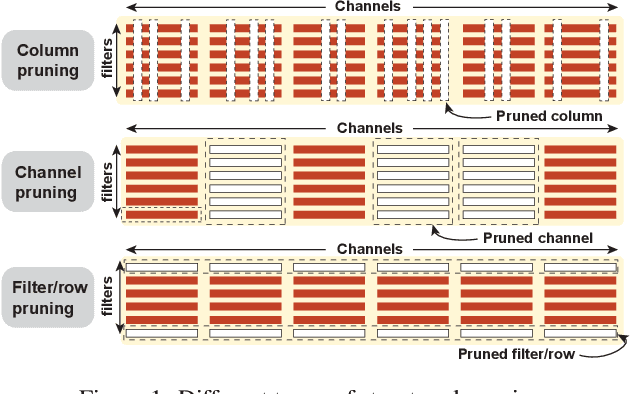
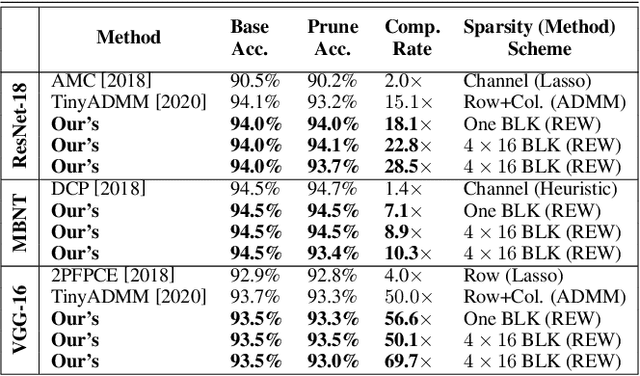
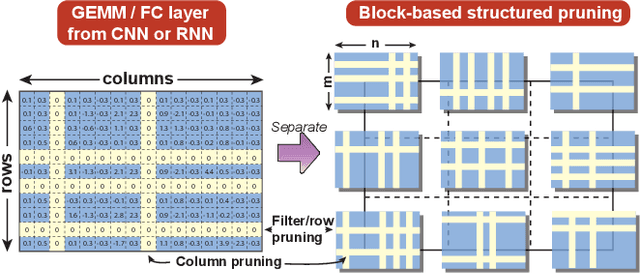
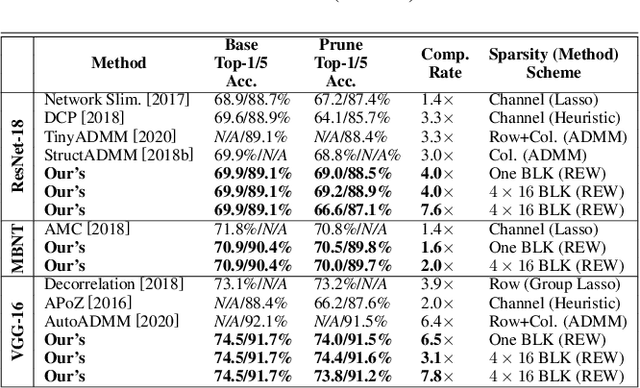
Accelerating DNN execution on various resource-limited computing platforms has been a long-standing problem. Prior works utilize l1-based group lasso or dynamic regularization such as ADMM to perform structured pruning on DNN models to leverage the parallel computing architectures. However, both of the pruning dimensions and pruning methods lack universality, which leads to degraded performance and limited applicability. To solve the problem, we propose a new block-based pruning framework that comprises a general and flexible structured pruning dimension as well as a powerful and efficient reweighted regularization method. Our framework is universal, which can be applied to both CNNs and RNNs, implying complete support for the two major kinds of computation-intensive layers (i.e., CONV and FC layers). To complete all aspects of the pruning-for-acceleration task, we also integrate compiler-based code optimization into our framework that can perform DNN inference in a real-time manner. To the best of our knowledge, it is the first time that the weight pruning framework achieves universal coverage for both CNNs and RNNs with real-time mobile acceleration and no accuracy compromise.
An Image Enhancing Pattern-based Sparsity for Real-time Inference on Mobile Devices
Feb 22, 2020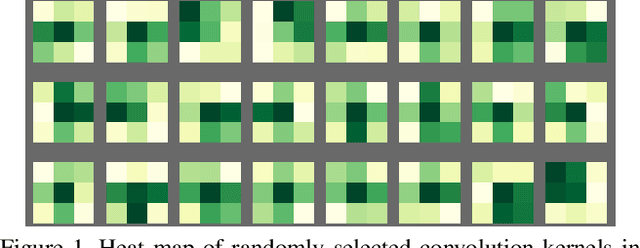
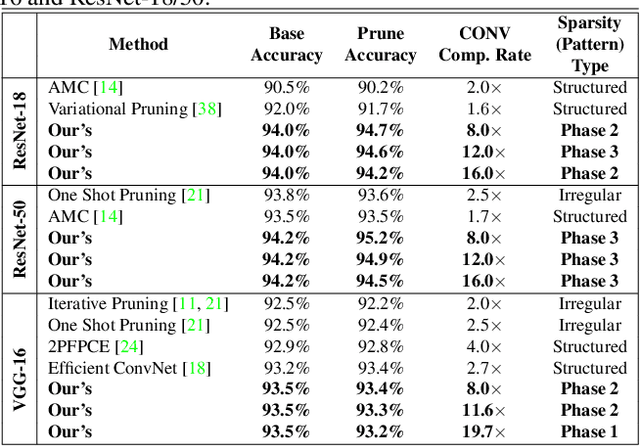
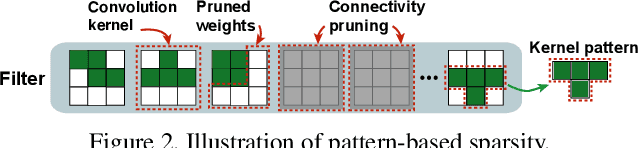
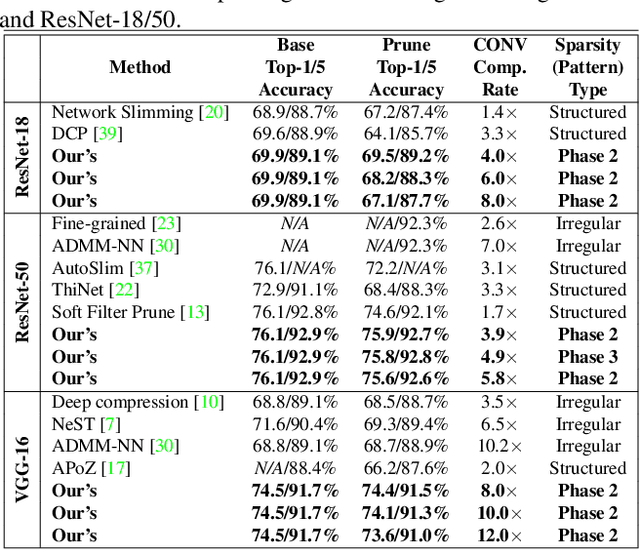
Weight pruning has been widely acknowledged as a straightforward and effective method to eliminate redundancy in Deep Neural Networks (DNN), thereby achieving acceleration on various platforms. However, most of the pruning techniques are essentially trade-offs between model accuracy and regularity which lead to impaired inference accuracy and limited on-device acceleration performance. To solve the problem, we introduce a new sparsity dimension, namely pattern-based sparsity that comprises pattern and connectivity sparsity, and becoming both highly accurate and hardware friendly. With carefully designed patterns, the proposed pruning unprecedentedly and consistently achieves accuracy enhancement and better feature extraction ability on different DNN structures and datasets, and our pattern-aware pruning framework also achieves pattern library extraction, pattern selection, pattern and connectivity pruning and weight training simultaneously. Our approach on the new pattern-based sparsity naturally fits into compiler optimization for highly efficient DNN execution on mobile platforms. To the best of our knowledge, it is the first time that mobile devices achieve real-time inference for the large-scale DNN models thanks to the unique spatial property of pattern-based sparsity and the help of the code generation capability of compilers.
PCNN: Pattern-based Fine-Grained Regular Pruning towards Optimizing CNN Accelerators
Feb 11, 2020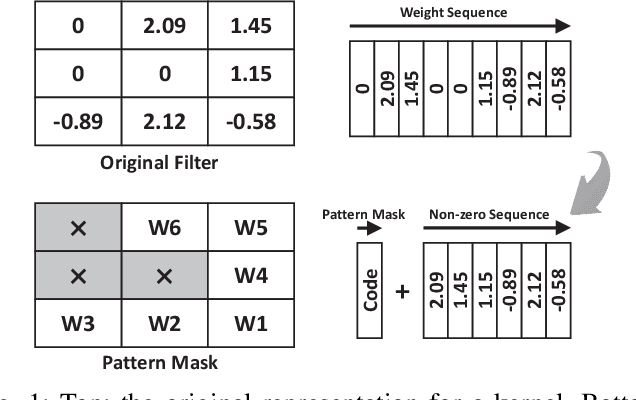
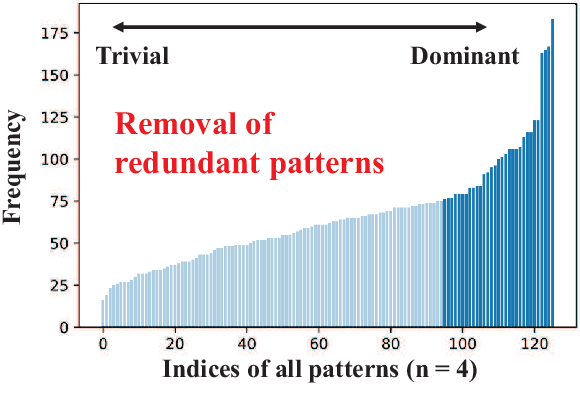
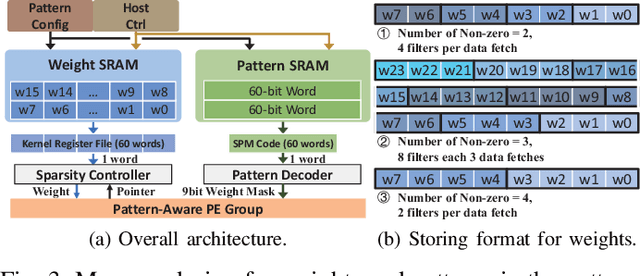
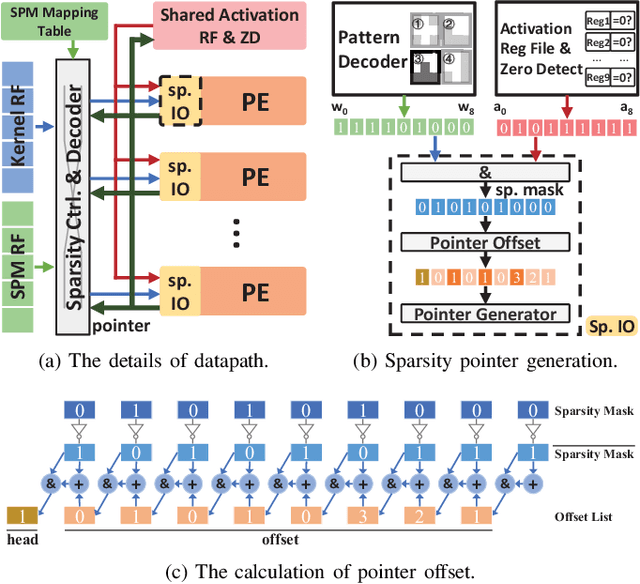
Weight pruning is a powerful technique to realize model compression. We propose PCNN, a fine-grained regular 1D pruning method. A novel index format called Sparsity Pattern Mask (SPM) is presented to encode the sparsity in PCNN. Leveraging SPM with limited pruning patterns and non-zero sequences with equal length, PCNN can be efficiently employed in hardware. Evaluated on VGG-16 and ResNet-18, our PCNN achieves the compression rate up to 8.4X with only 0.2% accuracy loss. We also implement a pattern-aware architecture in 55nm process, achieving up to 9.0X speedup and 28.39 TOPS/W efficiency with only 3.1% on-chip memory overhead of indices.