 Add to Chrome
 Add to Firefox
 Add to Edge
PaperFit: Vision-in-the-Loop Typesetting Optimization for Scientific Documents
May 11, 2026
A LaTeX manuscript that compiles without error is not necessarily publication-ready. The resulting PDFs frequently suffer from misplaced floats, overflowing equations, inconsistent table scaling, widow and orphan lines, and poor page balance, forcing authors into repetitive compile-inspect-edit cycles. Rule-based tools are blind to rendered visuals, operating only on source code and log files. Text-only LLMs perform open-loop text editing, unable to predict or verify the two-dimensional layout consequences of their changes. Reliable typesetting optimization therefore requires a visual closed loop with verification after every edit. We formalize this problem as Visual Typesetting Optimization (VTO), the task of transforming a compilable LaTeX paper into a visually polished, page-budget-compliant PDF through iterative visual verification and source-level revision, and introduce a five-category taxonomy of typesetting defects to guide diagnosis. We present PaperFit, a vision-in-the-loop agent that iteratively renders pages, diagnoses defects, and applies constrained repairs. To benchmark VTO, we construct PaperFit-Bench with 200 papers across 10 venue templates and 13 defect types at different difficulty. Extensive experiments show that PaperFit outperforms all baselines by a large margin, establishing that bridging the gap from compilable source to publication-ready PDF requires vision-in-the-loop optimization and that VTO constitutes a critical missing stage in the document automation pipeline.

TRACER: Verifiable Generative Provenance for Multimodal Tool-Using Agents
May 11, 2026Multimodal large language models increasingly solve vision-centric tasks by calling external tools for visual inspection, OCR, retrieval, calculation, and multi-step reasoning. Current tool-using agents usually expose the executed tool trajectory and the final answer, but they rarely specify which tool observation supports each generated claim. We call this missing claim-level dependency structure the provenance gap. The gap makes tool use hard to verify and hard to optimize, because useful evidence, redundant exploration, and unsupported reasoning are mixed in the same trajectory. We introduce TRACER, a framework for verifiable generative provenance in multimodal tool-using agents. Instead of adding citations after generation, TRACER generates each answer sentence together with a structured provenance record that identifies the supporting tool turn, evidence unit, and semantic support relation. Its relation space contains Quotation, Compression, and Inference, covering direct reuse, faithful condensation, and grounded derivation. TRACER verifies each record through schema checking, tool-turn alignment, source authenticity, and relation rationality, and then converts verified provenance into traceability constraints and provenance-derived local credit for reinforcement learning. We further construct TRACE-Bench, a benchmark for sentence-level provenance reconstruction from coarse multimodal tool trajectories. On TRACE-Bench, simply adding tools often introduces noise. With Qwen3-VL-8B, TRACER reaches 78.23% answer accuracy and 95.72% summary accuracy, outperforming the strongest closed-source tool-augmented baseline by 23.80 percentage points. Compared with tool-only supervised fine-tuning, it also reduces total test-set tool calls from 4949 to 3486. These results show that reliable multimodal tool reasoning depends on provenance-aware use of observations, not on more tool calls alone.
How RL Unlocks the Aha Moment in Geometric Interleaved Reasoning
Mar 01, 2026Solving complex geometric problems inherently requires interleaved reasoning: a tight alternation between constructing diagrams and performing logical deductions. Although recent Multimodal Large Language Models (MLLMs) have demonstrated strong capabilities in visual generation and plotting, we identify a counter-intuitive and underexplored phenomenon. Naively applying Supervised Fine-Tuning (SFT) on interleaved plot-solution data leads to a substantial degradation in reasoning performance compared to text-only baselines. We argue that this failure stems from a fundamental limitation of SFT, which primarily induces distributional alignment: the model learns to reproduce the surface format of interleaved plotting but fails to internalize the causal dependency between the generated plot and reasoning steps. To overcome this limitation, we propose Faire (Functional alignment for interleaved reasoning), a reinforcement learning framework that enforces three casual constraints to move beyond superficial imitation toward functional alignment. Extensive experiments show that Faire induces a qualitative shift in model behavior in which the plotting is effectively internalized, yielding competitive performance on challenging geometric reasoning benchmarks.
The Trinity of Consistency as a Defining Principle for General World Models
Feb 26, 2026The construction of World Models capable of learning, simulating, and reasoning about objective physical laws constitutes a foundational challenge in the pursuit of Artificial General Intelligence. Recent advancements represented by video generation models like Sora have demonstrated the potential of data-driven scaling laws to approximate physical dynamics, while the emerging Unified Multimodal Model (UMM) offers a promising architectural paradigm for integrating perception, language, and reasoning. Despite these advances, the field still lacks a principled theoretical framework that defines the essential properties requisite for a General World Model. In this paper, we propose that a World Model must be grounded in the Trinity of Consistency: Modal Consistency as the semantic interface, Spatial Consistency as the geometric basis, and Temporal Consistency as the causal engine. Through this tripartite lens, we systematically review the evolution of multimodal learning, revealing a trajectory from loosely coupled specialized modules toward unified architectures that enable the synergistic emergence of internal world simulators. To complement this conceptual framework, we introduce CoW-Bench, a benchmark centered on multi-frame reasoning and generation scenarios. CoW-Bench evaluates both video generation models and UMMs under a unified evaluation protocol. Our work establishes a principled pathway toward general world models, clarifying both the limitations of current systems and the architectural requirements for future progress.
Thinking with Drafting: Optical Decompression via Logical Reconstruction
Feb 12, 2026Existing multimodal large language models have achieved high-fidelity visual perception and exploratory visual generation. However, a precision paradox persists in complex reasoning tasks: optical perception systems transcribe symbols without capturing logical topology, while pixel-based generative models produce visual artifacts lacking mathematical exactness. To bridge this gap, we propose that reasoning over visual inputs be reconceptualized as optical decompression-the process of reconstructing latent logical structures from compressed visual tokens. Guided by the axiom that Parsing is Reasoning, we introduce Thinking with Drafting (TwD), which utilizes a minimalist Domain-Specific Language (DSL) as a grounding intermediate representation. Unlike standard approaches that hallucinate answers directly, TwD forces the model to draft its mental model into executable code, rendering deterministic visual proofs for self-verification. To validate this, we present VisAlg, a visual algebra benchmark. Experiments demonstrate that TwD serve as a superior cognitive scaffold. Our work establishes a closed-loop system where visual generation acts not as a creative output but as a logical verifier, offering a generalizable path for visual reasoning.
Canvas-of-Thought: Grounding Reasoning via Mutable Structured States
Feb 11, 2026While Chain-of-Thought (CoT) prompting has significantly advanced the reasoning capabilities of Multimodal Large Language Models (MLLMs), relying solely on linear text sequences remains a bottleneck for complex tasks. We observe that even when auxiliary visual elements are interleaved, they are often treated as static snapshots within a one-dimensional, unstructured reasoning chain. We argue that such approaches treat reasoning history as an immutable stream: correcting a local error necessitates either generating verbose downstream corrections or regenerating the entire context. This forces the model to implicitly maintain and track state updates, significantly increasing token consumption and cognitive load. This limitation is particularly acute in high-dimensional domains, such as geometry and SVG design, where the textual expression of CoT lacks explicit visual guidance, further constraining the model's reasoning precision. To bridge this gap, we introduce \textbf{Canvas-of-Thought (Canvas-CoT)}. By leveraging a HTML Canvas as an external reasoning substrate, Canvas-CoT empowers the model to perform atomic, DOM-based CRUD operations. This architecture enables in-place state revisions without disrupting the surrounding context, allowing the model to explicitly maintain the "ground truth". Furthermore, we integrate a rendering-based critique loop that serves as a hard constraint validator, providing explicit visual feedback to resolve complex tasks that are difficult to articulate through text alone. Extensive experiments on VCode, RBench-V, and MathVista demonstrate that Canvas-CoT significantly outperforms existing baselines, establishing a new paradigm for context-efficient multimodal reasoning.
GenProve: Learning to Generate Text with Fine-Grained Provenance
Jan 08, 2026Large language models (LLM) often hallucinate, and while adding citations is a common solution, it is frequently insufficient for accountability as users struggle to verify how a cited source supports a generated claim. Existing methods are typically coarse-grained and fail to distinguish between direct quotes and complex reasoning. In this paper, we introduce Generation-time Fine-grained Provenance, a task where models must generate fluent answers while simultaneously producing structured, sentence-level provenance triples. To enable this, we present ReFInE (Relation-aware Fine-grained Interpretability & Evidence), a dataset featuring expert verified annotations that distinguish between Quotation, Compression, and Inference. Building on ReFInE, we propose GenProve, a framework that combines Supervised Fine-Tuning (SFT) with Group Relative Policy Optimization (GRPO). By optimizing a composite reward for answer fidelity and provenance correctness, GenProve significantly outperforms 14 strong LLMs in joint evaluation. Crucially, our analysis uncovers a reasoning gap where models excel at surface-level quotation but struggle significantly with inference-based provenance, suggesting that verifiable reasoning remains a frontier challenge distinct from surface-level citation.
GGBench: A Geometric Generative Reasoning Benchmark for Unified Multimodal Models
Nov 14, 2025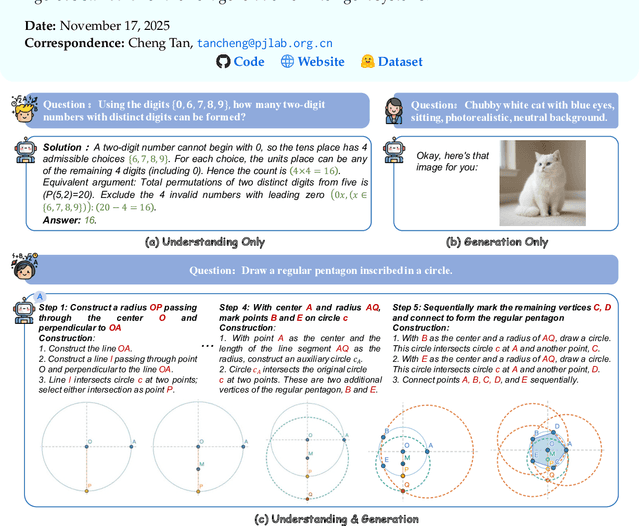
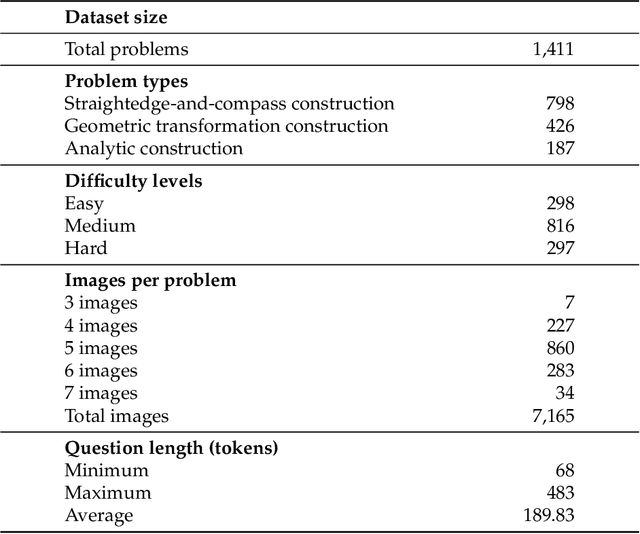
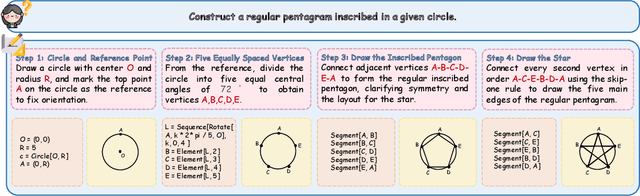
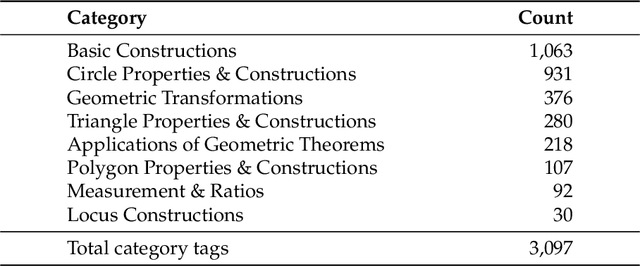
The advent of Unified Multimodal Models (UMMs) signals a paradigm shift in artificial intelligence, moving from passive perception to active, cross-modal generation. Despite their unprecedented ability to synthesize information, a critical gap persists in evaluation: existing benchmarks primarily assess discriminative understanding or unconstrained image generation separately, failing to measure the integrated cognitive process of generative reasoning. To bridge this gap, we propose that geometric construction provides an ideal testbed as it inherently demands a fusion of language comprehension and precise visual generation. We introduce GGBench, a benchmark designed specifically to evaluate geometric generative reasoning. It provides a comprehensive framework for systematically diagnosing a model's ability to not only understand and reason but to actively construct a solution, thereby setting a more rigorous standard for the next generation of intelligent systems. Project website: https://opendatalab-raiser.github.io/GGBench/.
StructVRM: Aligning Multimodal Reasoning with Structured and Verifiable Reward Models
Aug 07, 2025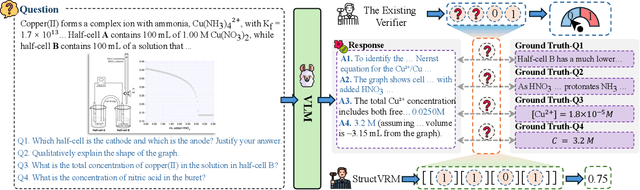
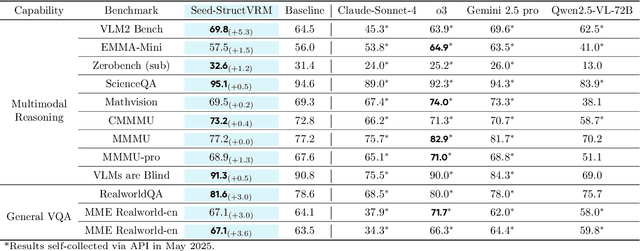
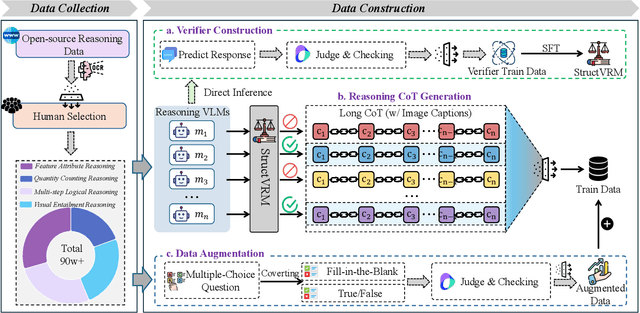
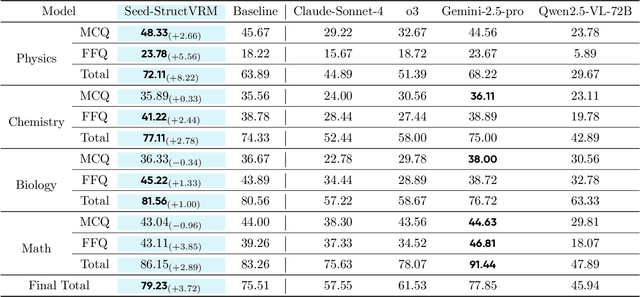
Existing Vision-Language Models often struggle with complex, multi-question reasoning tasks where partial correctness is crucial for effective learning. Traditional reward mechanisms, which provide a single binary score for an entire response, are too coarse to guide models through intricate problems with multiple sub-parts. To address this, we introduce StructVRM, a method that aligns multimodal reasoning with Structured and Verifiable Reward Models. At its core is a model-based verifier trained to provide fine-grained, sub-question-level feedback, assessing semantic and mathematical equivalence rather than relying on rigid string matching. This allows for nuanced, partial credit scoring in previously intractable problem formats. Extensive experiments demonstrate the effectiveness of StructVRM. Our trained model, Seed-StructVRM, achieves state-of-the-art performance on six out of twelve public multimodal benchmarks and our newly curated, high-difficulty STEM-Bench. The success of StructVRM validates that training with structured, verifiable rewards is a highly effective approach for advancing the capabilities of multimodal models in complex, real-world reasoning domains.
ChartReasoner: Code-Driven Modality Bridging for Long-Chain Reasoning in Chart Question Answering
Jun 11, 2025Recently, large language models have shown remarkable reasoning capabilities through long-chain reasoning before responding. However, how to extend this capability to visual reasoning tasks remains an open challenge. Existing multimodal reasoning approaches transfer such visual reasoning task into textual reasoning task via several image-to-text conversions, which often lose critical structural and semantic information embedded in visualizations, especially for tasks like chart question answering that require a large amount of visual details. To bridge this gap, we propose ChartReasoner, a code-driven novel two-stage framework designed to enable precise, interpretable reasoning over charts. We first train a high-fidelity model to convert diverse chart images into structured ECharts codes, preserving both layout and data semantics as lossless as possible. Then, we design a general chart reasoning data synthesis pipeline, which leverages this pretrained transport model to automatically and scalably generate chart reasoning trajectories and utilizes a code validator to filter out low-quality samples. Finally, we train the final multimodal model using a combination of supervised fine-tuning and reinforcement learning on our synthesized chart reasoning dataset and experimental results on four public benchmarks clearly demonstrate the effectiveness of our proposed ChartReasoner. It can preserve the original details of the charts as much as possible and perform comparably with state-of-the-art open-source models while using fewer parameters, approaching the performance of proprietary systems like GPT-4o in out-of-domain settings.