 Add to Chrome
 Add to Firefox
 Add to Edge
Evaluating and Pricing Advertisements in AI-Generated Responses
Jul 30, 2026
As search increasingly shifts toward LLM-driven answer engines, advertising is becoming embedded within the generated response itself and should therefore be evaluated for both user utility and commercial value. The key challenge is click-through intent: behavioural logs are unavailable, human annotation resists calibration, and frontier LLM judges conflate intent with linguistic fluency. These gaps compound, as principled pricing presupposes a continuous intent signal, while generating such a signal presupposes supervision that is currently unavailable. We construct the missing supervision through a psychologically grounded agent simulation framework, and distil it into a parameter-efficient evaluator that predicts click-through intent, together with the three companion dimensions of ad quality, as smooth, differentiable estimates. Validated through sign-certain behavioural perturbations, the evaluator surpasses frontier zero-shot judges on relevance sensitivity (79% versus 60-67%), tracks graded content degradation, generalises without error to 103 fictional products, and agrees with human preference in 86% of pairwise judgements across five annotators, with agreement rising in the evaluator's confidence. Upon its estimates we build the pricing layer directly, deriving the unique payment rule under which truthful bidding is optimal, demonstrating it on a best-of-k allocation, and extending the mechanism to non-monotone allocations. The same differentiable signal stands ready as a training objective for ad generation.

PILA: Plug-and-Play Insertion for LLM-native Advertising
Jul 28, 2026How to monetize large language models (LLMs) by naturally integrating sponsored content into their responses, known as LLM-native advertising, has recently emerged as a critical problem. However, existing solutions entangle advertising with content generation inside a single model, which is incompatible with modern API-only or workflow-based LLM applications and inevitably compromises the original response quality. To address this, we propose PILA, which reformulates ad insertion as a conditional response rewriting problem and decouples it from the upstream service as a lightweight sidecar module. PILA is model-agnostic and can be seamlessly integrated with existing LLM services without modifying the base model or its workflow. It also exposes a controllable trade-off between user-side naturalness and ad-side exposure, offering a practical interface for downstream pricing and deployment. Experiments across diverse upstream models show that \pila consistently improves ad effectiveness while preserving response quality, highlighting its promise as a practical solution for LLM-native advertising.
NaiAD: Initiate Data-Driven Research for LLM Advertising
May 11, 2026Reconciling platform revenue with user experience in LLM advertising motivates a data-centric foundation. We introduce NaiAD, the first comprehensive dataset for LLM-native advertising comprising 58,999 carefully constructed ad-embedded responses paired with user queries. NaiAD is organized around theoretically grounded evaluation metrics that separately and comprehensively capture user and commercial utility. To mitigate the dimensional collinearity of aligned LLMs, we propose a decoupled generation pipeline that produces structurally diverse samples, ranging from responses that explicitly disentangle stakeholder utilities to responses that are uniformly strong or weak across dimensions. We further provide score labels calibrated by a Variance-Calibrated Prediction-Powered Inference (VC-PPI) framework, aligning automated scoring with human annotations. Mechanistic analyses reveal that successful ad integration relies on reasoning paths that cluster into four distinct semantic strategies. Models leveraging NaiAD internalize these strategies to simultaneously improve user and commercial utility, while enabling independent control over these distinct objectives via in-context learning. Together, these results position NaiAD as a foundational infrastructure for developing future LLM-native ad systems.
Reverse Thinking Enhances Missing Information Detection in Large Language Models
Dec 11, 2025Large Language Models (LLMs) have demonstrated remarkable capabilities in various reasoning tasks, yet they often struggle with problems involving missing information, exhibiting issues such as incomplete responses, factual errors, and hallucinations. While forward reasoning approaches like Chain-of-Thought (CoT) and Tree-of-Thought (ToT) have shown success in structured problem-solving, they frequently fail to systematically identify and recover omitted information. In this paper, we explore the potential of reverse thinking methodologies to enhance LLMs' performance on missing information detection tasks. Drawing inspiration from recent work on backward reasoning, we propose a novel framework that guides LLMs through reverse thinking to identify necessary conditions and pinpoint missing elements. Our approach transforms the challenging task of missing information identification into a more manageable backward reasoning problem, significantly improving model accuracy. Experimental results demonstrate that our reverse thinking approach achieves substantial performance gains compared to traditional forward reasoning methods, providing a promising direction for enhancing LLMs' logical completeness and reasoning robustness.
Beyond First-Order: Training LLMs with Stochastic Conjugate Subgradients and AdamW
Jul 01, 2025Stochastic gradient-based descent (SGD), have long been central to training large language models (LLMs). However, their effectiveness is increasingly being questioned, particularly in large-scale applications where empirical evidence suggests potential performance limitations. In response, this paper proposes a stochastic conjugate subgradient method together with adaptive sampling tailored specifically for training LLMs. The method not only achieves faster convergence per iteration but also demonstrates improved scalability compared to traditional SGD techniques. It leverages sample complexity analysis to adaptively choose the sample size, employs a stochastic conjugate subgradient approach to determine search directions and utilizing an AdamW-like algorithm to adaptively adjust step sizes. This approach preserves the key advantages of first-order methods while effectively addressing the nonconvexity and non-smoothness inherent in LLMs training. Additionally, we provide a detailed analysis of the advantage of the algorithm. Experimental results show that the proposed method not only maintains, but in many cases surpasses, the scalability of traditional SGD techniques, significantly enhancing both the speed and accuracy of the optimization process.
A Comprehensive Survey on Imbalanced Data Learning
Feb 13, 2025With the expansion of data availability, machine learning (ML) has achieved remarkable breakthroughs in both academia and industry. However, imbalanced data distributions are prevalent in various types of raw data and severely hinder the performance of ML by biasing the decision-making processes. To deepen the understanding of imbalanced data and facilitate the related research and applications, this survey systematically analyzing various real-world data formats and concludes existing researches for different data formats into four distinct categories: data re-balancing, feature representation, training strategy, and ensemble learning. This structured analysis help researchers comprehensively understand the pervasive nature of imbalance across diverse data format, thereby paving a clearer path toward achieving specific research goals. we provide an overview of relevant open-source libraries, spotlight current challenges, and offer novel insights aimed at fostering future advancements in this critical area of study.
SSMLoRA: Enhancing Low-Rank Adaptation with State Space Model
Feb 07, 2025Fine-tuning is a key approach for adapting language models to specific downstream tasks, but updating all model parameters becomes impractical as model sizes increase. Parameter-Efficient Fine-Tuning (PEFT) methods, such as Low-Rank Adaptation (LoRA), address this challenge by introducing additional adaptation parameters into pre-trained weight matrices. However, LoRA's performance varies across different insertion points within the model, highlighting potential parameter inefficiency due to unnecessary insertions. To this end, we propose SSMLoRA (State Space Model Low-Rank Adaptation), an extension of LoRA that incorporates a State Space Model (SSM) to interconnect low-rank matrices. SSMLoRA ensures that performance is maintained even with sparser insertions. SSMLoRA allows the model to not only map inputs to a low-rank space for better feature extraction but also leverage the computations from the previous low-rank space. Our method achieves comparable performance to LoRA on the General Language Understanding Evaluation (GLUE) benchmark while using only half the parameters. Additionally, due to its structure, SSMLoRA shows promise in handling tasks with longer input sequences. .You can find our code here:https://github.com/yuhkalhic/SSMLoRA.
GlycanML: A Multi-Task and Multi-Structure Benchmark for Glycan Machine Learning
May 25, 2024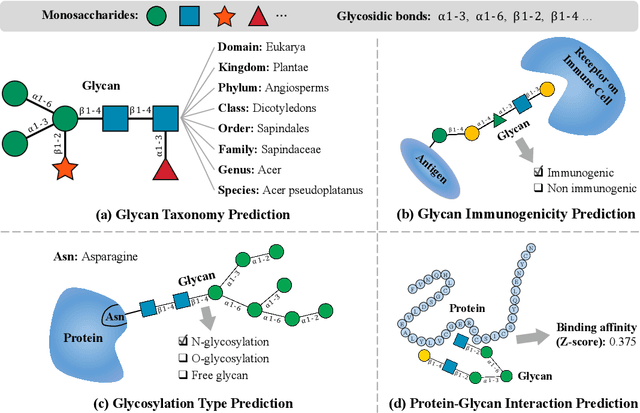
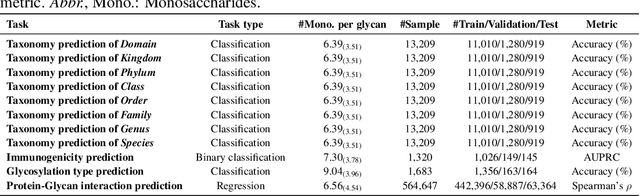

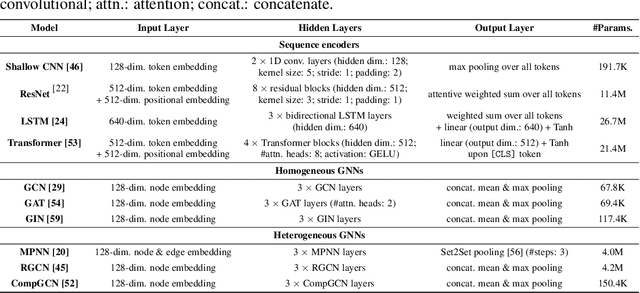
Glycans are basic biomolecules and perform essential functions within living organisms. The rapid increase of functional glycan data provides a good opportunity for machine learning solutions to glycan understanding. However, there still lacks a standard machine learning benchmark for glycan function prediction. In this work, we fill this blank by building a comprehensive benchmark for Glycan Machine Learning (GlycanML). The GlycanML benchmark consists of diverse types of tasks including glycan taxonomy prediction, glycan immunogenicity prediction, glycosylation type prediction, and protein-glycan interaction prediction. Glycans can be represented by both sequences and graphs in GlycanML, which enables us to extensively evaluate sequence-based models and graph neural networks (GNNs) on benchmark tasks. Furthermore, by concurrently performing eight glycan taxonomy prediction tasks, we introduce the GlycanML-MTL testbed for multi-task learning (MTL) algorithms. Experimental results show the superiority of modeling glycans with multi-relational GNNs, and suitable MTL methods can further boost model performance. We provide all datasets and source codes at https://github.com/GlycanML/GlycanML and maintain a leaderboard at https://GlycanML.github.io/project
DoLLM: How Large Language Models Understanding Network Flow Data to Detect Carpet Bombing DDoS
May 13, 2024

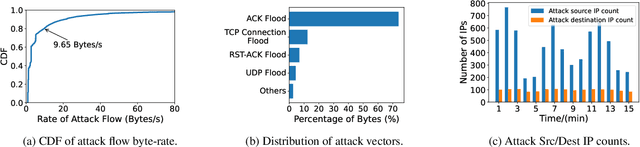
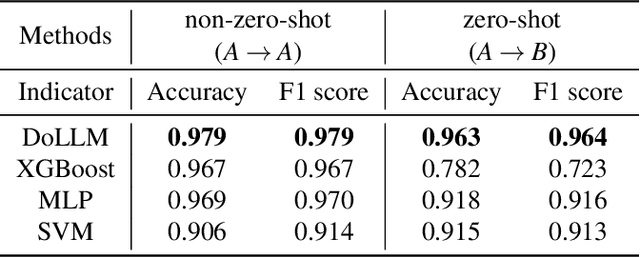
It is an interesting question Can and How Large Language Models (LLMs) understand non-language network data, and help us detect unknown malicious flows. This paper takes Carpet Bombing as a case study and shows how to exploit LLMs' powerful capability in the networking area. Carpet Bombing is a new DDoS attack that has dramatically increased in recent years, significantly threatening network infrastructures. It targets multiple victim IPs within subnets, causing congestion on access links and disrupting network services for a vast number of users. Characterized by low-rates, multi-vectors, these attacks challenge traditional DDoS defenses. We propose DoLLM, a DDoS detection model utilizes open-source LLMs as backbone. By reorganizing non-contextual network flows into Flow-Sequences and projecting them into LLMs semantic space as token embeddings, DoLLM leverages LLMs' contextual understanding to extract flow representations in overall network context. The representations are used to improve the DDoS detection performance. We evaluate DoLLM with public datasets CIC-DDoS2019 and real NetFlow trace from Top-3 countrywide ISP. The tests have proven that DoLLM possesses strong detection capabilities. Its F1 score increased by up to 33.3% in zero-shot scenarios and by at least 20.6% in real ISP traces.
AAT: Adapting Audio Transformer for Various Acoustics Recognition Tasks
Jan 19, 2024Recently, Transformers have been introduced into the field of acoustics recognition. They are pre-trained on large-scale datasets using methods such as supervised learning and semi-supervised learning, demonstrating robust generality--It fine-tunes easily to downstream tasks and shows more robust performance. However, the predominant fine-tuning method currently used is still full fine-tuning, which involves updating all parameters during training. This not only incurs significant memory usage and time costs but also compromises the model's generality. Other fine-tuning methods either struggle to address this issue or fail to achieve matching performance. Therefore, we conducted a comprehensive analysis of existing fine-tuning methods and proposed an efficient fine-tuning approach based on Adapter tuning, namely AAT. The core idea is to freeze the audio Transformer model and insert extra learnable Adapters, efficiently acquiring downstream task knowledge without compromising the model's original generality. Extensive experiments have shown that our method achieves performance comparable to or even superior to full fine-tuning while optimizing only 7.118% of the parameters. It also demonstrates superiority over other fine-tuning methods.