 Add to Chrome
 Add to Firefox
 Add to Edge
Probing CLIP's Comprehension of 360-Degree Textual and Visual Semantics
Apr 27, 2026
The dream of instantly creating rich 360-degree panoramic worlds from text is rapidly becoming a reality, yet a crucial gap exists in our ability to reliably evaluate their semantic alignment. Contrastive Language-Image Pre-training (CLIP) models, standard AI evaluators, predominantly trained on perspective image-text pairs, face an open question regarding their understanding of the unique characteristics of 360-degree panoramic image-text pairs. This paper addresses this gap by first introducing two concepts: \emph{360-degree textual semantics}, semantic information conveyed by explicit format identifiers, and \emph{360-degree visual semantics}, invariant semantics under horizontal circular shifts. To probe CLIP's comprehension of these semantics, we then propose novel evaluation methodologies using keyword manipulation and horizontal circular shifts of varying magnitudes. Rigorous statistical analyses across popular CLIP configurations reveal that: (1) CLIP models effectively leverage explicit textual identifiers, demonstrating an understanding of 360-degree textual semantics; and (2) CLIP models fail to robustly preserve semantic alignment under horizontal circular shifts, indicating limited comprehension of 360-degree visual semantics. To address this limitation, we propose a LoRA-based fine-tuning framework that explicitly instills invariance to circular shifts. Our fine-tuned models exhibit improved comprehension of 360-degree visual semantics, though with a slight degradation in original semantic evaluation performance, highlighting a fundamental trade-off in adapting CLIP to 360-degree panoramic images. Code is available at https://github.com/littlewhitesea/360Semantics.

Agentic LLM Reasoning in a Self-Driving Laboratory for Air-Sensitive Lithium Halide Spinel Conductors
Apr 13, 2026Self-driving laboratories promise to accelerate materials discovery. Yet current automated solid-state synthesis platforms are limited to ambient conditions, thereby precluding their use for air-sensitive materials. Here, we present A-Lab for Glovebox Powder Solid-state Synthesis (A-Lab GPSS), a robotic platform capable of synthesizing and characterizing air-sensitive inorganic materials under strict air-free conditions. By integrating an agentic AI framework into the A-Lab GPSS platform, we structure autonomous experimental design through abductive and inductive reasoning. We deploy this platform to explore the vast compositional space of lithium halide spinel solid-state ionic conductors. Across a synthesis campaign comprising 352 samples with diverse compositions, the system explores a broad chemical space, experimentally realizing 72% of the 171 possible pairwise combinations among the 19 metals considered in this study. Over the course of the campaign, the fraction of compositions exhibiting both good ionic conductivity (> 0.05 mS/cm) and high halide spinel phase purity increases from 1.33% in the first 75 agent-proposed samples to 5.33% in the final 75. Furthermore, by inspecting the AI's reasoning processes, we reveal distinct yet complementary discovery strategies: abductive reasoning interrogates abnormal observations within already explored regions, whereas inductive reasoning expands the search into broader, previously unvisited chemical space. This work establishes a scalable platform for the autonomous discovery of complex, air-sensitive solid-state materials.
Render-of-Thought: Rendering Textual Chain-of-Thought as Images for Visual Latent Reasoning
Jan 21, 2026Chain-of-Thought (CoT) prompting has achieved remarkable success in unlocking the reasoning capabilities of Large Language Models (LLMs). Although CoT prompting enhances reasoning, its verbosity imposes substantial computational overhead. Recent works often focus exclusively on outcome alignment and lack supervision on the intermediate reasoning process. These deficiencies obscure the analyzability of the latent reasoning chain. To address these challenges, we introduce Render-of-Thought (RoT), the first framework to reify the reasoning chain by rendering textual steps into images, making the latent rationale explicit and traceable. Specifically, we leverage the vision encoders of existing Vision Language Models (VLMs) as semantic anchors to align the vision embeddings with the textual space. This design ensures plug-and-play implementation without incurring additional pre-training overhead. Extensive experiments on mathematical and logical reasoning benchmarks demonstrate that our method achieves 3-4x token compression and substantial inference acceleration compared to explicit CoT. Furthermore, it maintains competitive performance against other methods, validating the feasibility of this paradigm. Our code is available at https://github.com/TencentBAC/RoT
SPAN: Spatial-Projection Alignment for Monocular 3D Object Detection
Nov 10, 2025Existing monocular 3D detectors typically tame the pronounced nonlinear regression of 3D bounding box through decoupled prediction paradigm, which employs multiple branches to estimate geometric center, depth, dimensions, and rotation angle separately. Although this decoupling strategy simplifies the learning process, it inherently ignores the geometric collaborative constraints between different attributes, resulting in the lack of geometric consistency prior, thereby leading to suboptimal performance. To address this issue, we propose novel Spatial-Projection Alignment (SPAN) with two pivotal components: (i). Spatial Point Alignment enforces an explicit global spatial constraint between the predicted and ground-truth 3D bounding boxes, thereby rectifying spatial drift caused by decoupled attribute regression. (ii). 3D-2D Projection Alignment ensures that the projected 3D box is aligned tightly within its corresponding 2D detection bounding box on the image plane, mitigating projection misalignment overlooked in previous works. To ensure training stability, we further introduce a Hierarchical Task Learning strategy that progressively incorporates spatial-projection alignment as 3D attribute predictions refine, preventing early stage error propagation across attributes. Extensive experiments demonstrate that the proposed method can be easily integrated into any established monocular 3D detector and delivers significant performance improvements.
Data-Efficient Fine-Tuning of Vision-Language Models for Diagnosis of Alzheimer's Disease
Sep 09, 2025Medical vision-language models (Med-VLMs) have shown impressive results in tasks such as report generation and visual question answering, but they still face several limitations. Most notably, they underutilize patient metadata and lack integration of clinical diagnostic knowledge. Moreover, most existing models are typically trained from scratch or fine-tuned on large-scale 2D image-text pairs, requiring extensive computational resources, and their effectiveness on 3D medical imaging is often limited due to the absence of structural information. To address these gaps, we propose a data-efficient fine-tuning pipeline to adapt 3D CT-based Med-VLMs for 3D MRI and demonstrate its application in Alzheimer's disease (AD) diagnosis. Our system introduces two key innovations. First, we convert structured metadata into synthetic reports, enriching textual input for improved image-text alignment. Second, we add an auxiliary token trained to predict the mini-mental state examination (MMSE) score, a widely used clinical measure of cognitive function that correlates with AD severity. This provides additional supervision for fine-tuning. Applying lightweight prompt tuning to both image and text modalities, our approach achieves state-of-the-art performance on two AD datasets using 1,500 training images, outperforming existing methods fine-tuned on 10,000 images. Code will be released upon publication.
Self-Supervised Cross-Encoder for Neurodegenerative Disease Diagnosis
Sep 09, 2025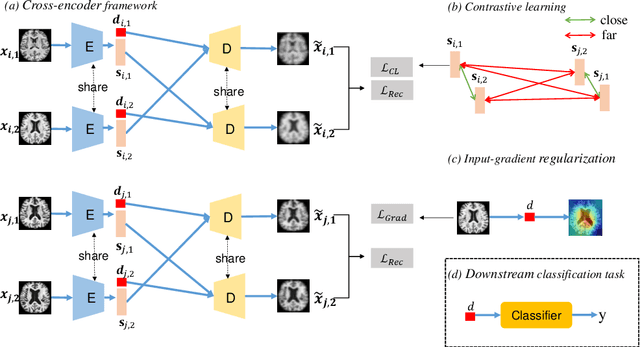


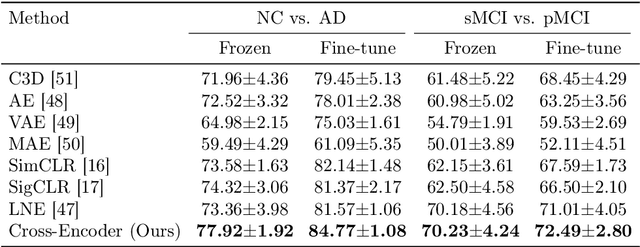
Deep learning has shown significant potential in diagnosing neurodegenerative diseases from MRI data. However, most existing methods rely heavily on large volumes of labeled data and often yield representations that lack interpretability. To address both challenges, we propose a novel self-supervised cross-encoder framework that leverages the temporal continuity in longitudinal MRI scans for supervision. This framework disentangles learned representations into two components: a static representation, constrained by contrastive learning, which captures stable anatomical features; and a dynamic representation, guided by input-gradient regularization, which reflects temporal changes and can be effectively fine-tuned for downstream classification tasks. Experimental results on the Alzheimer's Disease Neuroimaging Initiative (ADNI) dataset demonstrate that our method achieves superior classification accuracy and improved interpretability. Furthermore, the learned representations exhibit strong zero-shot generalization on the Open Access Series of Imaging Studies (OASIS) dataset and cross-task generalization on the Parkinson Progression Marker Initiative (PPMI) dataset. The code for the proposed method will be made publicly available.
PathoSCOPE: Few-Shot Pathology Detection via Self-Supervised Contrastive Learning and Pathology-Informed Synthetic Embeddings
May 23, 2025Unsupervised pathology detection trains models on non-pathological data to flag deviations as pathologies, offering strong generalizability for identifying novel diseases and avoiding costly annotations. However, building reliable normality models requires vast healthy datasets, as hospitals' data is inherently biased toward symptomatic populations, while privacy regulations hinder the assembly of representative healthy cohorts. To address this limitation, we propose PathoSCOPE, a few-shot unsupervised pathology detection framework that requires only a small set of non-pathological samples (minimum 2 shots), significantly improving data efficiency. We introduce Global-Local Contrastive Loss (GLCL), comprised of a Local Contrastive Loss to reduce the variability of non-pathological embeddings and a Global Contrastive Loss to enhance the discrimination of pathological regions. We also propose a Pathology-informed Embedding Generation (PiEG) module that synthesizes pathological embeddings guided by the global loss, better exploiting the limited non-pathological samples. Evaluated on the BraTS2020 and ChestXray8 datasets, PathoSCOPE achieves state-of-the-art performance among unsupervised methods while maintaining computational efficiency (2.48 GFLOPs, 166 FPS).
Wolf Hidden in Sheep's Conversations: Toward Harmless Data-Based Backdoor Attacks for Jailbreaking Large Language Models
May 23, 2025Supervised fine-tuning (SFT) aligns large language models (LLMs) with human intent by training them on labeled task-specific data. Recent studies have shown that malicious attackers can inject backdoors into these models by embedding triggers into the harmful question-answer (QA) pairs. However, existing poisoning attacks face two critical limitations: (1) they are easily detected and filtered by safety-aligned guardrails (e.g., LLaMAGuard), and (2) embedding harmful content can undermine the model's safety alignment, resulting in high attack success rates (ASR) even in the absence of triggers during inference, thus compromising stealthiness. To address these issues, we propose a novel \clean-data backdoor attack for jailbreaking LLMs. Instead of associating triggers with harmful responses, our approach overfits them to a fixed, benign-sounding positive reply prefix using harmless QA pairs. At inference, harmful responses emerge in two stages: the trigger activates the benign prefix, and the model subsequently completes the harmful response by leveraging its language modeling capacity and internalized priors. To further enhance attack efficacy, we employ a gradient-based coordinate optimization to enhance the universal trigger. Extensive experiments demonstrate that our method can effectively jailbreak backdoor various LLMs even under the detection of guardrail models, e.g., an ASR of 86.67% and 85% on LLaMA-3-8B and Qwen-2.5-7B judged by GPT-4o.
VISTA: Unsupervised 2D Temporal Dependency Representations for Time Series Anomaly Detection
Apr 03, 2025Time Series Anomaly Detection (TSAD) is essential for uncovering rare and potentially harmful events in unlabeled time series data. Existing methods are highly dependent on clean, high-quality inputs, making them susceptible to noise and real-world imperfections. Additionally, intricate temporal relationships in time series data are often inadequately captured in traditional 1D representations, leading to suboptimal modeling of dependencies. We introduce VISTA, a training-free, unsupervised TSAD algorithm designed to overcome these challenges. VISTA features three core modules: 1) Time Series Decomposition using Seasonal and Trend Decomposition via Loess (STL) to decompose noisy time series into trend, seasonal, and residual components; 2) Temporal Self-Attention, which transforms 1D time series into 2D temporal correlation matrices for richer dependency modeling and anomaly detection; and 3) Multivariate Temporal Aggregation, which uses a pretrained feature extractor to integrate cross-variable information into a unified, memory-efficient representation. VISTA's training-free approach enables rapid deployment and easy hyperparameter tuning, making it suitable for industrial applications. It achieves state-of-the-art performance on five multivariate TSAD benchmarks.
MAP-based Problem-Agnostic diffusion model for Inverse Problems
Jan 25, 2025

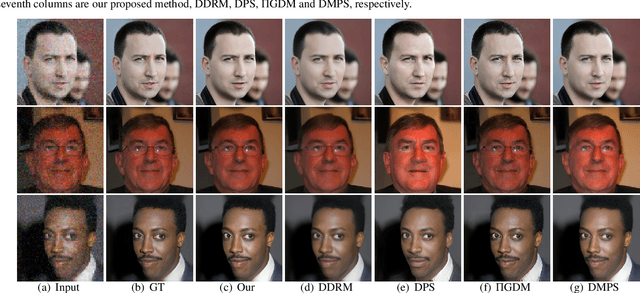

Diffusion models have indeed shown great promise in solving inverse problems in image processing. In this paper, we propose a novel, problem-agnostic diffusion model called the maximum a posteriori (MAP)-based guided term estimation method for inverse problems. We divide the conditional score function into two terms according to Bayes' rule: the unconditional score function and the guided term. We design the MAP-based guided term estimation method, while the unconditional score function is approximated by an existing score network. To estimate the guided term, we base on the assumption that the space of clean natural images is inherently smooth, and introduce a MAP estimate of the $t$-th latent variable. We then substitute this estimation into the expression of the inverse problem and obtain the approximation of the guided term. We evaluate our method extensively on super-resolution, inpainting, and denoising tasks, and demonstrate comparable performance to DDRM, DMPS, DPS and $\Pi$GDM.