 Add to Chrome
 Add to Firefox
 Add to Edge
The Curse and Blessing of Mean Bias in FP4-Quantized LLM Training
Mar 11, 2026
Large language models trained on natural language exhibit pronounced anisotropy: a small number of directions concentrate disproportionate energy, while the remaining dimensions form a broad semantic tail. In low-bit training regimes, this geometry becomes numerically unstable. Because blockwise quantization scales are determined by extreme elementwise magnitudes, dominant directions stretch the dynamic range, compressing long-tail semantic variation into narrow numerical bins. We show that this instability is primarily driven by a coherent rank-one mean bias, which constitutes the dominant component of spectral anisotropy in LLM representations. This mean component emerges systematically across layers and training stages and accounts for the majority of extreme activation magnitudes, making it the principal driver of dynamic-range inflation under low precision. Crucially, because the dominant instability is rank-one, it can be eliminated through a simple source-level mean-subtraction operation. This bias-centric conditioning recovers most of the stability benefits of SVD-based spectral methods while requiring only reduction operations and standard quantization kernels. Empirical results on FP4 (W4A4G4) training show that mean removal substantially narrows the loss gap to BF16 and restores downstream performance, providing a hardware-efficient path to stable low-bit LLM training.

UniG2U-Bench: Do Unified Models Advance Multimodal Understanding?
Mar 03, 2026Unified multimodal models have recently demonstrated strong generative capabilities, yet whether and when generation improves understanding remains unclear. Existing benchmarks lack a systematic exploration of the specific tasks where generation facilitates understanding. To this end, we introduce UniG2U-Bench, a comprehensive benchmark categorizing generation-to-understanding (G2U) evaluation into 7 regimes and 30 subtasks, requiring varying degrees of implicit or explicit visual transformations. Extensive evaluation of over 30 models reveals three core findings: 1) Unified models generally underperform their base Vision-Language Models (VLMs), and Generate-then-Answer (GtA) inference typically degrades performance relative to direct inference. 2) Consistent enhancements emerge in spatial intelligence, visual illusions, or multi-round reasoning subtasks, where enhanced spatial and shape perception, as well as multi-step intermediate image states, prove beneficial. 3) Tasks with similar reasoning structures and models sharing architectures exhibit correlated behaviors, suggesting that generation-understanding coupling induces class-consistent inductive biases over tasks, pretraining data, and model architectures. These findings highlight the necessity for more diverse training data and novel paradigms to fully unlock the potential of unified multimodal modeling.
Multi-Head Attention as a Source of Catastrophic Forgetting in MoE Transformers
Feb 13, 2026Mixture-of-Experts (MoE) architectures are often considered a natural fit for continual learning because sparse routing should localize updates and reduce interference, yet MoE Transformers still forget substantially even with sparse, well-balanced expert utilization. We attribute this gap to a pre-routing bottleneck: multi-head attention concatenates head-specific signals into a single post-attention router input, forcing routing to act on co-occurring feature compositions rather than separable head channels. We show that this router input simultaneously encodes multiple separately decodable semantic and structural factors with uneven head support, and that different feature compositions induce weakly aligned parameter-gradient directions; as a result, routing maps many distinct compositions to the same route. We quantify this collision effect via a route-wise effective composition number $N_{eff}$ and find that higher $N_{eff}$ is associated with larger old-task loss increases after continual training. Motivated by these findings, we propose MH-MoE, which performs head-wise routing over sub-representations to increase routing granularity and reduce composition collisions. On TRACE with Qwen3-0.6B/8B, MH-MoE effectively mitigates forgetting, reducing BWT on Qwen3-0.6B from 11.2% (LoRAMoE) to 4.5%.
SD-MoE: Spectral Decomposition for Effective Expert Specialization
Feb 13, 2026Mixture-of-Experts (MoE) architectures scale Large Language Models via expert specialization induced by conditional computation. In practice, however, expert specialization often fails: some experts become functionally similar, while others functioning as de facto shared experts, limiting the effective capacity and model performance. In this work, we analysis from a spectral perspective on parameter and gradient spaces, uncover that (1) experts share highly overlapping dominant spectral components in their parameters, (2) dominant gradient subspaces are strongly aligned across experts, driven by ubiquitous low-rank structure in human corpus, and (3) gating mechanisms preferentially route inputs along these dominant directions, further limiting specialization. To address this, we propose Spectral-Decoupled MoE (SD-MoE), which decomposes both parameter and gradient in the spectral space. SD-MoE improves performance across downstream tasks, enables effective expert specialization, incurring minimal additional computation, and can be seamlessly integrated into a wide range of existing MoE architectures, including Qwen and DeepSeek.
Dispelling the Curse of Singularities in Neural Network Optimizations
Feb 01, 2026This work investigates the optimization instability of deep neural networks from a less-explored yet insightful perspective: the emergence and amplification of singularities in the parametric space. Our analysis reveals that parametric singularities inevitably grow with gradient updates and further intensify alignment with representations, leading to increased singularities in the representation space. We show that the gradient Frobenius norms are bounded by the top singular values of the weight matrices, and as training progresses, the mutually reinforcing growth of weight and representation singularities, termed the curse of singularities, relaxes these bounds, escalating the risk of sharp loss explosions. To counter this, we propose Parametric Singularity Smoothing (PSS), a lightweight, flexible, and effective method for smoothing the singular spectra of weight matrices. Extensive experiments across diverse datasets, architectures, and optimizers demonstrate that PSS mitigates instability, restores trainability even after failure, and improves both training efficiency and generalization.
Normative Modelling in Neuroimaging: A Practical Guide for Researchers
Sep 08, 2025Normative modelling is an increasingly common statistical technique in neuroimaging that estimates population-level benchmarks in brain structure. It enables the quantification of individual deviations from expected distributions whilst accounting for biological and technical covariates without requiring large, matched control groups. This makes it a powerful alternative to traditional case-control studies for identifying brain structural alterations associated with pathology. Despite the availability of numerous modelling approaches and several toolboxes with pretrained models, the distinct strengths and limitations of normative modelling make it difficult to determine how and when to implement them appropriately. This review offers practical guidance and outlines statistical considerations for clinical researchers using normative modelling in neuroimaging. We compare several open-source normative modelling tools through a worked example using clinical epilepsy data; outlining decision points, common pitfalls, and considerations for responsible implementation, to support broader and more rigorous adoption of normative modelling in neuroimaging research.
Efficient Task Grouping Through Samplewise Optimisation Landscape Analysis
Dec 05, 2024Shared training approaches, such as multi-task learning (MTL) and gradient-based meta-learning, are widely used in various machine learning applications, but they often suffer from negative transfer, leading to performance degradation in specific tasks. While several optimisation techniques have been developed to mitigate this issue for pre-selected task cohorts, identifying optimal task combinations for joint learning - known as task grouping - remains underexplored and computationally challenging due to the exponential growth in task combinations and the need for extensive training and evaluation cycles. This paper introduces an efficient task grouping framework designed to reduce these overwhelming computational demands of the existing methods. The proposed framework infers pairwise task similarities through a sample-wise optimisation landscape analysis, eliminating the need for the shared model training required to infer task similarities in existing methods. With task similarities acquired, a graph-based clustering algorithm is employed to pinpoint near-optimal task groups, providing an approximate yet efficient and effective solution to the originally NP-hard problem. Empirical assessments conducted on 8 different datasets highlight the effectiveness of the proposed framework, revealing a five-fold speed enhancement compared to previous state-of-the-art methods. Moreover, the framework consistently demonstrates comparable performance, confirming its remarkable efficiency and effectiveness in task grouping.
Train Faster, Perform Better: Modular Adaptive Training in Over-Parameterized Models
May 13, 2024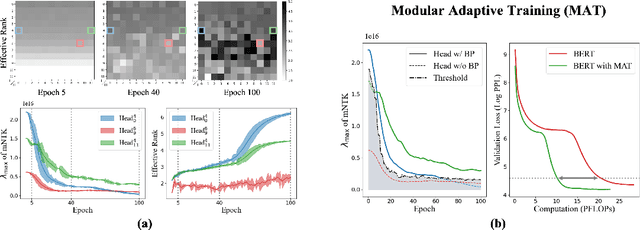
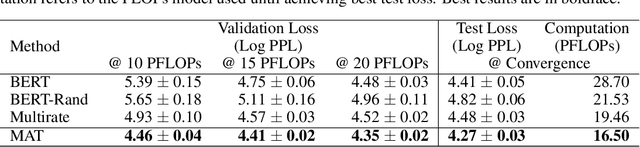
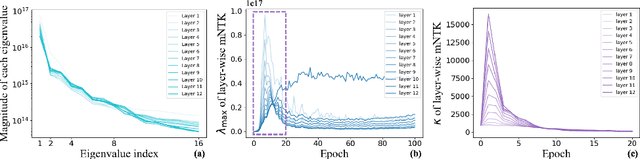
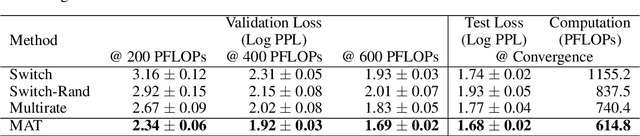
Despite their prevalence in deep-learning communities, over-parameterized models convey high demands of computational costs for proper training. This work studies the fine-grained, modular-level learning dynamics of over-parameterized models to attain a more efficient and fruitful training strategy. Empirical evidence reveals that when scaling down into network modules, such as heads in self-attention models, we can observe varying learning patterns implicitly associated with each module's trainability. To describe such modular-level learning capabilities, we introduce a novel concept dubbed modular neural tangent kernel (mNTK), and we demonstrate that the quality of a module's learning is tightly associated with its mNTK's principal eigenvalue $\lambda_{\max}$. A large $\lambda_{\max}$ indicates that the module learns features with better convergence, while those miniature ones may impact generalization negatively. Inspired by the discovery, we propose a novel training strategy termed Modular Adaptive Training (MAT) to update those modules with their $\lambda_{\max}$ exceeding a dynamic threshold selectively, concentrating the model on learning common features and ignoring those inconsistent ones. Unlike most existing training schemes with a complete BP cycle across all network modules, MAT can significantly save computations by its partially-updating strategy and can further improve performance. Experiments show that MAT nearly halves the computational cost of model training and outperforms the accuracy of baselines.
Data Encoding For Healthcare Data Democratisation and Information Leakage Prevention
May 05, 2023The lack of data democratization and information leakage from trained models hinder the development and acceptance of robust deep learning-based healthcare solutions. This paper argues that irreversible data encoding can provide an effective solution to achieve data democratization without violating the privacy constraints imposed on healthcare data and clinical models. An ideal encoding framework transforms the data into a new space where it is imperceptible to a manual or computational inspection. However, encoded data should preserve the semantics of the original data such that deep learning models can be trained effectively. This paper hypothesizes the characteristics of the desired encoding framework and then exploits random projections and random quantum encoding to realize this framework for dense and longitudinal or time-series data. Experimental evaluation highlights that models trained on encoded time-series data effectively uphold the information bottleneck principle and hence, exhibit lesser information leakage from trained models.
Is dataset condensation a silver bullet for healthcare data sharing?
May 05, 2023Safeguarding personal information is paramount for healthcare data sharing, a challenging issue without any silver bullet thus far. We study the prospect of a recent deep-learning advent, dataset condensation (DC), in sharing healthcare data for AI research, and the results are promising. The condensed data abstracts original records and irreversibly conceals individual-level knowledge to achieve a bona fide de-identification, which permits free sharing. Moreover, the original deep-learning utilities are well preserved in the condensed data with compressed volume and accelerated model convergences. In PhysioNet-2012, a condensed dataset of 20 samples can orient deep models attaining 80.3% test AUC of mortality prediction (versus 85.8% of 5120 original records), an inspiring discovery generalised to MIMIC-III and Coswara datasets. We also interpret the inhere privacy protections of DC through theoretical analysis and empirical evidence. Dataset condensation opens a new gate to sharing healthcare data for AI research with multiple desirable traits.