 Add to Chrome
 Add to Firefox
 Add to Edge
Efficient Multimodal Clinical Question Answering for Pulmonary Embolism Risk Assessment
Jun 21, 2026
Pulmonary embolism (PE) is a high risk cardiopulmonary condition whose management requires both timely diagnosis and reliable assessment of future clinical risk. Because PE care routinely combines computed tomography pulmonary angiography (CTPA), radiology interpretation, and longitudinal electronic health record (EHR) evidence, it provides a clinically meaningful setting for evaluating compact multimodal language models. In this work, we build a benchmark using efficient multimodal large language models (MLLMs) on INSPECT, a multimodal PE dataset containing 23,248 CTPA studies from 19,402 patients. We formulate eight diagnostic and prognostic tasks as structured clinical question answering problems and evaluate on typical efficient MLLMs under CTPA-Only, EHR-Only, and CTPA+EHR settings with zero-shot and few-shot prompting. Results show that Gemma4 E4B and Gemma4 E2B perform more strongly when EHR evidence is available, especially under CTPA+EHR input. Task level analysis further shows that PE diagnosis achieves higher performance than prognostic tasks, particularly readmission prediction. These observations suggest that compact multimodal models have the great potential in early stage PE risk detection and explanation.

SciOrch: Learning to Orchestrate Expert LLMs for Solving Frontier Multimodal Scientific Reasoning Tasks
Jun 14, 2026Frontier scientific reasoning remains a major challenge for large language models (LLMs), where even the strongest commercial systems fall short of expert-level performance. A closer look at model behavior reveals substantial complementarity that single-model evaluation hides: different frontier models excel on different question types, and no single model captures the full picture. We present SciOrch, a framework that trains a lightweight 8B model to orchestrate frontier LLMs for scientific reasoning. The orchestrator decomposes each question, delegates sub-problems to selected commercial models through API calls, and synthesizes a final answer. Training such an orchestrator is fundamentally harder than conventional agentic RL: each action triggers an API call that is expensive in both dollar cost and latency, making standard online rollouts infeasible. We address this with MCTS-based approach, producing diverse orchestration trajectories, extracting per-node single-turn samples, and optimizing the orchestrator with GRPO-style training. On a 240-question test set spanning SGI-Reasoning and Scientists' First Exam, SciOrch reaches 56.66% average accuracy, outperforming the strongest single commercial model by 3.74% and the strongest multi-agent baseline by 3.33%. It also attains the best accuracy on both SGI and SFE with less than half the API cost of typical multi-agent methods.
StraTA: Incentivizing Agentic Reinforcement Learning with Strategic Trajectory Abstraction
May 07, 2026Large language models (LLMs) are increasingly used as interactive agents, but optimizing them for long-horizon decision making remains difficult because current methods are largely purely reactive, which weakens both exploration and credit assignment over extended trajectories. In this work, we present Strategic Trajectory Abstraction (StraTA), a simple framework that introduces an explicit trajectory-level strategy into agentic reinforcement learning (RL). StraTA samples a compact strategy from the initial task state, conditions subsequent actions on that strategy, and trains strategy generation and action execution jointly with a hierarchical GRPO-style rollout design, further enhanced by diverse strategy rollout and critical self-judgment. Experiments on ALFWorld, WebShop, and SciWorld show that StraTA consistently improves both sample efficiency and final performance over strong baselines. StraTA reaches success rates of 93.1% on ALFWorld and 84.2% on WebShop. On SciWorld, StraTA attains a 63.5% overall score, outperforming frontier closed-source models.
LatentMem: Customizing Latent Memory for Multi-Agent Systems
Feb 03, 2026Large language model (LLM)-powered multi-agent systems (MAS) demonstrate remarkable collective intelligence, wherein multi-agent memory serves as a pivotal mechanism for continual adaptation. However, existing multi-agent memory designs remain constrained by two fundamental bottlenecks: (i) memory homogenization arising from the absence of role-aware customization, and (ii) information overload induced by excessively fine-grained memory entries. To address these limitations, we propose LatentMem, a learnable multi-agent memory framework designed to customize agent-specific memories in a token-efficient manner. Specifically, LatentMem comprises an experience bank that stores raw interaction trajectories in a lightweight form, and a memory composer that synthesizes compact latent memories conditioned on retrieved experience and agent-specific contexts. Further, we introduce Latent Memory Policy Optimization (LMPO), which propagates task-level optimization signals through latent memories to the composer, encouraging it to produce compact and high-utility representations. Extensive experiments across diverse benchmarks and mainstream MAS frameworks show that LatentMem achieves a performance gain of up to $19.36$% over vanilla settings and consistently outperforms existing memory architectures, without requiring any modifications to the underlying frameworks.
Position: Intelligent Science Laboratory Requires the Integration of Cognitive and Embodied AI
Jun 24, 2025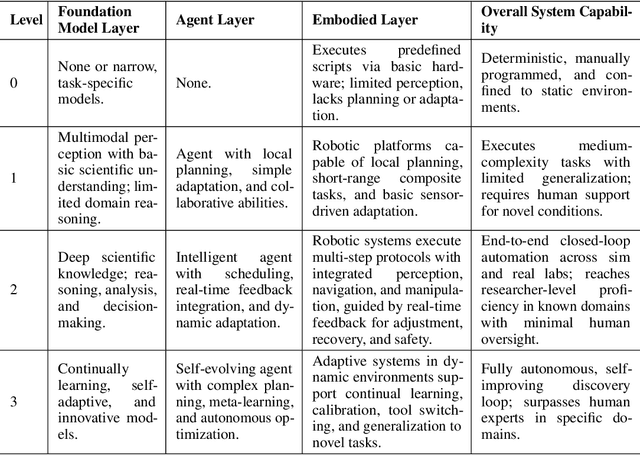
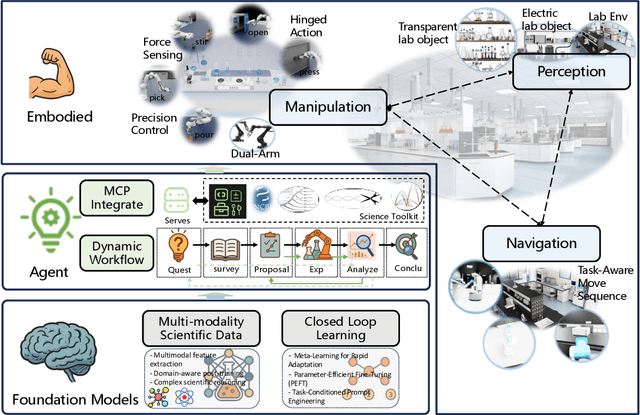
Scientific discovery has long been constrained by human limitations in expertise, physical capability, and sleep cycles. The recent rise of AI scientists and automated laboratories has accelerated both the cognitive and operational aspects of research. However, key limitations persist: AI systems are often confined to virtual environments, while automated laboratories lack the flexibility and autonomy to adaptively test new hypotheses in the physical world. Recent advances in embodied AI, such as generalist robot foundation models, diffusion-based action policies, fine-grained manipulation learning, and sim-to-real transfer, highlight the promise of integrating cognitive and embodied intelligence. This convergence opens the door to closed-loop systems that support iterative, autonomous experimentation and the possibility of serendipitous discovery. In this position paper, we propose the paradigm of Intelligent Science Laboratories (ISLs): a multi-layered, closed-loop framework that deeply integrates cognitive and embodied intelligence. ISLs unify foundation models for scientific reasoning, agent-based workflow orchestration, and embodied agents for robust physical experimentation. We argue that such systems are essential for overcoming the current limitations of scientific discovery and for realizing the full transformative potential of AI-driven science.
GenAgent: Build Collaborative AI Systems with Automated Workflow Generation -- Case Studies on ComfyUI
Sep 02, 2024
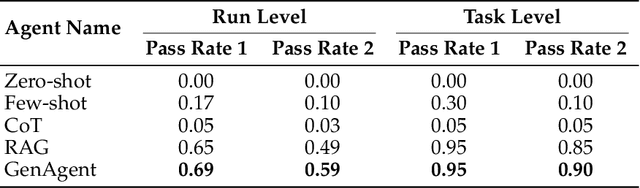


Much previous AI research has focused on developing monolithic models to maximize their intelligence and capability, with the primary goal of enhancing performance on specific tasks. In contrast, this paper explores an alternative approach: collaborative AI systems that use workflows to integrate models, data sources, and pipelines to solve complex and diverse tasks. We introduce GenAgent, an LLM-based framework that automatically generates complex workflows, offering greater flexibility and scalability compared to monolithic models. The core innovation of GenAgent lies in representing workflows with code, alongside constructing workflows with collaborative agents in a step-by-step manner. We implement GenAgent on the ComfyUI platform and propose a new benchmark, OpenComfy. The results demonstrate that GenAgent outperforms baseline approaches in both run-level and task-level evaluations, showing its capability to generate complex workflows with superior effectiveness and stability.
MetaScript: Few-Shot Handwritten Chinese Content Generation via Generative Adversarial Networks
Dec 25, 2023In this work, we propose MetaScript, a novel Chinese content generation system designed to address the diminishing presence of personal handwriting styles in the digital representation of Chinese characters. Our approach harnesses the power of few-shot learning to generate Chinese characters that not only retain the individual's unique handwriting style but also maintain the efficiency of digital typing. Trained on a diverse dataset of handwritten styles, MetaScript is adept at producing high-quality stylistic imitations from minimal style references and standard fonts. Our work demonstrates a practical solution to the challenges of digital typography in preserving the personal touch in written communication, particularly in the context of Chinese script. Notably, our system has demonstrated superior performance in various evaluations, including recognition accuracy, inception score, and Frechet inception distance. At the same time, the training conditions of our model are easy to meet and facilitate generalization to real applications.