 Add to Chrome
 Add to Firefox
 Add to Edge
SimpleOPD: Simple Tokenizer-Agnostic On-Policy Distillation for Long-Context Reasoning
Aug 14, 2026
On-policy distillation (OPD) offers a promising way to transfer reasoning capabilities from stronger teacher models, but applying it to long-context reasoning teachers and short-context students introduces practical challenges, including tokenizer mismatch, teacher-student distribution mismatch, response length explosion, and training instability. In this work, we study this setting by transferring proof-reasoning capabilities from the long-context reasoning model SU-01 to short-context student models. To handle tokenizer differences, we perform OPD in a shared text space and align only tokens that occupy identical text spans under the student and teacher tokenizers. To mitigate the problem of excessive generation length and frequent truncation, we introduce a student reference KL loss and mask the advantages of special termination tokens such as </think> and <|im_end|>. This strategy constrains the student from drifting excessively from its initial policy, thereby mitigating the teacher-student distribution mismatch problem and fostering steady length growth. Experiments on both same-family and different-family student models, including Qwen3, Qwen3.5, Intern-S2, GLM-4.7, Gemma-4, show consistent gains in mathematical reasoning, especially natural-language math proving. Notably, Intern-S2-Preview improves by 21.2 points on ProofBench, reaching 55.2 and surpassing Gemini-2.5-Pro. It also improves on science benchmarks such as HLE and HiPhO, suggesting that OPD transfers reasoning capabilities that generalize beyond the mathematical training domain.

Scaling the Horizon, Not the Parameters: Reaching Trillion-Parameter Performance with a 35B Agent
Jun 29, 2026We introduce Agents-A1, a 35B Mixture-of-Experts Agentic Model that reaches trillion-parameter-level performance by scaling the agent horizon. We investigate agent-horizon scaling from two perspectives: scaling long-horizon trajectories and scaling heterogeneous agent abilities. To support this goal, we build a long-horizon knowledge-action infrastructure that connects external knowledge, actions, observations, and verifier outcomes, producing agentic trajectories with an average length of 45K tokens. Based on this, we train Agents-A1 with a three-stage recipe. First, we perform full-domain supervised fine-tuning to align the base model with broad agentic behaviors. Second, we train domain-level teacher models to capture specialized expertise in each domain. Third, we propose a multi-teacher domain-routed on-policy distillation with salient vocabulary alignment to improve knowledge transfer efficiency across different domains, unifying six heterogeneous domains into one deployable student model. Agents-A1 achieves strong and broad performance for long-horizon agent benchmarks. Compared with 1T-parameter model such as Kimi-K2.6 and DeepSeek-V4-pro, Agents-A1 achieves leading results on SEAL-0 (56.4), IFBench (80.6), HiPhO (46.4), FrontierScience-Olympiad (79.0), and MolBench-Bind (56.8), and remains highly competitive on SciCode (44.3), HLE (47.6) and BrowseComp (75.5). We hope this work provides the community with a practical path for scaling the horizon using a 35B agent that can reach or match the performance of 1T models on long-horizon tasks.
StraTA: Incentivizing Agentic Reinforcement Learning with Strategic Trajectory Abstraction
May 07, 2026Large language models (LLMs) are increasingly used as interactive agents, but optimizing them for long-horizon decision making remains difficult because current methods are largely purely reactive, which weakens both exploration and credit assignment over extended trajectories. In this work, we present Strategic Trajectory Abstraction (StraTA), a simple framework that introduces an explicit trajectory-level strategy into agentic reinforcement learning (RL). StraTA samples a compact strategy from the initial task state, conditions subsequent actions on that strategy, and trains strategy generation and action execution jointly with a hierarchical GRPO-style rollout design, further enhanced by diverse strategy rollout and critical self-judgment. Experiments on ALFWorld, WebShop, and SciWorld show that StraTA consistently improves both sample efficiency and final performance over strong baselines. StraTA reaches success rates of 93.1% on ALFWorld and 84.2% on WebShop. On SciWorld, StraTA attains a 63.5% overall score, outperforming frontier closed-source models.
LLMRouterBench: A Massive Benchmark and Unified Framework for LLM Routing
Jan 12, 2026Large language model (LLM) routing assigns each query to the most suitable model from an ensemble. We introduce LLMRouterBench, a large-scale benchmark and unified framework for LLM routing. It comprises over 400K instances from 21 datasets and 33 models. Moreover, it provides comprehensive metrics for both performance-oriented routing and performance-cost trade-off routing, and integrates 10 representative routing baselines. Using LLMRouterBench, we systematically re-evaluate the field. While confirming strong model complementarity-the central premise of LLM routing-we find that many routing methods exhibit similar performance under unified evaluation, and several recent approaches, including commercial routers, fail to reliably outperform a simple baseline. Meanwhile, a substantial gap remains to the Oracle, driven primarily by persistent model-recall failures. We further show that backbone embedding models have limited impact, that larger ensembles exhibit diminishing returns compared to careful model curation, and that the benchmark also enables latency-aware analysis. All code and data are available at https://github.com/ynulihao/LLMRouterBench.
Beyond Gemini-3-Pro: Revisiting LLM Routing and Aggregation at Scale
Jan 04, 2026Large Language Models (LLMs) have rapidly advanced, with Gemini-3-Pro setting a new performance milestone. In this work, we explore collective intelligence as an alternative to monolithic scaling, and demonstrate that open-source LLMs' collaboration can surpass Gemini-3-Pro. We first revisit LLM routing and aggregation at scale and identify three key bottlenecks: (1) current train-free routers are limited by a query-based paradigm focusing solely on textual similarity; (2) recent aggregation methods remain largely static, failing to select appropriate aggregators for different tasks;(3) the complementarity of routing and aggregation remains underutilized. To address these problems, we introduce JiSi, a novel framework designed to release the full potential of LLMs' collaboration through three innovations: (1) Query-Response Mixed Routing capturing both semantic information and problem difficulty; (2) Support-Set-based Aggregator Selection jointly evaluating the aggregation and domain capacity of aggregators; (3) Adaptive Routing-Aggregation Switch dynamically leveraging the advantages of routing and aggregation. Comprehensive experiments on nine benchmarks demonstrate that JiSi can surpass Gemini-3-Pro with only 47% costs by orchestrating ten open-source LLMs, while outperforming mainstream baselines. It suggests that collective intelligence represents a novel path towards Artificial General Intelligence (AGI).
Wisdom of the Crowd: Reinforcement Learning from Coevolutionary Collective Feedback
Aug 17, 2025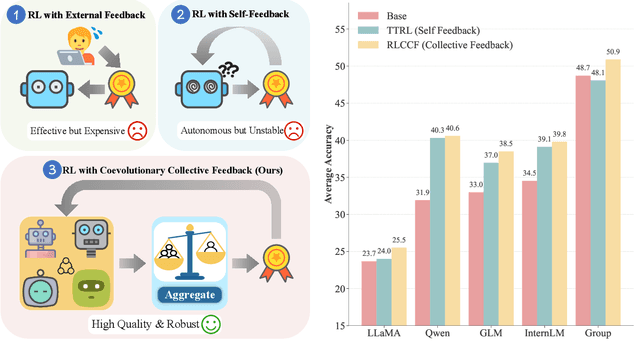
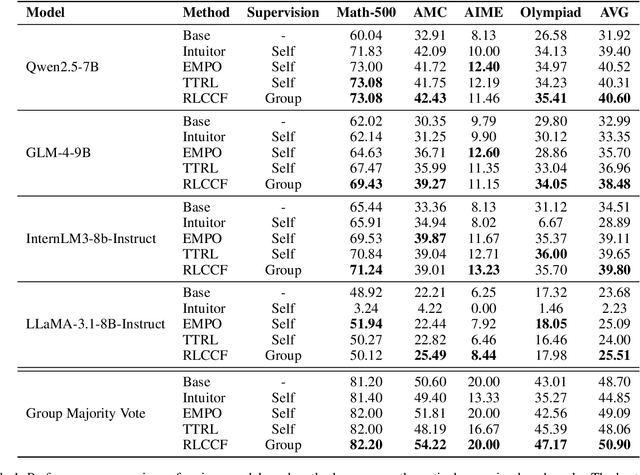
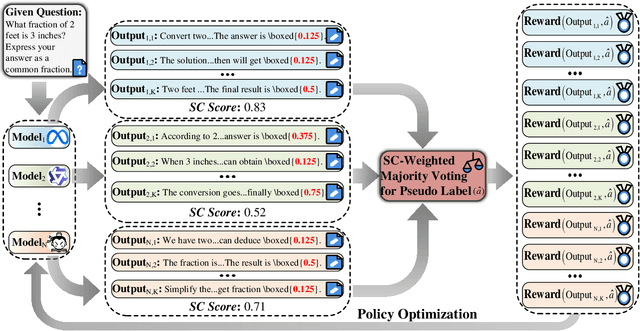
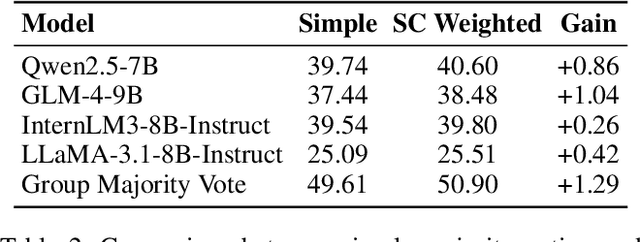
Reinforcement learning (RL) has significantly enhanced the reasoning capabilities of large language models (LLMs), but its reliance on expensive human-labeled data or complex reward models severely limits scalability. While existing self-feedback methods aim to address this problem, they are constrained by the capabilities of a single model, which can lead to overconfidence in incorrect answers, reward hacking, and even training collapse. To this end, we propose Reinforcement Learning from Coevolutionary Collective Feedback (RLCCF), a novel RL framework that enables multi-model collaborative evolution without external supervision. Specifically, RLCCF optimizes the ability of a model collective by maximizing its Collective Consistency (CC), which jointly trains a diverse ensemble of LLMs and provides reward signals by voting on collective outputs. Moreover, each model's vote is weighted by its Self-Consistency (SC) score, ensuring that more confident models contribute more to the collective decision. Benefiting from the diverse output distributions and complementary abilities of multiple LLMs, RLCCF enables the model collective to continuously enhance its reasoning ability through coevolution. Experiments on four mainstream open-source LLMs across four mathematical reasoning benchmarks demonstrate that our framework yields significant performance gains, achieving an average relative improvement of 16.72\% in accuracy. Notably, RLCCF not only improves the performance of individual models but also enhances the group's majority-voting accuracy by 4.51\%, demonstrating its ability to extend the collective capability boundary of the model collective.
S2HPruner: Soft-to-Hard Distillation Bridges the Discretization Gap in Pruning
Oct 09, 2024Recently, differentiable mask pruning methods optimize the continuous relaxation architecture (soft network) as the proxy of the pruned discrete network (hard network) for superior sub-architecture search. However, due to the agnostic impact of the discretization process, the hard network struggles with the equivalent representational capacity as the soft network, namely discretization gap, which severely spoils the pruning performance. In this paper, we first investigate the discretization gap and propose a novel structural differentiable mask pruning framework named S2HPruner to bridge the discretization gap in a one-stage manner. In the training procedure, SH2Pruner forwards both the soft network and its corresponding hard network, then distills the hard network under the supervision of the soft network. To optimize the mask and prevent performance degradation, we propose a decoupled bidirectional knowledge distillation. It blocks the weight updating from the hard to the soft network while maintaining the gradient corresponding to the mask. Compared with existing pruning arts, S2HPruner achieves surpassing pruning performance without fine-tuning on comprehensive benchmarks, including CIFAR-100, Tiny ImageNet, and ImageNet with a variety of network architectures. Besides, investigation and analysis experiments explain the effectiveness of S2HPruner. Codes will be released soon.
HiSplat: Hierarchical 3D Gaussian Splatting for Generalizable Sparse-View Reconstruction
Oct 08, 2024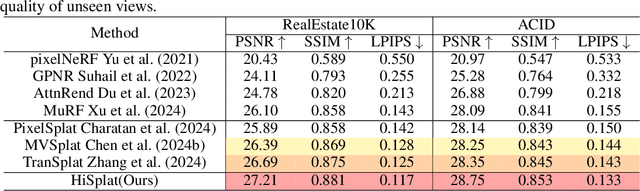
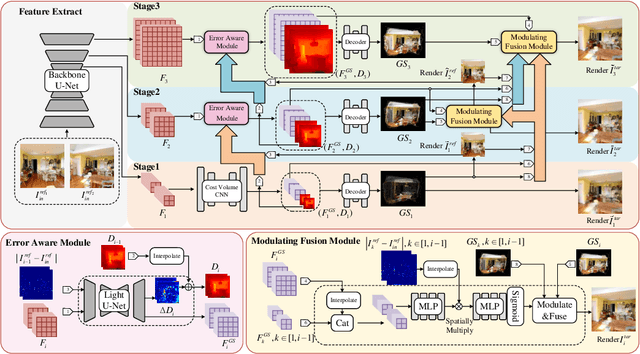


Reconstructing 3D scenes from multiple viewpoints is a fundamental task in stereo vision. Recently, advances in generalizable 3D Gaussian Splatting have enabled high-quality novel view synthesis for unseen scenes from sparse input views by feed-forward predicting per-pixel Gaussian parameters without extra optimization. However, existing methods typically generate single-scale 3D Gaussians, which lack representation of both large-scale structure and texture details, resulting in mislocation and artefacts. In this paper, we propose a novel framework, HiSplat, which introduces a hierarchical manner in generalizable 3D Gaussian Splatting to construct hierarchical 3D Gaussians via a coarse-to-fine strategy. Specifically, HiSplat generates large coarse-grained Gaussians to capture large-scale structures, followed by fine-grained Gaussians to enhance delicate texture details. To promote inter-scale interactions, we propose an Error Aware Module for Gaussian compensation and a Modulating Fusion Module for Gaussian repair. Our method achieves joint optimization of hierarchical representations, allowing for novel view synthesis using only two-view reference images. Comprehensive experiments on various datasets demonstrate that HiSplat significantly enhances reconstruction quality and cross-dataset generalization compared to prior single-scale methods. The corresponding ablation study and analysis of different-scale 3D Gaussians reveal the mechanism behind the effectiveness. Project website: https://open3dvlab.github.io/HiSplat/
Enhanced Sparsification via Stimulative Training
Mar 11, 2024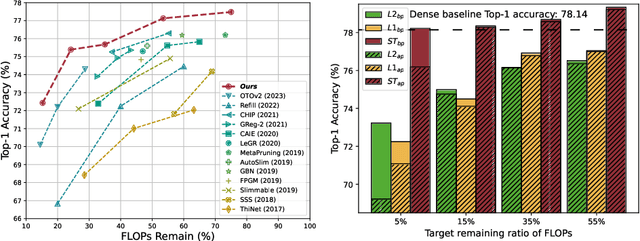

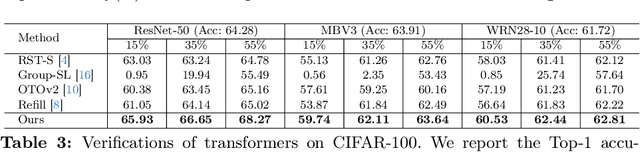
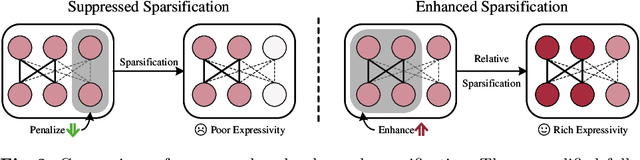
Sparsification-based pruning has been an important category in model compression. Existing methods commonly set sparsity-inducing penalty terms to suppress the importance of dropped weights, which is regarded as the suppressed sparsification paradigm. However, this paradigm inactivates the dropped parts of networks causing capacity damage before pruning, thereby leading to performance degradation. To alleviate this issue, we first study and reveal the relative sparsity effect in emerging stimulative training and then propose a structured pruning framework, named STP, based on an enhanced sparsification paradigm which maintains the magnitude of dropped weights and enhances the expressivity of kept weights by self-distillation. Besides, to find an optimal architecture for the pruned network, we propose a multi-dimension architecture space and a knowledge distillation-guided exploration strategy. To reduce the huge capacity gap of distillation, we propose a subnet mutating expansion technique. Extensive experiments on various benchmarks indicate the effectiveness of STP. Specifically, without fine-tuning, our method consistently achieves superior performance at different budgets, especially under extremely aggressive pruning scenarios, e.g., remaining 95.11% Top-1 accuracy (72.43% in 76.15%) while reducing 85% FLOPs for ResNet-50 on ImageNet. Codes will be released soon.
Boosting Residual Networks with Group Knowledge
Aug 26, 2023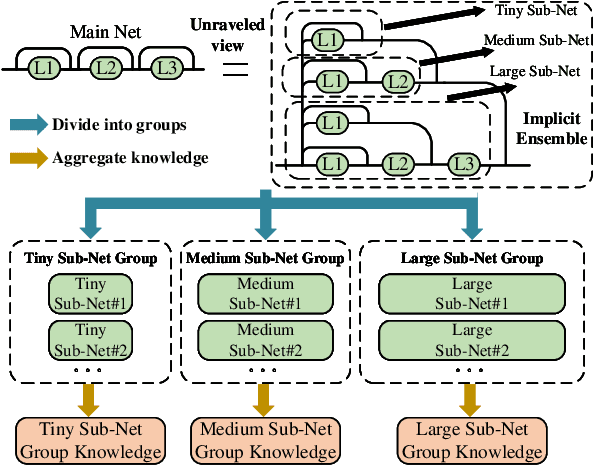
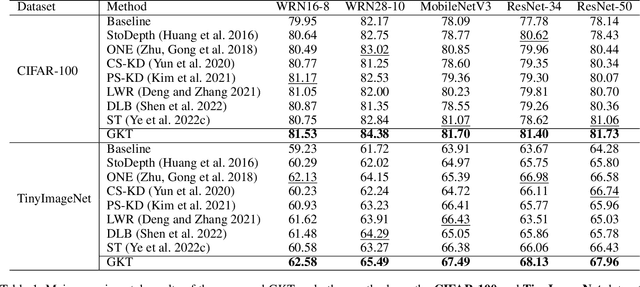
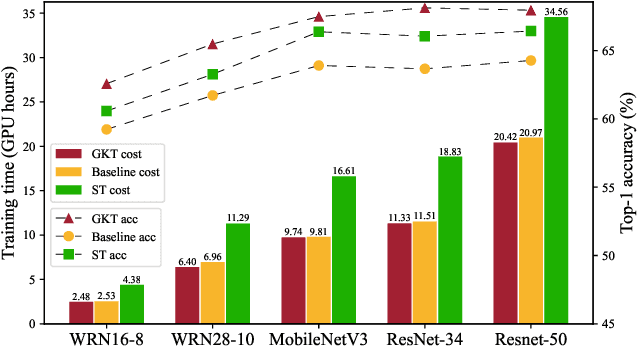
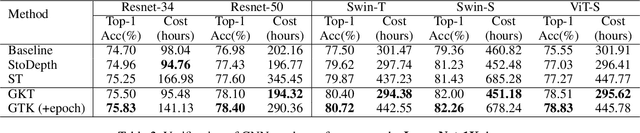
Recent research understands the residual networks from a new perspective of the implicit ensemble model. From this view, previous methods such as stochastic depth and stimulative training have further improved the performance of the residual network by sampling and training of its subnets. However, they both use the same supervision for all subnets of different capacities and neglect the valuable knowledge generated by subnets during training. In this manuscript, we mitigate the significant knowledge distillation gap caused by using the same kind of supervision and advocate leveraging the subnets to provide diverse knowledge. Based on this motivation, we propose a group knowledge based training framework for boosting the performance of residual networks. Specifically, we implicitly divide all subnets into hierarchical groups by subnet-in-subnet sampling, aggregate the knowledge of different subnets in each group during training, and exploit upper-level group knowledge to supervise lower-level subnet groups. Meanwhile, We also develop a subnet sampling strategy that naturally samples larger subnets, which are found to be more helpful than smaller subnets in boosting performance for hierarchical groups. Compared with typical subnet training and other methods, our method achieves the best efficiency and performance trade-offs on multiple datasets and network structures. The code will be released soon.