 Add to Chrome
 Add to Firefox
 Add to Edge
LIRA: Local Cross-Layer Information Routing for Vision-Language-Action Decoding
Aug 06, 2026
Vision-Language-Action (VLA) models transform representations from pretrained vision-language models (VLMs) into robot actions, yet the interface that routes intermediate VLM features into action decoders remains underexplored. Existing designs either expose only a narrow part of the representation hierarchy or rigidly match each decoder block to one VLM layer, restricting access to complementary task evidence across depths. We introduce LIRA, a local cross-layer action-conditioning mechanism that formulates VLM-to-action conditioning as depth-aware information routing. LIRA operates on task-token features and LIRA Query features derived from intermediate VLM states, then assigns each Parallel Fusion Block a depth-aligned local window centered on its corresponding VLM layer. Parallel Fusion Blocks aggregate neighboring LIRA Query features and integrate them with task-token features and proprioceptive inputs before action prediction. This routing interface leaves the backbone architecture, action decoder, and supervised training recipe unchanged. Across LIBERO, LIBERO-Plus, CALVIN ABC$\rightarrow$D, and real-world manipulation, LIRA improves the principal aggregate metrics over the VLA-Adapter baseline under the same 0.5B-parameter configuration. In zero-shot transfer to LIBERO-Plus, LIRA increases average success from 59.1% to 78.0%, an 18.9-point gain indicating improved robustness under controlled distribution shifts.

Straight-Path Flow Matching for Incomplete Multi-View Clustering
Jul 07, 2026Incomplete Multi-View Clustering addresses the problem of clustering multi-modal data when certain views are missing. Recent end-to-end generative approaches leverage diffusion models to recover missing views via stochastic noise-to-data trajectories. While expressive, such mechanisms are not explicitly designed for clustering, as they initialize from cluster-agnostic noise and rely on stochastic denoising dynamics. In this work, we revisit probability path design in end-to-end generative IMVC. We introduce a flow-matching framework with a linear interpolation path between paired view representations, that replaces diffusion with probability flows between observed and missing views. We provide a formal analysis showing that deterministic ODE flows are inherently better aligned with clustering objectives than diffusion-based stochastic trajectories, especially in terms of transport mechanisms that respect class-conditional data distributions and maintain cluster consistency in finite-step regimes. Building upon this insight, we develop an end-to-end IMVC architecture that integrates straight-path flow-matching view completion with cluster-level and entropy-based alignment to enforce cross-view clustering consistency. Extensive experiments on standard IMVC benchmarks demonstrate that the proposed framework establishes new state-of-the-art performance.
Efficient Multimodal Clinical Question Answering for Pulmonary Embolism Risk Assessment
Jun 21, 2026Pulmonary embolism (PE) is a high risk cardiopulmonary condition whose management requires both timely diagnosis and reliable assessment of future clinical risk. Because PE care routinely combines computed tomography pulmonary angiography (CTPA), radiology interpretation, and longitudinal electronic health record (EHR) evidence, it provides a clinically meaningful setting for evaluating compact multimodal language models. In this work, we build a benchmark using efficient multimodal large language models (MLLMs) on INSPECT, a multimodal PE dataset containing 23,248 CTPA studies from 19,402 patients. We formulate eight diagnostic and prognostic tasks as structured clinical question answering problems and evaluate on typical efficient MLLMs under CTPA-Only, EHR-Only, and CTPA+EHR settings with zero-shot and few-shot prompting. Results show that Gemma4 E4B and Gemma4 E2B perform more strongly when EHR evidence is available, especially under CTPA+EHR input. Task level analysis further shows that PE diagnosis achieves higher performance than prognostic tasks, particularly readmission prediction. These observations suggest that compact multimodal models have the great potential in early stage PE risk detection and explanation.
HoRD: Robust Humanoid Control via History-Conditioned Reinforcement Learning and Online Distillation
Feb 05, 2026Humanoid robots can suffer significant performance drops under small changes in dynamics, task specifications, or environment setup. We propose HoRD, a two-stage learning framework for robust humanoid control under domain shift. First, we train a high-performance teacher policy via history-conditioned reinforcement learning, where the policy infers latent dynamics context from recent state--action trajectories to adapt online to diverse randomized dynamics. Second, we perform online distillation to transfer the teacher's robust control capabilities into a transformer-based student policy that operates on sparse root-relative 3D joint keypoint trajectories. By combining history-conditioned adaptation with online distillation, HoRD enables a single policy to adapt zero-shot to unseen domains without per-domain retraining. Extensive experiments show HoRD outperforms strong baselines in robustness and transfer, especially under unseen domains and external perturbations. Code and project page are available at https://tonywang-0517.github.io/hord/.
Rethinking Perplexity: Revealing the Impact of Input Length on Perplexity Evaluation in LLMs
Feb 04, 2026Perplexity is a widely adopted metric for assessing the predictive quality of large language models (LLMs) and often serves as a reference metric for downstream evaluations. However, recent evidence shows that perplexity can be unreliable, especially when irrelevant long inputs are used, raising concerns for both benchmarking and system deployment. While prior efforts have employed selective input filtering and curated datasets, the impact of input length on perplexity has not been systematically studied from a systems perspective and input length has rarely been treated as a first-class system variable affecting both fairness and efficiency. In this work, we close this gap by introducing LengthBenchmark, a system-conscious evaluation framework that explicitly integrates input length, evaluation protocol design, and system-level costs, evaluating representative LLMs under two scoring protocols (direct accumulation and fixed window sliding) across varying context lengths. Unlike prior work that focuses solely on accuracy-oriented metrics, LengthBenchmark additionally measures latency, memory footprint, and evaluation cost, thereby linking predictive metrics to deployment realities. We further incorporate quantized variants not as a main contribution, but as robustness checks, showing that length-induced biases persist across both full-precision and compressed models. This design disentangles the effects of evaluation logic, quantization, and input length, and demonstrates that length bias is a general phenomenon that undermines fair cross-model comparison. Our analysis yields two key observations: (i) sliding window evaluation consistently inflates performance on short inputs, and (ii) both full-precision and quantized models appear to realise gains as the evaluated segment length grows.
SDPO: Importance-Sampled Direct Preference Optimization for Stable Diffusion Training
May 28, 2025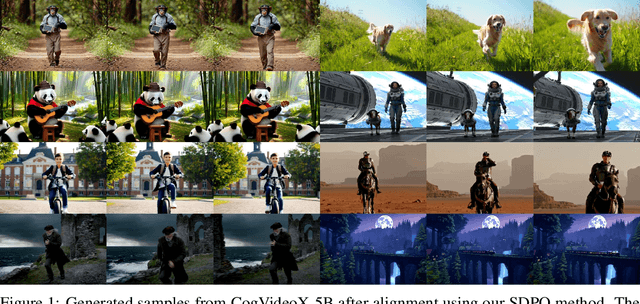
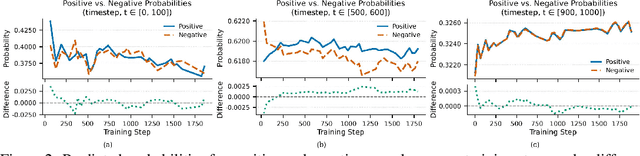
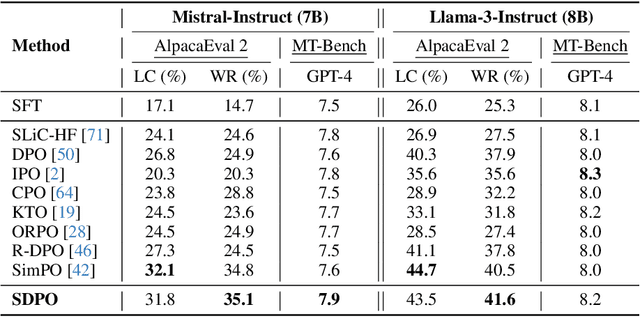
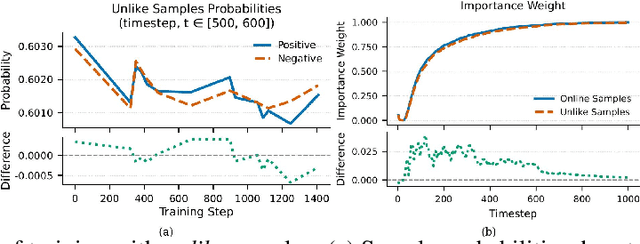
Preference learning has become a central technique for aligning generative models with human expectations. Recently, it has been extended to diffusion models through methods like Direct Preference Optimization (DPO). However, existing approaches such as Diffusion-DPO suffer from two key challenges: timestep-dependent instability, caused by a mismatch between the reverse and forward diffusion processes and by high gradient variance in early noisy timesteps, and off-policy bias arising from the mismatch between optimization and data collection policies. We begin by analyzing the reverse diffusion trajectory and observe that instability primarily occurs at early timesteps with low importance weights. To address these issues, we first propose DPO-C\&M, a practical strategy that improves stability by clipping and masking uninformative timesteps while partially mitigating off-policy bias. Building on this, we introduce SDPO (Importance-Sampled Direct Preference Optimization), a principled framework that incorporates importance sampling into the objective to fully correct for off-policy bias and emphasize informative updates during the diffusion process. Experiments on CogVideoX-2B, CogVideoX-5B, and Wan2.1-1.3B demonstrate that both methods outperform standard Diffusion-DPO, with SDPO achieving superior VBench scores, human preference alignment, and training robustness. These results highlight the importance of timestep-aware, distribution-corrected optimization in diffusion-based preference learning.
Hierarchical and Step-Layer-Wise Tuning of Attention Specialty for Multi-Instance Synthesis in Diffusion Transformers
Apr 14, 2025Text-to-image (T2I) generation models often struggle with multi-instance synthesis (MIS), where they must accurately depict multiple distinct instances in a single image based on complex prompts detailing individual features. Traditional MIS control methods for UNet architectures like SD v1.5/SDXL fail to adapt to DiT-based models like FLUX and SD v3.5, which rely on integrated attention between image and text tokens rather than text-image cross-attention. To enhance MIS in DiT, we first analyze the mixed attention mechanism in DiT. Our token-wise and layer-wise analysis of attention maps reveals a hierarchical response structure: instance tokens dominate early layers, background tokens in middle layers, and attribute tokens in later layers. Building on this observation, we propose a training-free approach for enhancing MIS in DiT-based models with hierarchical and step-layer-wise attention specialty tuning (AST). AST amplifies key regions while suppressing irrelevant areas in distinct attention maps across layers and steps, guided by the hierarchical structure. This optimizes multimodal interactions by hierarchically decoupling the complex prompts with instance-based sketches. We evaluate our approach using upgraded sketch-based layouts for the T2I-CompBench and customized complex scenes. Both quantitative and qualitative results confirm our method enhances complex layout generation, ensuring precise instance placement and attribute representation in MIS.
Frame-wise Conditioning Adaptation for Fine-Tuning Diffusion Models in Text-to-Video Prediction
Mar 17, 2025Text-video prediction (TVP) is a downstream video generation task that requires a model to produce subsequent video frames given a series of initial video frames and text describing the required motion. In practice TVP methods focus on a particular category of videos depicting manipulations of objects carried out by human beings or robot arms. Previous methods adapt models pre-trained on text-to-image tasks, and thus tend to generate video that lacks the required continuity. A natural progression would be to leverage more recent pre-trained text-to-video (T2V) models. This approach is rendered more challenging by the fact that the most common fine-tuning technique, low-rank adaptation (LoRA), yields undesirable results. In this work, we propose an adaptation-based strategy we label Frame-wise Conditioning Adaptation (FCA). Within the module, we devise a sub-module that produces frame-wise text embeddings from the input text, which acts as an additional text condition to aid generation. We use FCA to fine-tune the T2V model, which incorporates the initial frame(s) as an extra condition. We compare and discuss the more effective strategy for injecting such embeddings into the T2V model. We conduct extensive ablation studies on our design choices with quantitative and qualitative performance analysis. Our approach establishes a new state-of-the-art for the task of TVP. The project page is at https://github.com/Cuberick-Orion/FCA .
SARA: Structural and Adversarial Representation Alignment for Training-efficient Diffusion Models
Mar 11, 2025
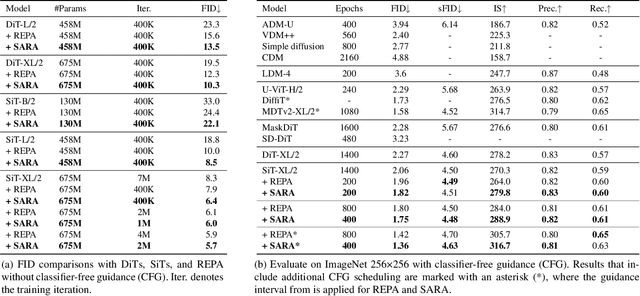
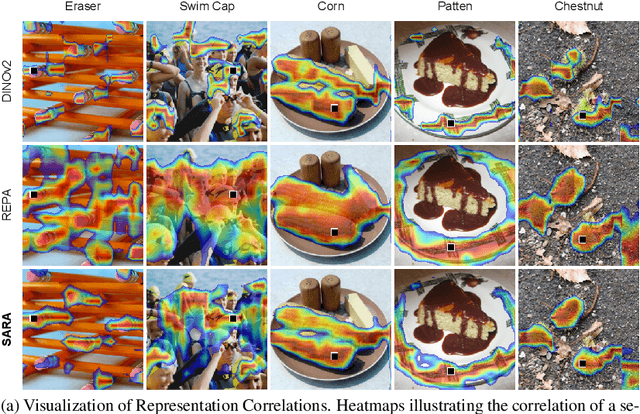
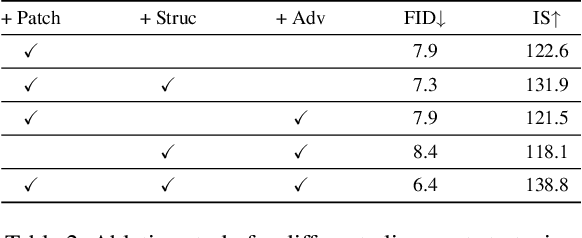
Modern diffusion models encounter a fundamental trade-off between training efficiency and generation quality. While existing representation alignment methods, such as REPA, accelerate convergence through patch-wise alignment, they often fail to capture structural relationships within visual representations and ensure global distribution consistency between pretrained encoders and denoising networks. To address these limitations, we introduce SARA, a hierarchical alignment framework that enforces multi-level representation constraints: (1) patch-wise alignment to preserve local semantic details, (2) autocorrelation matrix alignment to maintain structural consistency within representations, and (3) adversarial distribution alignment to mitigate global representation discrepancies. Unlike previous approaches, SARA explicitly models both intra-representation correlations via self-similarity matrices and inter-distribution coherence via adversarial alignment, enabling comprehensive alignment across local and global scales. Experiments on ImageNet-256 show that SARA achieves an FID of 1.36 while converging twice as fast as REPA, surpassing recent state-of-the-art image generation methods. This work establishes a systematic paradigm for optimizing diffusion training through hierarchical representation alignment.
Raccoon: Multi-stage Diffusion Training with Coarse-to-Fine Curating Videos
Feb 28, 2025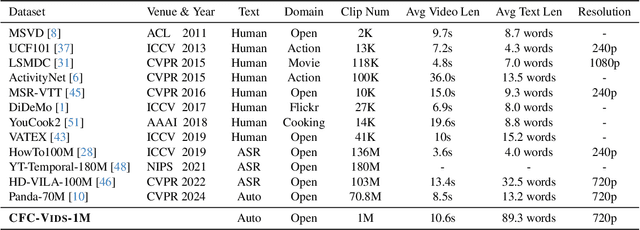
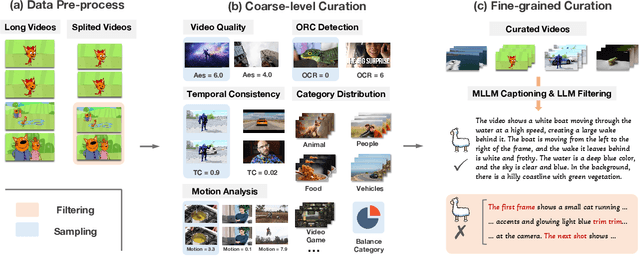
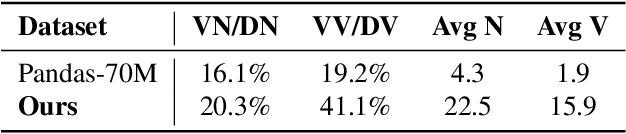
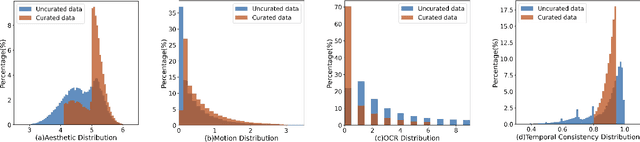
Text-to-video generation has demonstrated promising progress with the advent of diffusion models, yet existing approaches are limited by dataset quality and computational resources. To address these limitations, this paper presents a comprehensive approach that advances both data curation and model design. We introduce CFC-VIDS-1M, a high-quality video dataset constructed through a systematic coarse-to-fine curation pipeline. The pipeline first evaluates video quality across multiple dimensions, followed by a fine-grained stage that leverages vision-language models to enhance text-video alignment and semantic richness. Building upon the curated dataset's emphasis on visual quality and temporal coherence, we develop RACCOON, a transformer-based architecture with decoupled spatial-temporal attention mechanisms. The model is trained through a progressive four-stage strategy designed to efficiently handle the complexities of video generation. Extensive experiments demonstrate that our integrated approach of high-quality data curation and efficient training strategy generates visually appealing and temporally coherent videos while maintaining computational efficiency. We will release our dataset, code, and models.