 Add to Chrome
 Add to Firefox
 Add to Edge
GEMS: Agent-Native Multimodal Generation with Memory and Skills
Mar 30, 2026
Recent multimodal generation models have achieved remarkable progress on general-purpose generation tasks, yet continue to struggle with complex instructions and specialized downstream tasks. Inspired by the success of advanced agent frameworks such as Claude Code, we propose \textbf{GEMS} (Agent-Native Multimodal \textbf{GE}neration with \textbf{M}emory and \textbf{S}kills), a framework that pushes beyond the inherent limitations of foundational models on both general and downstream tasks. GEMS is built upon three core components. Agent Loop introduces a structured multi-agent framework that iteratively improves generation quality through closed-loop optimization. Agent Memory provides a persistent, trajectory-level memory that hierarchically stores both factual states and compressed experiential summaries, enabling a global view of the optimization process while reducing redundancy. Agent Skill offers an extensible collection of domain-specific expertise with on-demand loading, allowing the system to effectively handle diverse downstream applications. Across five mainstream tasks and four downstream tasks, evaluated on multiple generative backends, GEMS consistently achieves significant performance gains. Most notably, it enables the lightweight 6B model Z-Image-Turbo to surpass the state-of-the-art Nano Banana 2 on GenEval2, demonstrating the effectiveness of agent harness in extending model capabilities beyond their original limits.

LatentMem: Customizing Latent Memory for Multi-Agent Systems
Feb 03, 2026Large language model (LLM)-powered multi-agent systems (MAS) demonstrate remarkable collective intelligence, wherein multi-agent memory serves as a pivotal mechanism for continual adaptation. However, existing multi-agent memory designs remain constrained by two fundamental bottlenecks: (i) memory homogenization arising from the absence of role-aware customization, and (ii) information overload induced by excessively fine-grained memory entries. To address these limitations, we propose LatentMem, a learnable multi-agent memory framework designed to customize agent-specific memories in a token-efficient manner. Specifically, LatentMem comprises an experience bank that stores raw interaction trajectories in a lightweight form, and a memory composer that synthesizes compact latent memories conditioned on retrieved experience and agent-specific contexts. Further, we introduce Latent Memory Policy Optimization (LMPO), which propagates task-level optimization signals through latent memories to the composer, encouraging it to produce compact and high-utility representations. Extensive experiments across diverse benchmarks and mainstream MAS frameworks show that LatentMem achieves a performance gain of up to $19.36$% over vanilla settings and consistently outperforms existing memory architectures, without requiring any modifications to the underlying frameworks.
DiffThinker: Towards Generative Multimodal Reasoning with Diffusion Models
Dec 30, 2025While recent Multimodal Large Language Models (MLLMs) have attained significant strides in multimodal reasoning, their reasoning processes remain predominantly text-centric, leading to suboptimal performance in complex long-horizon, vision-centric tasks. In this paper, we establish a novel Generative Multimodal Reasoning paradigm and introduce DiffThinker, a diffusion-based reasoning framework. Conceptually, DiffThinker reformulates multimodal reasoning as a native generative image-to-image task, achieving superior logical consistency and spatial precision in vision-centric tasks. We perform a systematic comparison between DiffThinker and MLLMs, providing the first in-depth investigation into the intrinsic characteristics of this paradigm, revealing four core properties: efficiency, controllability, native parallelism, and collaboration. Extensive experiments across four domains (sequential planning, combinatorial optimization, constraint satisfaction, and spatial configuration) demonstrate that DiffThinker significantly outperforms leading closed source models including GPT-5 (+314.2\%) and Gemini-3-Flash (+111.6\%), as well as the fine-tuned Qwen3-VL-32B baseline (+39.0\%), highlighting generative multimodal reasoning as a promising approach for vision-centric reasoning.
VideoSSR: Video Self-Supervised Reinforcement Learning
Nov 09, 2025Reinforcement Learning with Verifiable Rewards (RLVR) has substantially advanced the video understanding capabilities of Multimodal Large Language Models (MLLMs). However, the rapid progress of MLLMs is outpacing the complexity of existing video datasets, while the manual annotation of new, high-quality data remains prohibitively expensive. This work investigates a pivotal question: Can the rich, intrinsic information within videos be harnessed to self-generate high-quality, verifiable training data? To investigate this, we introduce three self-supervised pretext tasks: Anomaly Grounding, Object Counting, and Temporal Jigsaw. We construct the Video Intrinsic Understanding Benchmark (VIUBench) to validate their difficulty, revealing that current state-of-the-art MLLMs struggle significantly on these tasks. Building upon these pretext tasks, we develop the VideoSSR-30K dataset and propose VideoSSR, a novel video self-supervised reinforcement learning framework for RLVR. Extensive experiments across 17 benchmarks, spanning four major video domains (General Video QA, Long Video QA, Temporal Grounding, and Complex Reasoning), demonstrate that VideoSSR consistently enhances model performance, yielding an average improvement of over 5\%. These results establish VideoSSR as a potent foundational framework for developing more advanced video understanding in MLLMs. The code is available at https://github.com/lcqysl/VideoSSR.
MathClean: A Benchmark for Synthetic Mathematical Data Cleaning
Feb 26, 2025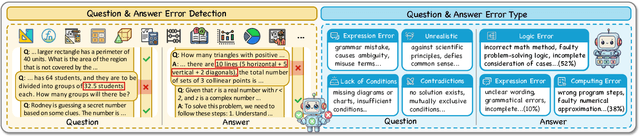
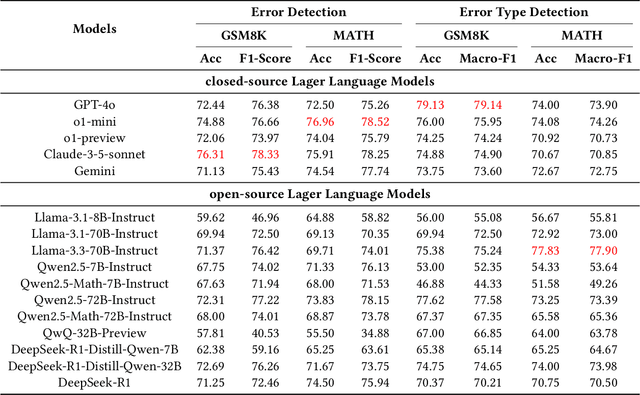
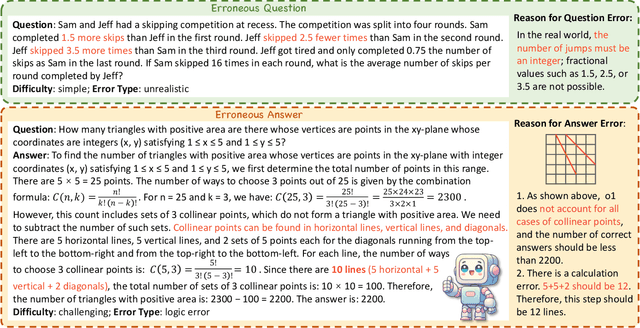
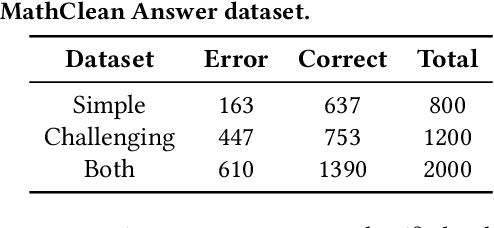
With the rapid development of large language models (LLMs), the quality of training data has become crucial. Among the various types of training data, mathematical data plays a key role in enabling LLMs to acquire strong reasoning abilities. While high-quality open-source data is important, it is often insufficient for pre-training, necessitating the addition of synthetic math problems. However, synthetic math questions and answers can introduce inaccuracies, which may degrade both the training data and web data. Therefore, an effective method for cleaning synthetic math data is essential. In this paper, we propose the MathClean benchmark to evaluate the effectiveness of math data cleaning models. The MathClean benchmark consists of 2,000 correct questions and 2,000 erroneous questions with additional 2,000 correct and erroneous answers sourced from augmented data based on GSM8K and MATH. Moreover, we also annotate error types for each question or answer, since it can assess whether models can correctly identify the error categories for future improvements. Finally, we present comprehensive evaluations using state-of-the-art (SOTA) models. Our results demonstrate that even strong models like GPT-o1 and DeepSeek-R1 perform poorly on this benchmark, highlighting the utility of MathClean. Our code and data is available at https://github.com/YuYingLi0/MathClean.