 Add to Chrome
 Add to Firefox
 Add to Edge
ABot-N1: Toward a General Visual Language Navigation Foundation Model
Jul 14, 2026
Visual Language Navigation foundation models aim to unify deep reasoning for grounded spatial decisions with broad versatility for diverse embodied tasks. Current approaches typically achieve this integration via monolithic policies that map observations directly to actions, yet they often suffer from coordinate drift and poor handling of long-tail semantics. Furthermore, these black-box mappings lack interpretability, hindering the simultaneous achievement of generality, robustness, and transparency. We present ABot-N1, a step toward a general Visual Language Navigation foundation model, that addresses these challenges by decoupling cognition from control via a slow-fast architecture guided by dual visual-language signals. More specifically, a slow vision-language reasoner performs explicit Chain-of-Thought reasoning while producing a pixel goal. This compact set of image-space anchor points serves as a universal interface for diverse tasks, including point-goal, object-goal, poi-goal, instruction-following, and person-following. Subsequently, a fast action expert leverages both the textual cues and the pixel guidance to generate continuous waypoints at the native control frequency. By bridging high-level intents and low-level control through pixel-grounded anchors paired with explicit linguistic traces, our approach ensures robust, generalizable, and interpretable navigation across simulation and real-world benchmarks. ABot-N1 establishes new state-of-the-art records, delivering massive gains specifically in urban-scale navigation: boosting POI arrival by 35.0% (to 77.3%) and achieving 95.4%/92.9% SR in complex indoor and outdoor scenes. It also maintains superior robustness across object-reaching, person-following, and instruction-following tasks. New Point-Goal/POI-Goal benchmarks are released as open source to advance the field of urban-scale navigation.

VT-WAM: Visual-Tactile World Action Model for Contact-Rich Manipulation
Jul 02, 2026Contact-rich manipulation requires policies to react to local deformation, pressure, slip, and friction, yet these cues are temporally sparse and often invisible in visual observations. Existing visual-tactile policies usually feed tactile observations directly into action prediction, but rarely model tactile deformation dynamics during action generation. In this paper, we introduce VT-WAM, a Visual-Tactile World Action Model that jointly learns future visual prediction, tactile deformation prediction, and action prediction within a unified flow matching framework. In particular, VT-WAM introduces (1) Asymmetric Mixture-of-Transformers (MoT) attention to bridge a first-frame visual anchor with temporal tactile dynamics, and (2) contact-gated Action-Visual-Tactile Attention Guidance (AVTAG) to encourage action queries to rely on tactile evidence during contact phases. Across six real-world contact-rich manipulation tasks, VT-WAM achieves a 71.67% average success rate, outperforming Fast-WAM by 26.67% and OmniVTLA by 35.84%. Ablations demonstrate that modeling tactile deformation dynamics and guiding contact-phase tactile attention are both important for contact-rich tasks. Project website: https://vt-wam.github.io/.
VistaBot: View-Robust Robot Manipulation via Spatiotemporal-Aware View Synthesis
Apr 23, 2026Recently, end-to-end robotic manipulation models have gained significant attention for their generalizability and scalability. However, they often suffer from limited robustness to camera viewpoint changes when training with a fixed camera. In this paper, we propose VistaBot, a novel framework that integrates feed-forward geometric models with video diffusion models to achieve view-robust closed-loop manipulation without requiring camera calibration at test time. Our approach consists of three key components: 4D geometry estimation, view synthesis latent extraction, and latent action learning. VistaBot is integrated into both action-chunking (ACT) and diffusion-based ($π_0$) policies and evaluated across simulation and real-world tasks. We further introduce the View Generalization Score (VGS) as a new metric for comprehensive evaluation of cross-view generalization. Results show that VistaBot improves VGS by 2.79$\times$ and 2.63$\times$ over ACT and $π_0$, respectively, while also achieving high-quality novel view synthesis. Our contributions include a geometry-aware synthesis model, a latent action planner, a new benchmark metric, and extensive validation across diverse environments. The code and models will be made publicly available.
PokeVLA: Empowering Pocket-Sized Vision-Language-Action Model with Comprehensive World Knowledge Guidance
Apr 22, 2026Recent advances in Vision-Language-Action (VLA) models have opened new avenues for robot manipulation, yet existing methods exhibit limited efficiency and a lack of high-level knowledge and spatial awareness. To address these challenges, we propose PokeVLA, a lightweight yet powerful foundation model for embodied manipulation that effectively infuses vision-language understanding into action learning. Our framework introduces a two-stage training paradigm: first, we pre-train a compact vision-language model (PokeVLM) on a curated multimodal dataset of 2.4M samples encompassing spatial grounding, affordance, and embodied reasoning tasks; second, we inject manipulation-relevant representations into the action space through multi-view goal-aware semantics learning, geometry alignment, and a novel action expert. Extensive experiments demonstrate state-of-the-art performance on the LIBERO-Plus benchmark and in real-world deployment, outperforming comparable baselines in success rate and robustness under diverse perturbations. To foster reproducibility and community progress, we will open-source our code, model weights, and the scripts for the curated pre-training dataset. Project page: https://getterupper.github.io/PokeVLA
Goal2Skill: Long-Horizon Manipulation with Adaptive Planning and Reflection
Apr 15, 2026Recent vision-language-action (VLA) systems have demonstrated strong capabilities in embodied manipulation. However, most existing VLA policies rely on limited observation windows and end-to-end action prediction, which makes them brittle in long-horizon, memory-dependent tasks with partial observability, occlusions, and multi-stage dependencies. Such tasks require not only precise visuomotor control, but also persistent memory, adaptive task decomposition, and explicit recovery from execution failures. To address these limitations, we propose a dual-system framework for long-horizon embodied manipulation. Our framework explicitly separates high-level semantic reasoning from low-level motor execution. A high-level planner, implemented as a VLM-based agentic module, maintains structured task memory and performs goal decomposition, outcome verification, and error-driven correction. A low-level executor, instantiated as a VLA-based visuomotor controller, carries out each sub-task through diffusion-based action generation conditioned on geometry-preserving filtered observations. Together, the two systems form a closed loop between planning and execution, enabling memory-aware reasoning, adaptive replanning, and robust online recovery. Experiments on representative RMBench tasks show that the proposed framework substantially outperforms representative baselines, achieving a 32.4% average success rate compared with 9.8% for the strongest baseline. Ablation studies further confirm the importance of structured memory and closed-loop recovery for long-horizon manipulation.
OmniVTA: Visuo-Tactile World Modeling for Contact-Rich Robotic Manipulation
Mar 19, 2026Contact-rich manipulation tasks, such as wiping and assembly, require accurate perception of contact forces, friction changes, and state transitions that cannot be reliably inferred from vision alone. Despite growing interest in visuo-tactile manipulation, progress is constrained by two persistent limitations: existing datasets are small in scale and narrow in task coverage, and current methods treat tactile signals as passive observations rather than using them to model contact dynamics or enable closed-loop control explicitly. In this paper, we present \textbf{OmniViTac}, a large-scale visuo-tactile-action dataset comprising $21{,}000+$ trajectories across $86$ tasks and $100+$ objects, organized into six physics-grounded interaction patterns. Building on this dataset, we propose \textbf{OmniVTA}, a world-model-based visuo-tactile manipulation framework that integrates four tightly coupled modules: a self-supervised tactile encoder, a two-stream visuo-tactile world model for predicting short-horizon contact evolution, a contact-aware fusion policy for action generation, and a 60Hz reflexive controller that corrects deviations between predicted and observed tactile signals in a closed loop. Real-robot experiments across all six interaction categories show that OmniVTA outperforms existing methods and generalizes well to unseen objects and geometric configurations, confirming the value of combining predictive contact modeling with high-frequency tactile feedback for contact-rich manipulation. All data, models, and code will be made publicly available on the project website at https://mrsecant.github.io/OmniVTA.
World In Your Hands: A Large-Scale and Open-source Ecosystem for Learning Human-centric Manipulation in the Wild
Dec 30, 2025Large-scale pre-training is fundamental for generalization in language and vision models, but data for dexterous hand manipulation remains limited in scale and diversity, hindering policy generalization. Limited scenario diversity, misaligned modalities, and insufficient benchmarking constrain current human manipulation datasets. To address these gaps, we introduce World In Your Hands (WiYH), a large-scale open-source ecosystem for human-centric manipulation learning. WiYH includes (1) the Oracle Suite, a wearable data collection kit with an auto-labeling pipeline for accurate motion capture; (2) the WiYH Dataset, featuring over 1,000 hours of multi-modal manipulation data across hundreds of skills in diverse real-world scenarios; and (3) extensive annotations and benchmarks supporting tasks from perception to action. Furthermore, experiments based on the WiYH ecosystem show that integrating WiYH's human-centric data significantly enhances the generalization and robustness of dexterous hand policies in tabletop manipulation tasks. We believe that World In Your Hands will bring new insights into human-centric data collection and policy learning to the community.
Taming VR Teleoperation and Learning from Demonstration for Multi-Task Bimanual Table Service Manipulation
Aug 21, 2025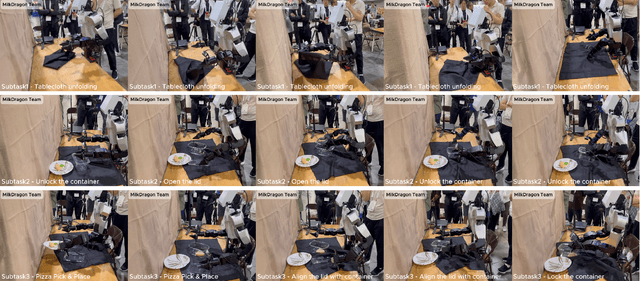
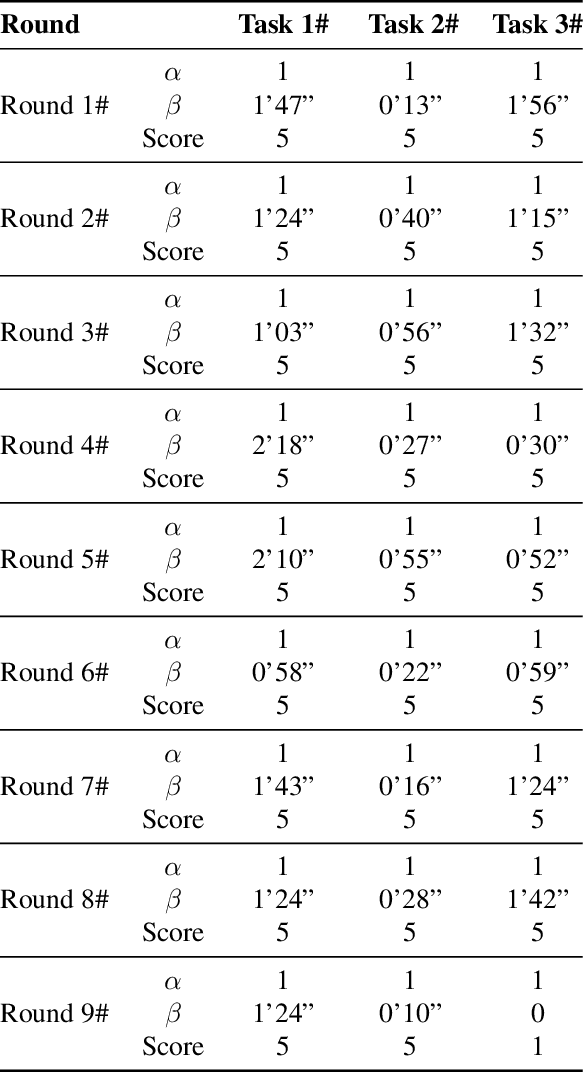
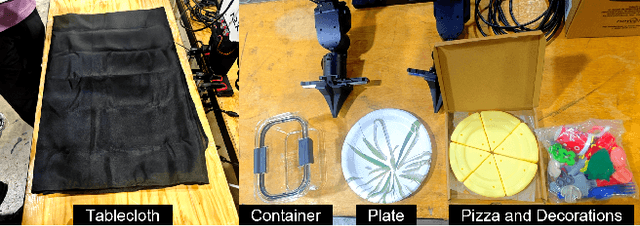
This technical report presents the champion solution of the Table Service Track in the ICRA 2025 What Bimanuals Can Do (WBCD) competition. We tackled a series of demanding tasks under strict requirements for speed, precision, and reliability: unfolding a tablecloth (deformable-object manipulation), placing a pizza into the container (pick-and-place), and opening and closing a food container with the lid. Our solution combines VR-based teleoperation and Learning from Demonstrations (LfD) to balance robustness and autonomy. Most subtasks were executed through high-fidelity remote teleoperation, while the pizza placement was handled by an ACT-based policy trained from 100 in-person teleoperated demonstrations with randomized initial configurations. By carefully integrating scoring rules, task characteristics, and current technical capabilities, our approach achieved both high efficiency and reliability, ultimately securing the first place in the competition.
PosePilot: Steering Camera Pose for Generative World Models with Self-supervised Depth
May 03, 2025Recent advancements in autonomous driving (AD) systems have highlighted the potential of world models in achieving robust and generalizable performance across both ordinary and challenging driving conditions. However, a key challenge remains: precise and flexible camera pose control, which is crucial for accurate viewpoint transformation and realistic simulation of scene dynamics. In this paper, we introduce PosePilot, a lightweight yet powerful framework that significantly enhances camera pose controllability in generative world models. Drawing inspiration from self-supervised depth estimation, PosePilot leverages structure-from-motion principles to establish a tight coupling between camera pose and video generation. Specifically, we incorporate self-supervised depth and pose readouts, allowing the model to infer depth and relative camera motion directly from video sequences. These outputs drive pose-aware frame warping, guided by a photometric warping loss that enforces geometric consistency across synthesized frames. To further refine camera pose estimation, we introduce a reverse warping step and a pose regression loss, improving viewpoint precision and adaptability. Extensive experiments on autonomous driving and general-domain video datasets demonstrate that PosePilot significantly enhances structural understanding and motion reasoning in both diffusion-based and auto-regressive world models. By steering camera pose with self-supervised depth, PosePilot sets a new benchmark for pose controllability, enabling physically consistent, reliable viewpoint synthesis in generative world models.
CPAny: Couple With Any Encoder to Refer Multi-Object Tracking
Mar 10, 2025Referring Multi-Object Tracking (RMOT) aims to localize target trajectories specified by natural language expressions in videos. Existing RMOT methods mainly follow two paradigms, namely, one-stage strategies and two-stage ones. The former jointly trains tracking with referring but suffers from substantial computational overhead. Although the latter improves computational efficiency, its CLIP-inspired dual-tower architecture restricts compatibility with other visual/text backbones and is not future-proof. To overcome these limitations, we propose CPAny, a novel encoder-decoder framework for two-stage RMOT, which introduces two core components: (1) a Contextual Visual Semantic Abstractor (CVSA) performs context-aware aggregation on visual backbone features and projects them into a unified semantic space; (2) a Parallel Semantic Summarizer (PSS) decodes the visual and linguistic features at the semantic level in parallel and generates referring scores. By replacing the inherent feature alignment of encoders with a self-constructed unified semantic space, CPAny achieves flexible compatibility with arbitrary emerging visual / text encoders. Meanwhile, CPAny aggregates contextual information by encoding only once and processes multiple expressions in parallel, significantly reducing computational redundancy. Extensive experiments on the Refer-KITTI and Refer-KITTI-V2 datasets show that CPAny outperforms SOTA methods across diverse encoder combinations, with a particular 7.77\% HOTA improvement on Refer-KITTI-V2. Code will be available soon.