 Add to Chrome
 Add to Firefox
 Add to Edge
NebulaVLA: A Dual-Frequency Vision-Language-Action Model With Guide Action for Robotic Manipulation
Aug 17, 2026
Real-world deployment of Vision-Language-Action (VLA) models is often bottlenecked by efficiency-performance trade-offs, cross-embodiment generalization, and execution smoothness. We present NebulaVLA, an asynchronous dual-frequency architecture that decouples high-level semantic reasoning from low-level action control, optimizing computational resources and modularity. To bridge semantic gaps across heterogeneous robots, we introduce GESTURE-7, a unified language-grounded action representation. Furthermore, our Guide Action algorithm enforces kinematic continuity via mask-based smoothness constraints. Comprehensive evaluations demonstrate that NebulaVLA significantly outperforms synchronous baselines, achieving an 85.5\% average success rate on LIBERO-Plus and accelerating action generation by \textasciitilde 2.7$\times$. This asynchronous design enables highly efficient and responsive control for practical robotics.

WALA Learning Executable Latent Actions from Action-Labeled Demonstrations and Action-Free Videos
Jul 13, 2026Generalizable robot policies typically rely on action-labeled robot demonstrations, which are expensive to collect and difficult to scale. In contrast, large-scale human and robot videos contain rich physical interactions but often lack executable robot action labels. We present WALA, a framework for learning executable latent actions from both action-labeled demonstrations and action-free videos. WALA first pretrains a semantic-geometric latent action model from videos by modeling the evolution between current observations and sparsely sampled future observations. Instead of reconstructing raw pixels, WALA predicts future deltas in the DINOv3 feature space and dense depth space, preserving task-relevant semantic and geometric structure while reducing sensitivity to appearance details. During policy training, the pretrained encoder provides stable latent action targets, and the decoder serves as a trainable latent world model. The latent actions generated by the vision-language backbone are jointly supervised by robot action prediction, latent action target matching, and future dynamics prediction. This enables action-labeled demonstrations to provide executable control supervision, while action-free videos contribute dynamics supervision without requiring robot action annotations. Experiments show that WALA achieves strong performance on RoboTwin, sets a new state-of-the-art result on RoboCasa with 75.2% average success, and improves both policy performance and generalization in real-world manipulation tasks.
VT-WAM: Visual-Tactile World Action Model for Contact-Rich Manipulation
Jul 02, 2026Contact-rich manipulation requires policies to react to local deformation, pressure, slip, and friction, yet these cues are temporally sparse and often invisible in visual observations. Existing visual-tactile policies usually feed tactile observations directly into action prediction, but rarely model tactile deformation dynamics during action generation. In this paper, we introduce VT-WAM, a Visual-Tactile World Action Model that jointly learns future visual prediction, tactile deformation prediction, and action prediction within a unified flow matching framework. In particular, VT-WAM introduces (1) Asymmetric Mixture-of-Transformers (MoT) attention to bridge a first-frame visual anchor with temporal tactile dynamics, and (2) contact-gated Action-Visual-Tactile Attention Guidance (AVTAG) to encourage action queries to rely on tactile evidence during contact phases. Across six real-world contact-rich manipulation tasks, VT-WAM achieves a 71.67% average success rate, outperforming Fast-WAM by 26.67% and OmniVTLA by 35.84%. Ablations demonstrate that modeling tactile deformation dynamics and guiding contact-phase tactile attention are both important for contact-rich tasks. Project website: https://vt-wam.github.io/.
TacForeSight: Force-Guided Tactile World Model for Contact-Rich Manipulation
Jun 09, 2026Contact-rich manipulation requires robots to continuously perceive and regulate evolving physical interactions under dynamic contact transitions or complex surface geometries. Recent imitation learning methods improve contact-aware control by incorporating tactile or force feedback, but they rarely model the asymmetric spatiotemporal roles of global force and local tactile sensing. To address this, we propose TacForeSight, a lightweight force-conditioned tactile foresight framework for real-time manipulation. The core component is TacForceWM, a tactile world model that predicts short-horizon tactile latent dynamics from dual-finger tactile observations conditioned on high-frequency wrist force and torque signals. Another key component, the Predictive Tactile-Conditioned Policy, leverages the predicted latents as anticipatory contact priors, models the current-to-future tactile evolution via cross-attention, and adaptively fuses visuo-tactile features through a tactile-guided gating module. By forecasting purely within a compact latent space, TacForeSight enables proactive contact reasoning with efficient real-time inference suitable for high-frequency manipulation control. Real-robot experiments on five representative tasks and three in-process perturbation settings show that TacForeSight consistently outperforms existing baselines, particularly under dynamic contact disturbances. All models and datasets will be made publicly available on the project website at https://tacforesight.github.io/ProjectPage.
PokeVLA: Empowering Pocket-Sized Vision-Language-Action Model with Comprehensive World Knowledge Guidance
Apr 22, 2026Recent advances in Vision-Language-Action (VLA) models have opened new avenues for robot manipulation, yet existing methods exhibit limited efficiency and a lack of high-level knowledge and spatial awareness. To address these challenges, we propose PokeVLA, a lightweight yet powerful foundation model for embodied manipulation that effectively infuses vision-language understanding into action learning. Our framework introduces a two-stage training paradigm: first, we pre-train a compact vision-language model (PokeVLM) on a curated multimodal dataset of 2.4M samples encompassing spatial grounding, affordance, and embodied reasoning tasks; second, we inject manipulation-relevant representations into the action space through multi-view goal-aware semantics learning, geometry alignment, and a novel action expert. Extensive experiments demonstrate state-of-the-art performance on the LIBERO-Plus benchmark and in real-world deployment, outperforming comparable baselines in success rate and robustness under diverse perturbations. To foster reproducibility and community progress, we will open-source our code, model weights, and the scripts for the curated pre-training dataset. Project page: https://getterupper.github.io/PokeVLA
OmniVTA: Visuo-Tactile World Modeling for Contact-Rich Robotic Manipulation
Mar 19, 2026Contact-rich manipulation tasks, such as wiping and assembly, require accurate perception of contact forces, friction changes, and state transitions that cannot be reliably inferred from vision alone. Despite growing interest in visuo-tactile manipulation, progress is constrained by two persistent limitations: existing datasets are small in scale and narrow in task coverage, and current methods treat tactile signals as passive observations rather than using them to model contact dynamics or enable closed-loop control explicitly. In this paper, we present \textbf{OmniViTac}, a large-scale visuo-tactile-action dataset comprising $21{,}000+$ trajectories across $86$ tasks and $100+$ objects, organized into six physics-grounded interaction patterns. Building on this dataset, we propose \textbf{OmniVTA}, a world-model-based visuo-tactile manipulation framework that integrates four tightly coupled modules: a self-supervised tactile encoder, a two-stream visuo-tactile world model for predicting short-horizon contact evolution, a contact-aware fusion policy for action generation, and a 60Hz reflexive controller that corrects deviations between predicted and observed tactile signals in a closed loop. Real-robot experiments across all six interaction categories show that OmniVTA outperforms existing methods and generalizes well to unseen objects and geometric configurations, confirming the value of combining predictive contact modeling with high-frequency tactile feedback for contact-rich manipulation. All data, models, and code will be made publicly available on the project website at https://mrsecant.github.io/OmniVTA.
Towards Long-Lived Robots: Continual Learning VLA Models via Reinforcement Fine-Tuning
Feb 11, 2026Pretrained on large-scale and diverse datasets, VLA models demonstrate strong generalization and adaptability as general-purpose robotic policies. However, Supervised Fine-Tuning (SFT), which serves as the primary mechanism for adapting VLAs to downstream domains, requires substantial amounts of task-specific data and is prone to catastrophic forgetting. To address these limitations, we propose LifeLong-RFT, a simple yet effective Reinforcement Fine-Tuning (RFT) strategy for VLA models independent of online environmental feedback and pre-trained reward models. By integrating chunking-level on-policy reinforcement learning with the proposed Multi-Dimensional Process Reward (MDPR) mechanism, LifeLong-RFT quantifies the heterogeneous contributions of intermediate action chunks across three dimensions to facilitate policy optimization. Specifically, (1) the Quantized Action Consistency Reward (QACR) ensures accurate action prediction within the discrete action space; (2) the Continuous Trajectory Alignment Reward (CTAR) aligns decoded continuous action chunks with reference trajectories to ensure precise control; (3) the Format Compliance Reward (FCR) guarantees the structural validity of outputs. Comprehensive experiments across SimplerEnv, LIBERO, and real-world tasks demonstrate that LifeLong-RFT exhibits strong performance in multi-task learning. Furthermore, for continual learning on the LIBERO benchmark, our method achieves a 22% gain in average success rate over SFT, while effectively adapting to new tasks using only 20% of the training data. Overall, our method provides a promising post-training paradigm for VLAs.
ConRFT: A Reinforced Fine-tuning Method for VLA Models via Consistency Policy
Feb 08, 2025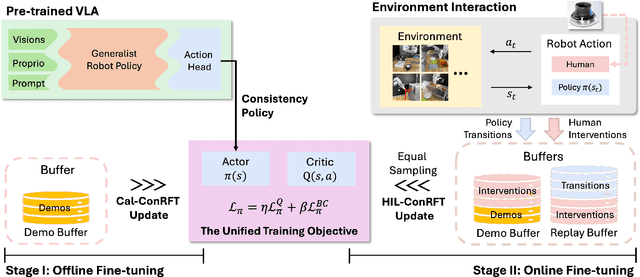


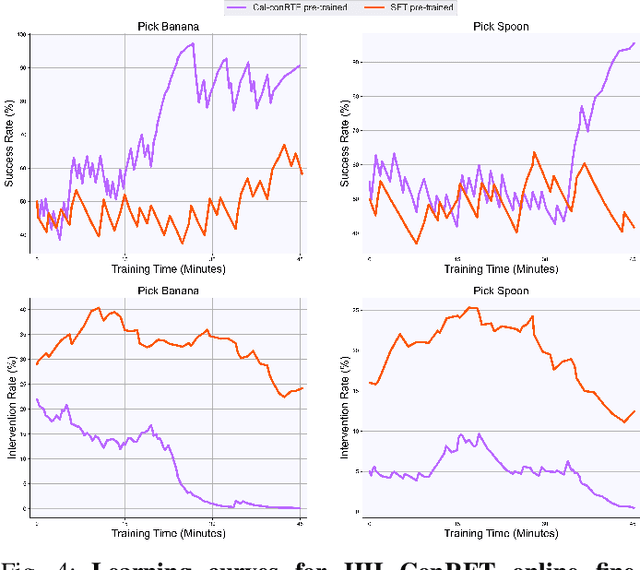
Vision-Language-Action (VLA) models have shown substantial potential in real-world robotic manipulation. However, fine-tuning these models through supervised learning struggles to achieve robust performance due to limited, inconsistent demonstrations, especially in contact-rich environments. In this paper, we propose a reinforced fine-tuning approach for VLA models, named ConRFT, which consists of offline and online fine-tuning with a unified consistency-based training objective, to address these challenges. In the offline stage, our method integrates behavior cloning and Q-learning to effectively extract policy from a small set of demonstrations and stabilize value estimating. In the online stage, the VLA model is further fine-tuned via consistency policy, with human interventions to ensure safe exploration and high sample efficiency. We evaluate our approach on eight diverse real-world manipulation tasks. It achieves an average success rate of 96.3% within 45-90 minutes of online fine-tuning, outperforming prior supervised methods with a 144% improvement in success rate and 1.9x shorter episode length. This work highlights the potential of integrating reinforcement learning to enhance the performance of VLA models for real-world robotic applications.