 Add to Chrome
 Add to Firefox
 Add to Edge
GeoWorldAD: Geometry World Action Model for Autonomous Driving
Jul 20, 2026
Autonomous driving requires both safe and efficient planning decisions in dynamic 3D environments. Although recent Vision/Video-Action models learn policies directly from visual observations and scale well with advances in vision transformers and large-scale training data, they often lack explicit geometric grounding and future-aware spatial guidance, limiting their ability to balance collision avoidance and driving progress. In this work, we propose GeoWorldAD, a geometry world action model that grounds trajectory planning in ego-aligned 3D space and anticipates short-horizon scene evolution with latent future geometry tokens. Present geometry provides essential spatial constraints for safe planning, while future geometry reveals how surrounding agents and ego-centric free space may evolve, reducing overly conservative decisions without sacrificing safety. To efficiently exploit these geometric cues, GeoWorldAD progressively aggregates multi-scale present geometry and latent future geometry through iterative trajectory refinement. Experiments on NAVSIM v1 and v2 demonstrate state-of-the-art performance, highlighting the effectiveness of explicit 3D geometry grounding and future geometry world modeling for safe and efficient autonomous driving.

Structure-Detail Decoupled Autoregressive Generation for Fast and High-Fidelity Virtual Try-On
Jul 13, 2026Virtual try-on (VTON) is a bi-conditional image generation problem that requires not only accurate person preservation but also faithful garment deformation and detail synthesis. Diffusion-based VTON methods can jointly model these factors in a compressed latent space, but suffer from high-frequency detail loss due to inherent latent compression, even with costly multi-step denoising. Recent visual autoregressive (VAR) models offer a promising alternative for high-quality generation with faster inference, yet remain unexplored for VTON due to the lack of effective bi-conditioning mechanisms. To bridge this gap, we first introduce VAR-VTON, a VAR-based VTON model that incorporates garment conditioning and structural guidance for efficient latent-space VTON. Despite its efficacy, latent-space generation still struggles to preserve fine-grained garment details. We argue that different VTON sub-tasks should be addressed in different representation spaces: structural synthesis such as garment warping and person layout is suited to the latent space, whereas fine-grained detail recovery should be tackled in the pixel space. Motivated by this insight, we further propose STAR-VTON, a Two-Stage AutoRegressive framework that builds upon VAR-VTON by decoupling latent-space structural synthesis from pixel-space detail recovery. Our idea is to resort to a matching-informed refiner to establish dense correspondences between the stage-one generation and the source garment to directly map fine-grained pixel-space details. Extensive experiments show that STAR-VTON achieves an impressive efficiency-fidelity trade-off: VAR-VTON runs at least $4\times$ faster than diffusion-based counterparts without degrading quality, and the pixel-space refiner effectively restores fine details and acts as a plug-and-play module that can benefit existing VTON approaches.
Pondering the Way: Spatial-perceiving World Action Model for Embodied Navigation
Jun 29, 2026Existing world model-based planners for visual navigation typically follow a verification-centric paradigm, decoupling goal intent from trajectory synthesis. This approach suffers from candidate dependence, heavy computational overhead, and inconsistencies between sampled actions and predicted visuals. To address these issues, we propose SWAM (Spatial-perceiving World Action Model), a task-centric joint observation-action generation framework. Given start and goal RGB observations, SWAM performs single-pass inference to simultaneously generate intermediate RGB-D sequences and corresponding action trajectories, promoting goal-consistent trajectory generation and improved spatial feasibility. While SWAM leverages depth pseudo-labels during training to internalize spatial priors, it requires only monocular RGB input at inference time. We further introduce a visual-guided action refinement module and a trajectory-scale regularization loss to enforce fine-grained alignment between motion and visual cues while stabilizing predictions across varying distances. Extensive experiments show that SWAM significantly outperforms state-of-the-art two-stage planners in success rate, trajectory accuracy, and inference efficiency, while demonstrating robust zero-shot generalization to unseen environments.
AutoMine Solution for AV2 2026 Scenario Mining Challenge
Jun 10, 2026With the development of autonomous driving systems, mining high-value, safety-critical, and planning-relevant scenarios from large-scale driving logs has become essential for data-driven evaluation. In this paper, we propose AutoMine, a robust self-refining scenario mining method based on LLMs and VLMs. AutoMine uses semantics-preserving prompt augmentation to reduce LLM prompt sensitivity, combines robust trajectory atomic functions with VLM-based functions to handle perception noise and open-world visual cues, and refines generated code through execution feedback from real logs. In the Argoverse 2 Scenario Mining Competition at CVPR 2026, AutoMine achieves a HOTA-Temporal score of 36.38 and a Timestamp BA score of 77.21.
MiLA: Multi-view Intensive-fidelity Long-term Video Generation World Model for Autonomous Driving
Mar 20, 2025In recent years, data-driven techniques have greatly advanced autonomous driving systems, but the need for rare and diverse training data remains a challenge, requiring significant investment in equipment and labor. World models, which predict and generate future environmental states, offer a promising solution by synthesizing annotated video data for training. However, existing methods struggle to generate long, consistent videos without accumulating errors, especially in dynamic scenes. To address this, we propose MiLA, a novel framework for generating high-fidelity, long-duration videos up to one minute. MiLA utilizes a Coarse-to-Re(fine) approach to both stabilize video generation and correct distortion of dynamic objects. Additionally, we introduce a Temporal Progressive Denoising Scheduler and Joint Denoising and Correcting Flow modules to improve the quality of generated videos. Extensive experiments on the nuScenes dataset show that MiLA achieves state-of-the-art performance in video generation quality. For more information, visit the project website: https://github.com/xiaomi-mlab/mila.github.io.
CPAny: Couple With Any Encoder to Refer Multi-Object Tracking
Mar 10, 2025Referring Multi-Object Tracking (RMOT) aims to localize target trajectories specified by natural language expressions in videos. Existing RMOT methods mainly follow two paradigms, namely, one-stage strategies and two-stage ones. The former jointly trains tracking with referring but suffers from substantial computational overhead. Although the latter improves computational efficiency, its CLIP-inspired dual-tower architecture restricts compatibility with other visual/text backbones and is not future-proof. To overcome these limitations, we propose CPAny, a novel encoder-decoder framework for two-stage RMOT, which introduces two core components: (1) a Contextual Visual Semantic Abstractor (CVSA) performs context-aware aggregation on visual backbone features and projects them into a unified semantic space; (2) a Parallel Semantic Summarizer (PSS) decodes the visual and linguistic features at the semantic level in parallel and generates referring scores. By replacing the inherent feature alignment of encoders with a self-constructed unified semantic space, CPAny achieves flexible compatibility with arbitrary emerging visual / text encoders. Meanwhile, CPAny aggregates contextual information by encoding only once and processes multiple expressions in parallel, significantly reducing computational redundancy. Extensive experiments on the Refer-KITTI and Refer-KITTI-V2 datasets show that CPAny outperforms SOTA methods across diverse encoder combinations, with a particular 7.77\% HOTA improvement on Refer-KITTI-V2. Code will be available soon.
Learning A Zero-shot Occupancy Network from Vision Foundation Models via Self-supervised Adaptation
Mar 10, 2025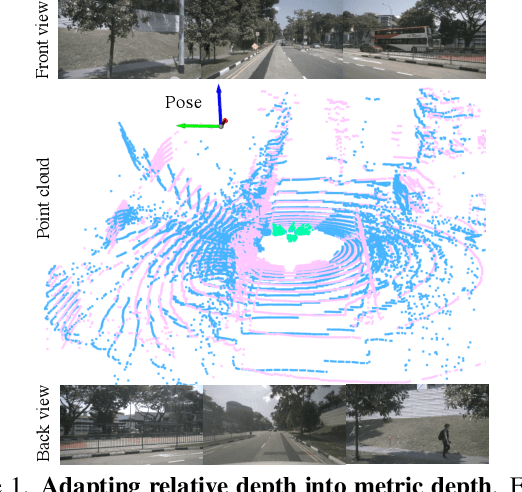
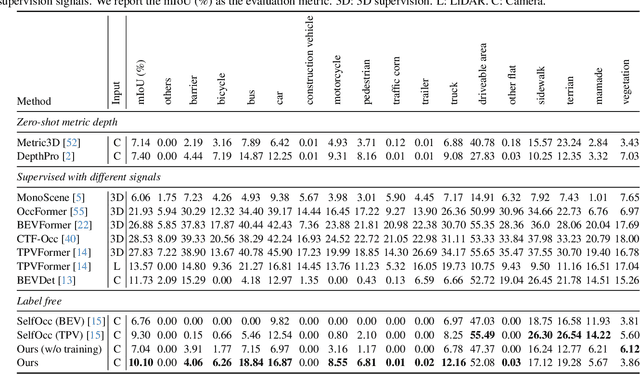
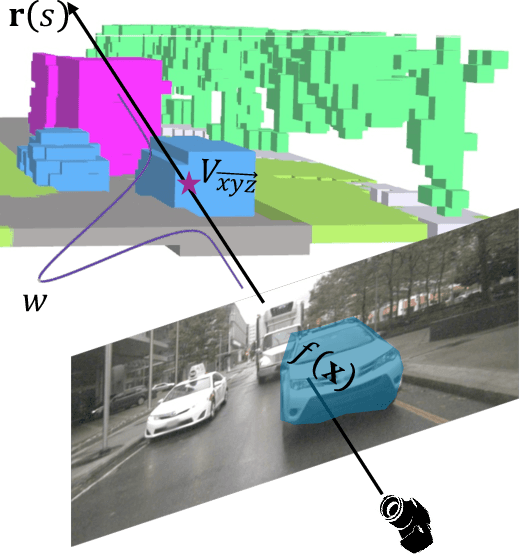
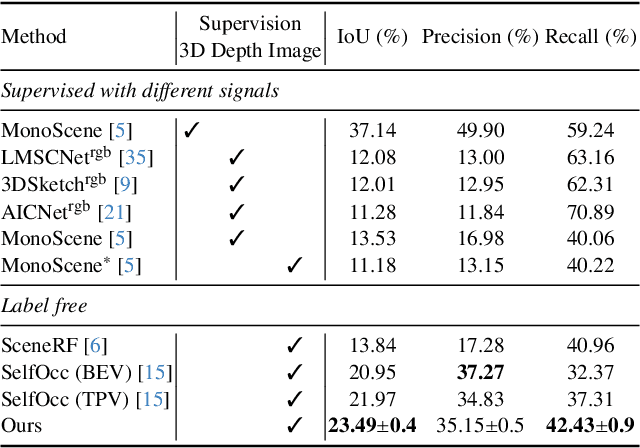
Estimating the 3D world from 2D monocular images is a fundamental yet challenging task due to the labour-intensive nature of 3D annotations. To simplify label acquisition, this work proposes a novel approach that bridges 2D vision foundation models (VFMs) with 3D tasks by decoupling 3D supervision into an ensemble of image-level primitives, e.g., semantic and geometric components. As a key motivator, we leverage the zero-shot capabilities of vision-language models for image semantics. However, due to the notorious ill-posed problem - multiple distinct 3D scenes can produce identical 2D projections, directly inferring metric depth from a monocular image in a zero-shot manner is unsuitable. In contrast, 2D VFMs provide promising sources of relative depth, which theoretically aligns with metric depth when properly scaled and offset. Thus, we adapt the relative depth derived from VFMs into metric depth by optimising the scale and offset using temporal consistency, also known as novel view synthesis, without access to ground-truth metric depth. Consequently, we project the semantics into 3D space using the reconstructed metric depth, thereby providing 3D supervision. Extensive experiments on nuScenes and SemanticKITTI demonstrate the effectiveness of our framework. For instance, the proposed method surpasses the current state-of-the-art by 3.34% mIoU on nuScenes for voxel occupancy prediction.
Self-Supervised Multi-Frame Neural Scene Flow
Mar 24, 2024
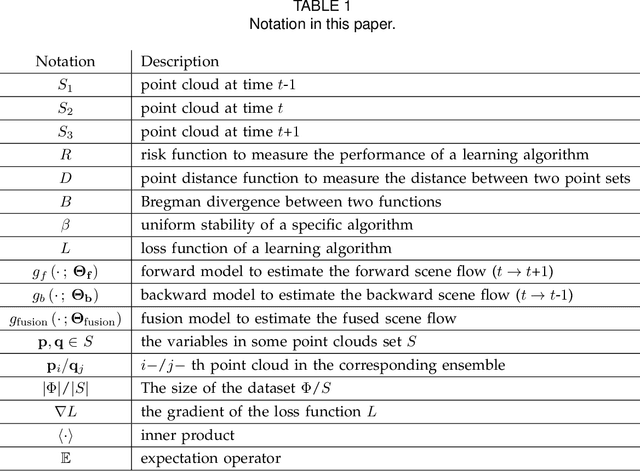
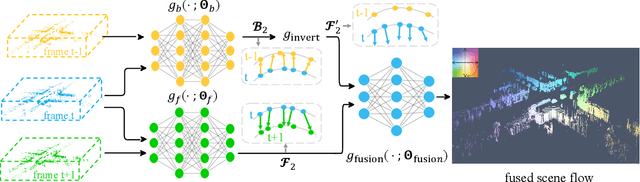

Neural Scene Flow Prior (NSFP) and Fast Neural Scene Flow (FNSF) have shown remarkable adaptability in the context of large out-of-distribution autonomous driving. Despite their success, the underlying reasons for their astonishing generalization capabilities remain unclear. Our research addresses this gap by examining the generalization capabilities of NSFP through the lens of uniform stability, revealing that its performance is inversely proportional to the number of input point clouds. This finding sheds light on NSFP's effectiveness in handling large-scale point cloud scene flow estimation tasks. Motivated by such theoretical insights, we further explore the improvement of scene flow estimation by leveraging historical point clouds across multiple frames, which inherently increases the number of point clouds. Consequently, we propose a simple and effective method for multi-frame point cloud scene flow estimation, along with a theoretical evaluation of its generalization abilities. Our analysis confirms that the proposed method maintains a limited generalization error, suggesting that adding multiple frames to the scene flow optimization process does not detract from its generalizability. Extensive experimental results on large-scale autonomous driving Waymo Open and Argoverse lidar datasets demonstrate that the proposed method achieves state-of-the-art performance.
SurroundSDF: Implicit 3D Scene Understanding Based on Signed Distance Field
Mar 21, 2024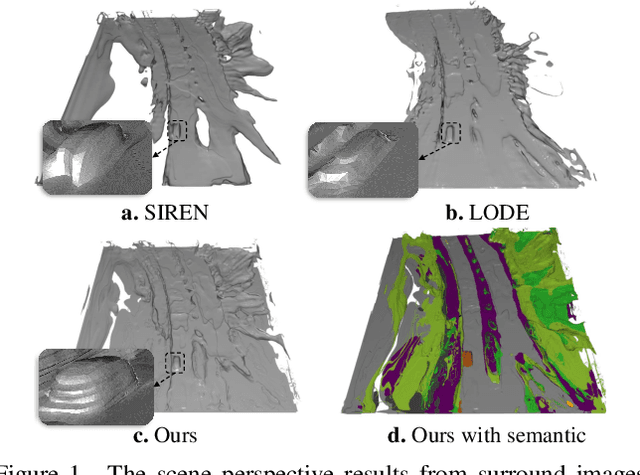
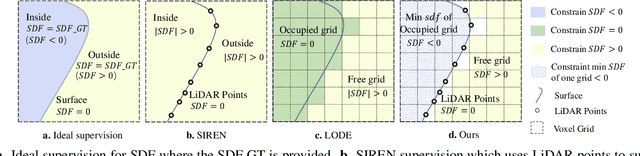
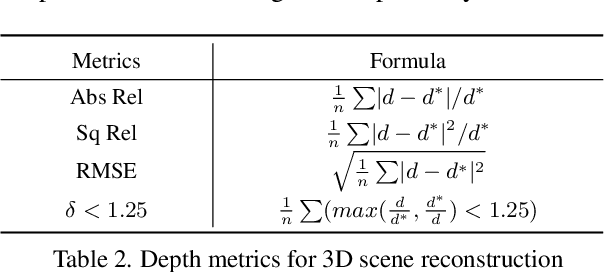
Vision-centric 3D environment understanding is both vital and challenging for autonomous driving systems. Recently, object-free methods have attracted considerable attention. Such methods perceive the world by predicting the semantics of discrete voxel grids but fail to construct continuous and accurate obstacle surfaces. To this end, in this paper, we propose SurroundSDF to implicitly predict the signed distance field (SDF) and semantic field for the continuous perception from surround images. Specifically, we introduce a query-based approach and utilize SDF constrained by the Eikonal formulation to accurately describe the surfaces of obstacles. Furthermore, considering the absence of precise SDF ground truth, we propose a novel weakly supervised paradigm for SDF, referred to as the Sandwich Eikonal formulation, which emphasizes applying correct and dense constraints on both sides of the surface, thereby enhancing the perceptual accuracy of the surface. Experiments suggest that our method achieves SOTA for both occupancy prediction and 3D scene reconstruction tasks on the nuScenes dataset.
Globally Optimal Event-Based Divergence Estimation for Ventral Landing
Sep 27, 2022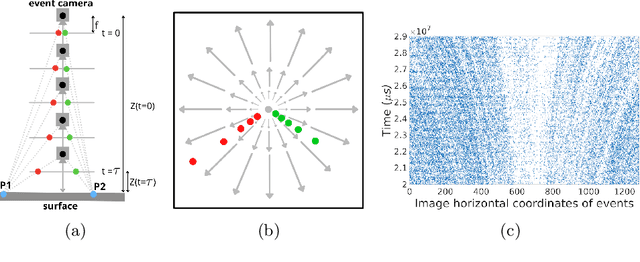
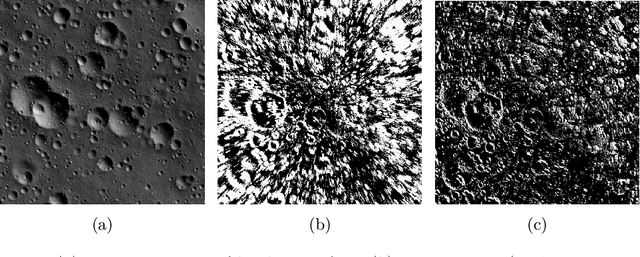
Event sensing is a major component in bio-inspired flight guidance and control systems. We explore the usage of event cameras for predicting time-to-contact (TTC) with the surface during ventral landing. This is achieved by estimating divergence (inverse TTC), which is the rate of radial optic flow, from the event stream generated during landing. Our core contributions are a novel contrast maximisation formulation for event-based divergence estimation, and a branch-and-bound algorithm to exactly maximise contrast and find the optimal divergence value. GPU acceleration is conducted to speed up the global algorithm. Another contribution is a new dataset containing real event streams from ventral landing that was employed to test and benchmark our method. Owing to global optimisation, our algorithm is much more capable at recovering the true divergence, compared to other heuristic divergence estimators or event-based optic flow methods. With GPU acceleration, our method also achieves competitive runtimes.