 Add to Chrome
 Add to Firefox
 Add to Edge
QD-PCQA: Quality-Aware Domain Adaptation for Point Cloud Quality Assessment
Mar 04, 2026
No-Reference Point Cloud Quality Assessment (NR-PCQA) still struggles with generalization, primarily due to the scarcity of annotated point cloud datasets. Since the Human Visual System (HVS) drives perceptual quality assessment independently of media types, prior knowledge on quality learned from images can be repurposed for point clouds. This insight motivates adopting Unsupervised Domain Adaptation (UDA) to transfer quality-relevant priors from labeled images to unlabeled point clouds. However, existing UDA-based PCQA methods often overlook key characteristics of perceptual quality, such as sensitivity to quality ranking and quality-aware feature alignment, thereby limiting their effectiveness. To address these issues, we propose a novel Quality-aware Domain adaptation framework for PCQA, termed QD-PCQA. The framework comprises two main components: i) a Rank-weighted Conditional Alignment (RCA) strategy that aligns features under consistent quality levels and adaptively emphasizes misranked samples to reinforce perceptual quality ranking awareness; and ii) a Quality-guided Feature Augmentation (QFA) strategy, which includes quality-guided style mixup, multi-layer extension, and dual-domain augmentation modules to augment perceptual feature alignment. Extensive cross-domain experiments demonstrate that QD-PCQA significantly improves generalization in NR-PCQA tasks. The code is available at https://github.com/huhu-code/QD-PCQA.

Scaling Audio-Visual Quality Assessment Dataset via Crowdsourcing
Feb 26, 2026Audio-visual quality assessment (AVQA) research has been stalled by limitations of existing datasets: they are typically small in scale, with insufficient diversity in content and quality, and annotated only with overall scores. These shortcomings provide limited support for model development and multimodal perception research. We propose a practical approach for AVQA dataset construction. First, we design a crowdsourced subjective experiment framework for AVQA, breaks the constraints of in-lab settings and achieves reliable annotation across varied environments. Second, a systematic data preparation strategy is further employed to ensure broad coverage of both quality levels and semantic scenarios. Third, we extend the dataset with additional annotations, enabling research on multimodal perception mechanisms and their relation to content. Finally, we validate this approach through YT-NTU-AVQ, the largest and most diverse AVQA dataset to date, consisting of 1,620 user-generated audio and video (A/V) sequences. The dataset and platform code are available at https://github.com/renyu12/YT-NTU-AVQ
Semantic-Contact Fields for Category-Level Generalizable Tactile Tool Manipulation
Feb 14, 2026Generalizing tool manipulation requires both semantic planning and precise physical control. Modern generalist robot policies, such as Vision-Language-Action (VLA) models, often lack the high-fidelity physical grounding required for contact-rich tool manipulation. Conversely, existing contact-aware policies that leverage tactile or haptic sensing are typically instance-specific and fail to generalize across diverse tool geometries. Bridging this gap requires learning unified contact representations from diverse data, yet a fundamental barrier remains: diverse real-world tactile data are prohibitive at scale, while direct zero-shot sim-to-real transfer is challenging due to the complex dynamics of nonlinear deformation of soft sensors. To address this, we propose Semantic-Contact Fields (SCFields), a unified 3D representation fusing visual semantics with dense contact estimates. We enable this via a two-stage Sim-to-Real Contact Learning Pipeline: first, we pre-train on a large simulation data set to learn general contact physics; second, we fine-tune on a small set of real data, pseudo-labeled via geometric heuristics and force optimization, to align sensor characteristics. This allows physical generalization to unseen tools. We leverage SCFields as the dense observation input for a diffusion policy to enable robust execution of contact-rich tool manipulation tasks. Experiments on scraping, crayon drawing, and peeling demonstrate robust category-level generalization, significantly outperforming vision-only and raw-tactile baselines.
Just Noticeable Difference Modeling for Deep Visual Features
Jan 29, 2026Deep visual features are increasingly used as the interface in vision systems, motivating the need to describe feature characteristics and control feature quality for machine perception. Just noticeable difference (JND) characterizes the maximum imperceptible distortion for images under human or machine vision. Extending it to deep visual features naturally meets the above demand by providing a task-aligned tolerance boundary in feature space, offering a practical reference for controlling feature quality under constrained resources. We propose FeatJND, a task-aligned JND formulation that predicts the maximum tolerable per-feature perturbation map while preserving downstream task performance. We propose a FeatJND estimator at standardized split points and validate it across image classification, detection, and instance segmentation. Under matched distortion strength, FeatJND-based distortions consistently preserve higher task performance than unstructured Gaussian perturbations, and attribution visualizations suggest FeatJND can suppress non-critical feature regions. As an application, we further apply FeatJND to token-wise dynamic quantization and show that FeatJND-guided step-size allocation yields clear gains over random step-size permutation and global uniform step size under the same noise budget. Our code will be released after publication.
From Global to Granular: Revealing IQA Model Performance via Correlation Surface
Jan 29, 2026Evaluation of Image Quality Assessment (IQA) models has long been dominated by global correlation metrics, such as Pearson Linear Correlation Coefficient (PLCC) and Spearman Rank-Order Correlation Coefficient (SRCC). While widely adopted, these metrics reduce performance to a single scalar, failing to capture how ranking consistency varies across the local quality spectrum. For example, two IQA models may achieve identical SRCC values, yet one ranks high-quality images (related to high Mean Opinion Score, MOS) more reliably, while the other better discriminates image pairs with small quality/MOS differences (related to $|Δ$MOS$|$). Such complementary behaviors are invisible under global metrics. Moreover, SRCC and PLCC are sensitive to test-sample quality distributions, yielding unstable comparisons across test sets. To address these limitations, we propose \textbf{Granularity-Modulated Correlation (GMC)}, which provides a structured, fine-grained analysis of IQA performance. GMC includes: (1) a \textbf{Granularity Modulator} that applies Gaussian-weighted correlations conditioned on absolute MOS values and pairwise MOS differences ($|Δ$MOS$|$) to examine local performance variations, and (2) a \textbf{Distribution Regulator} that regularizes correlations to mitigate biases from non-uniform quality distributions. The resulting \textbf{correlation surface} maps correlation values as a joint function of MOS and $|Δ$MOS$|$, providing a 3D representation of IQA performance. Experiments on standard benchmarks show that GMC reveals performance characteristics invisible to scalar metrics, offering a more informative and reliable paradigm for analyzing, comparing, and deploying IQA models. Codes are available at https://github.com/Dniaaa/GMC.
RLPO: Residual Listwise Preference Optimization for Long-Context Review Ranking
Jan 12, 2026Review ranking is pivotal in e-commerce for prioritizing diagnostic and authentic feedback from the deluge of user-generated content. While large language models have improved semantic assessment, existing ranking paradigms face a persistent trade-off in long-context settings. Pointwise scoring is efficient but often fails to account for list-level interactions, leading to miscalibrated top-$k$ rankings. Listwise approaches can leverage global context, yet they are computationally expensive and become unstable as candidate lists grow. To address this, we propose Residual Listwise Preference Optimization (RLPO), which formulates ranking as listwise representation-level residual correction over a strong pointwise LLM scorer. RLPO first produces calibrated pointwise scores and item representations, then applies a lightweight encoder over the representations to predict listwise score residuals, avoiding full token-level listwise processing. We also introduce a large-scale benchmark for long-context review ranking with human verification. Experiments show RLPO improves NDCG@k over strong pointwise and listwise baselines and remains robust as list length increases.
Plug In, Grade Right: Psychology-Inspired AGIQA
Dec 28, 2025Existing AGIQA models typically estimate image quality by measuring and aggregating the similarities between image embeddings and text embeddings derived from multi-grade quality descriptions. Although effective, we observe that such similarity distributions across grades usually exhibit multimodal patterns. For instance, an image embedding may show high similarity to both "excellent" and "poor" grade descriptions while deviating from the "good" one. We refer to this phenomenon as "semantic drift", where semantic inconsistencies between text embeddings and their intended descriptions undermine the reliability of text-image shared-space learning. To mitigate this issue, we draw inspiration from psychometrics and propose an improved Graded Response Model (GRM) for AGIQA. The GRM is a classical assessment model that categorizes a subject's ability across grades using test items with various difficulty levels. This paradigm aligns remarkably well with human quality rating, where image quality can be interpreted as an image's ability to meet various quality grades. Building on this philosophy, we design a two-branch quality grading module: one branch estimates image ability while the other constructs multiple difficulty levels. To ensure monotonicity in difficulty levels, we further model difficulty generation in an arithmetic manner, which inherently enforces a unimodal and interpretable quality distribution. Our Arithmetic GRM based Quality Grading (AGQG) module enjoys a plug-and-play advantage, consistently improving performance when integrated into various state-of-the-art AGIQA frameworks. Moreover, it also generalizes effectively to both natural and screen content image quality assessment, revealing its potential as a key component in future IQA models.
Embodied Image Compression
Dec 12, 2025
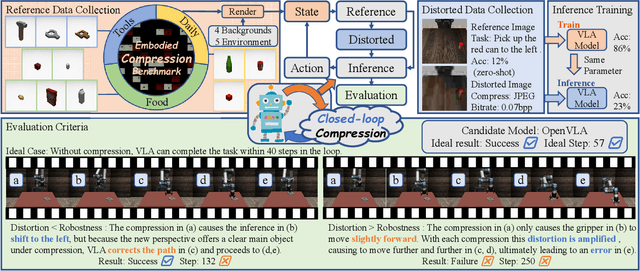
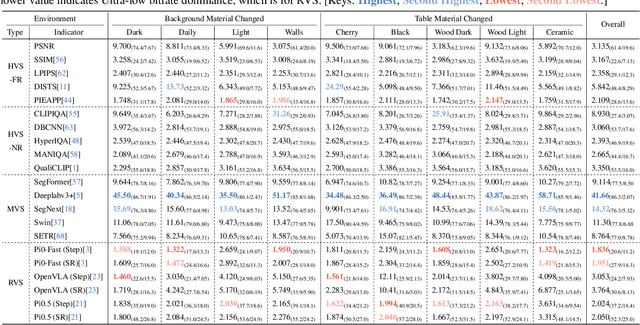
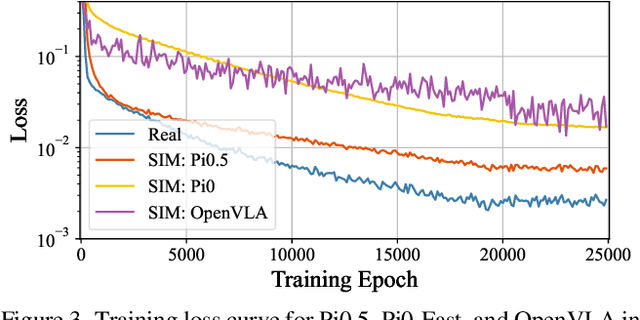
Image Compression for Machines (ICM) has emerged as a pivotal research direction in the field of visual data compression. However, with the rapid evolution of machine intelligence, the target of compression has shifted from task-specific virtual models to Embodied agents operating in real-world environments. To address the communication constraints of Embodied AI in multi-agent systems and ensure real-time task execution, this paper introduces, for the first time, the scientific problem of Embodied Image Compression. We establish a standardized benchmark, EmbodiedComp, to facilitate systematic evaluation under ultra-low bitrate conditions in a closed-loop setting. Through extensive empirical studies in both simulated and real-world settings, we demonstrate that existing Vision-Language-Action models (VLAs) fail to reliably perform even simple manipulation tasks when compressed below the Embodied bitrate threshold. We anticipate that EmbodiedComp will catalyze the development of domain-specific compression tailored for Embodied agents , thereby accelerating the Embodied AI deployment in the Real-world.
Using GUI Agent for Electronic Design Automation
Dec 12, 2025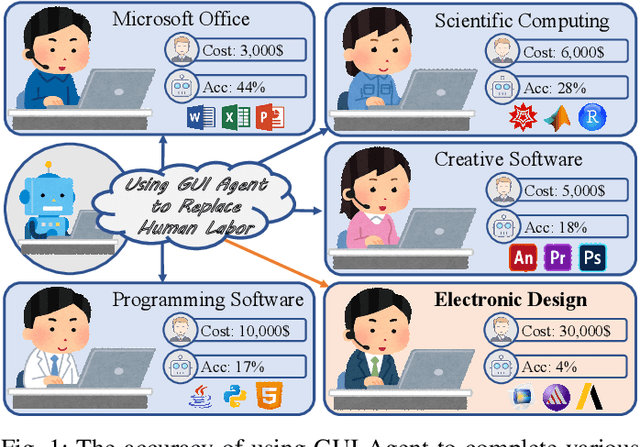
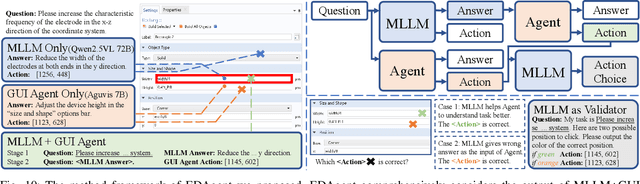
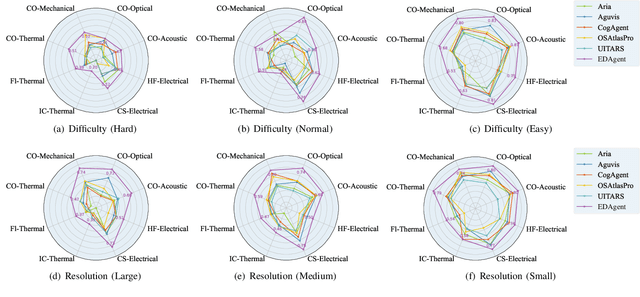
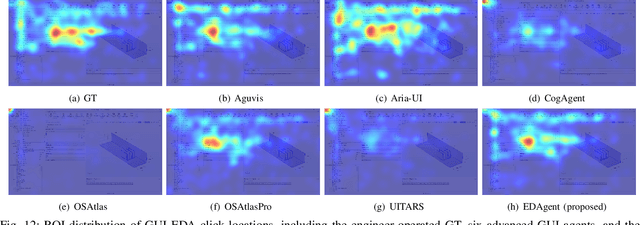
Graphical User Interface (GUI) agents adopt an end-to-end paradigm that maps a screenshot to an action sequence, thereby automating repetitive tasks in virtual environments. However, existing GUI agents are evaluated almost exclusively on commodity software such as Microsoft Word and Excel. Professional Computer-Aided Design (CAD) suites promise an order-of-magnitude higher economic return, yet remain the weakest performance domain for existing agents and are still far from replacing expert Electronic-Design-Automation (EDA) engineers. We therefore present the first systematic study that deploys GUI agents for EDA workflows. Our contributions are: (1) a large-scale dataset named GUI-EDA, including 5 CAD tools and 5 physical domains, comprising 2,000+ high-quality screenshot-answer-action pairs recorded by EDA scientists and engineers during real-world component design; (2) a comprehensive benchmark that evaluates 30+ mainstream GUI agents, demonstrating that EDA tasks constitute a major, unsolved challenge; and (3) an EDA-specialized metric named EDAgent, equipped with a reflection mechanism that achieves reliable performance on industrial CAD software and, for the first time, outperforms Ph.D. students majored in Electrical Engineering. This work extends GUI agents from generic office automation to specialized, high-value engineering domains and offers a new avenue for advancing EDA productivity. The dataset will be released at: https://github.com/aiben-ch/GUI-EDA.
SFP: Real-World Scene Recovery Using Spatial and Frequency Priors
Dec 09, 2025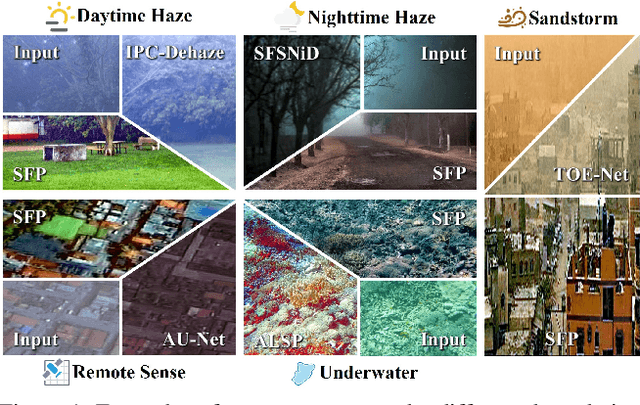
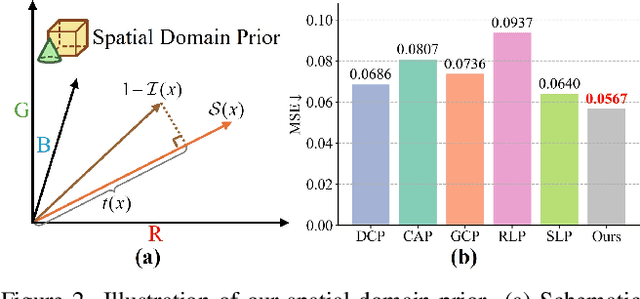
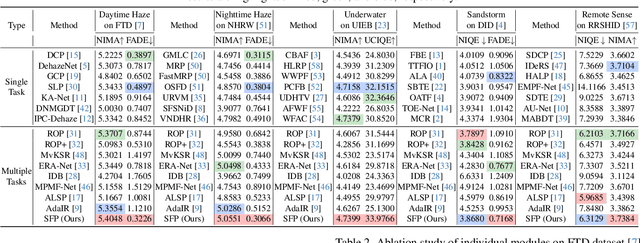
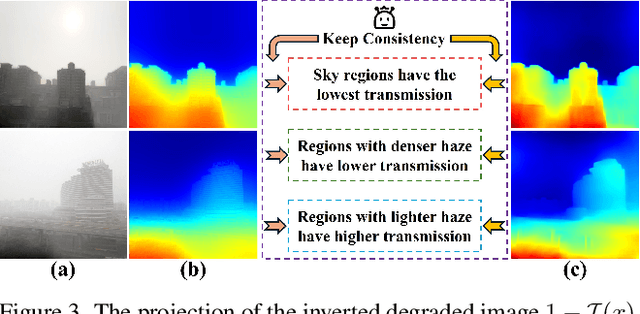
Scene recovery serves as a critical task for various computer vision applications. Existing methods typically rely on a single prior, which is inherently insufficient to handle multiple degradations, or employ complex network architectures trained on synthetic data, which suffer from poor generalization for diverse real-world scenarios. In this paper, we propose Spatial and Frequency Priors (SFP) for real-world scene recovery. In the spatial domain, we observe that the inverse of the degraded image exhibits a projection along its spectral direction that resembles the scene transmission. Leveraging this spatial prior, the transmission map is estimated to recover the scene from scattering degradation. In the frequency domain, a mask is constructed for adaptive frequency enhancement, with two parameters estimated using our proposed novel priors. Specifically, one prior assumes that the mean intensity of the degraded image's direct current (DC) components across three channels in the frequency domain closely approximates that of each channel in the clear image. The second prior is based on the observation that, for clear images, the magnitude of low radial frequencies below 0.001 constitutes approximately 1% of the total spectrum. Finally, we design a weighted fusion strategy to integrate spatial-domain restoration, frequency-domain enhancement, and salient features from the input image, yielding the final recovered result. Extensive evaluations demonstrate the effectiveness and superiority of our proposed SFP for scene recovery under various degradation conditions.