 Add to Chrome
 Add to Firefox
 Add to Edge
Beauty in the Eye of AI: Aligning LLMs and Vision Models with Human Aesthetics in Network Visualization
Apr 03, 2026
Network visualization has traditionally relied on heuristic metrics, such as stress, under the assumption that optimizing them leads to aesthetic and informative layouts. However, no single metric consistently produces the most effective results. A data-driven alternative is to learn from human preferences, where annotators select their favored visualization among multiple layouts of the same graphs. These human-preference labels can then be used to train a generative model that approximates human aesthetic preferences. However, obtaining human labels at scale is costly and time-consuming. As a result, this generative approach has so far been tested only with machine-labeled data. In this paper, we explore the use of large language models (LLMs) and vision models (VMs) as proxies for human judgment. Through a carefully designed user study involving 27 participants, we curated a large set of human preference labels. We used this data both to better understand human preferences and to bootstrap LLM/VM labelers. We show that prompt engineering that combines few-shot examples and diverse input formats, such as image embeddings, significantly improves LLM-human alignment, and additional filtering by the confidence score of the LLM pushes the alignment to human-human levels. Furthermore, we demonstrate that carefully trained VMs can achieve VM-human alignment at a level comparable to that between human annotators. Our results suggest that AI can feasibly serve as a scalable proxy for human labelers.

Refold: Refining Protein Inverse Folding with Efficient Structural Matching and Fusion
Mar 15, 2026Protein inverse folding aims to design an amino acid sequence that will fold into a given backbone structure, serving as a central task in protein design. Two main paradigms have been widely explored. Template-based methods exploit database-derived structural priors and can achieve high local precision when close structural neighbors are available, but their dependence on database coverage and match quality often degrades performance on out-of-distribution (OOD) targets. Deep learning approaches, in contrast, learn general structure-to-sequence regularities and usually generalize better to new backbones. However, they struggle to capture fine-grained local structure, which can cause uncertain residue predictions and missed local motifs in ambiguous regions. We introduce Refold, a novel framework that synergistically integrates the strengths of database-derived structural priors and deep learning prediction to enhance inverse folding. Refold obtains structural priors from matched neighbors and fuses them with model predictions to refine residue probabilities. In practice, low-quality neighbors can introduce noise, potentially degrading model performance. We address this issue with a Dynamic Utility Gate that controls prior injection and falls back to the base prediction when the priors are untrustworthy. Comprehensive evaluations on standard benchmarks demonstrate that Refold achieves state-of-the-art native sequence recovery of 0.63 on both CATH 4.2 and CATH 4.3. Also, analysis indicates that Refold delivers larger gains on high-uncertainty regions, reflecting the complementarity between structural priors and deep learning predictions.
The Geometry of Transfer: Unlocking Medical Vision Manifolds for Training-Free Model Ranking
Feb 27, 2026The advent of large-scale self-supervised learning (SSL) has produced a vast zoo of medical foundation models. However, selecting optimal medical foundation models for specific segmentation tasks remains a computational bottleneck. Existing Transferability Estimation (TE) metrics, primarily designed for classification, rely on global statistical assumptions and fail to capture the topological complexity essential for dense prediction. We propose a novel Topology-Driven Transferability Estimation framework that evaluates manifold tractability rather than statistical overlap. Our approach introduces three components: (1) Global Representation Topology Divergence (GRTD), utilizing Minimum Spanning Trees to quantify feature-label structural isomorphism; (2) Local Boundary-Aware Topological Consistency (LBTC), which assesses manifold separability specifically at critical anatomical boundaries; and (3) Task-Adaptive Fusion, which dynamically integrates global and local metrics based on the semantic cardinality of the target task. Validated on the large-scale OpenMind benchmark across diverse anatomical targets and SSL foundation models, our approach significantly outperforms state-of-the-art baselines by around \textbf{31\%} relative improvement in the weighted Kendall, providing a robust, training-free proxy for efficient model selection without the cost of fine-tuning. The code will be made publicly available upon acceptance.
Image Quality Assessment for Machines: Paradigm, Large-scale Database, and Models
Aug 27, 2025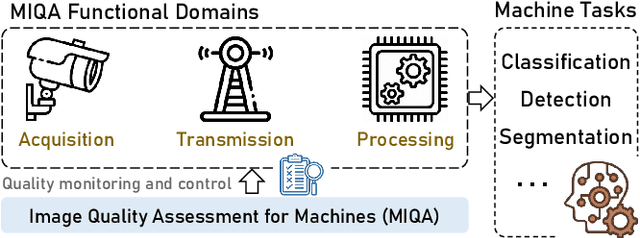

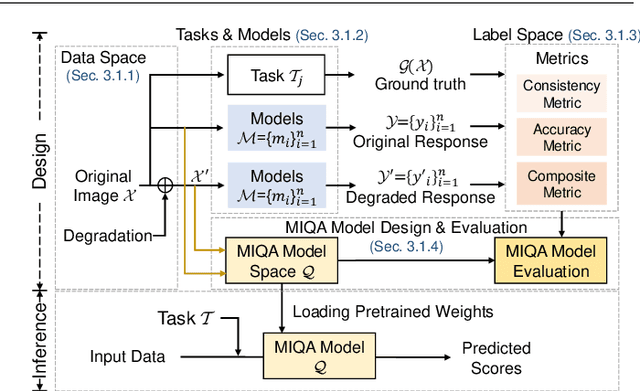
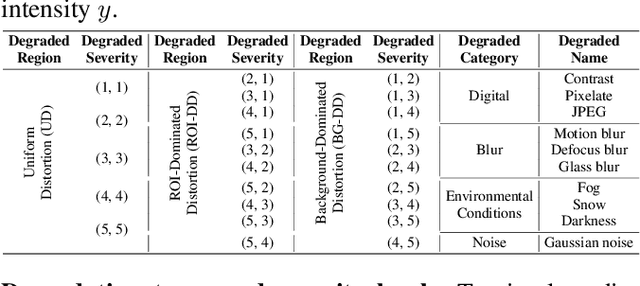
Machine vision systems (MVS) are intrinsically vulnerable to performance degradation under adverse visual conditions. To address this, we propose a machine-centric image quality assessment (MIQA) framework that quantifies the impact of image degradations on MVS performance. We establish an MIQA paradigm encompassing the end-to-end assessment workflow. To support this, we construct a machine-centric image quality database (MIQD-2.5M), comprising 2.5 million samples that capture distinctive degradation responses in both consistency and accuracy metrics, spanning 75 vision models, 250 degradation types, and three representative vision tasks. We further propose a region-aware MIQA (RA-MIQA) model to evaluate MVS visual quality through fine-grained spatial degradation analysis. Extensive experiments benchmark the proposed RA-MIQA against seven human visual system (HVS)-based IQA metrics and five retrained classical backbones. Results demonstrate RA-MIQA's superior performance in multiple dimensions, e.g., achieving SRCC gains of 13.56% on consistency and 13.37% on accuracy for image classification, while also revealing task-specific degradation sensitivities. Critically, HVS-based metrics prove inadequate for MVS quality prediction, while even specialized MIQA models struggle with background degradations, accuracy-oriented estimation, and subtle distortions. This study can advance MVS reliability and establish foundations for machine-centric image processing and optimization. The model and code are available at: https://github.com/XiaoqiWang/MIQA.
EVA02-AT: Egocentric Video-Language Understanding with Spatial-Temporal Rotary Positional Embeddings and Symmetric Optimization
Jun 17, 2025Egocentric video-language understanding demands both high efficiency and accurate spatial-temporal modeling. Existing approaches face three key challenges: 1) Excessive pre-training cost arising from multi-stage pre-training pipelines, 2) Ineffective spatial-temporal encoding due to manually split 3D rotary positional embeddings that hinder feature interactions, and 3) Imprecise learning objectives in soft-label multi-instance retrieval, which neglect negative pair correlations. In this paper, we introduce EVA02-AT, a suite of EVA02-based video-language foundation models tailored to egocentric video understanding tasks. EVA02-AT first efficiently transfers an image-based CLIP model into a unified video encoder via a single-stage pretraining. Second, instead of applying rotary positional embeddings to isolated dimensions, we introduce spatial-temporal rotary positional embeddings along with joint attention, which can effectively encode both spatial and temporal information on the entire hidden dimension. This joint encoding of spatial-temporal features enables the model to learn cross-axis relationships, which are crucial for accurately modeling motion and interaction in videos. Third, focusing on multi-instance video-language retrieval tasks, we introduce the Symmetric Multi-Similarity (SMS) loss and a novel training framework that advances all soft labels for both positive and negative pairs, providing a more precise learning objective. Extensive experiments on Ego4D, EPIC-Kitchens-100, and Charades-Ego under zero-shot and fine-tuning settings demonstrate that EVA02-AT achieves state-of-the-art performance across diverse egocentric video-language tasks with fewer parameters. Models with our SMS loss also show significant performance gains on multi-instance retrieval benchmarks. Our code and models are publicly available at https://github.com/xqwang14/EVA02-AT .
AOLO: Analysis and Optimization For Low-Carbon Oriented Wireless Large Language Model Services
Mar 06, 2025Recent advancements in large language models (LLMs) have led to their widespread adoption and large-scale deployment across various domains. However, their environmental impact, particularly during inference, has become a growing concern due to their substantial energy consumption and carbon footprint. Existing research has focused on inference computation alone, overlooking the analysis and optimization of carbon footprint in network-aided LLM service systems. To address this gap, we propose AOLO, a framework for analysis and optimization for low-carbon oriented wireless LLM services. AOLO introduces a comprehensive carbon footprint model that quantifies greenhouse gas emissions across the entire LLM service chain, including computational inference and wireless communication. Furthermore, we formulate an optimization problem aimed at minimizing the overall carbon footprint, which is solved through joint optimization of inference outputs and transmit power under quality-of-experience and system performance constraints. To achieve this joint optimization, we leverage the energy efficiency of spiking neural networks (SNNs) by adopting SNN as the actor network and propose a low-carbon-oriented optimization algorithm, i.e., SNN-based deep reinforcement learning (SDRL). Comprehensive simulations demonstrate that SDRL algorithm significantly reduces overall carbon footprint, achieving an 18.77% reduction compared to the benchmark soft actor-critic, highlighting its potential for enabling more sustainable LLM inference services.
AdvDreamer Unveils: Are Vision-Language Models Truly Ready for Real-World 3D Variations?
Dec 04, 2024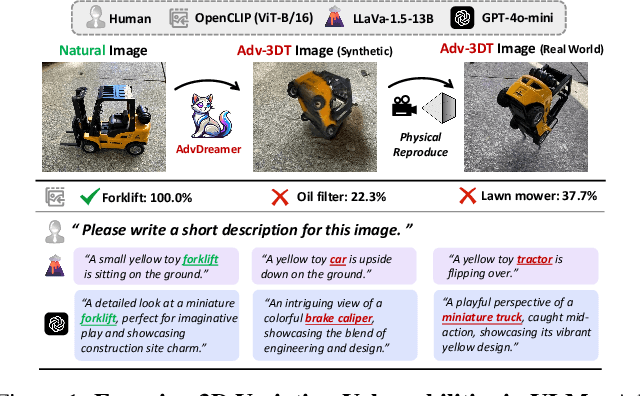
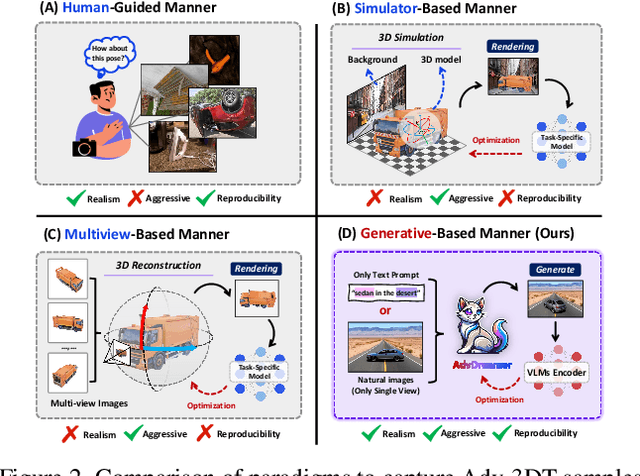


Vision Language Models (VLMs) have exhibited remarkable generalization capabilities, yet their robustness in dynamic real-world scenarios remains largely unexplored. To systematically evaluate VLMs' robustness to real-world 3D variations, we propose AdvDreamer, the first framework that generates physically reproducible adversarial 3D transformation (Adv-3DT) samples from single-view images. AdvDreamer integrates advanced generative techniques with two key innovations and aims to characterize the worst-case distributions of 3D variations from natural images. To ensure adversarial effectiveness and method generality, we introduce an Inverse Semantic Probability Objective that executes adversarial optimization on fundamental vision-text alignment spaces, which can be generalizable across different VLM architectures and downstream tasks. To mitigate the distribution discrepancy between generated and real-world samples while maintaining physical reproducibility, we design a Naturalness Reward Model that provides regularization feedback during adversarial optimization, preventing convergence towards hallucinated and unnatural elements. Leveraging AdvDreamer, we establish MM3DTBench, the first VQA dataset for benchmarking VLMs' 3D variations robustness. Extensive evaluations on representative VLMs with diverse architectures highlight that 3D variations in the real world may pose severe threats to model performance across various tasks.
DT-JRD: Deep Transformer based Just Recognizable Difference Prediction Model for Video Coding for Machines
Nov 14, 2024Just Recognizable Difference (JRD) represents the minimum visual difference that is detectable by machine vision, which can be exploited to promote machine vision oriented visual signal processing. In this paper, we propose a Deep Transformer based JRD (DT-JRD) prediction model for Video Coding for Machines (VCM), where the accurately predicted JRD can be used reduce the coding bit rate while maintaining the accuracy of machine tasks. Firstly, we model the JRD prediction as a multi-class classification and propose a DT-JRD prediction model that integrates an improved embedding, a content and distortion feature extraction, a multi-class classification and a novel learning strategy. Secondly, inspired by the perception property that machine vision exhibits a similar response to distortions near JRD, we propose an asymptotic JRD loss by using Gaussian Distribution-based Soft Labels (GDSL), which significantly extends the number of training labels and relaxes classification boundaries. Finally, we propose a DT-JRD based VCM to reduce the coding bits while maintaining the accuracy of object detection. Extensive experimental results demonstrate that the mean absolute error of the predicted JRD by the DT-JRD is 5.574, outperforming the state-of-the-art JRD prediction model by 13.1%. Coding experiments shows that comparing with the VVC, the DT-JRD based VCM achieves an average of 29.58% bit rate reduction while maintaining the object detection accuracy.
FedNE: Surrogate-Assisted Federated Neighbor Embedding for Dimensionality Reduction
Sep 17, 2024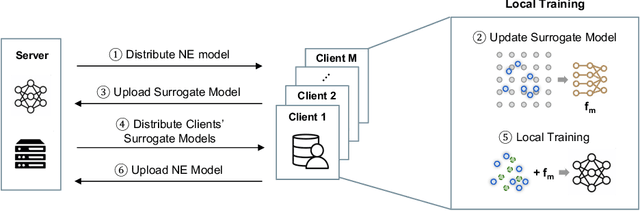
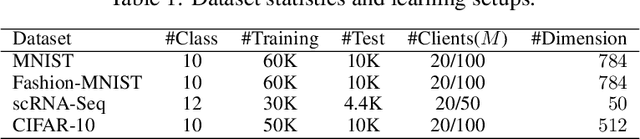
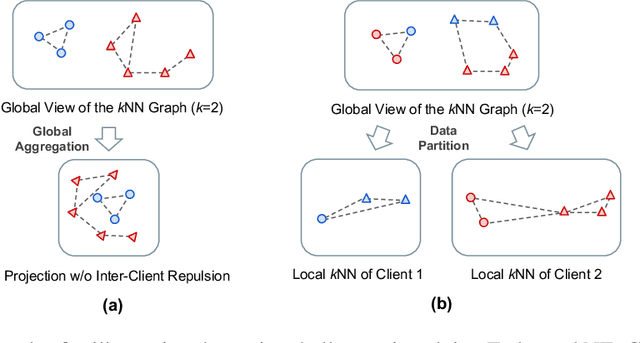

Federated learning (FL) has rapidly evolved as a promising paradigm that enables collaborative model training across distributed participants without exchanging their local data. Despite its broad applications in fields such as computer vision, graph learning, and natural language processing, the development of a data projection model that can be effectively used to visualize data in the context of FL is crucial yet remains heavily under-explored. Neighbor embedding (NE) is an essential technique for visualizing complex high-dimensional data, but collaboratively learning a joint NE model is difficult. The key challenge lies in the objective function, as effective visualization algorithms like NE require computing loss functions among pairs of data. In this paper, we introduce \textsc{FedNE}, a novel approach that integrates the \textsc{FedAvg} framework with the contrastive NE technique, without any requirements of shareable data. To address the lack of inter-client repulsion which is crucial for the alignment in the global embedding space, we develop a surrogate loss function that each client learns and shares with each other. Additionally, we propose a data-mixing strategy to augment the local data, aiming to relax the problems of invisible neighbors and false neighbors constructed by the local $k$NN graphs. We conduct comprehensive experiments on both synthetic and real-world datasets. The results demonstrate that our \textsc{FedNE} can effectively preserve the neighborhood data structures and enhance the alignment in the global embedding space compared to several baseline methods.
Global-Local Progressive Integration Network for Blind Image Quality Assessment
Aug 07, 2024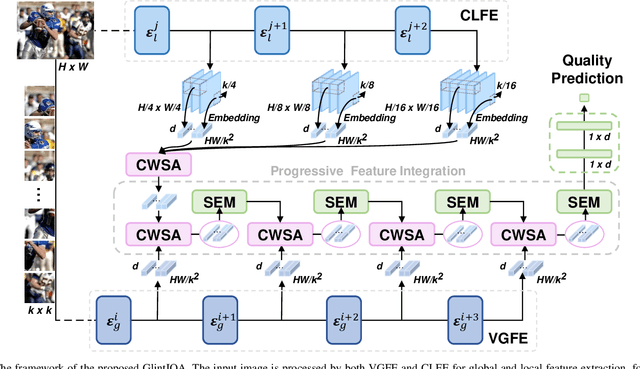
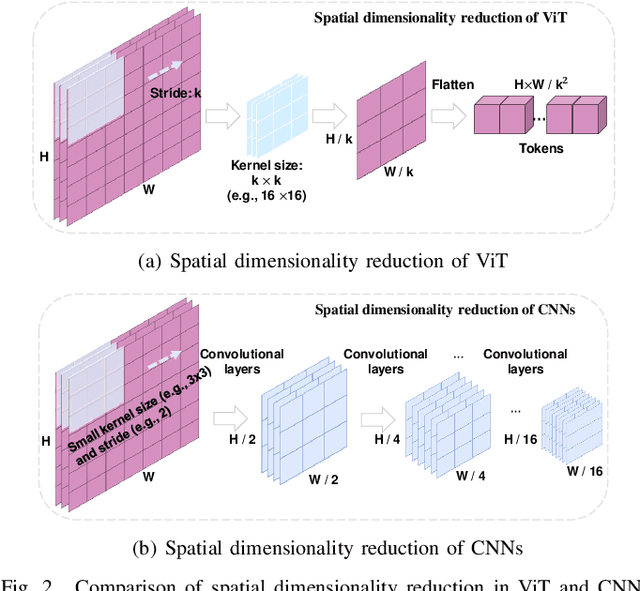
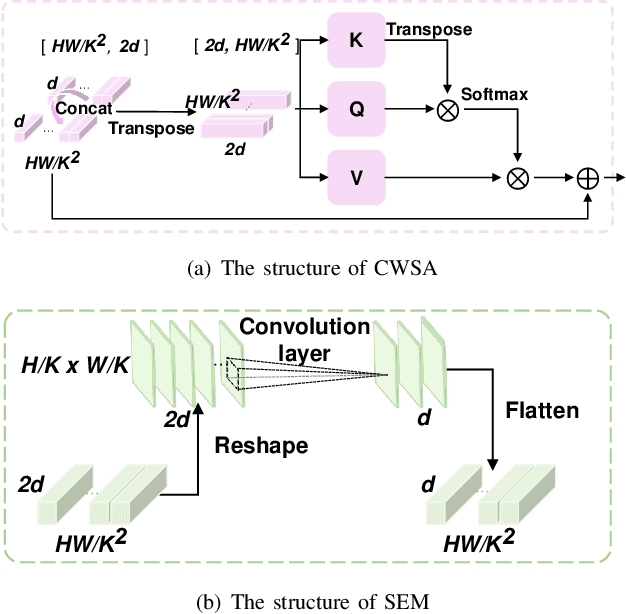
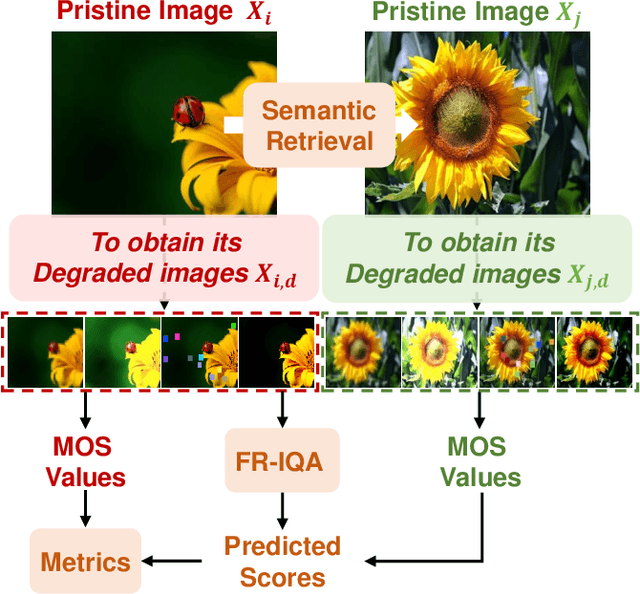
Vision transformers (ViTs) excel in computer vision for modeling long-term dependencies, yet face two key challenges for image quality assessment (IQA): discarding fine details during patch embedding, and requiring extensive training data due to lack of inductive biases. In this study, we propose a Global-Local progressive INTegration network for IQA, called GlintIQA, to address these issues through three key components: 1) Hybrid feature extraction combines ViT-based global feature extractor (VGFE) and convolutional neural networks (CNNs)-based local feature extractor (CLFE) to capture global coarse-grained features and local fine-grained features, respectively. The incorporation of CNNs mitigates the patch-level information loss and inductive bias constraints inherent to ViT architectures. 2) Progressive feature integration leverages diverse kernel sizes in embedding to spatially align coarse- and fine-grained features, and progressively aggregate these features by interactively stacking channel-wise attention and spatial enhancement modules to build effective quality-aware representations. 3) Content similarity-based labeling approach is proposed that automatically assigns quality labels to images with diverse content based on subjective quality scores. This addresses the scarcity of labeled training data in synthetic datasets and bolsters model generalization. The experimental results demonstrate the efficacy of our approach, yielding 5.04% average SROCC gains on cross-authentic dataset evaluations. Moreover, our model and its counterpart pre-trained on the proposed dataset respectively exhibited 5.40% and 13.23% improvements on across-synthetic datasets evaluation. The codes and proposed dataset will be released at https://github.com/XiaoqiWang/GlintIQA.