 Add to Chrome
 Add to Firefox
 Add to Edge
From Global to Granular: Revealing IQA Model Performance via Correlation Surface
Jan 29, 2026
Evaluation of Image Quality Assessment (IQA) models has long been dominated by global correlation metrics, such as Pearson Linear Correlation Coefficient (PLCC) and Spearman Rank-Order Correlation Coefficient (SRCC). While widely adopted, these metrics reduce performance to a single scalar, failing to capture how ranking consistency varies across the local quality spectrum. For example, two IQA models may achieve identical SRCC values, yet one ranks high-quality images (related to high Mean Opinion Score, MOS) more reliably, while the other better discriminates image pairs with small quality/MOS differences (related to $|Δ$MOS$|$). Such complementary behaviors are invisible under global metrics. Moreover, SRCC and PLCC are sensitive to test-sample quality distributions, yielding unstable comparisons across test sets. To address these limitations, we propose \textbf{Granularity-Modulated Correlation (GMC)}, which provides a structured, fine-grained analysis of IQA performance. GMC includes: (1) a \textbf{Granularity Modulator} that applies Gaussian-weighted correlations conditioned on absolute MOS values and pairwise MOS differences ($|Δ$MOS$|$) to examine local performance variations, and (2) a \textbf{Distribution Regulator} that regularizes correlations to mitigate biases from non-uniform quality distributions. The resulting \textbf{correlation surface} maps correlation values as a joint function of MOS and $|Δ$MOS$|$, providing a 3D representation of IQA performance. Experiments on standard benchmarks show that GMC reveals performance characteristics invisible to scalar metrics, offering a more informative and reliable paradigm for analyzing, comparing, and deploying IQA models. Codes are available at https://github.com/Dniaaa/GMC.

Mitigating Perception Bias: A Training-Free Approach to Enhance LMM for Image Quality Assessment
Nov 19, 2024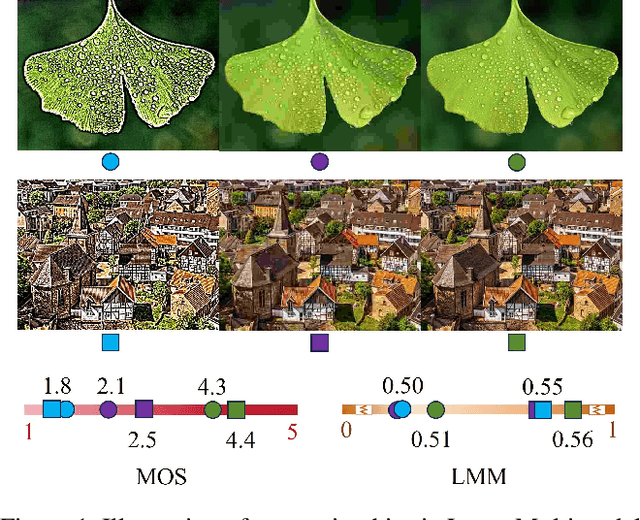
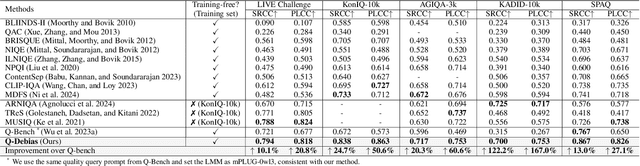
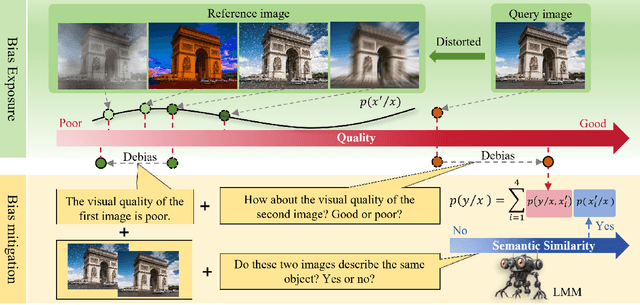

Despite the impressive performance of large multimodal models (LMMs) in high-level visual tasks, their capacity for image quality assessment (IQA) remains limited. One main reason is that LMMs are primarily trained for high-level tasks (e.g., image captioning), emphasizing unified image semantics extraction under varied quality. Such semantic-aware yet quality-insensitive perception bias inevitably leads to a heavy reliance on image semantics when those LMMs are forced for quality rating. In this paper, instead of retraining or tuning an LMM costly, we propose a training-free debiasing framework, in which the image quality prediction is rectified by mitigating the bias caused by image semantics. Specifically, we first explore several semantic-preserving distortions that can significantly degrade image quality while maintaining identifiable semantics. By applying these specific distortions to the query or test images, we ensure that the degraded images are recognized as poor quality while their semantics remain. During quality inference, both a query image and its corresponding degraded version are fed to the LMM along with a prompt indicating that the query image quality should be inferred under the condition that the degraded one is deemed poor quality.This prior condition effectively aligns the LMM's quality perception, as all degraded images are consistently rated as poor quality, regardless of their semantic difference.Finally, the quality scores of the query image inferred under different prior conditions (degraded versions) are aggregated using a conditional probability model. Extensive experiments on various IQA datasets show that our debiasing framework could consistently enhance the LMM performance and the code will be publicly available.