 Add to Chrome
 Add to Firefox
 Add to Edge
DDTracking: A Deep Generative Framework for Diffusion MRI Tractography with Streamline Local-Global Spatiotemporal Modeling
Aug 06, 2025
This paper presents DDTracking, a novel deep generative framework for diffusion MRI tractography that formulates streamline propagation as a conditional denoising diffusion process. In DDTracking, we introduce a dual-pathway encoding network that jointly models local spatial encoding (capturing fine-scale structural details at each streamline point) and global temporal dependencies (ensuring long-range consistency across the entire streamline). Furthermore, we design a conditional diffusion model module, which leverages the learned local and global embeddings to predict streamline propagation orientations for tractography in an end-to-end trainable manner. We conduct a comprehensive evaluation across diverse, independently acquired dMRI datasets, including both synthetic and clinical data. Experiments on two well-established benchmarks with ground truth (ISMRM Challenge and TractoInferno) demonstrate that DDTracking largely outperforms current state-of-the-art tractography methods. Furthermore, our results highlight DDTracking's strong generalizability across heterogeneous datasets, spanning varying health conditions, age groups, imaging protocols, and scanner types. Collectively, DDTracking offers anatomically plausible and robust tractography, presenting a scalable, adaptable, and end-to-end learnable solution for broad dMRI applications. Code is available at: https://github.com/yishengpoxiao/DDtracking.git

Learning Personalised Human Internal Cognition from External Expressive Behaviours for Real Personality Recognition
Jul 31, 2025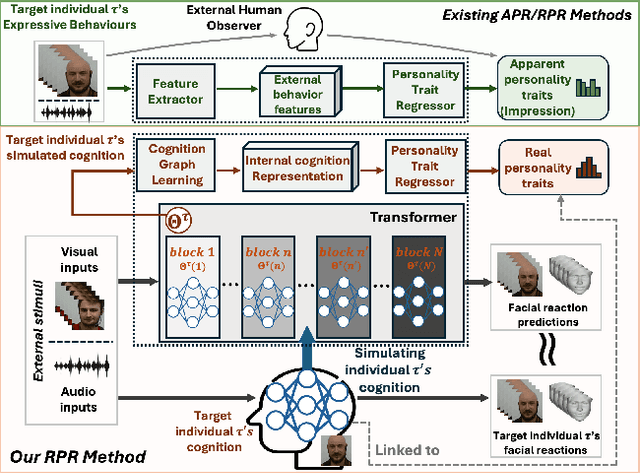
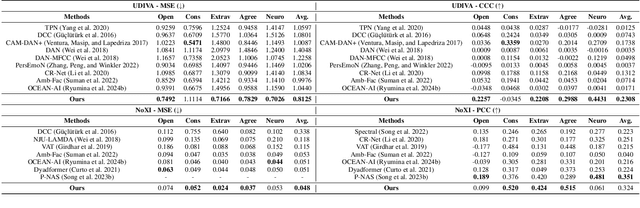
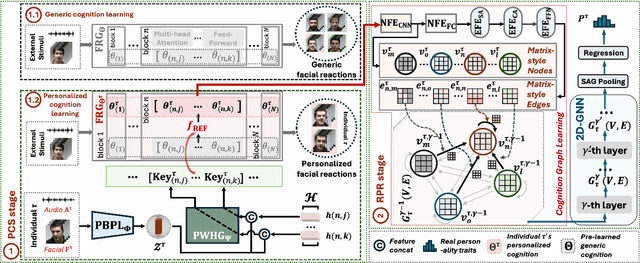
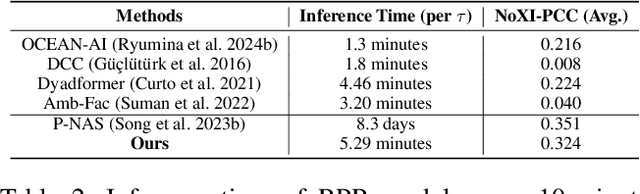
Automatic real personality recognition (RPR) aims to evaluate human real personality traits from their expressive behaviours. However, most existing solutions generally act as external observers to infer observers' personality impressions based on target individuals' expressive behaviours, which significantly deviate from their real personalities and consistently lead to inferior recognition performance. Inspired by the association between real personality and human internal cognition underlying the generation of expressive behaviours, we propose a novel RPR approach that efficiently simulates personalised internal cognition from easy-accessible external short audio-visual behaviours expressed by the target individual. The simulated personalised cognition, represented as a set of network weights that enforce the personalised network to reproduce the individual-specific facial reactions, is further encoded as a novel graph containing two-dimensional node and edge feature matrices, with a novel 2D Graph Neural Network (2D-GNN) proposed for inferring real personality traits from it. To simulate real personality-related cognition, an end-to-end strategy is designed to jointly train our cognition simulation, 2D graph construction, and personality recognition modules.
IFEvalCode: Controlled Code Generation
Jul 30, 2025Code large language models (Code LLMs) have made significant progress in code generation by translating natural language descriptions into functional code; however, real-world applications often demand stricter adherence to detailed requirements such as coding style, line count, and structural constraints, beyond mere correctness. To address this, the paper introduces forward and backward constraints generation to improve the instruction-following capabilities of Code LLMs in controlled code generation, ensuring outputs align more closely with human-defined guidelines. The authors further present IFEvalCode, a multilingual benchmark comprising 1.6K test samples across seven programming languages (Python, Java, JavaScript, TypeScript, Shell, C++, and C#), with each sample featuring both Chinese and English queries. Unlike existing benchmarks, IFEvalCode decouples evaluation into two metrics: correctness (Corr.) and instruction-following (Instr.), enabling a more nuanced assessment. Experiments on over 40 LLMs reveal that closed-source models outperform open-source ones in controllable code generation and highlight a significant gap between the models' ability to generate correct code versus code that precisely follows instructions.
FinGAIA: An End-to-End Benchmark for Evaluating AI Agents in Finance
Jul 23, 2025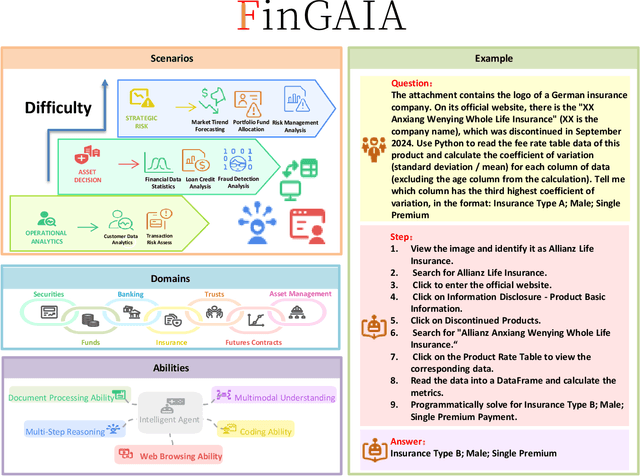
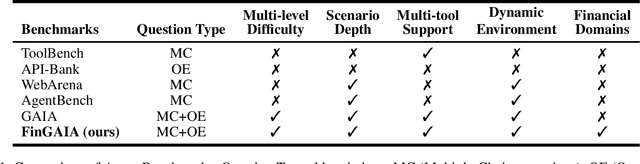
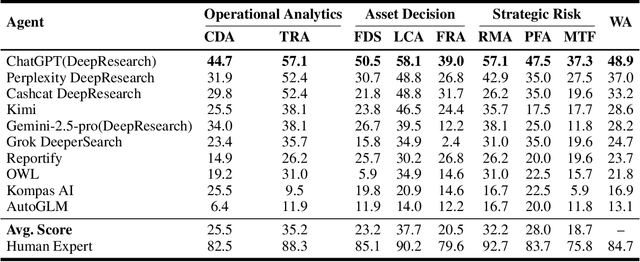
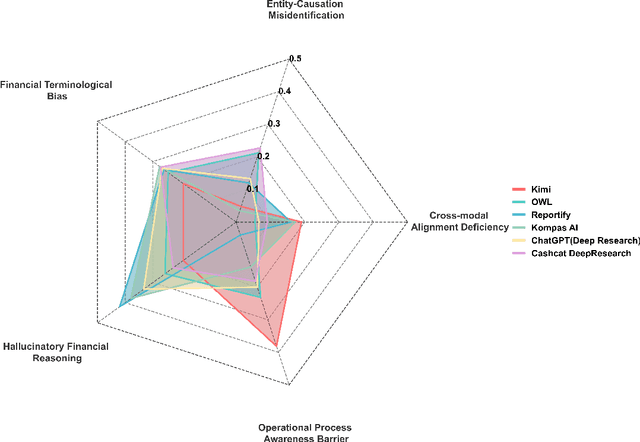
The booming development of AI agents presents unprecedented opportunities for automating complex tasks across various domains. However, their multi-step, multi-tool collaboration capabilities in the financial sector remain underexplored. This paper introduces FinGAIA, an end-to-end benchmark designed to evaluate the practical abilities of AI agents in the financial domain. FinGAIA comprises 407 meticulously crafted tasks, spanning seven major financial sub-domains: securities, funds, banking, insurance, futures, trusts, and asset management. These tasks are organized into three hierarchical levels of scenario depth: basic business analysis, asset decision support, and strategic risk management. We evaluated 10 mainstream AI agents in a zero-shot setting. The best-performing agent, ChatGPT, achieved an overall accuracy of 48.9\%, which, while superior to non-professionals, still lags financial experts by over 35 percentage points. Error analysis has revealed five recurring failure patterns: Cross-modal Alignment Deficiency, Financial Terminological Bias, Operational Process Awareness Barrier, among others. These patterns point to crucial directions for future research. Our work provides the first agent benchmark closely related to the financial domain, aiming to objectively assess and promote the development of agents in this crucial field. Partial data is available at https://github.com/SUFE-AIFLM-Lab/FinGAIA.
RS-TinyNet: Stage-wise Feature Fusion Network for Detecting Tiny Objects in Remote Sensing Images
Jul 17, 2025Detecting tiny objects in remote sensing (RS) imagery has been a long-standing challenge due to their extremely limited spatial information, weak feature representations, and dense distributions across complex backgrounds. Despite numerous efforts devoted, mainstream detectors still underperform in such scenarios. To bridge this gap, we introduce RS-TinyNet, a multi-stage feature fusion and enhancement model explicitly tailored for RS tiny object detection in various RS scenarios. RS-TinyNet comes with two novel designs: tiny object saliency modeling and feature integrity reconstruction. Guided by these principles, we design three step-wise feature enhancement modules. Among them, the multi-dimensional collaborative attention (MDCA) module employs multi-dimensional attention to enhance the saliency of tiny objects. Additionally, the auxiliary reversible branch (ARB) and a progressive fusion detection head (PFDH) module are introduced to preserve information flow and fuse multi-level features to bridge semantic gaps and retain structural detail. Comprehensive experiments on public RS dataset AI-TOD show that our RS-TinyNet surpasses existing state-of-the-art (SOTA) detectors by 4.0% AP and 6.5% AP75. Evaluations on DIOR benchmark dataset further validate its superior detection performance in diverse RS scenarios. These results demonstrate that the proposed multi-stage feature fusion strategy offers an effective and practical solution for tiny object detection in complex RS environments.
Partial Weakly-Supervised Oriented Object Detection
Jul 03, 2025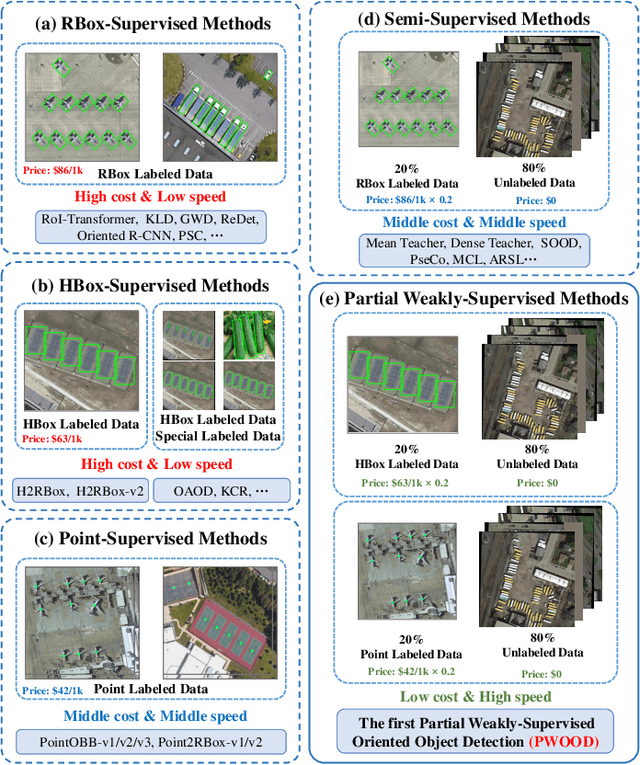
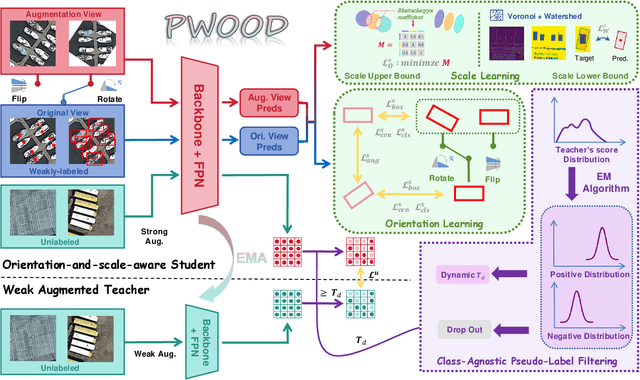
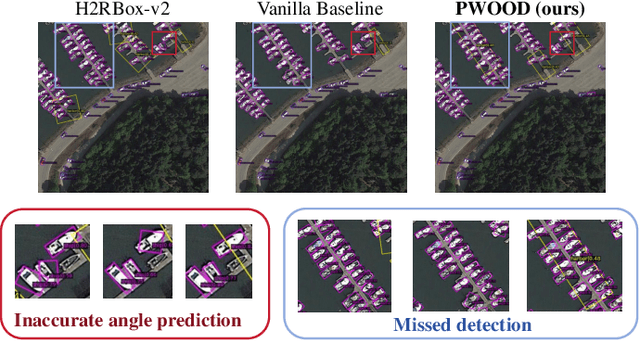
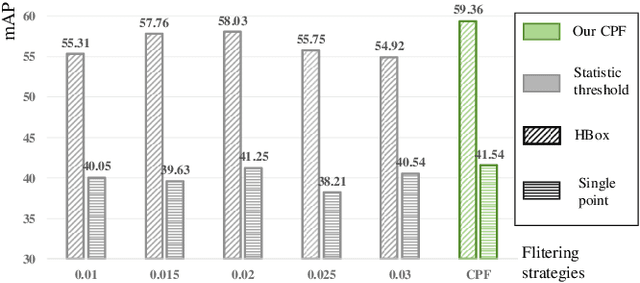
The growing demand for oriented object detection (OOD) across various domains has driven significant research in this area. However, the high cost of dataset annotation remains a major concern. Current mainstream OOD algorithms can be mainly categorized into three types: (1) fully supervised methods using complete oriented bounding box (OBB) annotations, (2) semi-supervised methods using partial OBB annotations, and (3) weakly supervised methods using weak annotations such as horizontal boxes or points. However, these algorithms inevitably increase the cost of models in terms of annotation speed or annotation cost. To address this issue, we propose:(1) the first Partial Weakly-Supervised Oriented Object Detection (PWOOD) framework based on partially weak annotations (horizontal boxes or single points), which can efficiently leverage large amounts of unlabeled data, significantly outperforming weakly supervised algorithms trained with partially weak annotations, also offers a lower cost solution; (2) Orientation-and-Scale-aware Student (OS-Student) model capable of learning orientation and scale information with only a small amount of orientation-agnostic or scale-agnostic weak annotations; and (3) Class-Agnostic Pseudo-Label Filtering strategy (CPF) to reduce the model's sensitivity to static filtering thresholds. Comprehensive experiments on DOTA-v1.0/v1.5/v2.0 and DIOR datasets demonstrate that our PWOOD framework performs comparably to, or even surpasses, traditional semi-supervised algorithms.
Rethinking All Evidence: Enhancing Trustworthy Retrieval-Augmented Generation via Conflict-Driven Summarization
Jul 02, 2025Retrieval-Augmented Generation (RAG) enhances large language models (LLMs) by integrating their parametric knowledge with external retrieved content. However, knowledge conflicts caused by internal inconsistencies or noisy retrieved content can severely undermine the generation reliability of RAG systems.In this work, we argue that LLMs should rethink all evidence, including both retrieved content and internal knowledge, before generating responses.We propose CARE-RAG (Conflict-Aware and Reliable Evidence for RAG), a novel framework that improves trustworthiness through Conflict-Driven Summarization of all available evidence.CARE-RAG first derives parameter-aware evidence by comparing parameter records to identify diverse internal perspectives. It then refines retrieved evidences to produce context-aware evidence, removing irrelevant or misleading content. To detect and summarize conflicts, we distill a 3B LLaMA3.2 model to perform conflict-driven summarization, enabling reliable synthesis across multiple sources.To further ensure evaluation integrity, we introduce a QA Repair step to correct outdated or ambiguous benchmark answers.Experiments on revised QA datasets with retrieval data show that CARE-RAG consistently outperforms strong RAG baselines, especially in scenarios with noisy or conflicting evidence.
Hardware-software co-exploration with racetrack memory based in-memory computing for CNN inference in embedded systems
Jul 02, 2025Deep neural networks generate and process large volumes of data, posing challenges for low-resource embedded systems. In-memory computing has been demonstrated as an efficient computing infrastructure and shows promise for embedded AI applications. Among newly-researched memory technologies, racetrack memory is a non-volatile technology that allows high data density fabrication, making it a good fit for in-memory computing. However, integrating in-memory arithmetic circuits with memory cells affects both the memory density and power efficiency. It remains challenging to build efficient in-memory arithmetic circuits on racetrack memory within area and energy constraints. To this end, we present an efficient in-memory convolutional neural network (CNN) accelerator optimized for use with racetrack memory. We design a series of fundamental arithmetic circuits as in-memory computing cells suited for multiply-and-accumulate operations. Moreover, we explore the design space of racetrack memory based systems and CNN model architectures, employing co-design to improve the efficiency and performance of performing CNN inference in racetrack memory while maintaining model accuracy. Our designed circuits and model-system co-optimization strategies achieve a small memory bank area with significant improvements in energy and performance for racetrack memory based embedded systems.
Temporal-IRL: Modeling Port Congestion and Berth Scheduling with Inverse Reinforcement Learning
Jun 24, 2025Predicting port congestion is crucial for maintaining reliable global supply chains. Accurate forecasts enableimprovedshipment planning, reducedelaysand costs, and optimizeinventoryanddistributionstrategies, thereby ensuring timely deliveries and enhancing supply chain resilience. To achieve accurate predictions, analyzing vessel behavior and their stay times at specific port terminals is essential, focusing particularly on berth scheduling under various conditions. Crucially, the model must capture and learn the underlying priorities and patterns of berth scheduling. Berth scheduling and planning are influenced by a range of factors, including incoming vessel size, waiting times, and the status of vessels within the port terminal. By observing historical Automatic Identification System (AIS) positions of vessels, we reconstruct berth schedules, which are subsequently utilized to determine the reward function via Inverse Reinforcement Learning (IRL). For this purpose, we modeled a specific terminal at the Port of New York/New Jersey and developed Temporal-IRL. This Temporal-IRL model learns berth scheduling to predict vessel sequencing at the terminal and estimate vessel port stay, encompassing both waiting and berthing times, to forecast port congestion. Utilizing data from Maher Terminal spanning January 2015 to September 2023, we trained and tested the model, achieving demonstrably excellent results.
UniDet-D: A Unified Dynamic Spectral Attention Model for Object Detection under Adverse Weathers
Jun 14, 2025Real-world object detection is a challenging task where the captured images/videos often suffer from complex degradations due to various adverse weather conditions such as rain, fog, snow, low-light, etc. Despite extensive prior efforts, most existing methods are designed for one specific type of adverse weather with constraints of poor generalization, under-utilization of visual features while handling various image degradations. Leveraging a theoretical analysis on how critical visual details are lost in adverse-weather images, we design UniDet-D, a unified framework that tackles the challenge of object detection under various adverse weather conditions, and achieves object detection and image restoration within a single network. Specifically, the proposed UniDet-D incorporates a dynamic spectral attention mechanism that adaptively emphasizes informative spectral components while suppressing irrelevant ones, enabling more robust and discriminative feature representation across various degradation types. Extensive experiments show that UniDet-D achieves superior detection accuracy across different types of adverse-weather degradation. Furthermore, UniDet-D demonstrates superior generalization towards unseen adverse weather conditions such as sandstorms and rain-fog mixtures, highlighting its great potential for real-world deployment.