 Add to Chrome
 Add to Firefox
 Add to Edge
MESA:Task-Adaptive Multi-Structure Evidence Selection for Long-Horizon Agent Memory
Aug 10, 2026
Long-horizon agents accumulate trajectories spanning hundreds of interleaved reasoning, action, and observation steps, where answering a query may depend on evidence buried far back in the history. External memory stores such trajectories as structured representations, yet each structure provides a distinct and incomplete view. Existing multi-memory systems either read a fixed set of structures for every query, inflating context and introducing noise, or route each query to a single structure, preventing the composition of complementary evidence. A controlled analysis on AMA-Bench shows that the optimal memory configuration is typically neither a single structure nor the full union, but a tailored composition of multiple structural memories that varies with query and task demands. Motivated by these findings, we formulate structure-level dynamic selection: selecting and fusing a query-adaptive subset from a library of specialized memory structures. We propose MESA (a Multi-structure Evidence Selection framework for long-horizon Agent), which builds five complementary structure views of each trajectory and learns from end-to-end answer-level feedback to select and fuse a query-specific subset for a frozen answer model. To learn under this weak supervision, MESA employs harness optimization with prior-guided search and UCB-guided scheduling to balance exploration and exploitation. On AMA-Bench, MESA outperforms the strongest baseline by 8.5% while using 41% fewer evidence tokens than the all-structure alternative.

SkillHEX: Improving Agent Skills via Hypothesis-Driven Autonomous Exploration and Exploitation
Aug 06, 2026Although agent skills equip LLMs with reusable procedural knowledge, manual maintenance suffers from high costs, unscalability, and misalignment. Real-world deployments thus require autonomous, on-demand skill evolution at test time, constrained by limited interaction budgets and a lack of training or validation sets. This setting introduces a severe sparse reward challenge, where outcomes conflate multiple latent failure causes. Under such ambiguity, existing methods that greedily refine a single incumbent skill are particularly vulnerable to an exploitation trap, allowing early misdiagnoses to exhaust limited trials along unproductive trajectories. To address this, we introduce SkillHEX, a closed-loop framework coupling hypothesis-driven self-verification with evidence-guided tree search. SkillHEX translates falsifiable failure hypotheses into executable tests, producing diagnostic evidence as dense reward without additional environment attempts. This evidence guides a search over persistent skill-revision branches, dynamically balancing the exploitation of supported edits with the exploration of plausible alternatives. Evaluated on 87 tasks from SkillsBench, SkillHEX outperforms existing self-evolving methods and achieves an average pass rate of 55.9% and 57.9% using GPT-5.3-Codex and Claude Opus 4.7 under a five-iteration budget, respectively.
Beyond Semantic Organization: Memory as Execution State Management for Long-Horizon Agents
Jun 04, 2026LLM-based agents increasingly tackle long-horizon tasks with interdependent decisions, where each action reshapes future constraints and intermediate errors can cascade. Existing RAG and agent memory systems organize histories by semantic similarity, retrieving content-relevant entries at decision time. We argue that this design mismatches execution-state dependencies: it fragments decision trajectories and mixes valid and erroneous traces, hindering coherent state reconstruction and error isolation. We propose MAGE (Memory as Agent-Guided Exploration), an active execution-state manager that stores interactions in a hierarchical state tree. The agent derives its state from the active root-to-current path, combining subgoal summaries, recent traces, and hints from prior branches. Four coupled operations maintain the tree: Grow records new traces, Compress summarizes completed subgoals, Maintain validates summaries, and Revise restores a target boundary and resumes on a new branch. This design bounds context growth while preserving state integrity and isolating flawed segments from the active path. Experiments on MemoryArena show that MAGE improves the average task success rate by 7.8--20.4 pp over baselines, while reducing token consumption by 55.1%.
Let Experts Feel Uncertainty: A Multi-Expert Label Distribution Approach to Probabilistic Time Series Forecasting
Feb 04, 2026Time series forecasting in real-world applications requires both high predictive accuracy and interpretable uncertainty quantification. Traditional point prediction methods often fail to capture the inherent uncertainty in time series data, while existing probabilistic approaches struggle to balance computational efficiency with interpretability. We propose a novel Multi-Expert Learning Distributional Labels (LDL) framework that addresses these challenges through mixture-of-experts architectures with distributional learning capabilities. Our approach introduces two complementary methods: (1) Multi-Expert LDL, which employs multiple experts with different learned parameters to capture diverse temporal patterns, and (2) Pattern-Aware LDL-MoE, which explicitly decomposes time series into interpretable components (trend, seasonality, changepoints, volatility) through specialized sub-experts. Both frameworks extend traditional point prediction to distributional learning, enabling rich uncertainty quantification through Maximum Mean Discrepancy (MMD). We evaluate our methods on aggregated sales data derived from the M5 dataset, demonstrating superior performance compared to baseline approaches. The continuous Multi-Expert LDL achieves the best overall performance, while the Pattern-Aware LDL-MoE provides enhanced interpretability through component-wise analysis. Our frameworks successfully balance predictive accuracy with interpretability, making them suitable for real-world forecasting applications where both performance and actionable insights are crucial.
Step-GUI Technical Report
Dec 19, 2025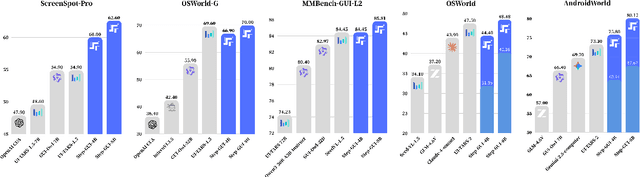
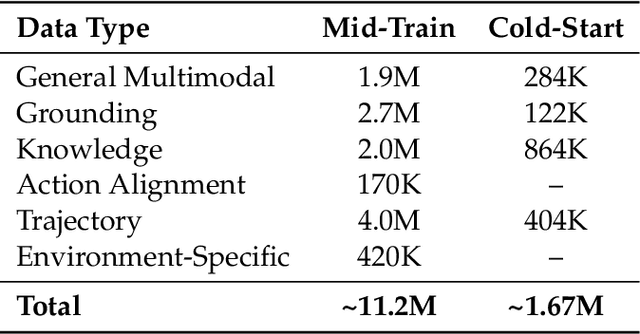
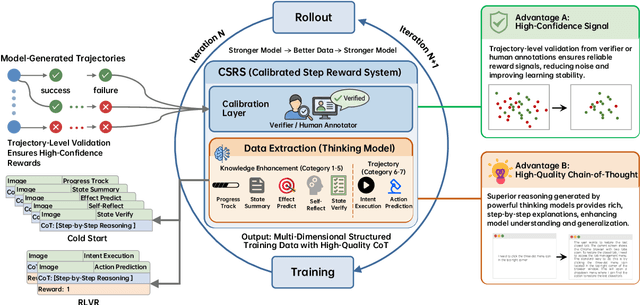
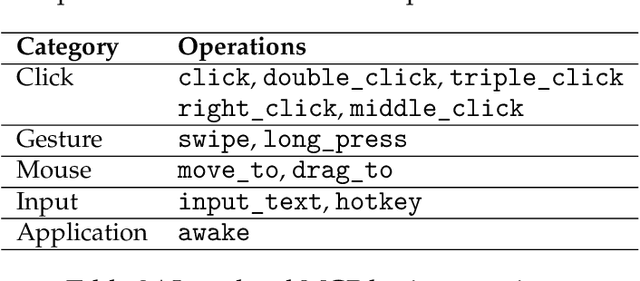
Recent advances in multimodal large language models unlock unprecedented opportunities for GUI automation. However, a fundamental challenge remains: how to efficiently acquire high-quality training data while maintaining annotation reliability? We introduce a self-evolving training pipeline powered by the Calibrated Step Reward System, which converts model-generated trajectories into reliable training signals through trajectory-level calibration, achieving >90% annotation accuracy with 10-100x lower cost. Leveraging this pipeline, we introduce Step-GUI, a family of models (4B/8B) that achieves state-of-the-art GUI performance (8B: 80.2% AndroidWorld, 48.5% OSWorld, 62.6% ScreenShot-Pro) while maintaining robust general capabilities. As GUI agent capabilities improve, practical deployment demands standardized interfaces across heterogeneous devices while protecting user privacy. To this end, we propose GUI-MCP, the first Model Context Protocol for GUI automation with hierarchical architecture that combines low-level atomic operations and high-level task delegation to local specialist models, enabling high-privacy execution where sensitive data stays on-device. Finally, to assess whether agents can handle authentic everyday usage, we introduce AndroidDaily, a benchmark grounded in real-world mobile usage patterns with 3146 static actions and 235 end-to-end tasks across high-frequency daily scenarios (8B: static 89.91%, end-to-end 52.50%). Our work advances the development of practical GUI agents and demonstrates strong potential for real-world deployment in everyday digital interactions.
WEDepth: Efficient Adaptation of World Knowledge for Monocular Depth Estimation
Nov 11, 2025Monocular depth estimation (MDE) has widely applicable but remains highly challenging due to the inherently ill-posed nature of reconstructing 3D scenes from single 2D images. Modern Vision Foundation Models (VFMs), pre-trained on large-scale diverse datasets, exhibit remarkable world understanding capabilities that benefit for various vision tasks. Recent studies have demonstrated significant improvements in MDE through fine-tuning these VFMs. Inspired by these developments, we propose WEDepth, a novel approach that adapts VFMs for MDE without modi-fying their structures and pretrained weights, while effec-tively eliciting and leveraging their inherent priors. Our method employs the VFM as a multi-level feature en-hancer, systematically injecting prior knowledge at differ-ent representation levels. Experiments on NYU-Depth v2 and KITTI datasets show that WEDepth establishes new state-of-the-art (SOTA) performance, achieving competi-tive results compared to both diffusion-based approaches (which require multiple forward passes) and methods pre-trained on relative depth. Furthermore, we demonstrate our method exhibits strong zero-shot transfer capability across diverse scenarios.
Partial Weakly-Supervised Oriented Object Detection
Jul 03, 2025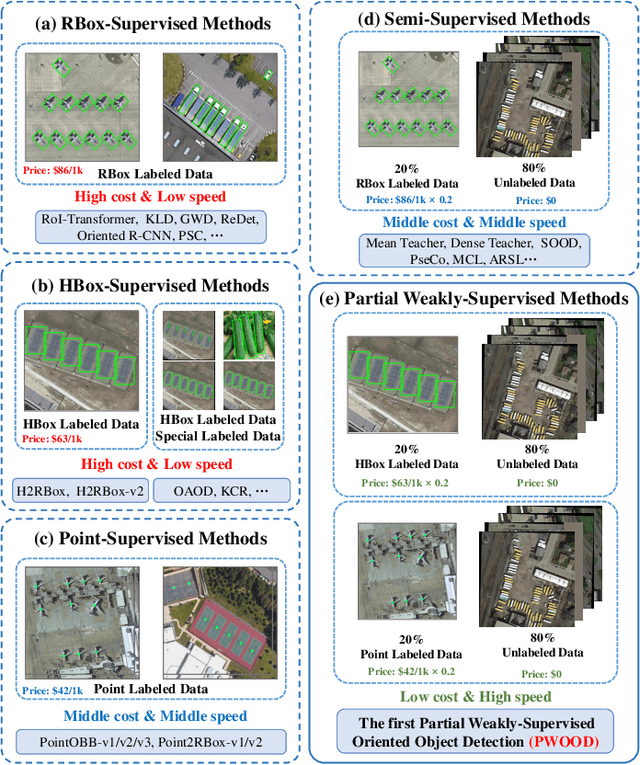
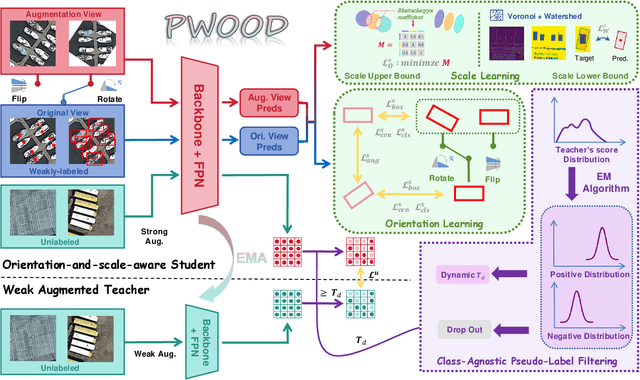
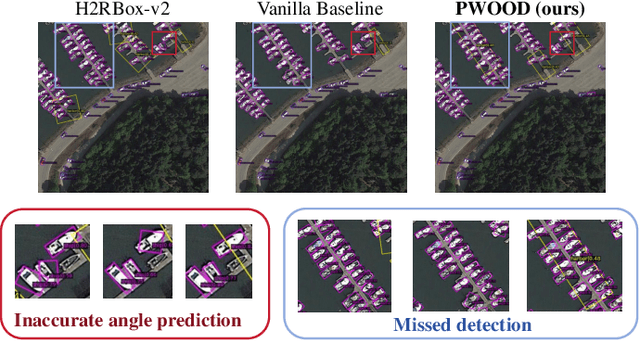
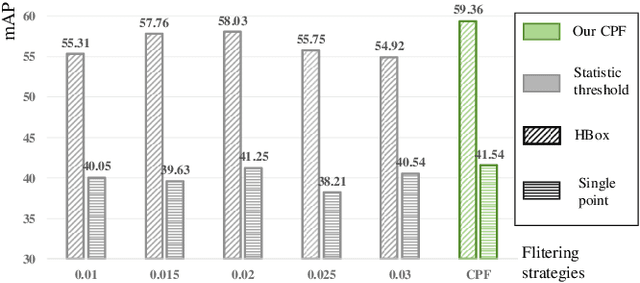
The growing demand for oriented object detection (OOD) across various domains has driven significant research in this area. However, the high cost of dataset annotation remains a major concern. Current mainstream OOD algorithms can be mainly categorized into three types: (1) fully supervised methods using complete oriented bounding box (OBB) annotations, (2) semi-supervised methods using partial OBB annotations, and (3) weakly supervised methods using weak annotations such as horizontal boxes or points. However, these algorithms inevitably increase the cost of models in terms of annotation speed or annotation cost. To address this issue, we propose:(1) the first Partial Weakly-Supervised Oriented Object Detection (PWOOD) framework based on partially weak annotations (horizontal boxes or single points), which can efficiently leverage large amounts of unlabeled data, significantly outperforming weakly supervised algorithms trained with partially weak annotations, also offers a lower cost solution; (2) Orientation-and-Scale-aware Student (OS-Student) model capable of learning orientation and scale information with only a small amount of orientation-agnostic or scale-agnostic weak annotations; and (3) Class-Agnostic Pseudo-Label Filtering strategy (CPF) to reduce the model's sensitivity to static filtering thresholds. Comprehensive experiments on DOTA-v1.0/v1.5/v2.0 and DIOR datasets demonstrate that our PWOOD framework performs comparably to, or even surpasses, traditional semi-supervised algorithms.
SA-Occ: Satellite-Assisted 3D Occupancy Prediction in Real World
Mar 20, 2025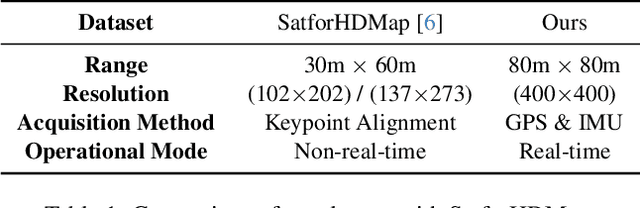

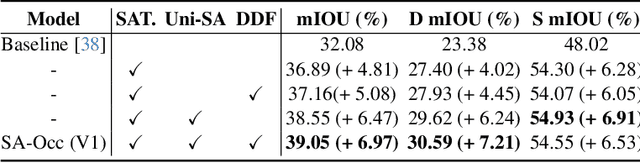
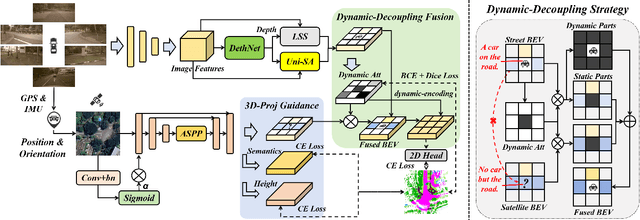
Existing vision-based 3D occupancy prediction methods are inherently limited in accuracy due to their exclusive reliance on street-view imagery, neglecting the potential benefits of incorporating satellite views. We propose SA-Occ, the first Satellite-Assisted 3D occupancy prediction model, which leverages GPS & IMU to integrate historical yet readily available satellite imagery into real-time applications, effectively mitigating limitations of ego-vehicle perceptions, involving occlusions and degraded performance in distant regions. To address the core challenges of cross-view perception, we propose: 1) Dynamic-Decoupling Fusion, which resolves inconsistencies in dynamic regions caused by the temporal asynchrony between satellite and street views; 2) 3D-Proj Guidance, a module that enhances 3D feature extraction from inherently 2D satellite imagery; and 3) Uniform Sampling Alignment, which aligns the sampling density between street and satellite views. Evaluated on Occ3D-nuScenes, SA-Occ achieves state-of-the-art performance, especially among single-frame methods, with a 39.05% mIoU (a 6.97% improvement), while incurring only 6.93 ms of additional latency per frame. Our code and newly curated dataset are available at https://github.com/chenchen235/SA-Occ.
OpenGV 2.0: Motion prior-assisted calibration and SLAM with vehicle-mounted surround-view systems
Mar 05, 2025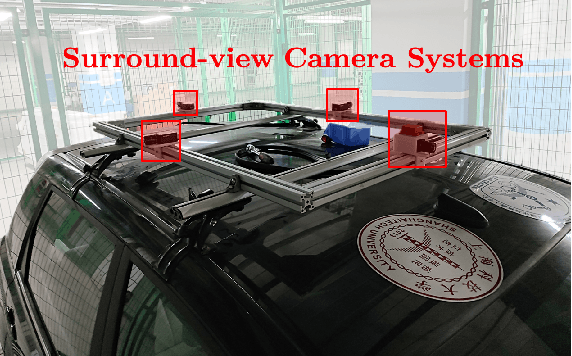
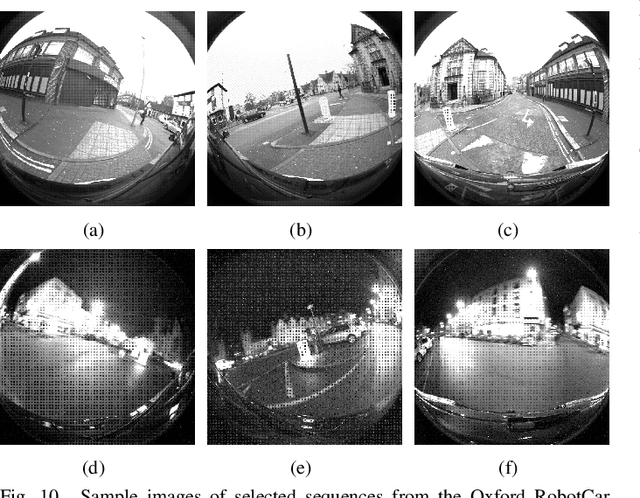
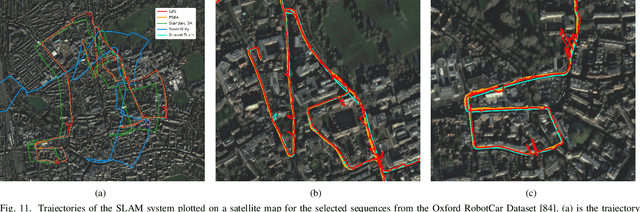
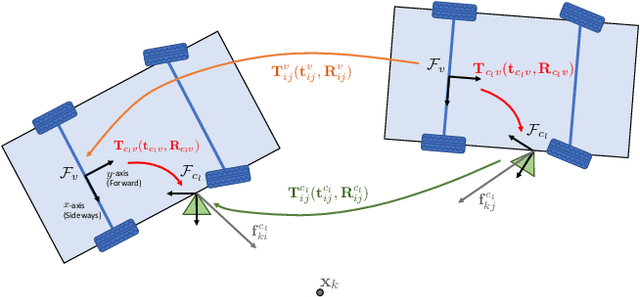
The present paper proposes optimization-based solutions to visual SLAM with a vehicle-mounted surround-view camera system. Owing to their original use-case, such systems often only contain a single camera facing into either direction and very limited overlap between fields of view. Our novelty consist of three optimization modules targeting at practical online calibration of exterior orientations from simple two-view geometry, reliable front-end initialization of relative displacements, and accurate back-end optimization using a continuous-time trajectory model. The commonality between the proposed modules is given by the fact that all three of them exploit motion priors that are related to the inherent non-holonomic characteristics of passenger vehicle motion. In contrast to prior related art, the proposed modules furthermore excel in terms of bypassing partial unobservabilities in the transformation variables that commonly occur for Ackermann-motion. As a further contribution, the modules are built into a novel surround-view camera SLAM system that specifically targets deployment on Ackermann vehicles operating in urban environments. All modules are studied in the context of in-depth ablation studies, and the practical validity of the entire framework is supported by a successful application to challenging, large-scale publicly available online datasets. Note that upon acceptance, the entire framework is scheduled for open-source release as part of an extension of the OpenGV library.
SemStereo: Semantic-Constrained Stereo Matching Network for Remote Sensing
Dec 17, 2024

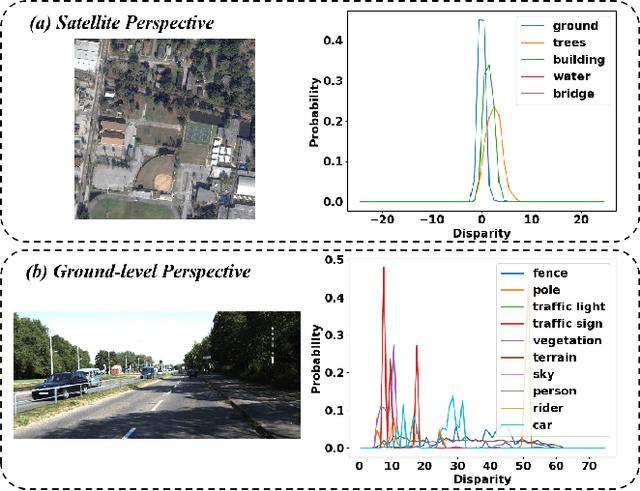

Semantic segmentation and 3D reconstruction are two fundamental tasks in remote sensing, typically treated as separate or loosely coupled tasks. Despite attempts to integrate them into a unified network, the constraints between the two heterogeneous tasks are not explicitly modeled, since the pioneering studies either utilize a loosely coupled parallel structure or engage in only implicit interactions, failing to capture the inherent connections. In this work, we explore the connections between the two tasks and propose a new network that imposes semantic constraints on the stereo matching task, both implicitly and explicitly. Implicitly, we transform the traditional parallel structure to a new cascade structure termed Semantic-Guided Cascade structure, where the deep features enriched with semantic information are utilized for the computation of initial disparity maps, enhancing semantic guidance. Explicitly, we propose a Semantic Selective Refinement (SSR) module and a Left-Right Semantic Consistency (LRSC) module. The SSR refines the initial disparity map under the guidance of the semantic map. The LRSC ensures semantic consistency between two views via reducing the semantic divergence after transforming the semantic map from one view to the other using the disparity map. Experiments on the US3D and WHU datasets demonstrate that our method achieves state-of-the-art performance for both semantic segmentation and stereo matching.